








✓ Medically reviewed by · Last reviewed: May 2026
Pharmacy Researcher · 8 years experience
Pharmacy researcher with 8 years reviewing clinical drug information, generic formulation equivalence, and international pharmaceutical standards. Focuses on patient-facing accuracy in medication education.
rosacea treatment options — Rosacea Treatment Options: 8 Clinically Proven Ways to Manage Your Skin. Read on for an evidence-backed guide covering everything you need to know.
You wake up, check the mirror, and your cheeks are flushed again — that familiar, frustrating redness that makes you feel like you are perpetually embarrassed or sunburned, even on days when you feel fine. Maybe there are small, acne-like bumps this time. Maybe your skin stings when you apply moisturizer. You have tried three different creams from the drugstore and nothing has worked. Your confidence is eroding, and you are ready to understand what real rosacea treatment options actually exist — not the marketing claims, but the treatments with clinical evidence behind them.
Rosacea treatment options — this guide covers every major category of rosacea treatment, matched to the specific subtype you have. By the end, you will know which topical medications are first-line, when oral antibiotics make sense, what laser and light therapies can (and cannot) do, and how to build a skincare routine that supports — rather than sabotages — your treatment plan.
Key Takeaways
- ✔ Rosacea cannot be cured, but it can be controlled — and most people achieve significant improvement with the right treatment combination. The key is matching the treatment to your specific subtype.
- ✔ Topical treatments — metronidazole, azelaic acid, and ivermectin — are first-line rosacea treatment options for the most common subtype (papulopustular rosacea with redness and bumps). Each works through a different mechanism.
- ✔ Sun protection is the single most important non-medication intervention — but one common sunscreen ingredient makes rosacea worse, and most people do not know which one.
- ✔ Oral antibiotics like doxycycline are not used primarily for their antibiotic effect in rosacea — they work as anti-inflammatory agents at low doses, a distinction that changes how long you can safely take them.
- ✔ The newest and fastest-acting option, brimonidine gel, reduces redness within 30 minutes — but it comes with a side effect that surprises many first-time users.
Table of Contents
- Understanding Rosacea Subtypes — The First Step
- Topical Rosacea Treatment Options: Creams and Gels
- Ivermectin Cream for Rosacea — What Makes It Different
- Azelaic Acid: The Multi-Tasking Rosacea Treatment
- Oral Rosacea Treatment Options: When Topicals Are Not Enough
- Laser and Light Therapy for Rosacea
- Lifestyle and Trigger Management
- Building a Rosacea-Friendly Skincare Routine
- How Long Until Rosacea Treatments Work?
- Frequently Asked Questions
- The Bottom Line
Understanding Rosacea Subtypes — The First Step — Rosacea treatment options Explained
Before you can choose among rosacea treatment options, you need to know which subtype you have. Rosacea is not one condition — it is a spectrum of four subtypes that can overlap, and the treatment that works brilliantly for one subtype may be completely wrong for another.
Rosacea treatment options — the four subtypes, as classified by the National Rosacea Society and recognized in dermatology guidelines:
- Erythematotelangiectatic (ETR) — Subtype 1: Persistent facial redness, flushing, and visible blood vessels (telangiectasias). The skin may sting or burn. This is the “classic” rosacea appearance — the face that always looks flushed. Topical brimonidine and laser therapy are the primary treatments; anti-inflammatory topicals like metronidazole and azelaic acid may help but are less central here.
- Papulopustular (PPR) — Subtype 2: Redness plus acne-like papules and pustules. This is the most common subtype and the one most people mean when they say “rosacea.” Topical metronidazole, azelaic acid, and ivermectin are first-line; oral doxycycline is added for moderate to severe cases.
- Phymatous — Subtype 3: Thickened, bumpy skin with enlarged pores, most commonly affecting the nose (rhinophyma). This is the least common subtype and the one that typically requires the most aggressive treatment — oral isotretinoin or ablative laser resurfacing. Topical treatments alone are rarely sufficient.
- Ocular rosacea — Subtype 4: Red, dry, irritated eyes; a gritty or burning sensation; blurred vision. This subtype is often missed because patients and even some doctors do not connect eye symptoms with rosacea. Treatment includes artificial tears, oral doxycycline, and in some cases, ophthalmology referral.
Rosacea treatment options — many patients have more than one subtype — for example, persistent redness (ETR) plus papules and pustules (PPR). When that happens, treatment typically targets the more bothersome subtype first, with the understanding that some treatments (like azelaic acid and oral doxycycline) address multiple subtypes simultaneously. This is why a proper diagnosis — ideally from a dermatologist — matters before you start experimenting with rosacea treatment options on your own.
Topical Rosacea Treatment Options: Creams and Gels
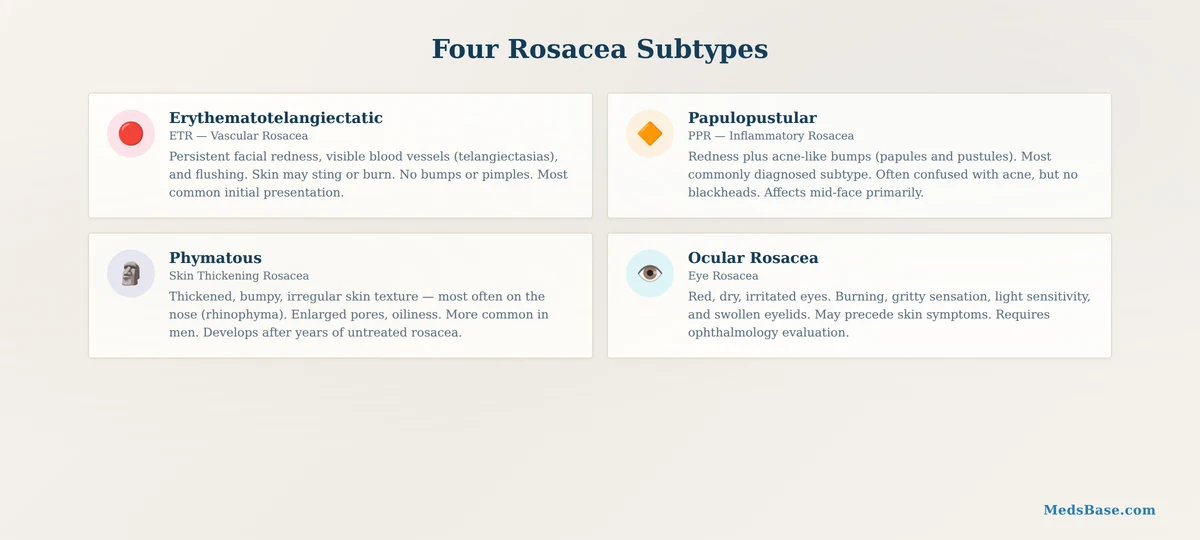
Rosacea has four distinct subtypes, each requiring a different treatment approach.
Rosacea treatment options — for the most common rosacea presentation — redness with papules and pustules — topical medications are the foundation of treatment. Three prescription topicals have the strongest evidence, and they work through different mechanisms, making them complementary rather than interchangeable.
| Treatment | Best For | How It Works | Typical Onset | Key Side Effects |
|---|---|---|---|---|
| Metronidazole (0.75% gel/cream, 1% gel) | Mild to moderate PPR | Anti-inflammatory and possibly antiparasitic | 4-8 weeks | Mild irritation, dryness (usually temporary) |
| Azelaic acid (15% gel/foam, 20% cream) | Mild to moderate PPR, also helps with post-inflammatory hyperpigmentation | Anti-inflammatory, normalizes keratinization, antimicrobial | 4-8 weeks | Stinging/burning on application (usually resolves with continued use) |
| Ivermectin (1% cream) | Moderate to severe PPR, particularly when Demodex mites are suspected | Antiparasitic (targets Demodex mites) + anti-inflammatory | 4-12 weeks | Mild burning, dryness (less irritation than azelaic acid for many patients) |
| Brimonidine (0.33% gel) | Persistent facial redness (ETR) | Vasoconstriction — temporarily narrows facial blood vessels | 30 minutes | Rebound redness (worse than baseline) in ~10-20% of users; flushing, burning |
Here is where it gets interesting. Metronidazole and azelaic acid have been first-line rosacea treatment options for decades, and their efficacy is well-established. But the Cochrane systematic review on interventions for rosacea found that ivermectin 1% cream may be more effective than metronidazole 0.75% for papulopustular rosacea, with a higher rate of complete or near-complete clearance. This finding has shifted prescribing patterns: many dermatologists now start with ivermectin for moderate to severe papulopustular rosacea and reserve metronidazole for milder cases.
Rosacea treatment options — brimonidine deserves special attention because it works completely differently from the anti-inflammatory topicals — and because its main side effect is something every potential user should know about. Brimonidine is a vasoconstrictor: it shrinks the dilated facial blood vessels that cause persistent redness, producing visibly paler skin within 30 minutes of application. It is the only topical that targets redness directly and immediately rather than treating the inflammatory process over weeks. But approximately 10% to 20% of users experience rebound redness — a worsening of erythema beyond baseline when the medication wears off, typically 8 to 12 hours after application. This rebound can be worse than the original redness and is distressing enough that many patients discontinue treatment. If you try brimonidine, test it on a small area first and be aware that the rapid results come with this trade-off.
Ivermectin Cream for Rosacea — What Makes It Different
Rosacea treatment options — ivermectin 1% cream (brand name Soolantra) represents a distinct mechanism among topical rosacea treatment options. Unlike metronidazole and azelaic acid, which are primarily anti-inflammatory, ivermectin directly targets Demodex folliculorum — microscopic mites that live in human hair follicles and sebaceous glands and are present in significantly higher numbers on the skin of people with rosacea.
Rosacea treatment options — does this mean rosacea is caused by mites? The evidence suggests it is more complex than that. Demodex mites are present on nearly everyone’s skin by adulthood, but people with rosacea have a higher density, and their skin appears to mount an exaggerated immune response to the mites or the bacteria they carry. Ivermectin kills the mites and reduces this inflammatory response — two actions that together explain its effectiveness.
Rosacea treatment options — in clinical trials, ivermectin 1% cream applied once daily produced significant reductions in inflammatory lesion counts, with results typically visible by 4 weeks and continuing to improve through 12 weeks. A 2015 study published in the Journal of Drugs in Dermatology found that ivermectin was superior to metronidazole 0.75% gel in reducing inflammatory lesions, and a 2017 systematic review in the British Journal of Dermatology confirmed this finding. Patients also tended to prefer ivermectin for its once-daily application and lower rate of stinging compared to azelaic acid.
The practical consideration: ivermectin cream is typically more expensive than generic metronidazole, and insurance coverage varies. For mild rosacea that responds to metronidazole, the cost difference may not justify switching. For moderate to severe rosacea with prominent papules and pustules, the superior efficacy data makes ivermectin a strong first choice.
Azelaic Acid: The Multi-Tasking Rosacea Treatment
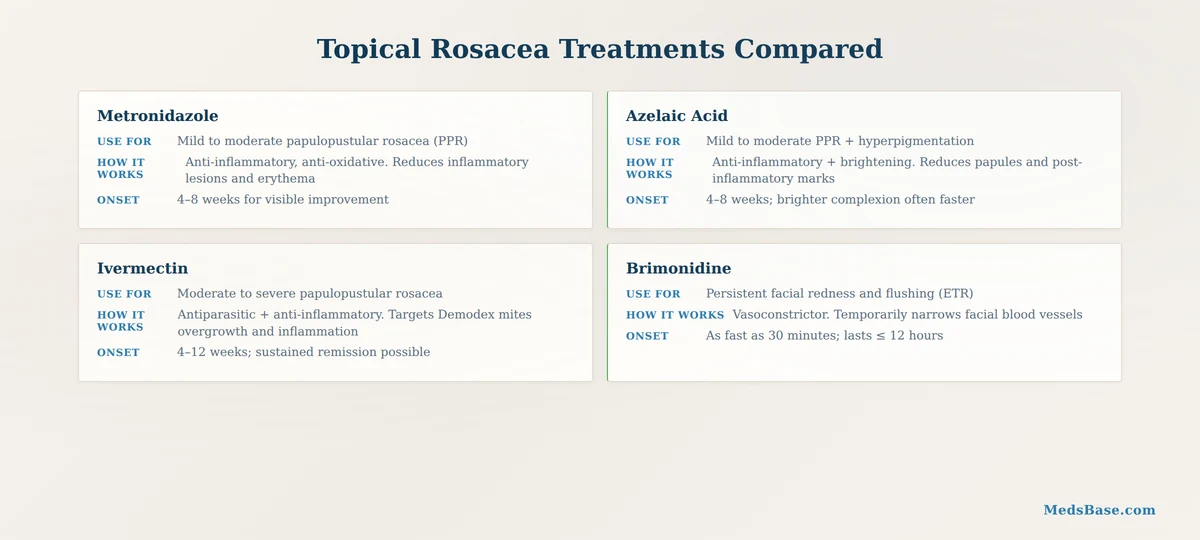
Topical treatments are first-line rosacea options — each targets different disease aspects.
Azelaic acid occupies a unique position among rosacea treatment options because it treats two related conditions simultaneously: rosacea and post-inflammatory hyperpigmentation. If your rosacea leaves behind dark spots after bumps heal — a common problem in people with darker skin tones — azelaic acid addresses both the active inflammation and the residual discoloration.
Azelaic acid works through three mechanisms relevant to rosacea: it reduces inflammation by inhibiting the production of reactive oxygen species, it normalizes the abnormal keratinization that contributes to clogged follicles, and it has antimicrobial properties against the bacteria and organisms implicated in rosacea. In addition, and uniquely among rosacea treatments, it inhibits tyrosinase — the enzyme responsible for melanin production — which is why it also treats hyperpigmentation.
The main drawback is the initial stinging and burning sensation on application, which affects roughly one-third of users. This side effect is usually temporary — it tends to diminish or resolve after the first two to four weeks of continued use — but it can be discouraging. Starting with a lower concentration (10% is available over-the-counter; prescription strength is 15% gel or 20% cream) and applying a moisturizer first as a buffer layer can reduce the sting.
For a deeper look at azelaic acid’s full range of uses, including its role beyond rosacea, see our detailed guide: Azelaic Acid for Hyperpigmentation, Rosacea & Acne: The Multi-Tasking Skincare Ingredient. And for the specific prescription formulation, read our Finacea Cream (Azelaic Acid 15%): Uses, Dosage & Side Effects guide.
Oral Rosacea Treatment Options: When Topicals Are Not Enough
When topical treatments have not provided sufficient improvement — or when rosacea is moderate to severe from the outset — oral medications are the next step in the treatment ladder. This does not mean you failed topical treatment; it means your rosacea requires a systemic approach in addition to, or sometimes instead of, a topical one.
Low-dose doxycycline is the mainstay oral treatment for rosacea, and understanding the “low-dose” distinction is critical. At standard antibiotic doses (100mg twice daily), doxycycline kills bacteria. At the sub-antimicrobial dose used for rosacea (40mg once daily, as Oracea or generic equivalent), doxycycline functions primarily as an anti-inflammatory agent — it suppresses the inflammatory mediators that drive rosacea flares without significantly affecting the body’s bacterial flora. This distinction is what makes long-term use feasible: because the dose is too low to exert antibiotic pressure, it does not promote antibiotic resistance to the same degree, and it disrupts the gut microbiome less.
Doxycycline 40mg modified-release is FDA-approved specifically for rosacea and is typically prescribed for an initial course of 12 to 16 weeks. Many patients can then transition to topical maintenance alone, though some require longer courses or intermittent re-treatment during flares.
Other oral antibiotics — minocycline, tetracycline, and in some cases, azithromycin — are sometimes used when doxycycline is not tolerated or is contraindicated. The data for these alternatives in rosacea specifically is less robust, but they are clinically effective and well-established in dermatology practice.
Oral isotretinoin is reserved for severe, treatment-resistant rosacea, particularly phymatous rosacea (where skin thickening is the primary problem). It is the same medication used for severe acne, but at lower doses for rosacea. Isotretinoin reduces sebaceous gland size and activity, normalizes follicular keratinization, and has anti-inflammatory effects. Because of its significant side-effect profile and the requirement for pregnancy prevention in women of childbearing age, it is typically considered a last-line option when other rosacea treatment options have failed.
Who Is Oral Treatment For?
Consider oral doxycycline if: you have moderate to severe papulopustular rosacea with numerous inflammatory lesions, topical treatments alone have not provided adequate improvement after 12 weeks, or you have ocular rosacea (oral doxycycline is one of the primary treatments for the eye symptoms).
Who Should Avoid Oral Antibiotics
Avoid or discuss alternatives if: you are pregnant or breastfeeding (tetracyclines are contraindicated), you have a history of antibiotic-associated colitis, you are taking medications that interact with doxycycline (including isotretinoin, warfarin, and some antacids), or your rosacea is primarily the redness/flushing subtype without inflammatory lesions (oral antibiotics are unlikely to help).
Laser and Light Therapy for Rosacea
For two specific rosacea problems — visible blood vessels (telangiectasias) and persistent background redness — no topical or oral medication is particularly effective. This is where laser and light-based therapies enter the picture.
Pulsed dye laser (PDL) and intense pulsed light (IPL) are the two most commonly used devices for rosacea. Both work by targeting hemoglobin in dilated blood vessels — the laser or light energy is absorbed by the red pigment in blood, heating and destroying the vessel wall without damaging the surrounding skin. Over a series of treatments, this reduces both individual visible vessels and generalized facial redness.
Here is what the evidence shows: laser and IPL treatments for rosacea typically require 2 to 4 sessions spaced 4 to 6 weeks apart for optimal results. Improvement is gradual and cumulative — you may see 20% to 30% reduction after the first session and 50% to 70% after the full series. Results are not permanent; maintenance treatments once or twice a year are usually needed to sustain the improvement. Side effects include temporary redness, swelling, and in rare cases, bruising or pigment changes.
The main limitation of laser and light therapy for rosacea is that it treats the visible redness and vessels — it does not reduce the inflammatory papules and pustules. For that, you still need topical or oral medication. The ideal approach for many patients combines laser (for the vascular component) with topical treatment (for the inflammatory component).
Cost is a practical consideration: laser and IPL treatments are typically considered cosmetic procedures and are not covered by insurance for rosacea. Per-session costs range widely depending on geography and provider, but patients should expect several hundred dollars per session. Before committing, ask for a test spot on a small area of skin to gauge your response before treating the full face.
Lifestyle and Trigger Management
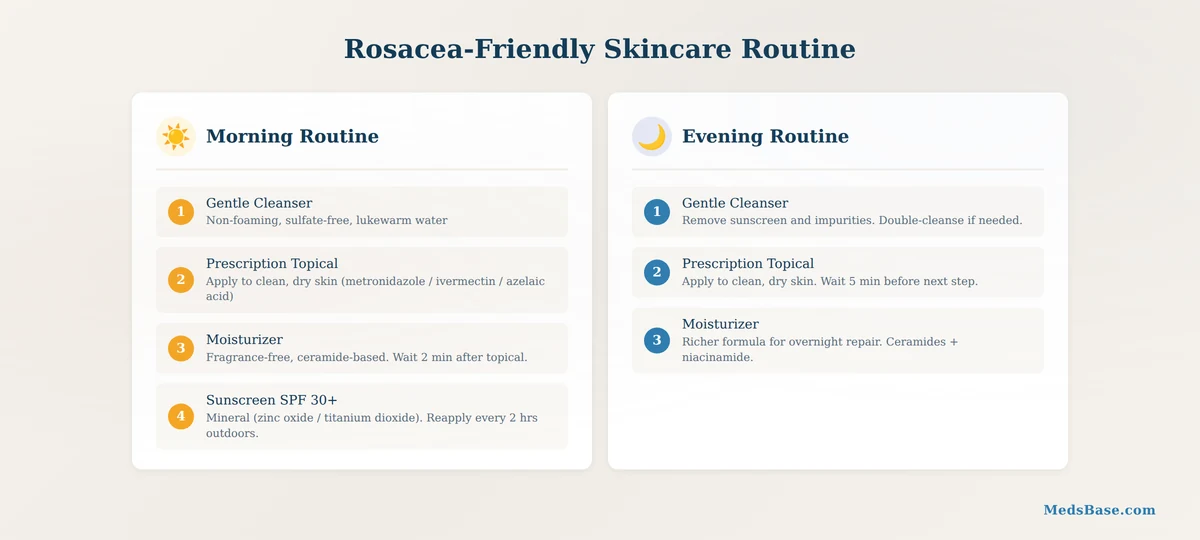
A gentle skincare routine supports prescription rosacea treatments and prevents irritation.
No discussion of rosacea treatment options is complete without addressing triggers. Rosacea is exquisitely sensitive to environmental and lifestyle factors — and identifying your personal triggers is often the single highest-impact intervention you can make, aside from prescribed medication.
The National Rosacea Society’s survey of over 1,000 patients identified the most common triggers:
| Trigger | % of Patients Affected | Practical Strategy |
|---|---|---|
| Sun exposure | 81% | Daily broad-spectrum SPF 30+ mineral sunscreen (zinc oxide or titanium dioxide — chemical sunscreens can irritate rosacea-prone skin) |
| Emotional stress | 79% | Stress-management techniques; biofeedback may reduce flushing severity |
| Hot weather | 75% | Stay in air-conditioned environments; cool compresses during flares |
| Wind | 57% | Scarf or face covering in windy conditions; barrier moisturizer |
| Heavy exercise | 56% | Lower-intensity exercise; cool room; cold water spray during workouts |
| Alcohol | 52% | Identify specific trigger beverages (red wine is a common culprit); moderation |
| Spicy foods | 45% | Avoid capsaicin-containing foods; identify your personal threshold |
The mineral sunscreen distinction is important enough to emphasize: many people with rosacea find that chemical sunscreens (those containing avobenzone, oxybenzone, octinoxate, or octisalate) sting or worsen redness. Mineral sunscreens with zinc oxide or titanium dioxide as the active ingredient are generally better tolerated because they sit on the skin surface rather than being absorbed. This is one of the most practical and frequently overlooked rosacea treatment options: the right sunscreen, applied daily, can reduce flare frequency by 50% or more, according to dermatology consensus.
Building a Rosacea-Friendly Skincare Routine
Your daily skincare routine can either support your rosacea treatment options or undermine them. The wrong products — harsh cleansers, exfoliating acids, fragranced moisturizers, or alcohol-based toners — can trigger flares that counteract the benefits of prescription treatment.
Here is a dermatologist-recommended framework:
Morning routine:
- Gentle, fragrance-free cleanser. Use lukewarm water — never hot. Pat dry; do not rub. Avoid scrubbing, exfoliating beads, or washcloths on the face.
- Prescription topical medication (metronidazole, azelaic acid, ivermectin, or brimonidine, as prescribed). Apply a thin layer to the entire affected area, not just individual bumps.
- Fragrance-free moisturizer. Look for ingredients like ceramides, niacinamide, and hyaluronic acid. Avoid products with alcohol, witch hazel, menthol, eucalyptus, or peppermint.
- Mineral sunscreen SPF 30 or higher. Zinc oxide or titanium dioxide. Apply generously — most people under-apply sunscreen by approximately 50%.
Evening routine:
- Gentle cleanser (same as morning) to remove sunscreen, makeup, and environmental debris.
- Prescription topical medication.
- Moisturizer.
A few products to approach cautiously if you have rosacea: retinoids (tretinoin, adapalene, retinol) can worsen rosacea in some people, particularly during the initial adjustment period; alpha-hydroxy acids (glycolic, lactic) and beta-hydroxy acid (salicylic) are often too irritating; physical exfoliants (scrubs, cleansing brushes) mechanically irritate rosacea-prone skin. If you need an anti-aging product, azelaic acid offers mild anti-aging benefits and is rosacea-compatible — a rare overlap.
How Long Until Rosacea Treatments Work?
Rosacea treatments are not instant, and the mismatch between patient expectations and treatment timelines is one of the most common reasons people abandon effective therapies too early.
Here is what to expect, by treatment type:
- Brimonidine gel: Visibly reduces redness within 30 minutes. The effect lasts 8 to 12 hours and must be reapplied daily. This is the only rapid-onset rosacea treatment.
- Oral doxycycline (40mg): Improvement in inflammatory lesions typically begins within 2 to 4 weeks. Maximum benefit at 12 to 16 weeks.
- Topical metronidazole: Gradual improvement over 4 to 8 weeks. Continue for at least 12 weeks before judging whether it is working for you.
- Topical azelaic acid: Similar timeline to metronidazole — 4 to 8 weeks for initial improvement, 12 weeks for maximum benefit.
- Topical ivermectin: May begin to show improvement by 4 weeks, with continued improvement through 12 to 16 weeks. In clinical trials, some patients continued to improve through 52 weeks of continuous use.
- Laser/IPL: Improvement is visible after each session, with cumulative benefit over 2 to 4 treatments spaced 4 to 6 weeks apart.
The most important takeaway: do not judge any rosacea treatment — except brimonidine — before 12 weeks of consistent use. Early improvement can be subtle, and the full benefit takes time to develop. If you stop after 4 weeks because “it is not working,” you may be abandoning a treatment that would have worked by week 10.
Take a hypothetical scenario: David, 41, started ivermectin cream for moderate papulopustular rosacea. At his 4-week follow-up, he saw maybe 20% improvement and was discouraged. His dermatologist encouraged him to continue. By week 12, his inflammatory lesions were reduced by over 80% — a result that would have been lost if he had stopped at week 4, which is exactly the point at which many patients give up.
Related Reading
- Azelaic Acid for Hyperpigmentation, Rosacea & Acne — Deep dive into one of rosacea’s most versatile treatments.
- GERD Medications Long-Term Safety: What 10+ Years of Research Reveals — Another evidence-first treatment guide for a chronic condition.
- Postpartum Depression Medication Options: 7 Evidence-Based Treatments — A condition-specific treatment comparison with a similar structure.
Frequently Asked Questions
What is the best treatment for rosacea?
There is no single best treatment for all rosacea — the right choice depends on your subtype and symptom severity. For papulopustular rosacea (the most common type), topical ivermectin, metronidazole, and azelaic acid are first-line choices, with oral low-dose doxycycline added for moderate to severe cases. For the redness/flushing subtype, brimonidine gel and laser/IPL therapy are the most effective options. A dermatologist can match the treatment to your specific presentation.
Can rosacea be cured permanently?
Rosacea cannot be cured, but it can be effectively controlled with ongoing treatment. Most patients achieve significant improvement with a combination of prescription medication, trigger avoidance, and a gentle skincare routine. Rosacea is a chronic condition that tends to flare and remit — the goal of treatment is to extend remissions, reduce flare severity, and prevent progression, not to achieve a one-time permanent cure.
What triggers rosacea flare-ups?
The most common rosacea triggers include sun exposure (the number one trigger, affecting approximately 81% of patients), emotional stress, hot weather, wind, heavy exercise, alcohol (especially red wine), spicy foods, hot beverages, and certain skincare products containing alcohol, fragrance, or exfoliating acids. Triggers vary between individuals, and identifying your personal triggers through a symptom diary is one of the most effective non-medication interventions.
Is ivermectin cream effective for rosacea?
Yes. Ivermectin 1% cream is highly effective for the papulopustular subtype of rosacea. Clinical studies have shown that ivermectin is superior to metronidazole 0.75% gel in reducing inflammatory lesions, and the effect continues to improve with prolonged use. It is thought to work by reducing Demodex mite populations on the skin and suppressing the associated inflammatory response. It is applied once daily and most patients see meaningful improvement within 4 to 12 weeks.
How long does rosacea treatment take to work?
Most rosacea treatments take 4 to 12 weeks to produce visible improvement. The exception is brimonidine gel, which reduces redness within 30 minutes. For topical treatments like metronidazole, azelaic acid, and ivermectin, initial improvement may be visible by week 4, with full benefit by week 12. Oral doxycycline tends to work slightly faster, with improvement beginning at 2 to 4 weeks. Laser and IPL treatments produce cumulative improvement over 2 to 4 sessions.
What is the difference between rosacea and acne?
Rosacea and acne are different conditions that can look similar. Key differences: rosacea typically affects the central face (cheeks, nose, chin, forehead) and includes persistent redness and flushing, while acne can occur anywhere with oil glands and is characterized by comedones (blackheads and whiteheads) — which are not a feature of rosacea. Rosacea usually develops after age 30, while acne typically begins in adolescence. The treatments overlap in some areas (azelaic acid, oral doxycycline) but differ in others (benzoyl peroxide and most retinoids are acne treatments, not rosacea treatments, and can worsen rosacea in some people).
Can rosacea go away on its own?
Rosacea is a chronic, progressive condition — it does not resolve on its own, and without treatment, it tends to worsen over time. Early treatment is important because it can prevent progression to more severe forms, including permanent skin thickening (rhinophyma) and ocular involvement. While individual flares may come and go, the underlying condition persists and benefits from consistent management.
What skincare ingredients should I avoid if I have rosacea?
If you have rosacea, avoid products containing alcohol (SD alcohol, denatured alcohol), witch hazel, menthol, eucalyptus oil, peppermint, fragrance (both synthetic and natural essential oils), glycolic acid, salicylic acid at high concentrations, physical exfoliants (scrubs, beads, brushes), and astringent toners. Chemical sunscreens can also be irritating for some rosacea patients — mineral sunscreens (zinc oxide, titanium dioxide) are generally better tolerated.
Medical Disclaimer
This article is for informational purposes only and does not constitute medical advice. Rosacea is a medical condition that requires professional diagnosis and treatment. Always consult a dermatologist or other qualified healthcare provider before starting any new medication, skincare product, or treatment regimen. Some rosacea treatments are available only by prescription and require medical supervision.
The Bottom Line
Rosacea is a chronic condition that requires ongoing management — but effective rosacea treatment options exist for every subtype, and most people achieve significant improvement with the right combination of prescription medication, trigger avoidance, and a gentle skincare routine. The key decisions: get the right subtype diagnosis, start with evidence-based topical treatment (matched to your subtype), add oral medication or laser therapy if needed, commit to daily sun protection, and give each treatment at least 12 weeks before judging its effectiveness.
If your rosacea has been frustrating you — the redness that will not go away, the bumps that look like acne but do not respond to acne treatments, the self-consciousness that comes with a face that always looks inflamed — the single best action you can take is to see a dermatologist. A proper diagnosis and a targeted treatment plan can transform the condition from something that controls your confidence to something you control.
Next questions you may have:
- Curious about azelaic acid’s full range of benefits? Read our complete guide.
- Wondering about prescription-strength azelaic acid? Our Finacea cream guide has the details.
- Browse rosacea-compatible products in our Skin Care category.
Reviewed by Medical Professional. Last updated: August 22, 2026.

Written by
Sophie ChenPharmaceutical Content Researcher · 8 years experience
Sophie Chen is a pharmaceutical content researcher with 8 years covering generic medication access and clinical pharmacology. She specialises in international regulatory frameworks, bioequivalence standards, and patient-facing education on therapeutic drug classes. She is not a clinician.