









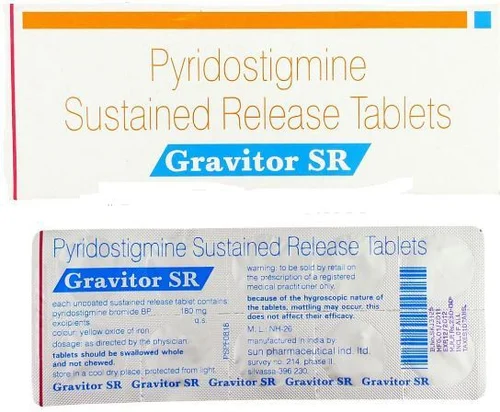
Gravitor SR
✅ Muscle strength enhancement
✅ Improved neuromuscular transmission
✅ Symptom relief in myasthenia gravis
✅ Enhanced muscle coordination
✅ Better motor function
Gravitor SR contains Pyridostigmine.
✓ Medically reviewed by Morgan Ellis — Pharmacy Researcher · 8 years experience · Last reviewed: May 2026
⚡ Quick Answer — What is Gravitor SR?
Gravitor SR is an oral sustained-release tablet (typically 180 mg, 8–12 hour release) containing pyridostigmine bromide (180 mg) — an acetylcholinesterase inhibitor used to treat myasthenia gravis. Action duration: 8–12 hours per dose. The SR formulation is preferred for nocturnal weakness and morning ptosis; one tablet at bedtime maintains therapeutic levels through the night. It works by blocking the breakdown of acetylcholine at the neuromuscular junction, restoring muscle strength in patients whose acetylcholine receptors are blocked by autoantibodies. Adult dosing in myasthenia gravis: 30–120 mg every 4–6 hours for the immediate-release form (typical 60 mg three to five times daily); 180 mg every 12–24 hours for the sustained-release form. Take 30–45 minutes before meals if dysphagia is the dominant symptom. Common side effects: abdominal cramps, diarrhoea, nausea, sweating, increased salivation, miosis (small pupils), muscle twitching. Watch for cholinergic crisis — over-dose can mimic myasthenic crisis itself; the edrophonium or ice-pack test can distinguish.
📦 Every order is covered by our Reshipment Assurance Policy — if your parcel does not arrive within 20 business days, we reship it.
Why order from MedsBase
Our generic medications are sourced from WHO-GMP certified manufacturers and shipped worldwide in discreet, plain packaging — no medication name on the parcel exterior. Card payments are routed through a regulated processor (statement descriptors include a regulated card-payment processor — never “MedsBase” or any medication name). Crypto and SEPA bank transfer are also accepted. Every order is backed by our Reshipment Assurance Policy.
What Is Gravitor SR?
Gravitor SR is an oral pyridostigmine bromide sustained-release tablet (typically 180 mg, 8–12 hour release) available in 180 mg. Pyridostigmine is a quaternary-ammonium reversible acetylcholinesterase inhibitor introduced in 1955 and one of the cornerstones of myasthenia gravis treatment ever since. Because the molecule is a permanently charged quaternary ammonium, it does not cross the blood-brain barrier — central effects are minimal compared with tertiary-amine cholinesterase inhibitors used for Alzheimer’s dementia.
The sustained-release form (Mestinon Timespan® / Gravitor SR SR) is designed to provide an 8–12-hour release window, primarily used at bedtime to cover nocturnal weakness and prevent morning ptosis or dysphagia. It is not a substitute for daytime immediate-release dosing in moderate-severe disease — the dose-by-dose adjustability of the immediate-release form is the standard backbone of therapy.
Gravitor SR is supplied by a WHO-GMP certified manufacturer and is bioequivalent to originator-brand pyridostigmine (Mestinon®).
How Does Gravitor SR Work?
In myasthenia gravis, autoantibodies (most commonly anti-acetylcholine-receptor antibodies, sometimes anti-MuSK) reduce the number of functional acetylcholine receptors at the neuromuscular junction. The signal from motor nerve to muscle becomes inefficient and muscles fatigue rapidly — the cardinal feature of the disease.
Pyridostigmine reversibly inhibits acetylcholinesterase, the enzyme that breaks down acetylcholine in the synaptic cleft. With less enzyme activity, acetylcholine persists longer and reaches more receptors, producing a stronger signal at the remaining functional acetylcholine receptors. The clinical result is improved muscle strength — particularly for ptosis, dysphagia, dysarthria and limb fatigue.
Pyridostigmine is symptomatic, not disease-modifying. It does not affect the underlying autoimmune process. Disease-modifying therapy (corticosteroids, azathioprine, mycophenolate, rituximab, eculizumab, efgartigimod, thymectomy) is needed to control disease activity in moderate-severe cases.
Uses and Indications
- Myasthenia gravis — symptomatic treatment (the main indication; FDA-approved)
- Reversal of non-depolarising neuromuscular block after surgery (IV form, hospital-only)
- Postoperative ileus and urinary retention — older indication, mostly historical
- Off-label: orthostatic hypotension (autonomic failure), congenital myasthenic syndromes, slow-channel syndromes, post-COVID fatigue (very limited evidence)
Pyridostigmine is not first-line for: Alzheimer’s dementia (use donepezil, rivastigmine, galantamine), Parkinson’s disease, or as a routine cognitive enhancer.
Gravitor SR Dosage and How to Take
Gravitor SR strength: 180 mg.
Standard adult dosing in myasthenia gravis:
- Sustained-release 180 mg: typically 1 tablet at bedtime for nocturnal weakness; up to 1 tablet every 12–24 hours. Many patients use SR only at night, with immediate-release pyridostigmine 60 mg every 4–6 hours during the day.
- Daytime SR dosing is less common — the dose cannot be quickly adjusted to daytime activity peaks (meals, work, exercise) like the immediate-release form.
- Children: 1 mg/kg per dose every 4–6 hours; titrate to effect under specialist guidance.
- Renal impairment: dose-adjust by creatinine clearance — reduce dose and frequency in CrCl <30 mL/min.
How to Take Gravitor SR Properly
- With or without food — food does not significantly affect absorption. Some patients take it 30–45 minutes before meals if dysphagia is the dominant symptom.
- Swallow whole. Do NOT crush, split or chew the SR tablet — this destroys the sustained-release coating and causes a dose dump (cholinergic side effects).
- Time doses around your daily activities and meals. Pyridostigmine is symptomatic — the goal is to have peak effect when you need it most. Most patients find a personalised schedule (e.g. on waking, before lunch, mid-afternoon, before dinner) better than rigid four-hourly dosing.
- Track your dose-response. Keep a brief diary in the first weeks: dose, time, symptom level. This helps your neurologist adjust the schedule.
- Watch for over-dosing. Cholinergic side effects (abdominal cramps, diarrhoea, sweating, salivation, twitching) and increased weakness are warning signs. Increased weakness on pyridostigmine can mean either insufficient dose (myasthenic) or too high a dose (cholinergic) — do not assume more is better.
- Tell every prescriber and dentist. Many drugs can worsen myasthenia (aminoglycosides, fluoroquinolones, macrolides, magnesium, beta-blockers, neuromuscular blockers in surgery, telithromycin — FDA black-box). Avoid telithromycin entirely.
- Keep extra doses available when travelling or during illness. Infections, fever and emotional stress can increase pyridostigmine requirements.
- Do not stop abruptly. Sudden cessation can produce a myasthenic crisis — severe weakness with respiratory failure. Reductions should be made under specialist supervision.
- Have an emergency plan. Severe weakness with breathing difficulty, choking on saliva, or inability to lift arms requires emergency care — either myasthenic crisis (under-dosing or disease flare) or cholinergic crisis (over-dosing) is a medical emergency.
Side Effects of Gravitor SR
Common (often dose-related — cholinergic side effects):
- Abdominal cramps, diarrhoea (most common — 30–50% at higher doses)
- Nausea, vomiting
- Increased salivation, sweating
- Miosis (small pupils), blurred vision, lacrimation
- Muscle twitching, fasciculations
- Increased bronchial secretions
- Urinary urgency, frequency
Less common but important:
- Bradycardia (slow heart rate)
- Hypotension
- Skin rash
- Anxiety, agitation
- Cholinergic effect on bladder (urgency)
Rare but seek emergency care:
- Cholinergic crisis — severe abdominal cramps, profuse diarrhoea, salivation, sweating, fasciculations, then increasing weakness with respiratory failure. Distinguishable from myasthenic crisis by edrophonium test or ice-pack response. Treatment: stop pyridostigmine, IV atropine, supportive care.
- Anaphylaxis or severe hypersensitivity
- Severe bradycardia, AV block
- Bronchospasm (severe in asthma/COPD)
- Severe hypotension
Warnings and Precautions — CRITICAL
- Cholinergic crisis vs myasthenic crisis — both present with worsening weakness and respiratory failure. Either can be fatal without treatment. Never assume that increasing pyridostigmine will fix worsening weakness; consult your neurologist first.
- Asthma, COPD, bronchiectasis — pyridostigmine increases bronchial secretions and can precipitate bronchospasm. Use with caution; have rescue inhaler available.
- Bradycardia, AV block, recent MI — pyridostigmine can lower heart rate and worsen AV conduction. Caution; cardiology input.
- Mechanical bowel or urinary obstruction — absolute contraindication.
- Drugs that worsen myasthenia gravis — many. Notable examples: aminoglycosides (gentamicin, neomycin, amikacin), fluoroquinolones, macrolides, telithromycin (FDA black-box, do not use in MG), magnesium, beta-blockers (especially propranolol), penicillamine, lithium, neuromuscular blockers in surgery. Tell every prescriber, dentist and surgeon you have MG.
- Renal impairment — pyridostigmine is renally cleared; dose-adjust by creatinine clearance.
- Pregnancy — pyridostigmine is generally considered the safest myasthenia gravis treatment in pregnancy; specialist supervision is essential.
- Surgery — tell your anaesthetist about Gravitor SR and your myasthenia gravis. Many anaesthetic drugs and neuromuscular blockers behave differently in MG.
- Driving — usually safe, but blurred vision and miosis can affect driving in low light.
Contraindications — Who Should NOT Take Gravitor SR
- Known hypersensitivity to pyridostigmine, neostigmine, edrophonium or any tablet excipient
- Mechanical intestinal or urinary obstruction
- Acute peritonitis
- Severe bradycardia, complete heart block, recent MI without specialist input
- Severe asthma or active bronchospasm (relative)
Drug Interactions
| Combine with | Effect | What to do |
|---|---|---|
| Aminoglycosides (gentamicin, neomycin, amikacin) | Worsen neuromuscular transmission — can precipitate myasthenic crisis | Avoid where possible. If essential, monitor closely; respiratory support ready. |
| Fluoroquinolones (ciprofloxacin, levofloxacin, moxifloxacin) | Can worsen MG; FDA warning | Use only if no alternative; observe closely. |
| Telithromycin | Black-box warning — severe MG exacerbations | Absolutely avoid in MG. |
| Macrolides (azithromycin, erythromycin, clarithromycin) | Can worsen MG | Use with caution; observe. |
| Magnesium (IV, oral high dose) | Worsens neuromuscular transmission | Avoid magnesium-based antacids and laxatives if possible. IV magnesium contraindicated. |
| Beta-blockers (especially propranolol) | Can worsen MG | Use cardio-selective beta-blockers if needed; observe. |
| Atropine, glycopyrrolate | Antagonise pyridostigmine | Used deliberately in cholinergic crisis; otherwise avoid. |
| Neuromuscular blockers (succinylcholine, rocuronium, vecuronium) | Unpredictable response in MG | Anaesthetist must know about MG before surgery. |
| Penicillamine, interferon-alpha, statins (rare), checkpoint inhibitors | Can induce or worsen MG | Specialist supervision. |
Storage Instructions
- Store at room temperature, 15–30°C. Protect from moisture — pyridostigmine is hygroscopic.
- Keep tablets in the original blister or bottle until use; close the cap tightly.
- Do not store in the bathroom.
- Keep out of reach of children — pyridostigmine overdose causes severe cholinergic toxicity.
- Do not use after the expiry date.
- Return unused tablets to a pharmacy for proper disposal.
Related Alternatives on MedsBase
Other medications stocked for related conditions:
- Browse all neurological & epilepsy medications
- Browse anti-migraine medications
- Browse mental health & psychiatric medications
Frequently Asked Questions
How quickly does Gravitor SR work?
Onset is 30–60 minutes after a dose; peak effect at 1–2 hours. Duration is 8–12 hours per dose for the immediate-release form. Patients usually time doses around the activities that matter most — before meals if dysphagia is the dominant symptom, on waking if morning weakness is the issue, before work or driving for stamina. The optimal schedule is patient-specific and is fine-tuned over the first weeks under your neurologist’s guidance.
How can I tell the difference between needing more Gravitor SR and having too much?
The two look similar — that is the hardest part of MG management. Both produce worsening weakness. Cholinergic excess (too much pyridostigmine) is associated with abdominal cramps, profuse diarrhoea, sweating, salivation, miosis (small pupils), and visible muscle twitching (fasciculations). Myasthenic worsening (not enough drug, or disease flare) is not associated with these cholinergic features. If in doubt, contact your neurologist or seek emergency care — do not just take more pyridostigmine. The edrophonium test or ice-pack test can distinguish in the emergency department.
Will Gravitor SR cure my myasthenia gravis?
No — pyridostigmine is symptomatic, not disease-modifying. It improves the strength of the signal from nerve to muscle but does not affect the underlying autoimmune process. Disease-modifying treatment in moderate-severe MG includes corticosteroids, azathioprine, mycophenolate, rituximab, eculizumab, efgartigimod, and thymectomy. Most patients with moderate-severe MG eventually need both pyridostigmine for symptom control plus a disease-modifying agent.
Why do antibiotics like ciprofloxacin worsen my MG?
Several drug classes interfere with neuromuscular transmission: aminoglycosides, fluoroquinolones, macrolides, telithromycin, beta-blockers, magnesium, neuromuscular blockers. They reduce acetylcholine release at the nerve terminal or block postsynaptic acetylcholine receptors. In a patient with MG, this push can tip the balance from compensated to crisis. Telithromycin is contraindicated (FDA black-box). Tell every prescriber, dentist and surgeon you have MG before any new prescription.
When should I use the SR form versus the immediate-release form?
The SR (sustained-release) form is ideal for nocturnal weakness, morning ptosis, and difficulty swallowing breakfast — one tablet at bedtime maintains pyridostigmine levels overnight and into the early morning. The immediate-release form is the daytime backbone because it allows precise timing around meals, work and activity. SR alone in the daytime usually does not give the dose-by-dose adjustability that MG management needs. Many patients use SR at night and immediate-release during the day.
Can I drink alcohol on Gravitor SR?
Light, occasional alcohol is usually tolerated but not encouraged — alcohol independently worsens fatigue and muscle strength in MG. Heavy drinking and binge drinking should be avoided. Alcohol can also dehydrate you and make pyridostigmine side effects (cramps, diarrhoea) more uncomfortable.
Is Gravitor SR safe in pregnancy?
Pyridostigmine is generally considered the safest MG treatment in pregnancy and has decades of use in pregnant MG patients. Specialist supervision is essential because MG can flare in pregnancy or post-partum, and dose may need adjustment. Magnesium sulfate (used for pre-eclampsia) is contraindicated in MG — tell your obstetrician.
What should I do if I am sick or have a fever?
Infections, fever and emotional stress increase pyridostigmine requirements and can precipitate myasthenic exacerbation. Seek same-day medical advice for any febrile illness, especially if breathing or swallowing is affected. Avoid the antibiotics that worsen MG (aminoglycosides, fluoroquinolones, macrolides, telithromycin); ampicillin, ceftriaxone and doxycycline are usually safer alternatives.
Can Gravitor SR help with long-COVID fatigue?
Evidence is very limited. Some clinicians have used pyridostigmine off-label for the autonomic-dysfunction component of post-COVID syndrome, with case-series support but no large RCT. The dosing and side-effect risks are similar to its myasthenia use. This is not a primary indication and should be considered only after specialist evaluation.
How do I stop Gravitor SR if I no longer need it?
Reductions should be slow and supervised by your neurologist. Pyridostigmine is symptomatic, so reducing the dose simply re-exposes the underlying disease — if disease activity is well controlled (e.g. by immunosuppression or thymectomy), the dose can often be reduced over weeks to months. Sudden discontinuation in active disease can precipitate myasthenic crisis with respiratory failure.
Where is Gravitor SR manufactured?
Gravitor SR is supplied by a WHO-GMP certified manufacturer and is bioequivalent to originator-brand pyridostigmine bromide (Mestinon®). Batch certificates of analysis are available on request.
Related Alternatives
Other products in Chronic Conditions that customers also view:
More options in Neurological Conditions and Epilepsy
Ranked by recent MedsBase order volume — what other customers in this category are picking.


| Strength | 180 mg |
|---|---|
| Quantity | 10 Tablet/s, 30 Tablet/s, 60 Tablet/s, 90 Tablet/s, 180 Tablet/s |
 Gravitor SR
Q & A
Gravitor SR
Related products







Reviews
There are no reviews yet