







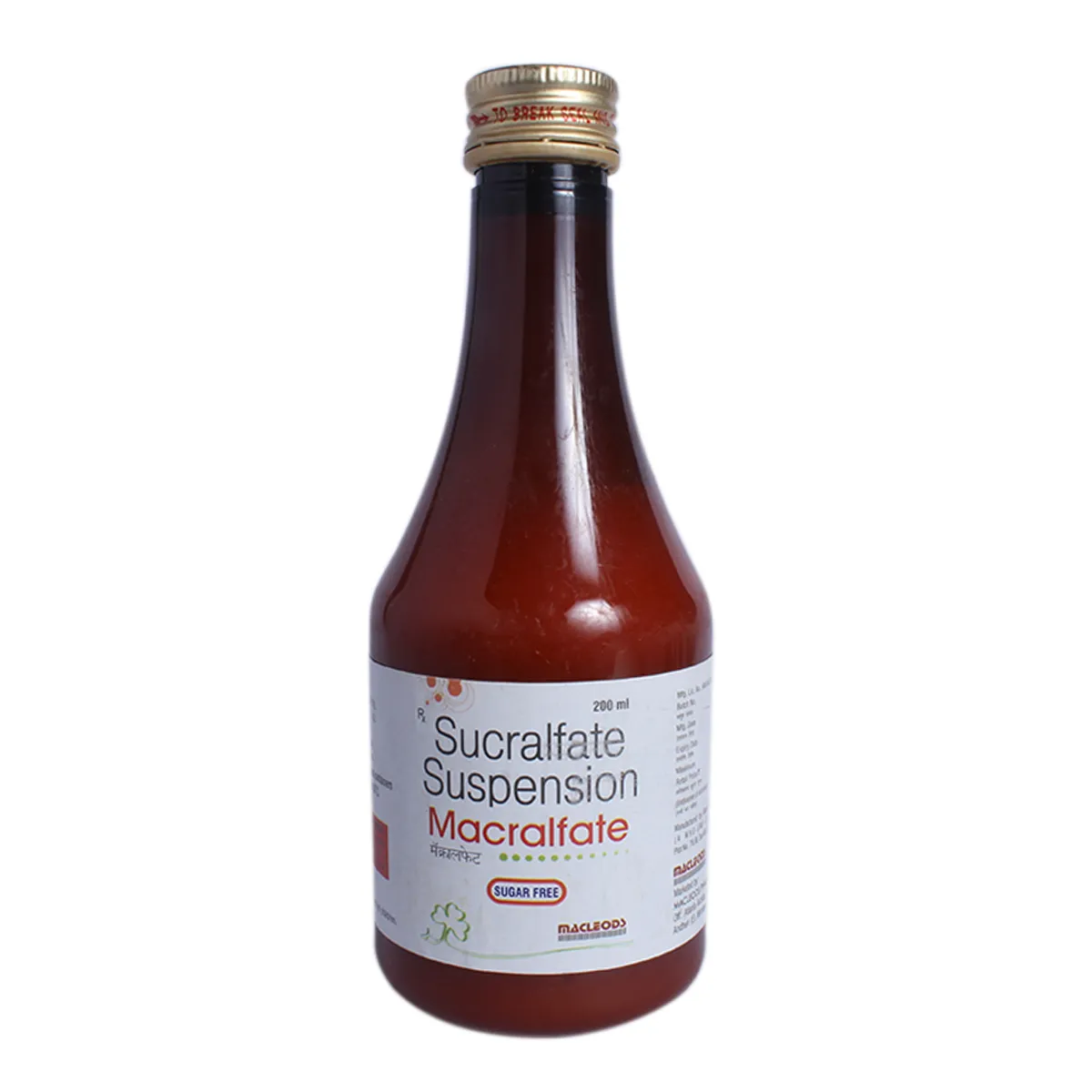
Macralfate Suspension
✅ Relieves gastric discomfort
✅ Promotes ulcer healing
✅ Forms protective barrier
✅ Reduces acid damage
✅ Soothes irritated stomach
Macralfate Suspension contains Sucralfate.
✓ Medically reviewed by Morgan Ellis — Pharmacy Researcher · 8 years experience · Last reviewed: May 2026
⚡ Quick Answer — What is Macralfate Suspension?
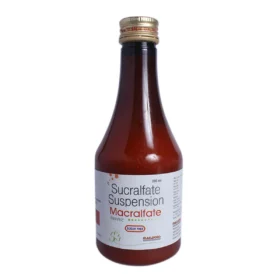
Macralfate Suspension contains sucralfate 1 g per 10 mL in a 200 mL bottle, from a WHO-GMP certified manufacturer. Sucralfate is a mucosal protectant, not an acid-suppressing drug — it is an aluminium-sucrose-octasulfate complex that polymerises into a viscous, adherent paste in the acid environment of the stomach and binds selectively to the surface of ulcers and erosions, forming a physical protective barrier for 6–8 hours. Standard adult dose: 10 mL (1 g) four times daily on an empty stomach — one hour before meals and at bedtime — for 4–8 weeks. Useful for peptic ulcer healing, bile reflux gastritis, NSAID ulcer prophylaxis, radiation-induced oesophagitis, and chemotherapy oral mucositis (off-label). Critical timing rule: sucralfate binds many other medicines and reduces their absorption — separate sucralfate from all other oral medicines by at least 2 hours. Avoid in dialysis patients (aluminium accumulation).
📦 Every order is covered by our Reshipment Assurance Policy — if your parcel does not arrive within 20 business days, we reship it.
Why order from MedsBase
Our generic medications are sourced from WHO-GMP certified manufacturers and shipped worldwide in discreet, plain packaging — no medication name on the parcel exterior. Card payments are routed through a regulated processor (statement descriptors include a regulated card-payment processor — never “MedsBase” or any medication name). Crypto and SEPA bank transfer are also accepted. Every order is backed by our Reshipment Assurance Policy.
What Macralfate Is
Macralfate Suspension is an oral suspension of sucralfate — the basic aluminium salt of sucrose octasulfate. Each 10 mL contains 1 g of sucralfate; the 200 mL bottle therefore provides 20 doses. Sucralfate is an unusual drug because it is not absorbed in any clinically meaningful amount — it works entirely topically in the gut lumen.
How Macralfate Works (Mechanism)
In the acid environment of the stomach (pH < 4), sucralfate undergoes protonation and polymerisation into a viscous, sticky, negatively-charged paste. Ulcers and erosions expose positively-charged proteins (especially albumin and fibrinogen) on their surface that the negatively-charged sucralfate polymer binds to selectively. The result is a physical adherent protective coating over the ulcer surface that lasts 6–8 hours and resists acid, pepsin and bile-salt erosion. Sucralfate also stimulates local prostaglandin and bicarbonate secretion at the mucosal surface, increases epidermal-growth-factor binding, and reduces pepsin activity. It does not reduce gastric acid secretion — if you also need acid suppression (most peptic ulcer patients do), a PPI or H2 antagonist is added.
Because sucralfate needs an acid environment to polymerise, do not take it together with a PPI or H2 antagonist — separate the two by at least 30–60 minutes (sucralfate first, then the acid-suppressant after the meal works well).
Indications — What Macralfate Treats
1. Peptic ulcer disease — gastric and duodenal
Sucralfate heals duodenal ulcers in 4 weeks and gastric ulcers in 8 weeks at 1 g four times daily. Healing rates are comparable to H2 antagonists; PPIs are more effective and faster but sucralfate is useful where PPI is contraindicated or where the patient prefers a non-systemic option.
2. Bile reflux gastritis
Where stomach acid is not the problem (post-gastrectomy, post-cholecystectomy bile reflux), PPIs offer little benefit. Sucralfate’s mechanical mucosal coating helps in this setting and is one of the few acid-related therapies with a defined niche here.
3. NSAID-associated gastritis and ulcer prophylaxis
For lower-risk patients on chronic NSAID therapy, sucralfate can reduce gastritis and ulcer development. PPIs are more effective and are first-line in higher-risk patients.
4. Radiation oesophagitis and proctitis
Sucralfate suspension reduces pain and accelerates healing in radiation-induced oesophagitis (head-and-neck cancer treatment) and radiation proctitis (pelvic radiation). The suspension can be swallowed as an oesophageal coating, or used as a retention enema for proctitis.
5. Chemotherapy-induced oral mucositis (off-label)
Sucralfate suspension used as an oral rinse-and-spit, or rinse-and-swallow, reduces pain and ulcer severity during chemotherapy mucositis. Evidence is limited but supportive.
6. Stress-ulcer prophylaxis (selected ICU populations)
Some ICU practice has shifted back toward sucralfate or H2 antagonists for stress-ulcer prophylaxis in selected ventilated patients, because PPIs increase ventilator-associated pneumonia and C. difficile rates. Specialist intensive-care decision.
7. Refractory GERD — adjunct to PPI
In refractory reflux despite optimised PPI therapy, adding sucralfate suspension can give symptom benefit by physically coating the eroded distal oesophagus. Take immediately before bedtime as a coating dose.
Dosing
| Indication | Dose | Duration |
|---|---|---|
| Peptic ulcer healing | 10 mL (1 g) four times daily on empty stomach | 4–8 weeks |
| Peptic ulcer maintenance | 10 mL twice daily on empty stomach | as needed |
| NSAID prophylaxis | 10 mL twice daily | duration of NSAID therapy |
| Radiation oesophagitis | 10 mL four times daily, swallow slowly | duration of radiation + 2 weeks |
| Radiation proctitis | 10 mL retention enema BD | specialist-led |
| Oral mucositis (off-label) | 10 mL rinse-and-spit four times daily | 2–4 weeks |
Take on an empty stomach — one hour before meals and at bedtime, four times daily. The drug needs an acid environment to polymerise; food and antacids both reduce its effectiveness. Shake the bottle well before each dose.
CRITICAL: Drug Timing Rule
Side Effects
Sucralfate is exceptionally well tolerated because it is not absorbed.
Common (1–5%):
- Constipation (the most common side effect; occurs in ~2% of users)
- Dry mouth
- Mild nausea
- Metallic taste
Uncommon but important:
- Aluminium toxicity in dialysis patients and severe chronic kidney disease — sucralfate is an aluminium salt; despite minimal absorption, accumulation in CKD can produce encephalopathy, osteomalacia and microcytic anaemia. Avoid in dialysis.
- Hypophosphataemia (rare, prolonged use)
- Bezoar formation in the stomach (very rare; reported in ICU patients on enteral feeds)
- Hypersensitivity rash
Drug Interactions Beyond the Timing Rule
Sucralfate has no enzyme-mediated drug interactions. All clinically important interactions are absorption-related and resolved by separating doses by 2 hours. The full list of drugs whose absorption is impaired by sucralfate is too long to enumerate — the safe rule is: take all other oral medicines at least 2 hours away from sucralfate.
Contraindications and Cautions
- Known hypersensitivity to sucralfate
- Severe chronic kidney disease (especially dialysis) — aluminium accumulation
- Bowel obstruction or severe constipation
- Premature infants and very young children — bezoar risk
Pregnancy, Breastfeeding, and Children
Pregnancy: Sucralfate is one of the safer acid-related options in pregnancy because it is not absorbed. Useful for pregnancy reflux that does not respond to lifestyle measures and antacids.
Breastfeeding: Compatible — not absorbed.
Children: Used in paediatric peptic ulcer disease and radiation/chemotherapy mucositis. Weight-based dosing 40–80 mg/kg/day in 4 divided doses (max 1 g/dose). Avoid in premature infants and neonates.
Storage
Store at 15–30 °C in the original bottle. Do not freeze. Shake well before each dose — the suspension settles. Discard 30 days after first opening if a date is not specified on the label, or sooner if the suspension changes appearance.
Frequently Asked Questions
Does Macralfate reduce stomach acid?
No. Sucralfate does not affect acid secretion. It works by physically coating ulcers and erosions, protecting them while they heal. If you also need acid suppression (most peptic ulcer patients do), a PPI or H2 antagonist is added — sucralfate complements rather than replaces them.
Why must I take it on an empty stomach?
Sucralfate needs an acid environment (pH < 4) to polymerise into its protective gel form. Food in the stomach buffers acid and reduces sucralfate’s effectiveness. Antacids, PPIs and H2 antagonists also raise pH and reduce sucralfate effectiveness if taken at the same time — separate them by at least 30–60 minutes.
How quickly does it work?
Sucralfate gives a soothing local effect almost immediately on contact, but ulcer healing takes the standard 4 weeks (duodenal) to 8 weeks (gastric). It is not a fast-acting symptom medication like an antacid.
Can I take it with my levothyroxine?
Not at the same time — sucralfate substantially reduces levothyroxine absorption. Take levothyroxine first thing in the morning on an empty stomach as usual, then take sucralfate at least 2 hours later (e.g. before lunch). If your dosing schedule cannot accommodate the 2-hour gap, recheck TSH 6–8 weeks after starting and adjust the levothyroxine dose if needed.
Is Macralfate safe in pregnancy?
Yes — one of the preferred acid-related options in pregnancy because it is not absorbed. Sucralfate is recommended after antacids and lifestyle measures and before PPIs in pregnancy reflux.
Why is it not safe for dialysis patients?
Sucralfate is an aluminium salt. Although the amount absorbed is tiny, normal kidneys excrete it without difficulty. Dialysis patients cannot clear aluminium and can accumulate it over time, producing aluminium-related encephalopathy, osteomalacia, and microcytic anaemia. Avoid sucralfate in dialysis; use H2 antagonists or PPIs instead.
Can I combine it with a PPI?
Yes — this is a recognised strategy in refractory peptic ulcer disease, severe oesophagitis, and bile-reflux gastritis. Take the sucralfate one hour before meals and the PPI 30–60 minutes before the same meal — the PPI maintains baseline acid suppression while the sucralfate provides physical mucosal coating.
Does Macralfate cause constipation?
Yes — the most common side effect, in about 2% of users. Aluminium-containing products tend to be constipating. Increase water intake, dietary fibre, and physical activity. If constipation is troublesome, ask your prescriber whether sucralfate can be paused or replaced with an alternative.
Is it absorbed into the bloodstream?
Less than 5% is absorbed in normal gut conditions, and most of that is the aluminium portion which is then renally cleared. The intact sucralfate polymer is essentially confined to the gut lumen and does not reach the systemic circulation in clinically relevant amounts.
Can it be used for mouth ulcers?
Yes, off-label — the suspension swirled in the mouth as a rinse-and-spit (or rinse-and-swallow) gives symptomatic relief and accelerates healing in chemotherapy/radiation mucositis and in severe aphthous stomatitis. Limit to 4 times daily for 2–4 weeks.
Related Alternatives
Other products in General Health that customers also view:
More options in Acid Reflux Treatment
Ranked by recent MedsBase order volume — what other customers in this category are picking.

| Strength | 200 ml |
|---|---|
| Quantity | 1 Bottle/s, 2 Bottle/s, 3 Bottle/s, 6 Bottle/s |
 Macralfate Suspension
Q & A
Macralfate Suspension
Related products




Reviews
There are no reviews yet