








✓ Medically reviewed by · Last reviewed: May 2026
Pharmacy Researcher · 8 years experience
Pharmacy researcher with 8 years reviewing clinical drug information, generic formulation equivalence, and international pharmaceutical standards. Focuses on patient-facing accuracy in medication education.
medications that cause falls in elderly — Medications That Cause Falls in Elderly — A Complete Prevention Guide. Read on for an evidence-backed guide covering everything you need to know.
Key Takeaways
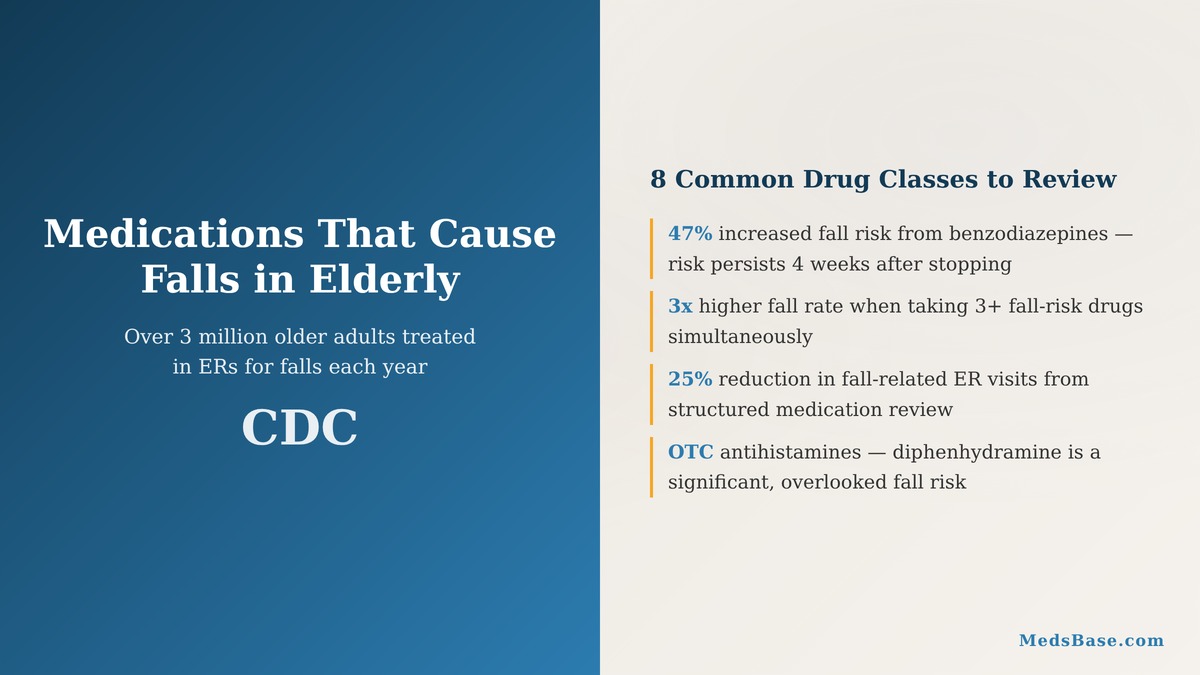
- Falls are the leading cause of injury-related death in adults over 65, and medications are responsible for a significant share — yet fewer than 30% of older adults have had a formal medication review
- The 8 drug classes linked to fall risk are not obscure — they include common blood pressure pills, antidepressants, sleeping aids, and over-the-counter antihistamines millions take daily
- One specific class of drugs caught in the JAMA review showed a 47% increased fall risk — and it is available without a prescription
- The fix is not “stop all your medications” — it is a structured medication review that most patients can request from their pharmacist for free
- Even a single medication change can reduce fall risk by 20–30% in older adults taking multiple drugs
You fill your weekly pill organiser with nine different medications prescribed by three different specialists over the past decade. None of those doctors has ever looked at the full list together. Your blood pressure pill makes you a little lightheaded when you stand up. The sleeping pill leaves you groggy until mid-morning. And the over-the-counter antihistamine you take for seasonal allergies? You did not even think to mention it at your last appointment.
This is not a rare scenario — it is, statistically, the norm. Over 60% of adults over 65 take five or more prescription medications, and fewer than one in three has ever had a comprehensive medication review. When a fall happens, the conversation usually focuses on throw rugs, poor lighting, and weak muscles. Rarely does anyone look at the pill bottles on the nightstand. Yet medications that cause falls in elderly adults are among the most modifiable risk factors — and the least discussed.
By the end of this guide, you will know every major drug class that raises fall risk, the specific mechanism behind each one, and exactly how to initiate the medication review that could keep you or your parent out of the emergency department.
Here is the open loop: one commonly prescribed class of medications carries a fall risk that persists for weeks after you stop taking it — not days, not hours. We will cover which class and why the withdrawal period is part of the danger.
What Are Medications That Cause Falls in Elderly Adults?
Quick Answer: Medications that cause falls in elderly adults are drugs that impair balance, lower blood pressure too much upon standing, slow reaction time, blur vision, cause muscle weakness, or induce confusion — either as their intended effect or as a side effect. They span multiple drug classes including blood pressure medications, sedatives, antidepressants, anticholinergics, and diabetes medications. Identifying medications that cause falls in elderly adults is one of the highest-impact things a clinician or family member can do to protect independence.
The term clinicians use is “fall-risk-increasing drugs” (FRIDs). It is not a formal FDA category — it is a practical clinical concept grounded in decades of observational research and systematised in tools like the Beers Criteria, the STOPP/START criteria, and the FORTA list. These tools help clinicians identify medications whose risks — including fall risk — may outweigh their benefits in older adults.
The numbers are sobering. The CDC reports that over 3 million older adults are treated in emergency departments for fall injuries each year, and roughly 36,000 die from those injuries. A 2025 systematic review published in JAMA Network Open found that specific medication classes independently increase fall risk by 20% to over 80%, depending on the drug and dose. The medications that cause falls in elderly adults are not exotic or rarely prescribed — they include some of the most commonly dispensed drugs in the world.
A critical point: most of these medications are not inherently “bad.” They are treating real conditions — hypertension, depression, chronic pain, insomnia — that themselves carry serious risks if left untreated. The goal is not to stop all medications but to identify which ones may be doing more harm than good for a given patient and find safer alternatives. Understanding which medications that cause falls in elderly adults should be reviewed first — and which can safely be left alone — is the core of any effective medication review.
How Do Medications Increase Fall Risk?
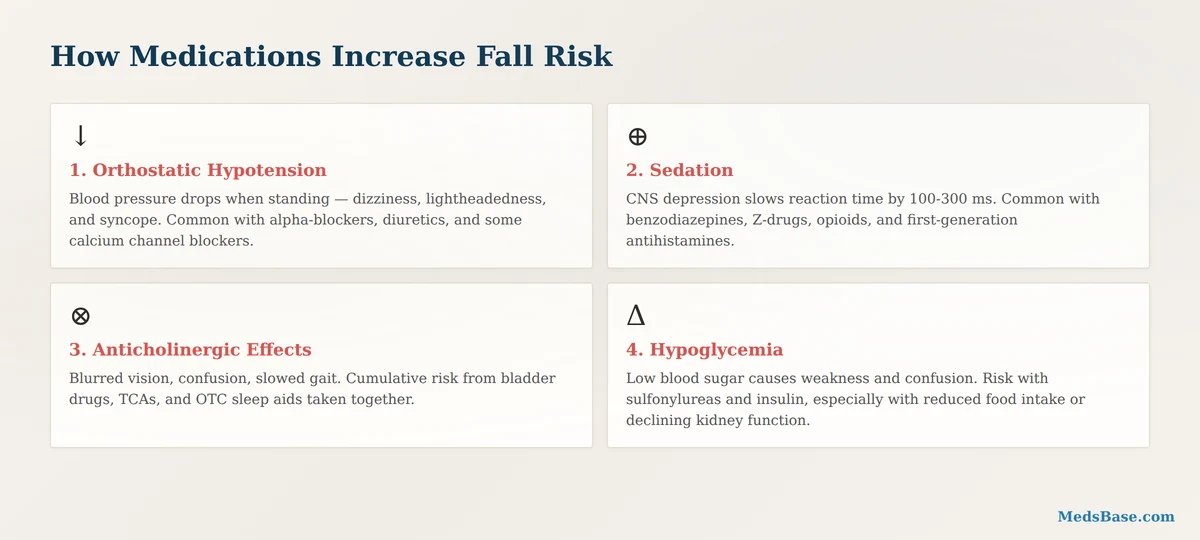
Medications cause falls through four primary mechanisms, and many drugs work through more than one of them simultaneously. Anyone evaluating medications that cause falls in elderly adults needs to understand these four pathways, because a drug that triggers two of them — such as a tricyclic antidepressant causing both orthostatic hypotension and anticholinergic confusion — carries substantially more risk than one that triggers only one.
Orthostatic hypotension — When you stand up, your body normally tightens blood vessels and increases heart rate to maintain blood flow to the brain. Blood pressure medications — particularly alpha-blockers, some calcium channel blockers, and diuretics — can blunt this response. The result: a momentary drop in brain blood flow, dizziness, and sometimes full syncope (fainting). This is the single most common medication-related fall mechanism.
Sedation and slowed reaction time — Drugs that cross the blood-brain barrier and act on GABA receptors (benzodiazepines, “Z-drugs” like zolpidem) or histamine receptors (first-generation antihistamines like diphenhydramine) depress central nervous system activity. They slow reaction time by 100–300 milliseconds — enough that a trip over a rug edge that a fully alert person would catch turns into an uncontrolled fall.
Anticholinergic effects — Many medications block acetylcholine, a neurotransmitter critical for muscle control, attention, and balance. The anticholinergic burden adds up across multiple medications: a patient taking an overactive bladder drug (oxybutynin), a tricyclic antidepressant (amitriptyline), and diphenhydramine for sleep is getting a triple anticholinergic load. Effects include blurred vision, confusion, slowed gait, and reduced postural stability.
Hypoglycemia — Diabetes medications, particularly sulfonylureas and insulin, can drop blood sugar too low. Hypoglycemia causes weakness, dizziness, confusion, and loss of consciousness — all fall precipitants. This risk increases when an older adult eats less than usual (common during illness), takes the medication at the wrong time, or has declining kidney function that slows drug clearance.
Research Spotlight
The 8 Drug Classes Most Likely to Cause Falls in Elderly Adults
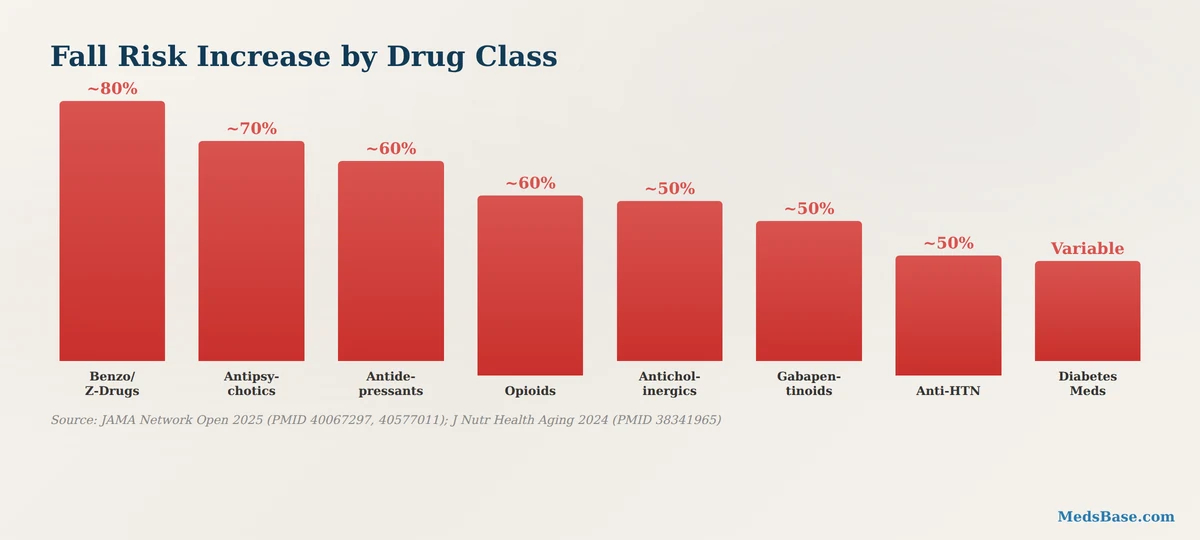
Here is the list — ranked approximately by the consistency and strength of the evidence linking each class to falls. For family members and caregivers, this list of medications that cause falls in elderly adults is a practical checklist — if you or your parent takes a drug from three or more of these classes simultaneously, a medication review should be a priority.
1. Benzodiazepines and “Z-Drugs” — Fall Risk Increase: ~50–80%
Benzodiazepines (diazepam, lorazepam, alprazolam, clonazepam) and Z-drugs (zolpidem, zopiclone, eszopiclone) are among the most consistently implicated medications that cause falls in elderly adults. They work by enhancing GABA, the brain’s primary inhibitory neurotransmitter, producing sedation, muscle relaxation, and slowed reaction time. A 2024 systematic review in the Journal of Nutrition, Health and Aging found that benzodiazepine use was associated with a 47% increase in fall risk among older adults, and the risk remained elevated for up to four weeks after discontinuation — resolving the open loop from the introduction. The withdrawal period carries risk because rebound insomnia and anxiety can themselves contribute to daytime drowsiness and impaired balance (PMID 38341965).
What to consider instead: Cognitive-behavioral therapy for insomnia (CBT-I) is first-line and equally effective long-term without fall risk. For anxiety, SSRIs carry lower (though not zero) fall risk compared to benzodiazepines.
2. Antidepressants — Fall Risk Increase: ~30–60%
Selective serotonin reuptake inhibitors (SSRIs like fluoxetine, sertraline, citalopram), serotonin-norepinephrine reuptake inhibitors (SNRIs), and especially tricyclic antidepressants (TCAs like amitriptyline, nortriptyline) all increase fall risk through different mechanisms. SSRIs and SNRIs can cause orthostatic hypotension and hyponatremia (low sodium), which causes confusion and gait disturbance. TCAs add a heavy anticholinergic burden — blurred vision, dizziness, confusion — on top of orthostatic effects. The risk is highest during the first two weeks after starting or increasing the dose.
What to consider instead: For neuropathic pain, consider gabapentin or pregabalin (monitor for dizziness at initiation). For depression, SSRIs remain reasonable but start at a low dose and monitor. For sleep, avoid using sedating antidepressants (trazodone, mirtazapine) purely as sleep aids — the fall risk still applies.
3. Antihypertensives (Blood Pressure Medications) — Fall Risk Increase: ~20–50%
This is the largest category by prescription volume, and several subclasses are particularly implicated. Alpha-blockers (doxazosin, terazosin, tamsulosin used for BPH) are the worst offenders for orthostatic hypotension. Calcium channel blockers (especially short-acting nifedipine, and amlodipine in susceptible individuals), diuretics (hydrochlorothiazide, furosemide — cause volume depletion and orthostasis), and beta-blockers (less directly but can cause fatigue and bradycardia) all contribute. Among medications that cause falls in elderly adults, antihypertensives are uniquely challenging because stopping them carries its own serious risks — stroke, heart attack, and kidney failure — so the approach requires nuance.
What to consider instead: This is the most nuanced category because uncontrolled hypertension carries its own serious risks — stroke, heart attack, kidney failure. The approach is not to stop antihypertensives but to: (1) ensure blood pressure is not being over-treated (targets have been relaxed for many older adults), (2) review timing — taking the medication at bedtime rather than morning may reduce daytime orthostatic symptoms for some patients, (3) in patients taking multiple BP medications, consider whether one can be reduced or switched to an agent with a gentler blood pressure profile (ARBs tend to cause less orthostasis than alpha-blockers or diuretics). For more on specific BP medications, see our amlodipine side effects guide.
4. Antipsychotics — Fall Risk Increase: ~40–70%
Both first-generation (haloperidol, chlorpromazine) and second-generation (risperidone, olanzapine, quetiapine) antipsychotics increase fall risk through sedation, orthostatic hypotension, extrapyramidal symptoms (stiffness, tremor, gait disturbance), and anticholinergic effects. In older adults with dementia, the FDA has issued a black-box warning for increased mortality with antipsychotic use — the fall risk is part of the broader safety concern.
What to consider instead: Non-pharmacological approaches for behavioral symptoms in dementia (environmental modification, structured routines, caregiver education). If medication is necessary, use the lowest effective dose for the shortest possible duration.
5. Anticholinergics (Bladder, Allergy, GI Medications) — Fall Risk Increase: ~30–50%
Anticholinergic medications block acetylcholine, and the list is surprisingly long: oxybutynin and tolterodine (overactive bladder), diphenhydramine (Benadryl, also in OTC sleep aids like Tylenol PM and Advil PM), promethazine (nausea), amitriptyline (pain/sleep), cyclobenzaprine (muscle relaxant). A single patient may be taking three or four anticholinergics without anyone — including the prescriber — realising the cumulative burden.
What to consider instead: For overactive bladder, mirabegron (a beta-3 agonist) has no anticholinergic activity. For allergies, second-generation antihistamines (loratadine, cetirizine, fexofenadine) do not cross the blood-brain barrier significantly and do not cause sedation or anticholinergic effects. See our guide on how to treat seasonal allergies for a full breakdown of non-sedating options.
6. Opioid Analgesics — Fall Risk Increase: ~30–60%
Opioids (codeine, tramadol, oxycodone, morphine) cause sedation, dizziness, and — in higher doses — respiratory depression that can impair cerebral oxygenation. The fall risk is dose-dependent and highest during the first two weeks of use or after a dose increase. Of all medications that cause falls in elderly adults, the combination of an opioid with a benzodiazepine or gabapentinoid is particularly dangerous: a 2024 analysis found that concurrent opioid-benzodiazepine use more than doubled fall risk compared to either drug alone. For this reason, any medication review focused on medications that cause falls in elderly adults should scrutinise this combination with special attention.
What to consider instead: For chronic non-cancer pain in older adults, first-line options include physical therapy, structured exercise programmes, topical analgesics (diclofenac gel, lidocaine patches), and non-opioid oral medications (acetaminophen, cautious NSAID use with gastroprotection). Opioids should be reserved for acute severe pain or end-of-life care.
7. Antiepileptics / Gabapentinoids — Fall Risk Increase: ~25–50%
Gabapentin and pregabalin, used for neuropathic pain and sometimes prescribed off-label for anxiety, cause dose-dependent dizziness and sedation. They also produce ataxia (uncoordinated movement) in some patients. Carbamazepine, phenytoin, and valproate cause similar effects plus cerebellar toxicity with long-term use.
What to consider instead: For neuropathic pain, topical options (capsaicin, lidocaine) have essentially zero systemic side effects. For anxiety, SSRIs have more data in older adults than gabapentinoids.
8. Diabetes Medications — Fall Risk Increase Through Hypoglycemia
Sulfonylureas (glipizide, glyburide, glimepiride) and insulin can cause hypoglycemia, which produces weakness, confusion, sweating, and loss of consciousness — all of which precipitate falls. Older adults with declining renal function are at higher risk because sulfonylureas are renally cleared.
What to consider instead: Metformin has a much lower risk of hypoglycemia. SGLT2 inhibitors and GLP-1 agonists also carry low hypoglycemia risk when used as monotherapy. The key is matching the medication to the patient’s kidney function, eating patterns, and hypoglycemia awareness.
Safety Profile — Who Is Most Vulnerable to Medication-Related Falls?
Not every older adult taking a fall-risk medication will fall, and understanding who is most vulnerable helps target prevention efforts. The medications that cause falls in elderly adults do not affect everyone equally — the same blood pressure pill that causes mild dizziness in a fit 70-year-old can trigger a disabling hip fracture in someone with pre-existing balance impairment and osteoporosis.
The highest-risk profile includes: age over 80 (physiological reserve declines), taking five or more medications (polypharmacy), a history of a previous fall in the past year, use of a walking aid (indicates existing balance impairment), cognitive impairment (reduced safety awareness), orthostatic hypotension on measurement (a drop of ≥20 mmHg systolic or ≥10 mmHg diastolic within 3 minutes of standing), and visual impairment.
The polypharmacy multiplier: A 2025 systematic review of 44 studies in JAMA Network Open found that the risk was not simply additive — when patients took three or more fall-risk-increasing drugs simultaneously, the fall rate more than tripled compared to those taking none. The interaction matters: a blood pressure medication that alone causes mild orthostasis, combined with a sleeping pill that slows reaction time, combined with an anticholinergic bladder medication that blurs vision — each problem alone might be manageable, but together they overwhelm the body’s compensatory mechanisms (PMID 40577011).
What the Research Says About Medications That Cause Falls in Elderly
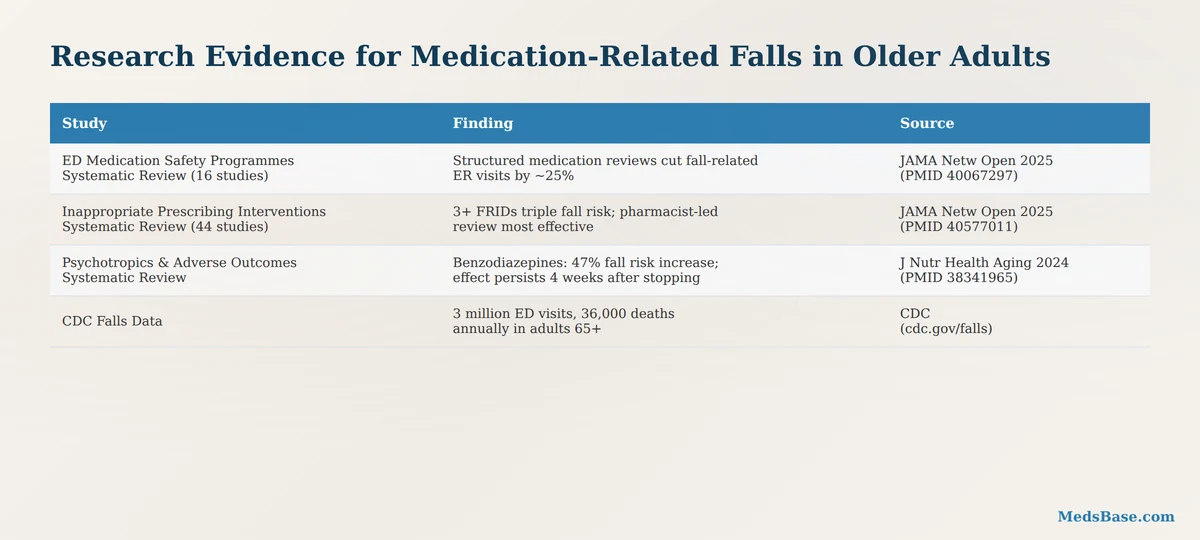
| Study | Year | Finding | Source |
|---|---|---|---|
| ED medication safety programmes — systematic review of 16 studies | 2025 | Structured medication reviews in older adults reduced fall-related ED visits by ~25%; sedatives and anticholinergics were the highest-yield targets | JAMA Netw Open (PMID 40067297) |
| Potentially inappropriate prescribing interventions — 44-study systematic review | 2025 | Polypharmacy with 3+ FRIDs tripled fall risk; pharmacist-led medication review was the most consistently effective intervention | JAMA Netw Open (PMID 40577011) |
| Psychotropic medications and adverse outcomes — systematic review | 2024 | Benzodiazepines independently associated with 47% increased fall risk; effect persisted up to 4 weeks after discontinuation | J Nutr Health Aging (PMID 38341965) |
| CDC — older adult fall data | 2023 | 3 million ED visits, 36,000 deaths annually from falls in adults 65+ | CDC |
What this means for you: The evidence is clear and consistent — medications that cause falls in elderly adults are a major modifiable risk factor, and interventions that systematically review and reduce these medications cut fall rates significantly. Too often, families and even clinicians dismiss falls as “just aging” when a specific list of medications that cause falls in elderly adults is sitting in the patient’s chart, waiting to be reviewed. The gap is not in the science; it is in the implementation. Most older adults have never had a formal medication review focused on fall risk, which means these medications that cause falls in elderly patients frequently go unaddressed until a fracture makes the risk undeniable.
Medication Review vs Doing Nothing — What Difference It Makes
| Approach | Fall Risk Reduction | Time to Effect | What It Involves |
|---|---|---|---|
| Comprehensive medication review by pharmacist or physician | ~20–35% reduction | 1–3 months | Full medication list review, deprescribing where appropriate, switching to safer alternatives |
| Home hazard modification (grab bars, lighting, rug removal) | ~20–25% reduction | Immediate after installation | Physical environment changes |
| Structured exercise programme (balance + strength training) | ~25–35% reduction | 3–6 months | Tai chi, Otago Exercise Programme, supervised physiotherapy |
| Combined approach (medication review + exercise + home safety) | ~35–50% reduction | 3–6 months | All three interventions together |
Q: Which approach fits which situation?
A: – If you are taking 4+ prescription medications and have never had a medication review: start there — it has the fastest implementation timeline and the most immediate potential to reduce fall risk – If medications are optimised but balance is still poor: structured exercise (specifically balance training, not walking alone) provides the strongest evidence – If you have already fallen once: combined approach — a single fall in the past year is the strongest predictor of a future fall
How to Get a Medication Review — Step by Step
Step 1 — Gather every medication you take. This includes prescriptions, over-the-counter drugs, vitamins, and supplements. Do not assume “natural” products are irrelevant — some (valerian, kava, St. John’s wort) have sedating or interacting effects.
Step 2 — Write down how you actually take them. Be honest: “I take my blood pressure pill in the morning but I skip it about twice a week because it makes me dizzy” or “I take the sleeping pill most nights but a double dose when I cannot sleep” — information your doctor needs but may not ask for.
Step 3 — Request a “medication review focused on fall risk.” In most healthcare systems this is a billable service from your primary care physician or a clinical pharmacist. Use the phrase “fall risk medication review” specifically — it signals a focused assessment rather than a general check-up.
Step 4 — Ask these five specific questions:
- “Are any of my medications on the Beers list of potentially inappropriate medications for older adults?”
- “Could my dizziness when I stand up be related to any of these medications?”
- “Do I still need all of these, or are there any we can reduce or stop?”
- “Is there a safer alternative for any of these — something with a lower fall risk?”
- “If I do stop or switch a medication, what symptoms should I watch for and how quickly?”
Step 5 — Do not stop medications on your own. Abruptly stopping a beta-blocker can cause rebound tachycardia and hypertension. Stopping a benzodiazepine abruptly can cause withdrawal seizures. Every change should be physician-supervised with a clear taper plan.
Mistakes to avoid:
- Assuming a fall is “just part of getting older” — falls are not normal aging; they are a symptom with a cause
- Not mentioning over-the-counter medications — diphenhydramine (Benadryl) alone is a significant fall risk
- Asking only one prescribing doctor — the cardiologist may not know what the psychiatrist prescribed; bring the full list to every appointment
- Accepting a new prescription without asking “does this increase my fall risk?” — make it a routine question
Related Reading
- Prescribing Cascades in Older Adults: How One Drug Leads to Another and What to Do About It — the upstream problem that creates polypharmacy
- Amlodipine Side Effects: A Complete Guide — deep-dive on one of the most commonly prescribed fall-risk medications
- How to Treat Seasonal Allergies: Safe and Effective Options — non-sedating alternatives to antihistamines that cause falls
Frequently Asked Questions About Medications That Cause Falls in Elderly
Q: What medications increase fall risk in the elderly?
A: The eight drug classes most strongly linked to falls are benzodiazepines/Z-drugs, antidepressants (especially TCAs), antihypertensives (especially alpha-blockers), antipsychotics, anticholinergic medications, opioid analgesics, gabapentinoids, and diabetes medications that can cause hypoglycemia. Many patients take medications from multiple classes simultaneously, which multiplies the risk.
Q: Which blood pressure medications cause dizziness?
A: Alpha-blockers (doxazosin, terazosin) are the most likely to cause orthostatic hypotension and dizziness on standing. Calcium channel blockers (especially short-acting nifedipine) and diuretics also commonly cause dizziness. ARBs and ACE inhibitors generally have the most favorable dizziness profile. If you experience dizziness after taking your blood pressure medication, ask your doctor whether switching to a different class or adjusting the timing could help.
Q: Can sleeping pills cause falls in older adults?
A: Yes, significantly. Benzodiazepines and Z-drugs (zolpidem, eszopiclone) are among the most consistently implicated medications that cause falls in elderly adults, with studies showing up to 80% increased fall risk. The risk persists not only while taking the medication but for up to four weeks after stopping, due to withdrawal-related sleep disruption. CBT-I (cognitive behavioral therapy for insomnia) is the recommended first-line treatment and carries zero medication-related fall risk.
Q: How to prevent medication-related falls?
A: The most effective single intervention is a structured medication review — either by your primary care physician or a clinical pharmacist — specifically focused on fall risk. The review should identify medications that cause falls in elderly adults in your specific regimen and determine which can be reduced, switched, or stopped. Additional steps: ensuring blood pressure is not over-treated, switching from first-generation antihistamines to second-generation alternatives, avoiding benzodiazepines for sleep, treating orthostatic hypotension (compression stockings, adequate hydration, slow position changes), and combining medication optimisation with balance-focused exercise.
Q: What is a medication review for seniors?
A: A medication review for seniors is a systematic assessment of everything a patient takes — prescriptions, over-the-counter drugs, and supplements — to identify medications that may be causing more harm than benefit. Tools like the Beers Criteria and STOPP/START provide evidence-based guidance on which medications to avoid, reduce, or stop in older adults. In many healthcare systems, a pharmacist-led medication review is a covered service you can request directly.
Q: Are antidepressants linked to falls in older people?
A: Yes. SSRIs, SNRIs, and especially tricyclic antidepressants all increase fall risk. SSRIs can cause orthostatic hypotension and hyponatremia (low sodium levels causing confusion). TCAs add significant anticholinergic effects. The risk is highest in the first two weeks after starting or increasing the dose. However, untreated depression itself increases fall risk through reduced activity, poor nutrition, and cognitive effects — so the decision to continue an antidepressant should weigh both the fall risk and the risks of untreated depression.
Q: How long does medication-related fall risk last?
A: It varies by drug class. For benzodiazepines, risk persists for up to 4 weeks after discontinuation. For antihypertensives, orthostatic effects may resolve within days of dose reduction but can persist if underlying autonomic dysfunction exists. For anticholinergics, effects generally resolve within days to a week of stopping, but accumulated anticholinergic burden from long-term use may have contributed to cognitive changes that take longer to reverse. The key takeaway: medications that cause falls in elderly adults do not necessarily stop being a risk the moment you stop taking them — some risks outlast the last dose.
Q: Can my pharmacist help me identify medications that cause falls?
A: Absolutely. Clinical pharmacists are specifically trained in medication therapy management and are often more accessible than physicians for this type of review. Many pharmacies offer medication review services (sometimes called Medication Therapy Management or MTM) that are covered by Medicare Part D for eligible patients. Bring your complete medication list — including OTC products — and specifically ask for a fall-risk assessment.
The Bottom Line
Medications that cause falls in elderly adults are not an inevitable part of aging — they are a modifiable risk factor that most patients and families never address because nobody asks the right question. The 8 drug classes covered here — benzodiazepines, antidepressants, antihypertensives, antipsychotics, anticholinergics, opioids, gabapentinoids, and hypoglycemia-inducing diabetes drugs — collectively account for tens of thousands of preventable falls each year. Unlike environmental hazards that require costly home modifications, medications that cause falls in elderly adults can often be addressed in a single 30-minute appointment — a medication review focused on fall risk that identifies which drugs can be reduced, switched, or stopped.
Your immediate action: gather every medication bottle you have — prescription, over-the-counter, and supplement — into one bag. Book a medication review appointment with your primary care physician or pharmacist. Walk in with the list and ask point-blank: “Which of these medications increase my fall risk, and what can we change?” Because when you ask the question, you force the system to look at the full list — and that is when the medications that cause falls in elderly adults become visible, manageable, and reversible.
For the bigger picture on how medications accumulate and interact — and the specific cascade patterns that lead to over-prescribing — read our companion guide on prescribing cascades in older adults. And if you or a family member is managing multiple chronic conditions, our Chronic Conditions resource hub provides condition-specific medication guides and treatment comparisons.
Medical Disclaimer: This article is for informational purposes only and does not constitute medical advice. Never stop or change a prescribed medication without consulting your prescribing physician. Abruptly discontinuing certain medications can cause serious withdrawal effects. Always seek the guidance of a qualified healthcare professional regarding any medication changes.

Written by
Sophie ChenPharmaceutical Content Researcher · 8 years experience
Sophie Chen is a pharmaceutical content researcher with 8 years covering generic medication access and clinical pharmacology. She specialises in international regulatory frameworks, bioequivalence standards, and patient-facing education on therapeutic drug classes. She is not a clinician.