







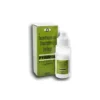

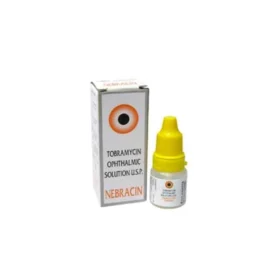
Nebracin Eye Drop
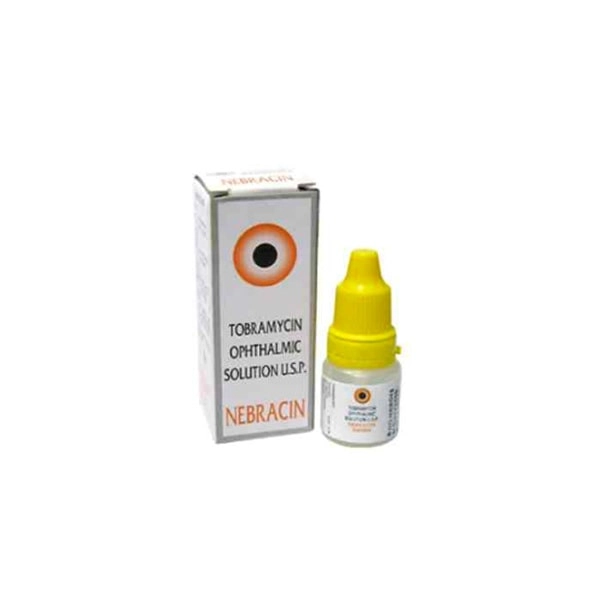
Nebracin (tobramycin 0.3%) — aminoglycoside eye drop for Gram-negative bacterial conjunctivitis. Hourly dosing in severe ulcers; corneal-toxicity caution beyond 7 days.
✓ Medically reviewed by Morgan Ellis — Pharmacy Researcher · 8 years experience · Last reviewed: May 2026
⚡ Quick Answer — What is Nebracin Eye Drop?
Nebracin Eye Drop is Tobramycin 0.3% ophthalmic solution, an aminoglycoside antibiotic for bacterial conjunctivitis, blepharitis, and external eye infections. Strong Pseudomonas and Staphylococcus aureus coverage. Used 4–6 times daily.
📦 Every order is covered by our Reshipment Assurance Policy — if your parcel does not arrive within 20 business days, we reship it.
Why order from MedsBase
Nebracin Eye Drop is sourced from a WHO-GMP certified manufacturer and shipped worldwide in plain, discreet packaging. Every order is covered by our Reshipment Assurance Policy — if it has not arrived after 20 business days we reship at no extra cost. Backed by 1,400+ verified customer reviews.
What is Nebracin Eye Drop?
Nebracin Eye Drop is manufactured by FDC and contains Tobramycin 0.3% as a sterile ophthalmic solution. Aminoglycosides are bactericidal antibiotics that have been used in ophthalmology for decades — particularly valued for Gram-negative coverage (including Pseudomonas) and Staphylococcus aureus.
How It Works
Tobramycin binds the 30S ribosomal subunit in bacteria, causing misreading of mRNA and the production of dysfunctional proteins. The bacterium synthesises faulty membrane proteins that eventually compromise membrane integrity, leading to cell lysis. The mechanism is bactericidal and concentration-dependent.
Indications
- Bacterial conjunctivitis — confirmed or strongly suspected
- Bacterial blepharitis
- Hordeolum (stye) / chalazion with bacterial component
- Bacterial keratitis — particularly Pseudomonas; under ophthalmologist supervision
- Post-operative prophylaxis after cataract or corneal surgery
Dosing
| Indication | Dose |
|---|---|
| Bacterial conjunctivitis (mild-moderate) | 1–2 drops in affected eye(s) every 4 hours for 7 days |
| Severe infection | 2 drops every 1 hour until improvement, then taper |
| Corneal ulcer (specialist) | Hourly day and night for 24–48 hours, then taper based on response |
Side Effects
Local: stinging, burning, conjunctival hyperaemia, eyelid itching or swelling, hypersensitivity reactions (more common with neomycin, less with tobramycin/gentamicin), punctate keratitis with prolonged use.
Systemic: negligible from topical use. Theoretical risks of ototoxicity and nephrotoxicity apply only to systemic dosing.
Warnings & Contraindications
- Hypersensitivity to aminoglycosides
- Viral, fungal, or mycobacterial keratitis
- Acanthamoeba keratitis (contact-lens users)
- Avoid prolonged use beyond 14 days
- Pregnancy / breastfeeding — topical absorption minimal, generally considered acceptable
Storage
Store at 15–25°C. Discard 28 days after first opening.
Frequently Asked Questions
When is Nebracin Eye Drop used?
Bacterial conjunctivitis, blepharitis, hordeolum, and pre/post-operative prophylaxis. Aminoglycosides have particularly strong Gram-negative coverage including Pseudomonas — important for contact-lens-associated keratitis.
How long should I use Nebracin Eye Drop?
5–7 days for conjunctivitis. Avoid courses beyond 14 days because of corneal toxicity (delayed epithelial healing).
What is the difference between solution and ointment?
Solutions are dosed 4–6 times daily and don’t blur vision. Ointments stay in the eye longer (dosed 2–3 times daily) but blur vision for 5–10 minutes after application — best used at bedtime.
Can I wear contact lenses?
No — stop lenses during treatment and for 24 hours after symptoms resolve. Contact-lens-associated keratitis specifically requires lens cessation.
What is corneal toxicity?
Long-term aminoglycoside use can damage corneal epithelial cells and slow healing. This is why courses should be limited to 7–14 days. Pseudomonas resistance also develops with prolonged exposure.
Is Nebracin Eye Drop safe in pregnancy?
Topical absorption is minimal. Generally considered acceptable when clearly indicated. Discuss with your prescriber.
Can Nebracin Eye Drop cause hearing loss?
Topical aminoglycosides do not reach high enough systemic levels to cause ototoxicity. The systemic ototoxicity warning applies only to IV gentamicin/tobramycin used for serious infections.
What if I have a hypersensitivity reaction?
Stop the drop. Symptoms include increasing redness, swelling of the lid skin, severe itching. Switch to a non-aminoglycoside antibiotic (fluoroquinolone, chloramphenicol).
What if symptoms don't improve in 48 hours?
The infection may not be susceptible, may be viral or fungal, or there may be a foreign body or other cause. Urgent ophthalmology review is appropriate.
Can Nebracin Eye Drop be used in young children?
Yes — generally well tolerated from infancy. Always under guidance for very young infants.
Other Eye-Care Medications
Customers viewing this product also consider these alternatives in our Eye Care range:
- Ciplox-D Eye Drops (cipro+dex)
- Gate P Eye Drops (gatifloxacin)
- Genticyn Eye Drop (gentamicin)
- Milflox Eye Drop (moxifloxacin)
- Oflox Eye Drop (ofloxacin)
Medical Disclaimer
The information on this page is for educational purposes only and is not a substitute for medical advice from a qualified ophthalmologist or optometrist. Eye conditions can rapidly threaten sight — sudden vision loss, severe pain, or trauma is an ophthalmology emergency. Always consult an eye-care professional before starting, stopping, or changing any treatment.
More options in Eye Care
Ranked by recent MedsBase order volume — what other customers in this category are picking.
| Strength | 0.3% (5 ml) Eye Drop |
|---|---|
| Quantity | 1 Eye Drop/s, 3 Eye Drop/s, 6 Eye Drop/s |
| Pharma Form | Eye Drop/s |
| Manufacturer | Sunways India |
| Treatment | Eye Care |
| Generic Brand | Tobramycin |
 Nebracin Eye Drop
Q & A
Nebracin Eye Drop
Related products



Reviews
There are no reviews yet