









Omez D
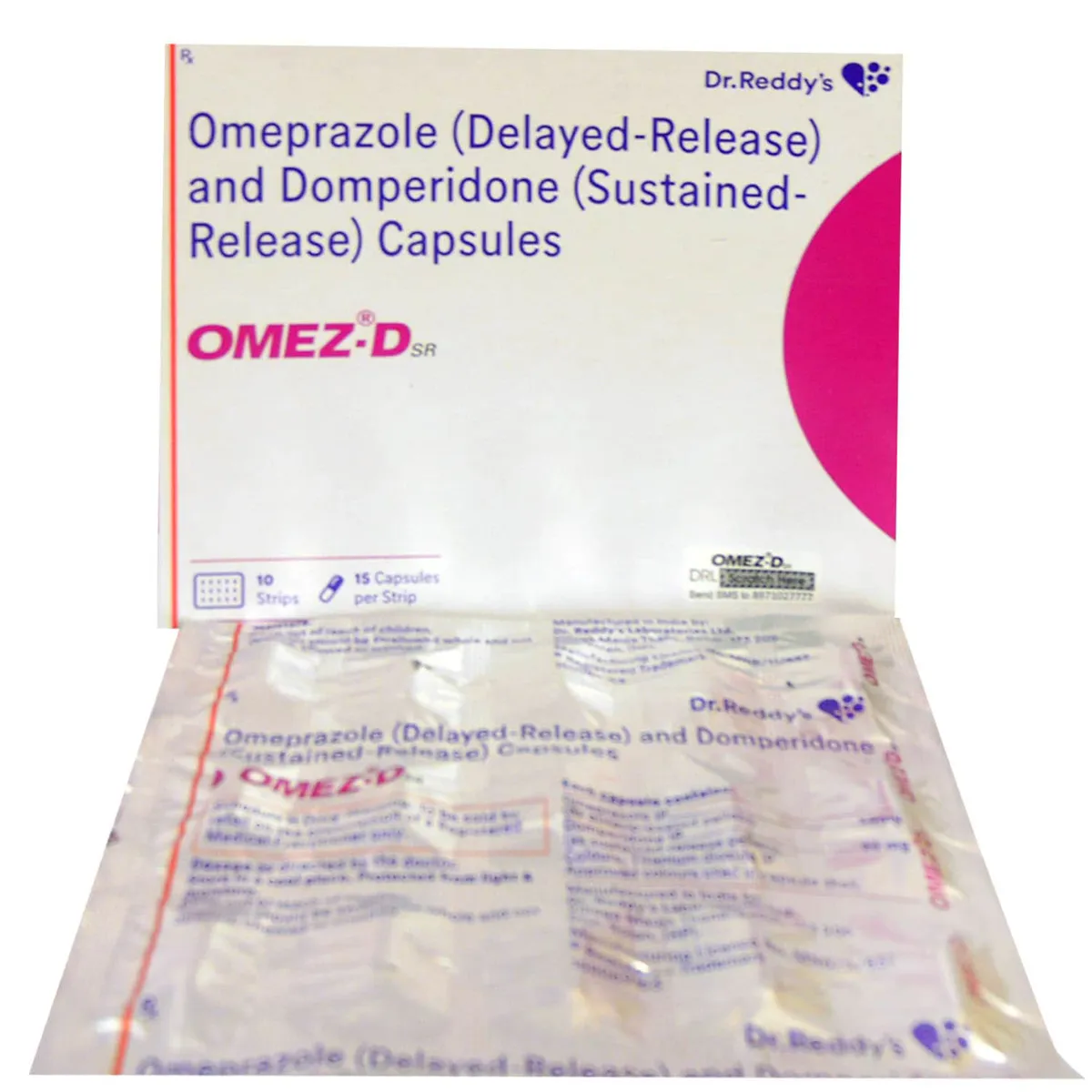
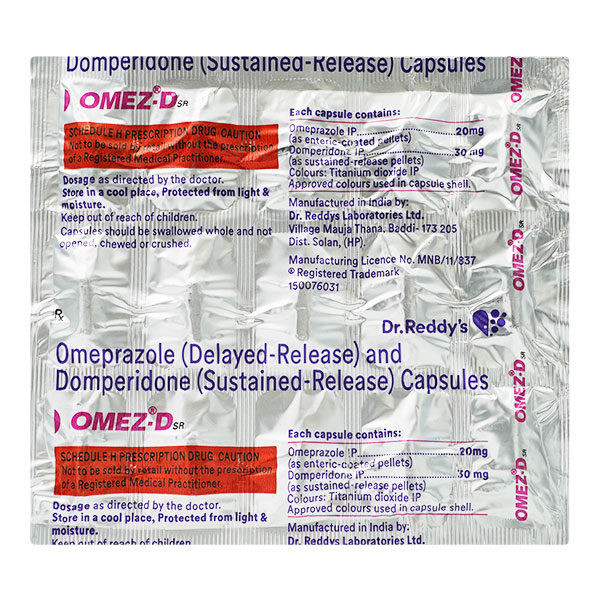

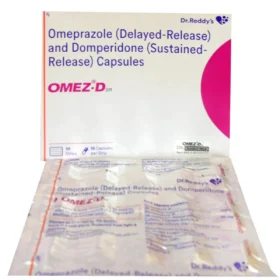
Omez D (Omeprazole 20 mg + Domperidone 30 mg SR) capsule from Dr. Reddy’s — PPI + prokinetic combination for GERD with regurgitation, gastroparesis, and functional dyspepsia. WHO-GMP certified manufacturer. Worldwide shipping from MedsBase.
✓ Medically reviewed by Morgan Ellis — Pharmacy Researcher · 8 years experience · Last reviewed: May 2026
⚡ Quick Answer — What is Omez D?
Omez D is a fixed-dose oral capsule combining a proton pump inhibitor (Omeprazole 20 mg) with the prokinetic dopamine antagonist domperidone 30 mg sustained-release. The PPI suppresses gastric acid secretion through irreversible inhibition of the parietal-cell H+/K+-ATPase; domperidone speeds gastric emptying and tightens lower-oesophageal sphincter tone, which is useful when GERD is accompanied by regurgitation, gastroparesis, or functional dyspepsia. Take 30–60 minutes before the first meal, swallow whole, do not crush the SR pellet. Manufactured by Dr. Reddy’s Laboratories under WHO-GMP standards.
📦 Every order is covered by our Reshipment Assurance Policy — if your parcel does not arrive within 20 business days, we reship it.
Why order from MedsBase
Our generic medications are sourced from WHO-GMP certified manufacturers and shipped worldwide in discreet, plain packaging — no medication name on the parcel exterior. Card payments are routed through a regulated processor (statement descriptors include a regulated card-payment processor — never “MedsBase” or any medication name). Crypto and SEPA bank transfer are also accepted. Every order is backed by our Reshipment Assurance Policy.
When is the PPI + domperidone combination preferred over a PPI alone?
Plain PPI monotherapy (Omez, Pan, Razo etc.) is the standard for uncomplicated GERD or peptic ulcer. Adding domperidone helps when the dominant symptom is regurgitation, postprandial fullness, nausea, or when there is delayed gastric emptying (diabetic gastroparesis, post-vagotomy, idiopathic). For uncomplicated heartburn the simpler PPI is preferred — domperidone has a small but real cardiac signal that does not justify routine use.
Why order from MedsBase
Omez D is supplied from a WHO-GMP certified manufacturer. Every order ships discreetly worldwide and is covered by our Reshipment Assurance Policy — if it does not arrive within 20 business days, we reship at no cost. Omeprazole is one of the most prescribed PPIs worldwide and the SR-domperidone fraction adds gastric-emptying support without the IR-domperidone’s pulse-and-trough exposure profile.
Mechanism of action
Omeprazole is a substituted benzimidazole PPI that is activated by the acidic environment of the parietal-cell secretory canaliculus. Once activated it covalently binds Cys813 (and other cysteines) on the α-subunit of the H+/K+-ATPase, irreversibly inhibiting acid secretion. Recovery requires synthesis of new pump protein (~24–48 h half-life of the pump itself).
Domperidone is a peripheral dopamine D2 receptor antagonist that does not cross the blood-brain barrier in significant amounts (so it lacks the central D2-antagonism extrapyramidal signature of metoclopramide). In the gut it increases lower-oesophageal sphincter tone, accelerates gastric emptying, and improves antroduodenal coordination. It also blocks D2 receptors in the chemoreceptor trigger zone (which sits outside the BBB) producing antiemetic effect.
Indications
- GERD with prominent regurgitation or postprandial fullness
- Diabetic gastroparesis (functional motility disorder)
- Functional dyspepsia (postprandial distress syndrome subtype)
- Symptomatic relief in chemo- or radiotherapy-induced nausea (short course)
- Reflux symptoms in scleroderma-related oesophageal dysmotility
Dose
One Omez D capsule once daily, 30–60 minutes before breakfast, swallow whole. Typical course is 4–8 weeks for symptom-driven use; if symptoms recur on discontinuation, switch to PPI monotherapy for maintenance and reserve domperidone for breakthrough symptoms (EMA short-course rule). Severe gastroparesis may require longer courses under specialist supervision with periodic ECG.
Side effects
- Common (> 1%): headache, dry mouth, abdominal cramp, diarrhoea, drowsiness
- Long-term PPI: low B12, low magnesium, fracture risk, fundic-gland polyps, increased CDI risk
- Domperidone-specific: hyperprolactinaemia (galactorrhoea, gynaecomastia, menstrual disturbance), QT prolongation, rare arrhythmia
- Rare: anaphylaxis, Stevens-Johnson syndrome, acute interstitial nephritis (PPI class effect)
Drug interactions
- Clopidogrel: omeprazole inhibits CYP2C19 and may reduce clopidogrel activation — switch to pantoprazole or rabeprazole if both are required.
- QT-prolonging drugs (azithromycin, fluoroquinolones, ondansetron, citalopram, methadone, hydroxychloroquine): avoid concurrent use.
- Strong CYP3A4 inhibitors (ketoconazole, ritonavir, clarithromycin, grapefruit juice): raise domperidone exposure 4–8 fold — avoid.
- Levodopa, dopamine agonists: domperidone antagonises peripheral D2 effects (can be used intentionally to control levodopa-induced nausea).
- Atazanavir, nelfinavir, posaconazole: need acid for absorption — PPI reduces blood levels significantly.
Frequently Asked Questions
Is Omez D safe to take long-term?
PPI exposure is generally well tolerated for months but risks accumulate (B12 / magnesium / fractures / CDI). The domperidone fraction should be limited to short courses (typically ≤ 7 days, max 30 mg/day per EMA). For chronic GERD maintenance, switch to PPI monotherapy.
Why take it before food?
PPIs require active proton pumps to bind. Pumps activate when food triggers acid secretion. Taking Omez D 30–60 minutes before the first meal gives maximum pump occupancy.
Will it interact with my heart medication?
Domperidone can prolong the QT interval. Tell the prescriber about every cardiac drug, antibiotic, antifungal, antidepressant, and antimalarial you take. A baseline ECG is sensible if you are over 60 or have known cardiac disease.
Can I drink coffee or alcohol on it?
Alcohol and coffee can both worsen reflux. Reduce intake during a flare. There is no disulfiram-like reaction with this combination.
Is it safe in pregnancy?
PPIs are class B/C; data in pregnancy is reassuring for omeprazole but not zero-risk. Domperidone has limited human pregnancy data — avoid unless the prescriber decides benefits outweigh. Breastfeeding: domperidone is excreted in breast milk in small amounts and is sometimes used off-label as a galactagogue.
What if I miss a dose?
Take it as soon as you remember. If it is close to the next dose, skip and continue the schedule. Do not double-dose — stacking domperidone increases QT risk.
Can I crush or open the capsule?
No. The SR pellets are designed to release domperidone gradually over the dose interval. Crushing dumps the dose and produces a high peak that is more arrhythmogenic.
How quickly will it work?
Acid suppression is detectable within hours but maximal at day 3–5. Domperidone-driven gastric-emptying acceleration is felt within 30–60 minutes of the first dose.
What if my symptoms do not improve after 4–8 weeks?
Reassess the diagnosis. Consider H. pylori eradication, oesophageal manometry for motility disorder, or referral for endoscopy (alarm symptoms: weight loss, dysphagia, anaemia, vomiting blood, age > 55 with new symptoms).
Storage
Below 30°C, protect from moisture. Keep out of reach of children.
Other Gastro Health Medications
- Pantocid DSR — Pantoprazole 40 + Domperidone 30 SR
- Famocid — Famotidine (H2 blocker)
- Omez — Omeprazole 20 mg (PPI mono)
- Dompewal — Domperidone 10 mg
- Reglan — Metoclopramide 10 mg
- Browse all Gastro Health Medications
More options in Gastro Health
Ranked by recent MedsBase order volume — what other customers in this category are picking.



| Strength | 20+30 mg |
|---|---|
| Quantity | 30 Capsule/s, 60 Capsule/s, 90 Capsule/s, 180 Capsule/s |
 Omez D
Q & A
Omez D
Related products


Reviews
There are no reviews yet