








✓ Medically reviewed by · Last reviewed: May 2026
Pharmacy Researcher · 8 years experience
Pharmacy researcher with 8 years reviewing clinical drug information, generic formulation equivalence, and international pharmaceutical standards. Focuses on patient-facing accuracy in medication education.
oral minoxidil vs topical minoxidil — Oral Minoxidil vs Topical Minoxidil for Hair Loss — Which One Is Right for You?. Read on for an evidence-backed guide covering everything you need to know.
Key Takeaways:
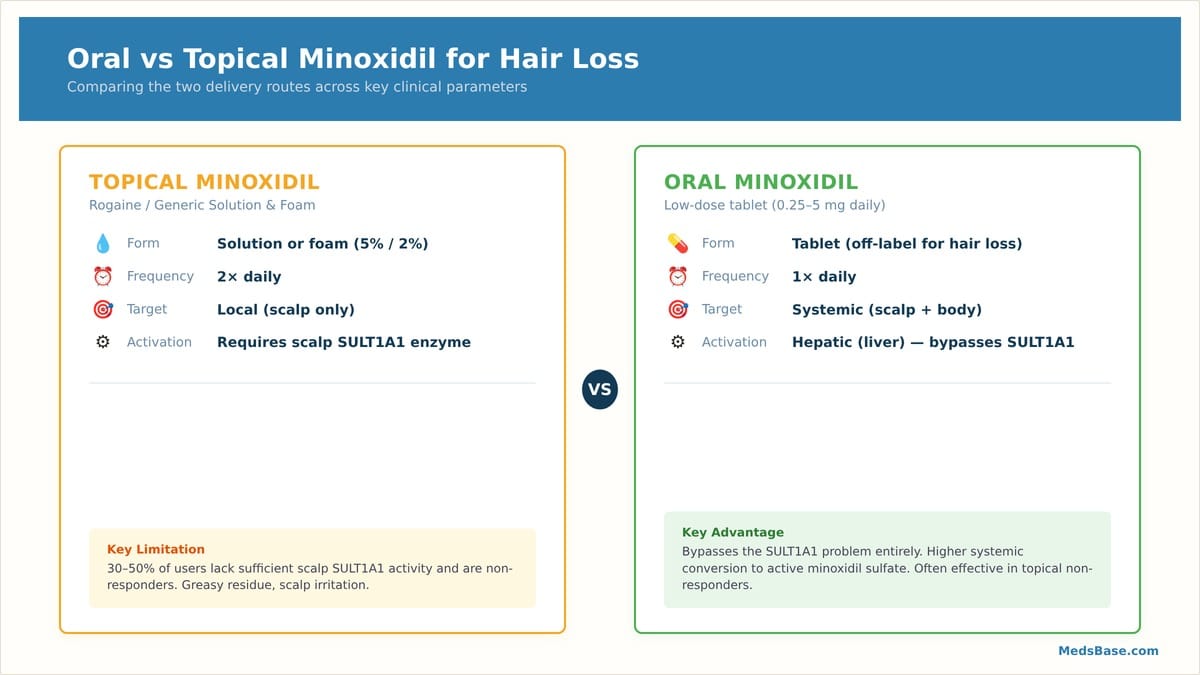
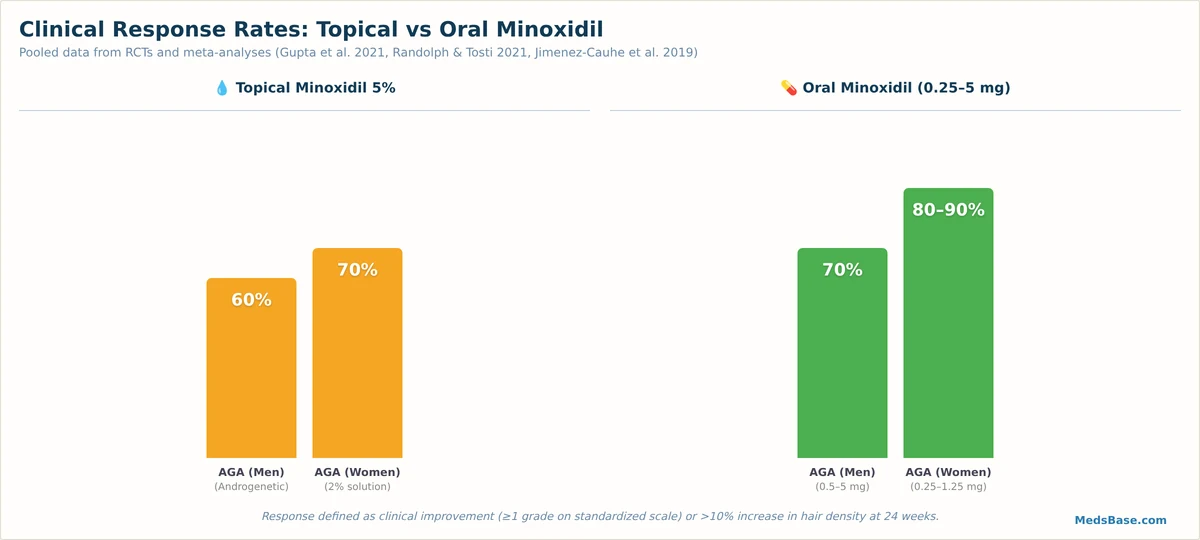
- Low-dose oral minoxidil produces measurable improvement in 70-90% of patients — compared to 60-70% for topical 5% — but carries a side effect that surprises almost everyone the first time they hear about it
- The reason ~40% of topical minoxidil users see little to no results comes down to a single enzyme in the scalp — and oral minoxidil bypasses the problem entirely by activating in the liver instead
- Hypertrichosis — hair growth in unwanted places — affects 15-40% of oral minoxidil users, and it’s the single biggest reason people switch back to topical
- Oral minoxidil is dosed in milligrams, not drops — and the difference between a therapeutic dose and a problematic one can be as small as 1.25mg
- Both formulations work through the same mechanism, but oral minoxidil starts showing results 4-8 weeks faster on average — the trade-off is that systemic exposure means systemic side effects
- The decision isn’t “which one is better” — it’s “which trade-off can you live with”
Table of Contents:
- What Is Minoxidil and How Does It Treat Hair Loss?
- How Does Minoxidil Work? — The Sulfotransferase Key
- Efficacy — Which Formulation Delivers Better Results?
- Side Effects — The Real Trade-Off
- Head-to-Head Comparison Table
- What the Evidence Says
- How to Decide — A Practical Decision Framework
- Related Reading
- Frequently Asked Questions
- The Bottom Line
Oral minoxidil vs topical minoxidil — you’ve been rubbing minoxidil foam into your scalp every night for eight months. The bathroom counter is sticky, your hair looks greasy by morning, and — most frustratingly — you’re not sure it’s actually working. Then a friend mentions she switched to “the pill version” and her hair thickened up in three months. Is low-dose oral minoxidil the upgrade you’ve been waiting for, or a trade-off you haven’t fully considered? The comparison between oral minoxidil vs topical minoxidil isn’t as simple as “pill beats foam” — and the most important variable isn’t the drug itself. It’s an enzyme in your scalp that determines whether either version will work at all.
When weighing oral minoxidil vs topical minoxidil, the real question isn’t “which one works” — it’s “which set of trade-offs can you live with for the next five years.” This guide puts both formulations side by side on efficacy, side effects, cost, and convenience — backed by clinical evidence — so you can decide which one fits your life, your budget, and your risk tolerance.
Oral minoxidil vs topical minoxidil: What Is Minoxidil and How Does It Treat Hair Loss?
Oral minoxidil vs topical minoxidil — minoxidil was approved by the FDA as an oral antihypertensive in 1979 under the brand name Loniten. Doctors quickly noticed an unusual side effect — patients on the drug started growing hair in unexpected places. By 1988, a topical formulation for male pattern baldness was FDA-approved (Rogaine 2%), and in 1997, the 5% strength followed.
Oral minoxidil vs topical minoxidil — for decades, topical minoxidil was the only game in town for non-prescription hair loss treatment. But in the 2020s, dermatologists began prescribing low-dose oral minoxidil (LDOM) off-label in increasing numbers — typically at doses of 0.625mg to 5mg daily, a fraction of the 10-40mg used for hypertension. Social media accelerated awareness, and by 2026, “oral minoxidil” had become one of the most searched hair loss terms on Google.
Oral minoxidil vs topical minoxidil — here’s the critical insight most articles skip: both formulations contain the exact same active molecule. The difference isn’t the drug — it’s the delivery. And that delivery difference changes everything about efficacy, side effects, and who should use which one.
Oral minoxidil vs topical minoxidil: How Does Minoxidil Work? — The Sulfotransferase Key
The Three-Stage Mechanism
Oral minoxidil vs topical minoxidil — minoxidil’s mechanism for hair growth involves three steps:
Stage 1 — Activation: Minoxidil enters the body (through the scalp for topical, through the gut for oral) and must be converted to minoxidil sulfate by the sulfotransferase enzyme SULT1A1. This is where the topical-vs-oral divergence begins.
Stage 2 — Vasodilation: Minoxidil sulfate opens ATP-sensitive potassium channels (KATP channels) in the smooth muscle cells of small arteries (arterioles), causing them to relax and widen. This increases blood flow, nutrient delivery, and oxygen to the hair follicle.
Stage 3 — Anagen Prolongation: The precise mechanism by which increased blood flow translates to hair growth remains incompletely understood, but the net effect is well-documented: the anagen (growth) phase of the hair cycle is extended, telogen (resting) phase is shortened, and miniaturized follicles in androgenetic alopecia partially reverse — producing thicker, longer hair shafts.
Research Spotlight: Why Topical Fails Some People
Oral minoxidil vs topical minoxidil — a 2014 study by Goren and colleagues measured sulfotransferase activity in scalp biopsy samples from topical minoxidil users and correlated it with clinical response. The finding was striking: patients with high enzyme activity responded well, while those with low activity showed essentially no response. The estimated proportion of “non-responders” — people lacking sufficient scalp sulfotransferase activity — is roughly 30-40%.
This is the single most important fact about the oral minoxidil vs topical minoxidil question: if you’re in the 40% with low scalp sulfotransferase, topical minoxidil probably won’t do much for you regardless of how consistently you apply it. Oral minoxidil, which activates in the liver (where sulfotransferase is abundant), sidesteps this bottleneck entirely.
Oral minoxidil vs topical minoxidil: Efficacy — Which Formulation Delivers Better Results?
Topical Minoxidil Efficacy
Oral minoxidil vs topical minoxidil — the evidence for topical minoxidil is robust, built on decades of randomized controlled trials:
- 5% topical solution applied twice daily produces moderate to dense regrowth in approximately 45% of men after 48 weeks (Olsen et al., 2007 RCT, n=393)
- 5% topical foam is bioequivalent to the solution and preferred by many patients for cosmetic reasons (less greasy, faster drying)
- Visible results typically appear after 3-6 months of consistent use
- Peak results at 12-18 months, after which continued use maintains gains (minoxidil does not “cure” hair loss — it manages it)
- Response is dose-dependent: 5% outperforms 2%, and twice-daily use outperforms once-daily
Oral Minoxidil Efficacy
Oral minoxidil vs topical minoxidil — the evidence for low-dose oral minoxidil is younger but compelling:
- Randolph and Tosti’s 2021 systematic review (17 studies, ~1,200 patients) reported a 70-90% overall response rate across LDOM doses of 0.25-5mg/day
- Vastarella et al. (2022) found 87% improvement at 24 weeks with doses of 0.5-5mg/day
- Onset of visible results averages 8-12 weeks — roughly 4-8 weeks faster than topical
- Dose-response relationship is clear: higher doses (2.5-5mg) produce more growth but also more side effects
- Oral minoxidil may be particularly effective for vertex (crown) thinning — an area where topical can be harder to apply adequately
The Catch — Evidence Quality
Almost all oral minoxidil data for hair loss comes from retrospective chart reviews and small open-label studies — not large double-blind RCTs. This matters because:
- Retrospective studies over-represent patients who stayed on treatment (responders), inflating apparent response rates
- Open-label studies are susceptible to expectation bias in both patients and assessors
- Direct head-to-head trials comparing topical vs oral minoxidil for hair loss are virtually nonexistent
The bottom line: oral minoxidil probably produces better and faster results for most people, but the evidence is less rigorous than the topical data. The oral minoxidil vs topical minoxidil evidence gap — strong RCTs for topical, retrospective cohorts for oral — is worth keeping in mind when reading dramatic online testimonials. The difference is real but overstated online.
Side Effects — The Real Trade-Off
| Side Effect | Topical Minoxidil 5% | Oral Minoxidil (LDOM 0.625-5mg) | Notes |
|---|---|---|---|
| Scalp irritation / itching | 5-10% | None | Topical’s most common complaint; usually due to propylene glycol in solution. Foam formulation avoids this. |
| Hypertrichosis (unwanted hair growth) | Rare (<1%, from systemic absorption) | 15-40% (dose-dependent) | Face, arms, and body hair. More common in women. Usually reverses within 3-6 months of stopping. |
| Initial shedding | 15-20% | 15-20% | “Dread shed” — telogen hairs pushed out as anagen starts. Normal and temporary (2-6 weeks). |
| Dizziness / lightheadedness | Rare | 2-5% | Mechanism: vasodilation. Usually mild and transient. Lower the dose if persistent. |
| Fluid retention / edema | Very rare | 1-3% | Mechanism: sodium and water retention from vasodilation. More common at doses >2.5mg/day. |
| Tachycardia (fast heart rate) | No | <1% | Mechanism: reflex tachycardia from vasodilation. Almost exclusively at doses >5mg. |
| Pericardial effusion | No | Extremely rare (case reports at >10mg) | The reason oral minoxidil for hypertension requires monitoring. Risk at LDOM doses (<5mg) is theoretical but not zero. |
| Greasy hair / residue | Common with solution; less with foam | None | Cosmetic issue, not medical. |
Hypertrichosis — The Elephant in the Room
Hypertrichosis — excessive hair growth in areas you didn’t intend to treat — is the defining side effect of oral minoxidil. It affects an estimated 15-40% of users, depending on the dose. For some people, it’s mild (a few extra temple hairs or slightly thicker arm hair). For others, it’s significant enough to be distressing — facial hair in women, increased body hair in both sexes, and eyebrow thickening.
The hypertrichosis rate rises with dose:
- 0.625mg/day: ~10-15% incidence, typically mild
- 1.25mg/day: ~15-20% incidence
- 2.5mg/day: ~25-35% incidence
- 5mg/day: ~35-40% incidence, more likely to be moderate-severe
The good news: hypertrichosis resolves in most patients within 3-6 months of stopping or reducing the dose. The bad news: it can take just as long to appear, meaning you might not know if it’s a problem for you until you’re 3-4 months into treatment.
This is the honest trade-off: oral minoxidil bypasses the sulfotransferase bottleneck and delivers better results for many people — but at the cost of systemic exposure that your whole body, not just your scalp, feels.
Clinical Insight
Dermatologists commonly start LDOM at the lowest effective dose (0.625mg daily for women, 1.25mg for men) and titrate upward slowly over 3-6 months, watching for hypertrichosis at each step. The goal is to find the dose where hair growth on the scalp is satisfactory and hair growth elsewhere is acceptable — and for many patients, that dose sits somewhere in the 1.25-2.5mg range.
Head-to-Head Comparison Table
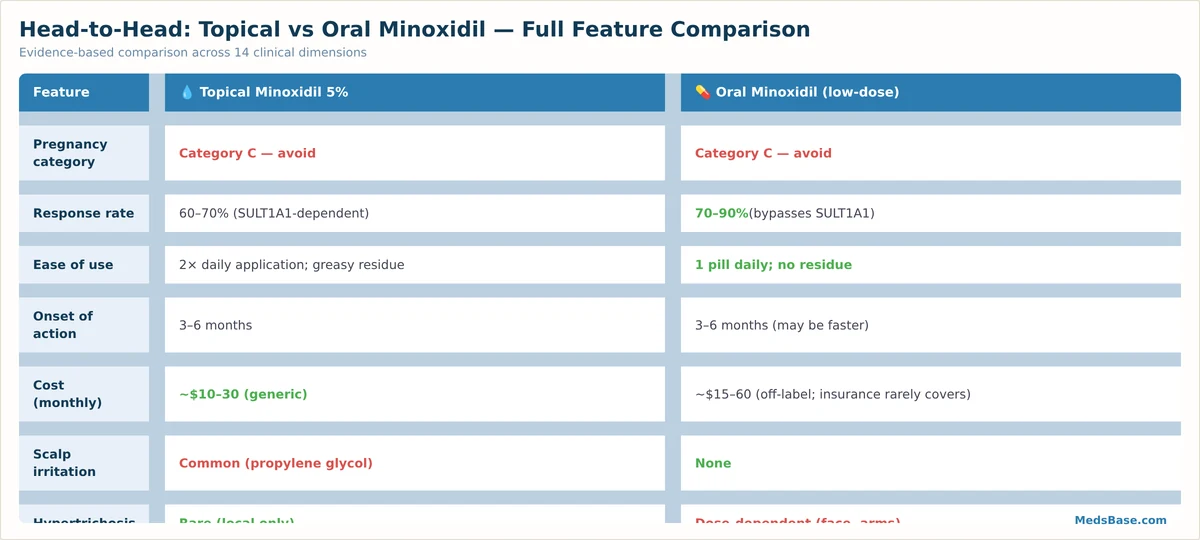
The oral minoxidil vs topical minoxidil comparison across every dimension that matters for real-world users:
| Dimension | Topical Minoxidil 5% | Low-Dose Oral Minoxidil |
|---|---|---|
| Efficacy (response rate) | 60-70% | 70-90% |
| Time to visible results | 12-24 weeks | 8-12 weeks |
| Mechanism advantage | Local activation if scalp sulfotransferase is adequate | Liver activation — bypasses the sulfotransferase bottleneck |
| Application | Twice daily to dry scalp | Once daily oral tablet |
| Convenience | Messy, time-consuming, interferes with styling | Clean, fast, no cosmetic issues |
| Main side effect | Scalp irritation, itching, dandruff-like flaking | Hypertrichosis (unwanted body/facial hair) |
| Systemic side effects | Very rare | Mild and dose-dependent: dizziness, fluid retention, possible tachycardia |
| Initial shedding | Yes, 2-6 weeks | Yes, 2-6 weeks |
| Monthly cost (generic) | ~$10-25 (varies by brand) | ~$15-40 (varies by dose and pharmacy) |
| Prescription required | No (OTC in most countries) | Yes (off-label in most countries) |
| Best for | First-line treatment, mild-moderate loss, people who want to avoid systemic exposure | Topical non-responders, vertex thinning, people who can’t maintain twice-daily topical routine |
| Not ideal for | Low sulfotransferase activity (if known), very advanced loss, people with scalp conditions | People concerned about hypertrichosis, pregnant/breastfeeding, history of pericardial disease, uncontrolled hypertension |
What the Evidence Says
| Study | Year | Finding | Source |
|---|---|---|---|
| Olsen et al. (RCT) | 2007 | Topical 5% minoxidil: 45% moderate-great improvement at 48 weeks (n=393) | Journal of the American Academy of Dermatology |
| Goren et al. (sulfotransferase study) | 2014 | ~40% of topical users are non-responders due to low scalp SULT1A1 activity | Dermatologic Therapy |
| Randolph & Tosti (systematic review) | 2021 | LDOM: 70-90% response rate across 17 studies (~1,200 patients) | Journal of the American Academy of Dermatology |
| Vastarella et al. (LDOM safety) | 2022 | 87% improvement; hypertrichosis 39% at mean dose 2.4mg | Dermatologic Therapy |
| Jimenez-Cauhe et al. (head-to-head) | 2022 | LDOM superior to topical for vertex; hypertrichosis in 24% of women at 0.5-1mg | |
| Beach (LDOM safety review) | 2021 | LDOM ≤5mg: no serious cardiovascular events in reviewed literature; hypertrichosis is dose-limiting factor | Journal of the American Academy of Dermatology |
What this means for you: Oral minoxidil outperforms topical on efficacy and speed for most people. Topical outperforms oral on side-effect profile and convenience of access (no prescription needed). The best formulation is the one whose trade-offs you can sustain for years — because minoxidil is a long-term commitment, not a short course.
How to Decide — A Practical Decision Framework
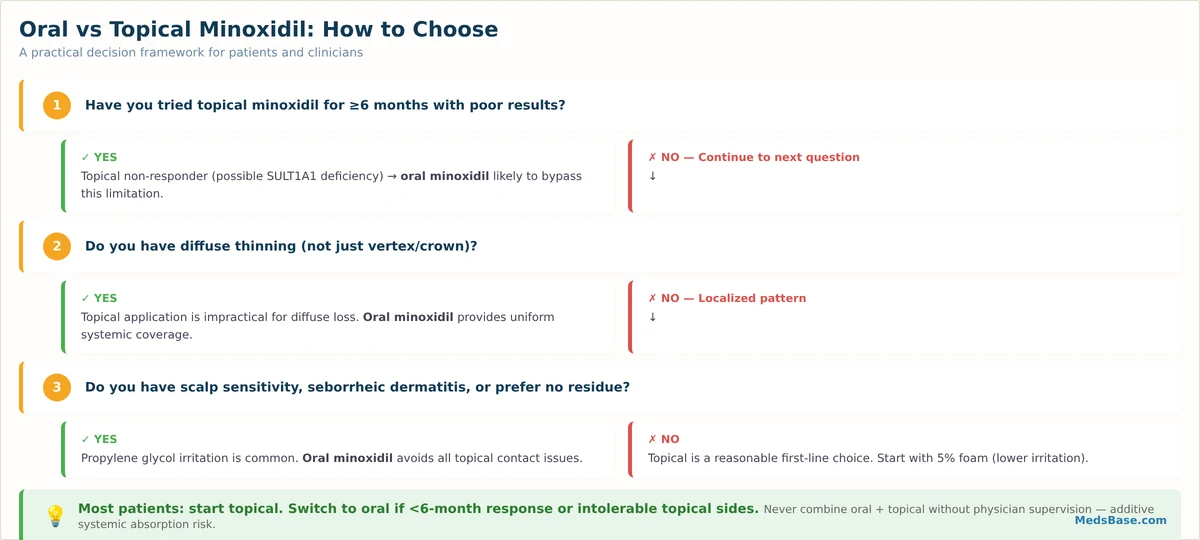
When comparing oral minoxidil vs topical minoxidil, the right answer depends on your personal history and risk tolerance. Walk through these questions in order:
Q: 1. Have you tried topical minoxidil for at least 6 months?
A: If no start with topical. It’s OTC, cheaper, and has fewer systemic risks. If you’re a responder, you’ve solved the problem with the simplest tool.
If yes and you responded well stick with topical. Why add systemic exposure if local delivery is working?
Q: 2. Did topical minoxidil fail or give poor results?
A: If yes the sulfotransferase bottleneck is a likely culprit. Oral minoxidil is a logical next step. Start low (0.625-1.25mg) and titrate.
Q: 3. Can you tolerate the possibility of increased body/facial hair?
A: If hypertrichosis is a dealbreaker consider topical minoxidil with a penetration enhancer. Microneedling (0.5-1.5mm dermaroller once weekly) increases topical absorption by up to 4× in some studies. Adding topical tretinoin (retinoic acid) 0.01% increases sulfotransferase expression in the scalp — essentially boosting your natural enzyme activity. Both strategies address the sulfotransferase problem without systemic exposure.
If hypertrichosis is acceptable oral minoxidil is worth trying at the lowest effective dose.
Q: 4. Are you a woman of childbearing age?
A: If yes oral minoxidil is pregnancy category C (animal studies show risk, human data lacking). Most dermatologists avoid prescribing LDOM to women who may become pregnant. Topical is preferred.
Q: 5. Is consistent daily application a practical challenge for you?
A: If yes oral minoxidil’s once-daily pill is substantially more convenient than twice-daily topical application, especially if you style your hair, exercise regularly, or swim. Adherence is the real efficacy ceiling for topical — the best drug in the world doesn’t work if it stays in the bottle.
If you’re ready to explore minoxidil options, browse the full range at MedsBase’s hair loss category — both topical and oral formulations are available.
Related Reading
- Finasteride vs Dutasteride: Which Hair Loss Medication Works Better? — Minoxidil isn’t the only game in town. Compare the two leading DHT-blocking alternatives.
- ACE Inhibitor Cough: 7 Proven Facts You Should Know — Managing medication side effects is a skill. Today’s companion post covers one of the most common drug side effects — and the simple fix.
- Hepatitis C Treatment: Direct-Acting Antivirals Guide — Treatment comparisons aren’t just for hair loss. Today’s second companion post covers choosing the right hepatitis C regimen.
Frequently Asked Questions
Q: Is oral minoxidil better than topical minoxidil?
A: In the oral minoxidil vs topical minoxidil debate, oral minoxidil produces faster and more robust hair regrowth for most people — 70-90% response rate compared to 60-70% for topical 5%. However, “better” depends on what you value. Oral minoxidil carries a 15-40% risk of hypertrichosis (unwanted body/facial hair growth), requires a prescription, and involves systemic drug exposure. Topical is safer, available OTC, and has no systemic side effects — but it doesn’t work for the ~40% of people with low scalp sulfotransferase activity. The best formulation is the one you’ll use consistently.
Q: What are the side effects of low-dose oral minoxidil?
A: The most common side effect is hypertrichosis — excessive hair growth on the face, arms, or body — affecting 15-40% of users depending on dose. Less common effects include mild dizziness (2-5%), fluid retention (1-3%), and temporary increased heart rate (<1%). These are dose-dependent and usually improve with dose reduction. At the low doses used for hair loss (0.625-5mg), serious cardiovascular events are extremely rare — the risk that exists at antihypertensive doses (10-40mg) does not appear to translate downward. Initial shedding (temporary increased hair fall in weeks 2-6 of treatment) affects 15-20% of users of both formulations.
Q: Does oral minoxidil cause hair growth everywhere?
A: Yes — that’s the point of the warning. Because oral minoxidil circulates through your bloodstream, it affects hair follicles everywhere, not just the scalp. Facial hair, arm hair, leg hair, and eyebrow thickness can all increase. The effect is dose-dependent: at 0.625mg, hypertrichosis is typically mild and limited to temples/upper cheeks; at 5mg, it can be cosmetically significant on the face and body. The effect reverses within 3-6 months of reducing or stopping the dose. If you want ONLY scalp results, topical minoxidil is the safer choice.
Q: How long does minoxidil take to work?
A: Visible results typically appear at 3-4 months for both formulations, with oral minoxidil often showing results 4-8 weeks sooner than topical. This is one of the most consistent findings across the oral minoxidil vs topical minoxidil literature — the pill usually wins on speed. Peak results occur at 12-18 months. Initial shedding (temporary increased hair loss) in weeks 2-6 is normal and means the drug is working — it’s pushing resting hairs out to make room for new growth. If you see no improvement at all by month 6, you may be a non-responder, and it’s worth discussing alternatives with your dermatologist.
Q: Can I switch from topical to oral minoxidil?
A: Yes — and many patients do. When switching from oral minoxidil vs topical minoxidil, the key is not creating a treatment gap. The typical transition approach is to overlap both formulations for 2-4 weeks (continue topical while starting oral) to avoid a gap in treatment and minimize rebound shedding, then taper off the topical once the oral dose is stable. Do not stop topical abruptly and start oral the next day — the gap can trigger a telogen effluvium (shedding) episode. Always coordinate the switch with your prescribing doctor.
Q: What dose of oral minoxidil is best for hair loss?
A: There is no universally “best” dose — the optimal dose is the lowest one that produces satisfactory results with acceptable side effects. Typical starting doses are 0.625mg daily for women and 1.25mg daily for men, titrated up every 3-6 months as tolerated. Most patients land somewhere between 1.25mg and 2.5mg/day. Doses above 5mg/day for hair loss are uncommon and carry a sharp increase in side-effect risk. Very few people need more than 5mg/day for cosmetic hair regrowth.
Q: Can I use minoxidil if I’m also taking finasteride?
A: Yes — minoxidil and finasteride work through completely different mechanisms (vasodilation + anagen prolongation vs DHT suppression) and are complementary. The combination is more effective than either alone for androgenetic alopecia. Topical minoxidil + oral finasteride is the most common dual-therapy approach; adding oral minoxidil on top is sometimes used for aggressive or treatment-resistant loss, though it increases the side-effect burden.
Q: Will I lose my hair again if I stop minoxidil?
A: Yes. Minoxidil does not cure androgenetic alopecia — it manages it. Any hair growth stimulated by minoxidil is dependent on continued use. If you stop, the anagen-prolonging effect wears off over 3-4 months, and you will shed the minoxidil-dependent hairs, returning to where you would have been had you never used it. This is true for both topical and oral formulations. Minoxidil is a long-term commitment — be prepared for that before you start.
The Bottom Line
No matter how you approach the oral minoxidil vs topical minoxidil decision, the choice comes down to one enzyme and one side effect. If your scalp has enough sulfotransferase activity — and roughly 60% of people do — topical minoxidil 5% is effective, safe, and accessible without a prescription. If it doesn’t (or if twice-daily application isn’t sustainable for you), low-dose oral minoxidil offers better efficacy and faster results — with the honest trade-off that you may grow more hair than you bargained for.
Your immediate action: if you haven’t tried topical minoxidil yet, start there. Give it 6 months of consistent, twice-daily use. If you see improvement, you’ve solved the problem with the lowest-risk tool. If you don’t respond — and you can accept the hypertrichosis risk — talk to a dermatologist about low-dose oral minoxidil, starting at the minimum effective dose.
For the other half of the hair-loss equation (DHT suppression), read our finasteride vs dutasteride comparison . And if medication side effects are a concern, today’s companion post on ACE inhibitor cough covers a common drug reaction with an even simpler fix.

Written by
Sophie ChenPharmaceutical Content Researcher · 8 years experience
Sophie Chen is a pharmaceutical content researcher with 8 years covering generic medication access and clinical pharmacology. She specialises in international regulatory frameworks, bioequivalence standards, and patient-facing education on therapeutic drug classes. She is not a clinician.