









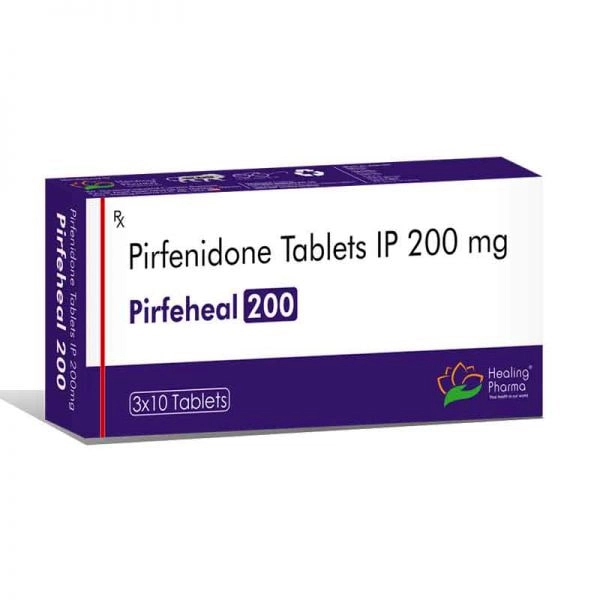
Pirfeheal
✅ Reduces inflammation
✅ Alleviates pain effectively
✅ Convenient tablet format
✅ Improved pain relief
contains Pirfenidone
✓ Medically reviewed by Morgan Ellis — Pharmacy Researcher · 8 years experience · Last reviewed: May 2026
⚡ Quick Answer — What is Pirfeheal?
Pirfeheal contains pirfenidone, an oral anti-fibrotic used for idiopathic pulmonary fibrosis (IPF) — a progressive scarring lung disease. Pirfenidone reduces the rate of lung function decline (FVC) and may improve survival in IPF, slowing disease progression. It is taken three times daily with meals to minimise GI side effects, with planned dose escalation over 14 days. Manufactured by Healing Pharma at WHO-GMP certified facilities. Same active drug as international brand Esbriet (Roche).
📦 Every order is covered by our Reshipment Assurance Policy — if your parcel does not arrive within 20 business days, we reship it.
Why order from MedsBase
Our generic medications are sourced from WHO-GMP certified manufacturers and shipped worldwide in discreet, plain packaging — no medication name on the parcel exterior. Card payments are routed through a regulated processor (statement descriptors include a regulated card-payment processor — never “MedsBase” or any medication name). Crypto and SEPA bank transfer are also accepted. Every order is backed by our Reshipment Assurance Policy.
What Is Pirfeheal?
Pirfeheal is an oral anti-fibrotic / anti-inflammatory pyridone derivative. Pirfenidone is one of two drugs licensed for IPF (the other is nintedanib / Ofev). Both slow disease progression but do not cure or reverse fibrosis. Pirfenidone is also used off-label for other interstitial lung diseases with fibrotic phenotypes.
How Does Pirfeheal Work?
Pirfenidone has multiple mechanisms relevant to pulmonary fibrosis:
- Reduces TGF-β-driven fibroblast proliferation and collagen synthesis
- Suppresses TNF-α and IL-1β inflammatory signalling
- Inhibits epithelial-mesenchymal transition (EMT) — a key driver of fibrosis
- Reduces oxidative stress via free-radical scavenging
The clinical benefit (CAPACITY, ASCEND trials) is a 50% reduction in lung-function decline rate over 12 months. Some meta-analyses show survival benefit.
Uses and Indications
- Idiopathic pulmonary fibrosis (IPF) — first-line slow-progression therapy alongside nintedanib
- Other progressive pulmonary fibrosis (interstitial lung disease with fibrotic phenotype) — off-label use
- Pulmonary fibrosis post-COVID-19 — emerging research
Pirfeheal Dosage
| Phase | Dose | Frequency |
|---|---|---|
| Days 1–7 (titration) | 200 mg | Three times daily with food |
| Days 8–14 (titration) | 400 mg | Three times daily with food |
| Day 15+ (maintenance) | 600 mg (3 × 200 mg) | Three times daily with food |
| Hepatic / renal impairment | Reduce dose 50% | Three times daily |
Side Effects of Pirfeheal
- Nausea, dyspepsia, anorexia (commonest — taking with full meal helps)
- Photosensitive rash (avoid sun exposure; SPF 50+ daily)
- Fatigue
- Dizziness, headache
- Diarrhoea
- Mild liver enzyme elevation
Serious — stop and seek help:
- Severe rash, especially photodistributed
- Hepatitis (jaundice, dark urine, pale stools, RUQ pain)
- Severe weight loss (>5%)
- Severe persistent vomiting
Warnings and Precautions
- Photosensitivity: avoid prolonged sun exposure; wear SPF 50+ broad-spectrum sunscreen daily.
- Liver function monitoring: baseline LFTs, then every month for 6 months, every 3 months thereafter.
- Take with full meals to reduce GI side effects and slow absorption (which lessens nausea).
- Smoking reduces pirfenidone exposure by ~50% — strongly advise smoking cessation.
- CYP1A2 inhibitors (fluvoxamine, ciprofloxacin) raise levels significantly — avoid or reduce dose.
- Pregnancy and breastfeeding: contraindicated.
Contraindications
- Hypersensitivity to pirfenidone
- Severe hepatic impairment (Child-Pugh C)
- End-stage renal disease (CrCl <30 ml/min) on dialysis
- Concomitant fluvoxamine
- Pregnancy
Drug Interactions
| Interacting drug | Effect | What to do |
|---|---|---|
| Fluvoxamine (potent CYP1A2 inhibitor) | 4× increase in pirfenidone levels | Contraindicated |
| Ciprofloxacin | 60% increase in pirfenidone levels | Avoid or halve pirfenidone dose |
| Smoking (induces CYP1A2) | ~50% reduction in levels | Smoking cessation strongly advised |
| Strong CYP1A2 inducers (rifampicin) | Reduce levels significantly | Avoid |
Storage
- Store below 25°C in a cool, dry place away from direct sunlight.
- Keep in original packaging until use to protect from moisture and light.
- Do not use after the expiry date printed on the strip.
- Keep out of reach of children.
Related Alternatives on MedsBase
- Budecort Inhaler — budesonide ICS for chronic lung disease
- Tiova Inhaler — tiotropium for chronic lung disease
- Unicontin-E — theophylline ER for severe lung disease
- Mucinac Effervescent — N-acetylcysteine antioxidant
- Rofaday — roflumilast for severe COPD
Frequently Asked Questions
Will pirfenidone cure my IPF?
No — pirfenidone slows disease progression but does not cure or reverse pulmonary fibrosis. Most patients experience continued slow lung-function decline; a smaller subset have stable disease for years.
How fast does it work?
Reduction in FVC decline rate is measurable at 6–12 months in trials. Symptom benefit is harder to perceive — the goal is preventing worsening.
Why do I have to take it three times a day?
Pirfenidone has a short half-life (~3 hours). Three-times-daily dosing maintains steady tissue levels. Always take with food to minimise nausea.
Why the rash?
Pirfenidone is photosensitising — UV exposure can cause sunburn-like reactions on exposed skin. Daily broad-spectrum SPF 50+ sunscreen, sun-protective clothing, and avoiding peak UV hours largely prevent it.
Can I take pirfenidone with nintedanib (Ofev)?
Combination therapy is being studied (INJOURNEY pilot). Routine combination is not yet standard outside clinical trials. Discuss with your specialist.
Why must I monitor liver tests?
About 4% of patients develop liver enzyme elevation in trials. Monthly LFTs for the first 6 months catch this early — dose reduction or temporary stop usually resolves it.
Can I drink alcohol on pirfenidone?
Alcohol can amplify nausea and may stress the liver. Moderate alcohol may be acceptable; heavy drinking is not.
How long do I need to take pirfenidone?
Indefinitely, as long as you tolerate it and the disease has not progressed to end-stage. Stopping leads to resumption of faster lung-function decline.
What if I miss a dose?
Take it as soon as you remember unless the next dose is due. Never double up.
More options in Asthma/COPD Treatment
Ranked by recent MedsBase order volume — what other customers in this category are picking.


| Strength | 200 mg |
|---|---|
| Quantity | 90 Tablet/s, 180 Tablet/s, 270 Tablet/s |
| Pharma Form | Tablet/s |
| Manufacturer | Healing Pharma |
| Treatment | Idiopathic pulmonary fibrosis |
| Generic Brand | Pirfenidone |
 Pirfeheal
Q & A
Pirfeheal
Related products

Reviews
There are no reviews yet