







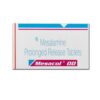
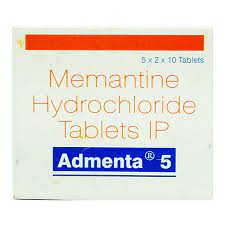
Admenta
✅ Enhances cognition
✅ Improves memory
✅ Slows neurodegeneration
✅ Reduces confusion
✅ Manages Alzheimer’s
Admenta contains Memantine.
✓ Medically reviewed by Morgan Ellis — Pharmacy Researcher · 8 years experience · Last reviewed: May 2026
⚡ Quick Answer — What is Admenta?
Admenta is an oral tablet from Sun Pharma containing memantine 5 mg — an uncompetitive NMDA receptor antagonist used for the symptomatic treatment of moderate-to-severe Alzheimer's disease. Memantine is not indicated for mild Alzheimer's. Slow upward titration over 4 weeks: 5 mg week 1, 10 mg week 2 (5 mg twice daily), 15 mg week 3, 20 mg week 4 onwards (10 mg twice daily). Generally well tolerated — main side effects are dizziness, headache, constipation and confusion. Reduce dose if eGFR < 30 mL/min. Often combined with donepezil in moderate-to-severe disease for additive cognitive benefit.
📦 Every order is covered by our Reshipment Assurance Policy — if your parcel does not arrive within 20 business days, we reship it.
Why order from MedsBase
Our generic medications are sourced from WHO-GMP certified manufacturers and shipped worldwide in discreet, plain packaging — no medication name on the parcel exterior. Card payments are routed through a regulated processor (statement descriptors include a regulated card-payment processor — never “MedsBase” or any medication name). Crypto and SEPA bank transfer are also accepted. Every order is backed by our Reshipment Assurance Policy.
What Is Admenta?
Admenta is an oral tablet from Sun Pharma containing memantine hydrochloride 5 mg. Memantine is a low-affinity, voltage-dependent, uncompetitive antagonist of the N-methyl-D-aspartate (NMDA) glutamate receptor. It is mechanistically distinct from the cholinesterase inhibitors (donepezil, galantamine, rivastigmine) and works through the second major pathway implicated in Alzheimer's disease — glutamate excitotoxicity.
Admenta from Sun Pharma is a 5 mg memantine tablet — the strength used during the mandatory 4-week up-titration to the 20 mg/day maintenance dose. Maintenance dosing is two 5 mg tablets twice daily (4 tablets total per day). Memantine is licensed only for moderate-to-severe Alzheimer's disease — not mild. It is the standard add-on to a cholinesterase inhibitor (typically donepezil) when patients progress past the mild stage, and produces additive cognitive and functional benefit with minimal increase in side effects.
How Does Admenta Work?
Alzheimer's disease causes chronic excessive glutamate signalling at NMDA receptors — a process called glutamate excitotoxicity. Constant low-level NMDA activation damages neurons and disrupts the signal-to-noise ratio that the brain needs for learning and memory. Memantine addresses this through a unique mechanism:
- Voltage-dependent NMDA blockade — memantine binds to NMDA receptor channels but only when they are already open. It blocks chronic low-level excitotoxic activation but releases the receptor during high-amplitude physiological signalling needed for learning. This is the key difference between memantine and older NMDA blockers like ketamine, which block both modes and cause cognitive impairment.
- Restores signal-to-noise ratio — by reducing background glutamate noise, memantine improves the brain's ability to detect meaningful signals during learning and memory tasks.
- Neuroprotective effect — reduced excitotoxicity may slow the progression of neuronal damage, though this has not been definitively shown to translate into a clinically meaningful disease-modifying effect.
Onset of cognitive benefit: visible at 4–12 weeks after reaching the maintenance 20 mg/day dose; peak benefit at 6 months.
Uses and Indications
- Moderate-to-severe Alzheimer's dementia — first-line indication
- Combination therapy with a cholinesterase inhibitor — standard of care in moderate-to-severe Alzheimer's; additive cognitive benefit
- Vascular dementia (mixed type) — off-label modest benefit
- Dementia with Lewy bodies — off-label, useful for behavioural symptoms
Admenta is not indicated for: mild Alzheimer's disease (cholinesterase inhibitors are first-line at this stage), mild cognitive impairment without dementia, frontotemporal dementia, or as a cognitive enhancer in healthy adults.
Admenta Dosage and How to Take — SLOW TITRATION
Admenta comes at 5 mg tablets. The titration schedule is mandatory — jumping straight to 20 mg/day causes intolerable confusion and dizziness in most patients.
Standard 4-week titration:
- Week 1: 5 mg once daily (1 tablet morning)
- Week 2: 10 mg/day = 5 mg twice daily (morning + evening)
- Week 3: 15 mg/day = 10 mg morning + 5 mg evening
- Week 4 onward (maintenance): 20 mg/day = 10 mg twice daily
How to Take Admenta Properly
- Take with or without food — food does not affect absorption.
- Swallow whole with water. Standard tablets can be split if scored.
- Twice daily at maintenance dose (10 mg morning + 10 mg evening), spaced about 12 hours apart.
- Renal dose adjustment: if estimated GFR is 30–49 mL/min, cap maintenance dose at 10 mg/day. If eGFR is 5–29 mL/min, maintenance dose is 10 mg/day. Avoid in eGFR < 5 mL/min.
- Missed dose: if remembered the same day, take it. If remembered the next day, skip and resume normally — do not double-dose.
- If treatment is interrupted for more than a few days, restart at 5 mg/day and re-titrate over 4 weeks. Memantine has no acute discontinuation syndrome but the slow titration is needed to avoid side effects.
- Caregiver supervision is critical — patients with moderate-severe Alzheimer's rarely manage twice-daily dosing reliably without support. Use a weekly pill organiser filled by a family member or carer.
- Re-assess after 6 months with formal cognitive testing (MMSE or MoCA). Continue if there is benefit or stabilisation; stop gradually if clear deterioration despite full-dose treatment.
Side Effects of Admenta
Common (worst during titration, settle once on maintenance):
- Dizziness
- Headache
- Confusion or worsening confusion (often improves once on stable maintenance dose)
- Constipation
- Sleepiness or fatigue
- Hypertension (mild rise in BP)
Less common:
- Hallucinations or worsening of existing hallucinations
- Agitation or aggression (paradoxical, especially during titration)
- Falls (from dizziness)
- Urinary tract infections
Rare but seek medical review:
- Seizures
- Severe psychiatric symptoms (psychosis, mania)
- Pancreatitis
- Hepatitis
- Stevens-Johnson syndrome (case reports)
Warnings and Precautions
- Renal impairment: dose reduction is mandatory. Cap at 10 mg/day if eGFR 5–49 mL/min. Avoid if eGFR < 5 mL/min. Memantine accumulates in renal failure and causes toxicity.
- Urinary alkalisation: conditions that raise urine pH (severe UTI, renal tubular acidosis, vegetarian diet with high-dose alkalinising drugs, sodium bicarbonate) reduce memantine clearance and raise blood levels — monitor for side effects.
- Seizure history: use cautiously — memantine may lower seizure threshold.
- Recent myocardial infarction, uncontrolled hypertension, severe heart failure: caution — not enough safety data in these populations.
- Hepatic impairment: no dose adjustment for mild-moderate; caution in severe.
- Hallucinations and delusions: can worsen pre-existing psychiatric symptoms in some patients with dementia. Monitor for behavioural changes.
- Caregiver support: patients in the moderate-severe Alzheimer's population for whom memantine is indicated rarely manage their own medication. Caregiver involvement in dose preparation, supervision and adherence is essential.
Contraindications — Who Should NOT Take Admenta
- Known hypersensitivity to memantine or any tablet excipient
- Severe renal impairment (eGFR < 5 mL/min)
- Mild Alzheimer's dementia (use a cholinesterase inhibitor first)
- Mild cognitive impairment without dementia
- Frontotemporal dementia (no benefit and may worsen behavioural symptoms)
Drug Interactions
| Combine with | Effect | What to do |
|---|---|---|
| Other NMDA antagonists (amantadine, ketamine, dextromethorphan) | Additive psychotomimetic effects (confusion, hallucinations, dissociation) | Avoid combination. Tell anaesthetist about memantine before any procedure involving ketamine. |
| Cholinesterase inhibitors (donepezil, galantamine, rivastigmine) | Standard combination — additive cognitive benefit, no significant interaction | Standard add-on therapy in moderate-severe Alzheimer's. See Aricep. |
| Hydrochlorothiazide and other thiazide diuretics | Memantine reduces diuretic effect; thiazide raises memantine levels | Monitor BP and check for memantine side effects. |
| Sodium bicarbonate, acetazolamide, urinary alkalisers | Reduce renal clearance of memantine — raise blood levels | Monitor for memantine toxicity (confusion, dizziness, sleepiness). |
| Levodopa, dopamine agonists (Parkinson's drugs) | Memantine may potentiate dopaminergic effects | Monitor for dyskinesias and psychiatric side effects. |
| Barbiturates, neuroleptics (antipsychotics) | Memantine may reduce their effect | Monitor symptom control; titrate as needed. |
| Warfarin | Some case reports of raised INR with combination | Check INR more frequently after starting memantine. |
Storage Instructions
- Store at room temperature, 15–25°C. Protect from light and moisture.
- Keep tablets in the original blister pack until use.
- Do not store in the bathroom — humidity shortens shelf life.
- Keep out of reach of children and patients who may not understand they are medication.
- Do not use after the expiry date printed on the pack.
- Return unused tablets to a pharmacy for disposal.
Related Alternatives on MedsBase
Other Alzheimer's and dementia medications stocked on MedsBase:
- Aricep (donepezil 5 / 10 mg)
- Donect (donepezil 10 mg)
- Donemax (donepezil 10 mg)
- Galamer (galantamine 4 mg)
- Rivamer (rivastigmine 1.5 mg)
Helpful reading: Everything you need to know about Alzheimer's disease · Everything to know about dementia · 7 ways to protect your brain health as you age · Best foods for a healthy brain and improved memory.
Frequently Asked Questions
Why is Admenta only for moderate-to-severe Alzheimer's?
Trials show no clinically meaningful cognitive benefit from memantine in mild Alzheimer's — the glutamate excitotoxicity pathway becomes a dominant driver of symptoms only later in the disease. For mild Alzheimer's, a cholinesterase inhibitor (donepezil, galantamine, rivastigmine) is first-line. Memantine is added when the patient progresses to moderate or severe disease.
Can Admenta be combined with donepezil?
Yes — this is the standard combination for moderate-to-severe Alzheimer's disease. The two drugs work on different pathways (cholinergic + glutamatergic) and produce additive cognitive and functional benefit. There is no significant pharmacokinetic interaction. Combination therapy is more effective than either drug alone at the moderate-to-severe stage. Aricep (donepezil) is the standard partner.
Why does Admenta need a 4-week titration?
Jumping to the 20 mg/day maintenance dose on day one causes intolerable confusion, dizziness and sometimes hallucinations — bad enough that most patients discontinue. The 4-week up-titration (5 → 10 → 15 → 20 mg/day) lets the brain adapt to NMDA blockade gradually. Skipping titration is the most common reason patients “cannot tolerate” memantine.
When will I or my family member see results?
Visible cognitive benefit at 4–12 weeks after reaching the 20 mg/day maintenance dose; peak benefit at 6 months. Like donepezil, memantine is symptomatic therapy, not disease-modifying. Re-assess with formal cognitive testing at 6 months.
Does Admenta need dose adjustment for kidney problems?
Yes. Memantine is renally cleared and accumulates in kidney impairment. Dose caps: eGFR 30–49 mL/min — cap maintenance at 10 mg/day. eGFR 5–29 mL/min — maintenance 10 mg/day. eGFR < 5 mL/min — avoid memantine entirely. Check kidney function before starting and at any sign of toxicity (confusion, sleepiness, dizziness on a previously stable dose).
Is Admenta a cure or does it slow Alzheimer's progression?
Neither. Memantine is symptomatic therapy — it stabilises function for a window of typically 6–18 months. The underlying neurodegeneration continues. Newer disease-modifying drugs (anti-amyloid antibodies like lecanemab and donanemab) target the underlying pathology but require IV infusion, regular MRI monitoring, and specialist supervision — they are not stocked here.
Does Admenta help with behavioural symptoms (agitation, aggression, hallucinations)?
Modest benefit on agitation and aggression in moderate-severe Alzheimer's — one of the reasons memantine is the preferred add-on at this stage rather than a second cholinesterase inhibitor. Memantine can paradoxically worsen hallucinations in a minority of patients — monitor and stop if this occurs.
Can I stop Admenta if it is not helping?
Discuss with the prescriber. If formal cognitive testing at 6 months shows no benefit and the patient has progressed clearly, memantine can be stopped. Unlike donepezil, memantine has no significant discontinuation syndrome — but a gradual taper over 1–2 weeks is still standard practice.
Is Admenta safe with my parent's blood pressure or heart medications?
Memantine is generally safe with most cardiovascular medications. There is no significant interaction with beta-blockers, ACE inhibitors, ARBs, calcium channel blockers, statins, or aspirin. Thiazide diuretics may slightly raise memantine levels — monitor for side effects but no dose adjustment is usually needed. Memantine causes a mild rise in BP in some patients — check BP at the 6-week and 3-month visits.
Related Alternatives
Other products in Chronic Conditions that customers also view:
More options in Alzheimer's Treatment
Ranked by recent MedsBase order volume — what other customers in this category are picking.

| Strength | 5 mg |
|---|---|
| Quantity | 30 Tablet/s, 60 Tablet/s, 90 Tablet/s, 180 Tablet/s |
 Admenta
Q & A
Admenta
Related products






Reviews
There are no reviews yet