







Amifru
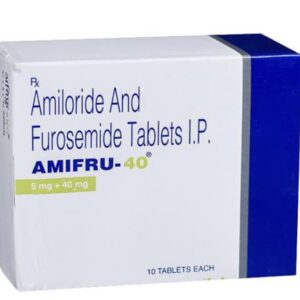
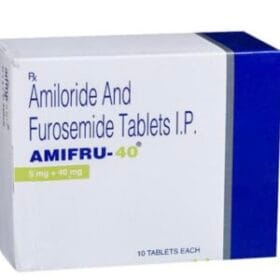
Amifru is Sun Pharma’s fixed-dose furosemide 40 mg + amiloride 5 mg tablets — combines a loop diuretic with a potassium-sparing agent acting on ENaC. Designed to prevent loop-induced hypokalaemia without adding spironolactone. Preferred when gynaecomastia contraindicates spironolactone or when rapid potassium-sparing effect is needed (hours, not days). Uses: heart failure with brittle potassium, hepatic ascites, oedema with CKD.
✓ Medically reviewed by Morgan Ellis — Pharmacy Researcher · 8 years experience · Last reviewed: May 2026
⚡ Quick Answer — What is Amifru?
Amifru is a 40/5 mg fixed-dose tablet of furosemide (frusemide) — a loop diuretic — and amiloride — a potassium-sparing diuretic — from Sun Pharma. The combination is used when a loop diuretic is needed but hypokalaemia is a problem — amiloride blocks distal-tubule potassium loss driven by aldosterone activation, balancing the potassium depletion caused by furosemide’s upstream sodium load. Common uses: hypertension with oedema, chronic heart failure with tendency to hypokalaemia, hepatic ascites where adequate potassium-sparing is not provided by spironolactone alone. Typical dosing: one tablet once daily in the morning (some patients require twice-daily). Absolutely contraindicated in anuria, hyperkalaemia >5.5, severe CKD (eGFR <30), and Addison disease. Monitor potassium, sodium, and creatinine on initiation and regularly thereafter.
📦 Every order is covered by our Reshipment Assurance Policy — if your parcel does not arrive within 20 business days, we reship it.
Why order from MedsBase
Our generic medications are sourced from WHO-GMP certified manufacturers and shipped worldwide in discreet, plain packaging — no medication name on the parcel exterior. Card payments are routed through a regulated processor (statement descriptors include a regulated card-payment processor — never “MedsBase” or any medication name). Crypto and SEPA bank transfer are also accepted. Every order is backed by our Reshipment Assurance Policy.
What Is Amifru?
Amifru is an oral fixed-dose combination tablet supplying furosemide (frusemide) and amiloride in a single pill (typical ratio 40 mg furosemide + 5 mg amiloride per tablet). Made by Sun Pharma, supplied in 30-180 tablets.
Furosemide is the reference loop diuretic, introduced in 1964 as Lasix. Amiloride is a potassium-sparing diuretic acting at the epithelial sodium channel (ENaC) in the distal tubule — introduced by MSD in 1967 specifically to offset thiazide and loop diuretic potassium loss.
Why Combine Furosemide With Amiloride?
Loop diuretics deliver large sodium loads to the distal tubule. Aldosterone then drives distal sodium reabsorption in exchange for potassium excretion — the classical mechanism of loop-induced hypokalaemia. Two counter-strategies:
- Block the mineralocorticoid receptor (spironolactone, eplerenone) — prevents aldosterone signalling.
- Block the epithelial sodium channel directly (amiloride, triamterene) — downstream of aldosterone, so works whether or not aldosterone is elevated.
Amiloride is preferred over spironolactone when:
- The patient has developed gynaecomastia or mastalgia on spironolactone
- Eplerenone (selective MR antagonist) is unavailable or unaffordable
- Rapid potassium-sparing effect is needed — amiloride acts within hours, spironolactone takes 24-72 hours
- The patient cannot tolerate spironolactone’s anti-androgen effects
Amifru is particularly useful in hepatic ascites (where potassium losses are often severe), chronic HF patients with brittle potassium, and patients who need a quick loop-diuretic effect without dropping potassium.
Dosage & Titration
Standard dose: one 40/5 mg tablet once daily in the morning.
Titration:
- Heart failure or oedema not controlled on one tablet: increase to two tablets daily or add a morning + early-afternoon split (avoid evening doses — nocturia).
- Cirrhotic ascites: often combined with spironolactone 100-200 mg for full aldosterone-antagonist cover.
- Hypertension: dose as above; most hypertensive patients do not need loop-diuretic combinations — if BP remains uncontrolled on an ACEi/ARB + CCB + thiazide triple, step up to spironolactone (PATHWAY-2) rather than switching to a loop combination unless renal function makes thiazide ineffective.
Monitoring schedule:
- Baseline: urea, potassium, sodium, creatinine, eGFR. BP, daily weight (if HF), serum urate, glucose.
- 1-2 weeks after start or dose change: repeat U&E. Watch for both hypokalaemia (if amiloride undersized) and hyperkalaemia (if amiloride/ACEi/ARB triple is active).
- 4-6 weeks: BP review; repeat full panel.
- Ongoing: every 3-6 months, or more frequently in CKD or unstable HF.
- Stop and investigate: potassium <3.0 or >5.5, sodium <130 with symptoms, creatinine rise >30%, gout flare, persistent dizziness or postural symptoms.
Side Effects
Common (>1%):
- Increased urine output, especially for the first 1-2 hours after dosing
- Postural dizziness (over-diuresis)
- Electrolyte shifts — hyponatraemia, hypomagnesaemia. Potassium usually stable but hyperkalaemia possible if amiloride dose disproportionately high or if combined with ACEi/ARB.
- Hyperuricaemia and gout flare
- Mild hyperglycaemia
- Rash (sulfonamide hypersensitivity can affect both components)
- Fatigue, muscle cramps
Uncommon but clinically important:
- Severe hyperkalaemia — the main risk when amiloride is combined with ACEi, ARB, potassium supplements, or in CKD
- Severe hyponatraemia — more common in elderly women on low-salt diets
- Acute kidney injury — particularly with NSAID + ACEi/ARB co-therapy (the “triple whammy”)
- Ototoxicity with high IV furosemide (not a concern at standard oral doses)
- Pancreatitis (rare loop/thiazide class effect)
- Cholestatic jaundice (rare)
Contraindications
- Hyperkalaemia >5.5 mmol/L at baseline — amiloride will worsen
- Severe renal impairment (eGFR <30)
- Anuria
- Addison disease (primary adrenal insufficiency) — hyperkalaemia risk
- Concurrent potassium supplements (unless under careful monitoring)
- Concurrent other potassium-sparing diuretic (spironolactone, eplerenone, triamterene) — additive hyperkalaemia
- Sulfonamide hypersensitivity (for the furosemide component)
- Severe hepatic impairment with hepatic encephalopathy — risk of precipitating coma via electrolyte shift
- Severe dehydration and pre-renal azotaemia
- Symptomatic hyponatraemia (Na <130) at baseline
Pregnancy: generally avoided. Loop diuretics cross the placenta; amiloride data in pregnancy are limited. Use only for compelling indications (pulmonary oedema) under specialist care.
Drug Interactions
- ACE inhibitors, ARBs, aliskiren — additive hyperkalaemia. The combination is sometimes necessary in HF but requires close monitoring (K+ at 1 week, 1 month, then every 3 months). Avoid in eGFR <45.
- Potassium supplements, salt substitutes, other K-sparing diuretics — hyperkalaemia risk. Generally do not combine.
- Lithium — CRITICAL. The furosemide component reduces lithium clearance; monitor levels weekly for the first month if combination unavoidable, and reduce lithium dose by 25-50%.
- NSAIDs — reduce diuretic effect; substantially raise AKI risk when combined with ACEi/ARB (triple whammy).
- Digoxin — check potassium closely; hypokalaemia precipitates digoxin toxicity; monitor digoxin levels.
- Aminoglycoside antibiotics (gentamicin, amikacin) — additive ototoxicity with furosemide at high IV doses.
- Corticosteroids, amphotericin B — additive electrolyte disturbance.
- Cholestyramine / colestipol — reduce furosemide absorption 50%. Separate dosing by 4 hours.
- Alcohol — additive postural hypotension.
Storage
Store Amifru below 25°C in the original blister pack. Keep out of reach of children.
Frequently Asked Questions
Why would I choose Amifru over plain furosemide?
Three situations. First, if you have developed hypokalaemia on furosemide alone and want a built-in potassium-sparing component without adding a separate spironolactone tablet. Second, if you have developed gynaecomastia or breast pain on spironolactone and need a non-steroidal alternative. Third, if rapid potassium-sparing effect is needed — amiloride acts within hours, whereas spironolactone takes 24-72 hours via its active metabolites.
When should I take Amifru?
Morning, with or without food. The diuretic effect peaks 1-2 hours after dosing and has mostly worn off by evening. Evening dosing causes nocturia and disrupts sleep.
Can I take Amifru with an ACE inhibitor or ARB?
Yes, with monitoring. The combination of amiloride + ACE inhibitor (or + ARB) raises potassium significantly and should be avoided in advanced CKD (eGFR <45) or if baseline potassium is >5.0. If combined, check potassium at 1 week, 1 month, and every 3 months. Many patients in this situation do better on a loop diuretic alone + ACEi/ARB (without the amiloride), accepting a potassium supplement if needed.
Is Amifru a first-line blood-pressure drug?
No. Loop-diuretic combinations are reserved for specific indications — hypertension with oedema or advanced CKD, chronic heart failure, or cirrhotic ascites. For standard hypertension, start with an ARB or ACE inhibitor, add a calcium-channel blocker or thiazide, and step up to spironolactone (PATHWAY-2 trial) before a loop-diuretic combination.
Will I lose or gain potassium on Amifru?
The combination is designed to be potassium-neutral — furosemide loses potassium, amiloride saves it, and the net effect is usually a stable potassium. A small number of patients will drift one way or the other depending on diet, kidney function, and concurrent drugs (ACEi/ARB raise potassium; corticosteroids lower it). Check potassium at baseline and 1-2 weeks to see which direction you drift.
I have gout — can I take Amifru?
With caution. The furosemide component can raise serum uric acid and precipitate gout flares. If gout is active, address the gout with urate-lowering therapy (allopurinol) rather than stopping Amifru outright — the underlying indication (HF, oedema, advanced CKD) usually cannot be managed without a loop diuretic.
Can I take ibuprofen with Amifru?
Chronic NSAIDs are risky on any loop-diuretic combination — they reduce the diuretic effect AND substantially raise AKI risk when combined with an ACE inhibitor or ARB. Use paracetamol preferentially for chronic pain.
What if I miss a dose?
Take it as soon as you remember unless it is nearly time for the next dose — in that case skip the missed dose. Do not double up. A single missed dose in chronic HF can let fluid accumulate; monitor weight the next day.
Can I take Amifru in pregnancy?
Routinely avoided. Loop diuretics cross the placenta and amiloride data in pregnancy are limited. Use only for compelling indications (pulmonary oedema, resistant heart failure) under specialist care.
Where can I buy Amifru online?
You can buy Amifru (40/5 mg furosemide + amiloride, 30-180 tablets) from MedsBase with discreet packaging and worldwide shipping.
Related Antihypertensives & Diuretics on MedsBase
- Aldactone — Spironolactone 25 mg (aldosterone antagonist)
- Amlode — Amlodipine 5/10 mg (CCB)
- Aquazide — Hydrochlorothiazide (HCTZ) thiazide
- Hyros — Hydrochlorothiazide (HCTZ)
- Losar — Losartan (ARB partner for diuretic)
- Ramcor — Ramipril (ACEi partner for diuretic)
- Browse all High Blood Pressure Medications
Related Alternatives
Other products in Chronic Conditions that customers also view:
More options in High Blood Pressure Medication
Ranked by recent MedsBase order volume — what other customers in this category are picking.

| Strength | 40 mg |
|---|---|
| Quantity | 30 Tablet/s, 60 Tablet/s, 90 Tablet/s, 180 Tablet/s |
 Amifru
Q & A
Amifru
Related products












Reviews
There are no reviews yet