








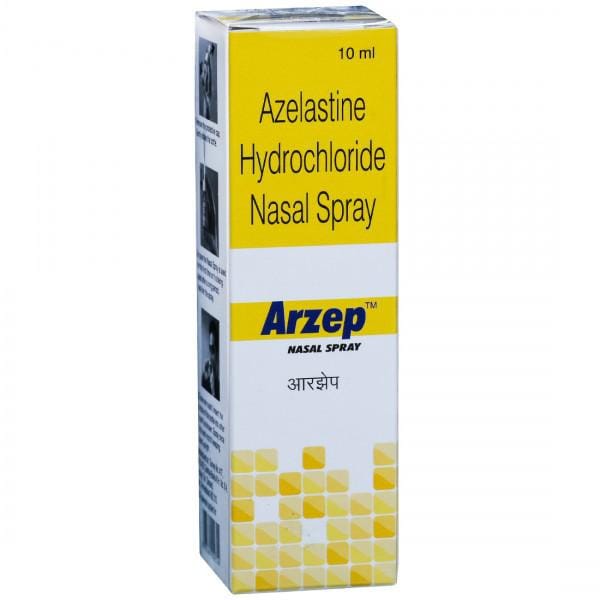
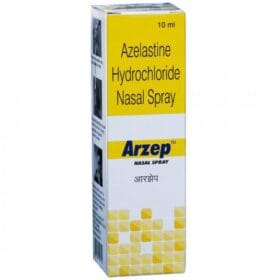
Arzep Nasal Spray
✅ Dual-action relief
✅ Relieves nasal congestion
✅ Reduces allergy symptoms
✅ Fast onset of action
✅ Long-lasting relief
Arzep Nasal Spray contains Azelastine and Fluticasone.
✓ Medically reviewed by Morgan Ellis — Pharmacy Researcher · 8 years experience · Last reviewed: May 2026
⚡ Quick Answer — What is Arzep Nasal Spray?
Arzep Nasal Spray is a combined nasal spray containing azelastine hydrochloride (a fast-acting intranasal antihistamine, 137 µg/spray) and fluticasone propionate (an intranasal corticosteroid, 50 µg/spray). Originator brand: Dymista (Meda/Viatris). It is the most effective single treatment for moderate-to-severe allergic rhinitis — superior to either component alone in head-to-head trials (MP-AzeFlu programme). Used for hay fever and perennial allergic rhinitis not controlled by single-agent therapy. Dose: 1 spray in each nostril twice daily. Onset within minutes for symptom relief (from azelastine), with full anti-inflammatory effect building over 1–2 weeks (from fluticasone). Main side effects: bitter taste (common with azelastine), nasal irritation, occasional epistaxis. Age 6+ in most markets.
📦 Every order is covered by our Reshipment Assurance Policy — if your parcel does not arrive within 20 business days, we reship it.
Why order from MedsBase
Our generic medications are sourced from WHO-GMP certified manufacturers and shipped worldwide in discreet, plain packaging — no medication name on the parcel exterior. Card payments are routed through a regulated processor (statement descriptors include a regulated card-payment processor — never “MedsBase” or any medication name). Crypto and SEPA bank transfer are also accepted. Every order is backed by our Reshipment Assurance Policy.
What Is Arzep Nasal Spray?
Arzep Nasal Spray is a metered-dose aqueous nasal spray combining two allergy medicines in one device:
- Azelastine hydrochloride — an intranasal H1 antihistamine, 137 µg per spray
- Fluticasone propionate — an intranasal corticosteroid, 50 µg per spray
Manufactured by WHO-GMP certified manufacturer; supplied as 1, 2 or 3 bottles (10 mL / ~120 doses each). Total strengths per actuation: Azelastine 137 µg + Fluticasone propionate 50 µg per spray. The originator brand is Dymista, approved by the FDA and EMA in 2012 for moderate-to-severe allergic rhinitis not responsive to intranasal corticosteroid or oral antihistamine alone.
What Is Arzep Nasal Spray Used For?
- Moderate-to-severe seasonal allergic rhinitis (hay fever) where single-agent therapy has failed
- Perennial allergic rhinitis (year-round, dust-mite or mould driven)
- Mixed rhinitis — patients with both allergic and non-allergic components
- Step-up treatment when mometasone/fluticasone nasal spray alone is not enough
It treats all four cardinal symptoms of allergic rhinitis — sneezing, runny nose, itchy nose, and nasal congestion — and also relieves associated eye symptoms through systemic and topical mechanisms.
How Does Arzep Nasal Spray Work?
The two components attack allergic inflammation through complementary mechanisms:
- Azelastine is a selective H1 antihistamine that also stabilises mast cells and reduces eosinophil activation. Applied directly in the nose, it delivers symptom relief within minutes — much faster than any oral antihistamine. It also has mild anti-leukotriene and anti-ICAM-1 effects.
- Fluticasone propionate is a potent intranasal corticosteroid that binds glucocorticoid receptors in the nasal mucosa, suppressing cytokine and chemokine production, reducing eosinophil infiltration, and downregulating the late-phase allergic response. Near-zero systemic absorption (< 0.5% bioavailable).
In head-to-head randomised trials (the MP-AzeFlu programme), the combination was more effective than either component alone for both total nasal and total ocular symptom scores, and worked faster. This is why it is reserved as a step-up option when single-agent therapy is not enough.
Dosage and Administration
Adults and children aged 12+: 1 spray in each nostril twice daily — morning and evening. Total daily dose: 2 sprays per nostril per day.
Children 6–11 years: 1 spray in each nostril twice daily, subject to prescriber approval (labelling differs by country).
Technique:
- Prime the bottle before first use — shake gently, then press the pump until a fine mist appears (usually 6–10 priming sprays). Re-prime (2 sprays) if not used for 14+ days.
- Blow your nose gently before each dose.
- Hold the bottle upright and tilt your head forward slightly.
- Insert the nozzle into one nostril, angled away from the nasal septum (toward the outer wall of the nose).
- Breathe in gently through the nose while pressing the pump once; avoid sniffing hard.
- Repeat in the other nostril.
- Do not tilt your head back after the spray — this is the main cause of the bitter taste.
- Wipe the nozzle with a clean tissue and replace the cap.
Missed dose: take as soon as you remember. If it is nearly time for the next dose, skip and continue as normal.
Side Effects
Common:
- Bitter or metallic taste — the most common complaint (from azelastine dripping down the throat). Minimise by spraying with the head tilted forward, not back.
- Nasal irritation, mild burning or stinging
- Mild epistaxis (nosebleeds) — usually prevented by angling the nozzle outward
- Headache
- Mild sedation (rare from intranasal azelastine, but possible)
Uncommon:
- Nasal dryness, crusting
- Cough, throat irritation
- Altered smell or taste
- Nasal septum perforation — very rare; associated with aggressive technique or pre-existing septal weakness
- Candida (thrush) of the mouth or nose — rare
- Cataracts or raised intraocular pressure — rare with intranasal use; eye checks sensible for long-term users
- Hypersensitivity reactions
Systemic absorption of both components is very low, so the systemic corticosteroid and antihistamine side-effect burden is minimal compared with oral therapies.
Drug Interactions
- Strong CYP3A4 inhibitors (ritonavir, ketoconazole, itraconazole, clarithromycin) — can raise fluticasone systemic levels modestly; rarely clinically significant at intranasal doses but avoid in chronic use.
- Alcohol, sedating medicines — very low risk with intranasal azelastine, but possible additive drowsiness at higher than labelled doses.
- Other intranasal or oral corticosteroids — cumulative systemic steroid exposure if combined long-term; discuss with your prescriber.
- Live vaccines — no meaningful interaction at intranasal doses.
Who Should Not Use Arzep Nasal Spray?
- Known hypersensitivity to azelastine, fluticasone, or any excipient
- Untreated local nasal infection (bacterial, fungal, herpes) — treat first
- Recent nasal surgery, trauma, or septal ulcers — avoid until healed
- Children below the label age cutoff for your country
- Pregnancy and breastfeeding — use only when clinically necessary; discuss with a clinician
Storage
Store Arzep Nasal Spray below 25°C in an upright position, in a dry place. Do not freeze. Keep out of reach of children. Discard per the in-use expiry on the label after first opening (commonly 3 months after first use, but check the label).
Frequently Asked Questions
Is Arzep Nasal Spray the same as Dymista?
Yes — Arzep Nasal Spray contains the same two active ingredients (azelastine 137 µg + fluticasone propionate 50 µg per spray) as Dymista (Meda/Viatris). Bioequivalence is required by regulatory authorities, so clinical effect is the same at the same dose.
When should I step up to a combination spray like Arzep Nasal Spray?
Current guidelines (ARIA, AAAAI) recommend stepping up to an azelastine + fluticasone combination when single-agent intranasal corticosteroid (mometasone, fluticasone, budesonide) or oral antihistamine alone is not controlling moderate-to-severe symptoms after 2–4 weeks of consistent daily use. It is also first-line for severe seasonal hay fever where fast onset matters.
Why does Arzep Nasal Spray taste bitter?
The bitterness is azelastine dripping down the throat. Two techniques minimise it: spray with your head tilted forward (not back), and breathe in gently rather than sniffing hard — the medicine should stay in the nose, not run down the back.
How fast does Arzep Nasal Spray work?
Azelastine provides symptom relief within minutes. Fluticasone’s anti-inflammatory effect takes 6–12 hours to start and 1–2 weeks to peak. The combination gives you both: fast relief today plus building control over two weeks.
Can I use Arzep Nasal Spray long-term?
Yes — long-term daily use is well-studied. Systemic absorption of both components is very low. For children, use the lowest effective dose and monitor growth periodically.
Can I combine Arzep Nasal Spray with an oral antihistamine?
Yes if clinically indicated, but usually unnecessary — Arzep Nasal Spray already includes an intranasal antihistamine. Adding an oral 2nd-generation antihistamine (loratadine, cetirizine, fexofenadine) is reasonable for severe symptoms or when eye symptoms are prominent.
Where can I buy Arzep Nasal Spray online?
You can order Arzep Nasal Spray (Azelastine 137 µg + Fluticasone propionate 50 µg per spray) from MedsBase as 1, 2 or 3 bottles (10 mL / ~120 doses each). We ship worldwide with discreet packaging and genuine WHO-GMP certified manufacturer stock.
Related Allergy Medications
- Meta Spray — Mometasone nasal spray (first-line INCS)
- Allegra — Fexofenadine (oral non-sedating)
- Xyzal — Levocetirizine
- Loratin — Loratadine
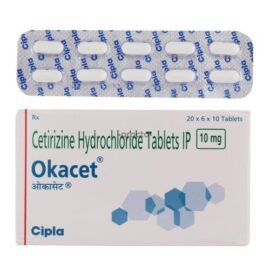
- Okacet — Cetirizine
- Ocurest-AH Eye Drops — for itchy allergic eyes
- Browse all Hay Fever & Allergy Medications
Related Alternatives
Other products in Chronic Conditions that customers also view:
More options in Hay Fever/Allergies Treatment
Ranked by recent MedsBase order volume — what other customers in this category are picking.


| Strength | 10 ml |
|---|---|
| Quantity | 1 Bottle/s, 2 Bottle/s, 3 Bottle/s, 6 Bottle/s |
 Arzep Nasal Spray
Q & A
Arzep Nasal Spray
Related products

Reviews
There are no reviews yet