









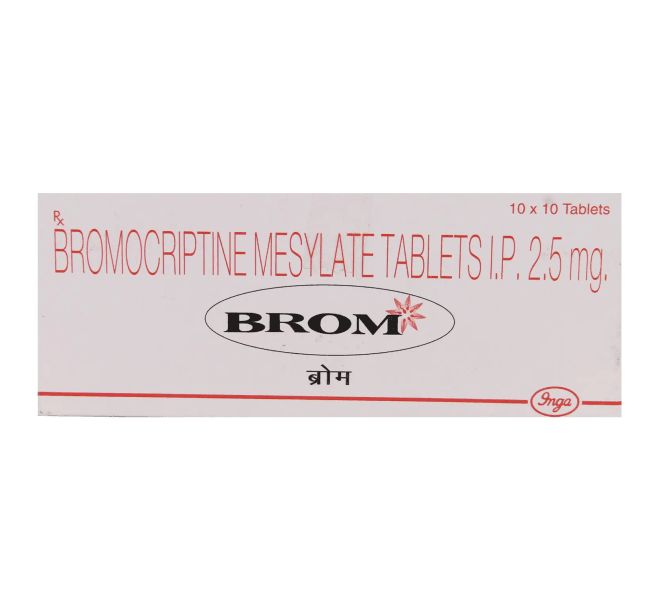
Brom
✅ Regulates hormone levels
✅ Treats hyperprolactinemia
✅ Manages menstrual disorders
✅ Reduces pituitary tumor size
✅ Improves fertility
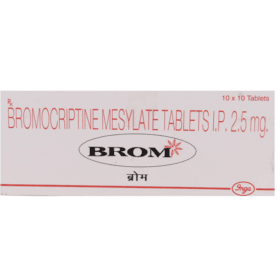
Brom contains Bromocriptine.
✓ Medically reviewed by Morgan Ellis — Pharmacy Researcher · 8 years experience · Last reviewed: May 2026
⚡ Quick Answer
Brom is an oral bromocriptine (2.5 mg) tablet — an ergot-derived dopamine agonist with a triple indication: Parkinson disease (especially as adjunct therapy when motor fluctuations develop on levodopa), hyperprolactinaemia (high prolactin causing infertility, amenorrhoea, galactorrhoea or low testosterone), and acromegaly (excess growth hormone). It directly stimulates dopamine D2 receptors and (in the pituitary) suppresses prolactin secretion. Important: ergot agonists can cause cardiac valve fibrosis and pleural/pericardial/retroperitoneal fibrosis with chronic high-dose use — an issue not seen with non-ergot agonists (ropinirole, pramipexole, piribedil). Echocardiogram screening is recommended for long-term users.
📦 Every order is covered by our Reshipment Assurance Policy — if your parcel does not arrive within 20 business days, we reship it.
Why order from MedsBase
Our generic medications are sourced from WHO-GMP certified manufacturers and shipped worldwide in discreet, plain packaging — no medication name on the parcel exterior. Card payments are routed through a regulated processor (statement descriptors include a regulated card-payment processor — never “MedsBase” or any medication name). Crypto and SEPA bank transfer are also accepted. Every order is backed by our Reshipment Assurance Policy.
What Is Brom?
Brom is an oral tablet containing bromocriptine 2.5 mg. Bromocriptine is the original ergot-derived dopamine agonist, marketed since the 1970s as Parlodel. It has three classical indications:
- Parkinson disease — symptomatic relief, alone or as adjunct to levodopa.
- Hyperprolactinaemia — pituitary prolactinoma, idiopathic high prolactin, drug-induced hyperprolactinaemia: causes amenorrhoea, infertility, galactorrhoea, hypogonadism.
- Acromegaly — suppresses growth-hormone secretion (less effective than somatostatin analogues, but useful in some patients).
Brom is manufactured by a WHO-GMP certified facility and is bioequivalent to the originator brand at 2.5 mg.
How Does Brom (Bromocriptine) Work?
Bromocriptine is a direct D2 dopamine receptor agonist with weak D1 antagonism, derived from the ergot alkaloid family. Its actions:
- Brain (basal ganglia): mimics dopamine at striatal D2 receptors, partially compensating for the loss of dopamine-producing neurones in Parkinson disease.
- Pituitary lactotroph cells: dopamine is the main inhibitor of prolactin release. Bromocriptine stimulates D2 receptors on these cells and shuts down prolactin secretion within hours; with prolonged treatment it can also shrink prolactinomas.
- Pituitary somatotrophs: in acromegaly, paradoxical D2 stimulation suppresses growth-hormone release.
Because bromocriptine is an ergot, it also binds 5-HT2B serotonin receptors on heart valves and connective tissue — the basis of the rare but serious fibrotic side effects.
Who Is Brom For?
Parkinson disease: historically a first-line dopamine agonist; most neurologists today start with a non-ergot agonist (ropinirole, pramipexole) because of the fibrosis risk. Brom remains useful when newer agonists are intolerable, unavailable, or cost-prohibitive, and as adjunct to levodopa in fluctuating patients.
Hyperprolactinaemia / prolactinoma: still widely used. Cabergoline is now usually preferred (twice-weekly dosing, fewer GI effects) but bromocriptine remains effective and is the standard option in pregnancy because it has the longest safety record.
Acromegaly: second-line, mostly for patients who cannot tolerate or afford somatostatin analogues (octreotide, lanreotide).
Lactation suppression after stillbirth or maternal contraindication to breastfeeding: historically used, but now rarely recommended because of cases of stroke, hypertension and seizures — non-pharmacological measures and cabergoline are usually preferred.
Not appropriate for: uncontrolled hypertension, severe coronary or peripheral vascular disease, history of valvular heart disease, current ergot alkaloid use (ergotamine, methysergide).
Dosing and Titration
| Indication | Starting dose | Maintenance | Notes |
|---|---|---|---|
| Parkinson disease | 1.25 mg twice daily with food (half a 2.5 mg tablet) | 10–40 mg/day in divided doses; rarely up to 100 mg/day | Increase by 2.5 mg/day every 2–4 weeks |
| Hyperprolactinaemia | 1.25 mg at bedtime with food | 2.5–15 mg/day; usually 5–7.5 mg | Titrate based on prolactin level every 2–4 weeks |
| Acromegaly | 1.25–2.5 mg at bedtime | 20–30 mg/day in divided doses | Higher than for prolactinoma |
Take with food. Always swallow tablets with food to reduce nausea. The first dose is best taken at bedtime.
- Cardiac valve fibrosis (mitral, aortic, tricuspid regurgitation) — from 5-HT2B agonism.
- Pleural and pericardial effusions and fibrosis.
- Retroperitoneal fibrosis — flank pain, leg oedema, ureteric obstruction.
Long-term users (especially Parkinson patients on >30 mg/day) should have a baseline echocardiogram and repeat every 6–12 months. New shortness of breath, oedema or flank pain warrants prompt evaluation.
Common Side Effects
Common (>10%): nausea, headache, dizziness, postural hypotension, fatigue, nasal congestion, constipation.
Less common: visual hallucinations, confusion (more common in older Parkinson patients), vasospasm of fingers/toes (Raynaud-like), erythromelalgia (red painful swollen feet), peripheral oedema, abdominal pain.
Rare but serious: cardiac valve regurgitation, pleural/pericardial/retroperitoneal fibrosis, stroke (particularly in postpartum lactation suppression), seizures, severe hypertension. Impulse-control disorders — gambling, hypersexuality, binge eating — can occur, though less frequently than with non-ergot agonists.
Drug Interactions
- Other ergot alkaloids (ergotamine, methysergide) — additive vasoconstriction, contraindicated.
- Strong CYP3A4 inhibitors (clarithromycin, erythromycin, ritonavir, ketoconazole, itraconazole) — markedly increase bromocriptine levels. Avoid or reduce dose.
- Dopamine antagonists (haloperidol, risperidone, metoclopramide, prochlorperazine) — pharmacological antagonism. Use domperidone for nausea instead.
- Antihypertensives — additive hypotension. Stand up slowly.
- Alcohol — may potentiate side effects; flushing reactions reported.
- Sympathomimetics, triptans — theoretical additive vasoconstriction; use cautiously.
Frequently Asked Questions
Why is bromocriptine used for so many different conditions?
All three indications — Parkinson disease, high prolactin, acromegaly — are conditions where dopamine D2 receptor stimulation is therapeutic. In the brain it relieves Parkinson symptoms; in the pituitary it shuts down prolactin (and, more weakly, growth hormone) release.
Is Brom still used for Parkinson disease, or have newer drugs replaced it?
Most neurologists now start with a non-ergot dopamine agonist (ropinirole, pramipexole, piribedil) for Parkinson disease because they avoid the fibrosis risk. Bromocriptine remains useful when newer agonists are unavailable, intolerable, or cost-prohibitive — and is still used as adjunct to levodopa in some fluctuating patients.
How quickly does bromocriptine lower prolactin?
Within hours of the first dose, prolactin drops sharply. Sustained suppression takes 1–2 weeks of regular dosing. In prolactinomas, tumour shrinkage is gradual — visible on MRI by 3–6 months, with maximum effect by 12 months.
Can I take Brom during pregnancy?
For prolactinoma: bromocriptine has the longest safety record of any prolactin-lowering drug in pregnancy. Most specialists stop it as soon as pregnancy is confirmed (small adenomas) but continue it under close supervision in macroprolactinomas where tumour expansion in pregnancy is a real risk. Discuss with your endocrinologist before conceiving. Cabergoline data is also reassuring but newer.
Why do I need an echocardiogram?
Bromocriptine binds 5-HT2B serotonin receptors on heart valves — with chronic high-dose use, this can cause valve fibrosis (mitral, aortic, tricuspid leak). Risk is dose- and duration-dependent. A baseline echocardiogram and annual repeat is the standard for long-term Parkinson patients on doses > 30 mg/day. For short-term hyperprolactinaemia treatment at 5–7.5 mg/day, the risk is very low.
What if I miss a dose?
Take it as soon as you remember unless it is close to the next dose. Do not double up. Missing one dose of bromocriptine for hyperprolactinaemia is unlikely to cause problems; missing several days can let prolactin rebound. For Parkinson, missing doses can let symptoms worsen — but never double the dose to catch up.
Can I stop bromocriptine abruptly?
For Parkinson disease, no — abrupt withdrawal of any dopaminergic agent can precipitate a neuroleptic malignant-like syndrome. Taper over 1–2 weeks. For hyperprolactinaemia, prolactin may rebound when the drug is stopped, so trial of withdrawal should be planned with serial prolactin checks.
Can bromocriptine cause gambling or other compulsive behaviours?
Yes — though less commonly than non-ergot agonists. Tell your neurologist about any new compulsive shopping, gambling, sexual behaviour or binge eating. Behaviour usually reverses on dose reduction.
Will Brom affect my driving?
Especially in the first weeks, dizziness and somnolence (and rarely sudden-onset sleep) can impair driving. Avoid driving until you have been on a stable dose for at least 2 weeks and feel alert.
Is bromocriptine still used to suppress lactation?
It used to be, but rare reports of postpartum stroke, hypertensive crisis and seizures led most countries to withdraw this indication. Cabergoline (single dose) is now the preferred ergot for medical lactation suppression where indicated; non-pharmacological measures are usually first-line.
How does MedsBase ship Brom?
Worldwide shipping in discreet packaging from a WHO-GMP certified manufacturer. Tablets are shipped in original sealed blister packs. Track your order from your MedsBase account.
Storage
Store at room temperature (15–30°C / 59–86°F), protected from heat, moisture and direct light. Keep in the original container with the lid tightly closed. Keep out of reach of children. Do not use beyond the expiry date printed on the packaging.
Medical Disclaimer
This information is provided for educational purposes only and is not a substitute for the advice of a qualified clinician. Parkinson disease and parkinsonian syndromes require individualised neurology care. Discuss all medications, supplements and pre-existing conditions with your doctor before starting, changing or stopping treatment. Do not abruptly discontinue dopaminergic therapy — sudden withdrawal can precipitate a neuroleptic malignant-like syndrome.
Related Alternatives
Other products in Chronic Conditions that customers also view:
More options in Parkinson's Disease Treatment
Ranked by recent MedsBase order volume — what other customers in this category are picking.

| Strength | 2.5 mg |
|---|---|
| Quantity | 30 Tablet/s, 60 Tablet/s, 90 Tablet/s, 180 Tablet/s |
 Brom
Brom
Q & A
Brom
Related products















Reviews
There are no reviews yet