







Calaptin SR
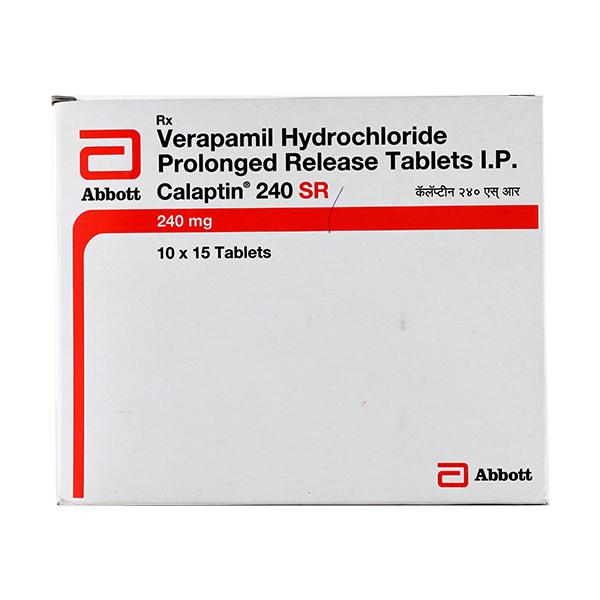
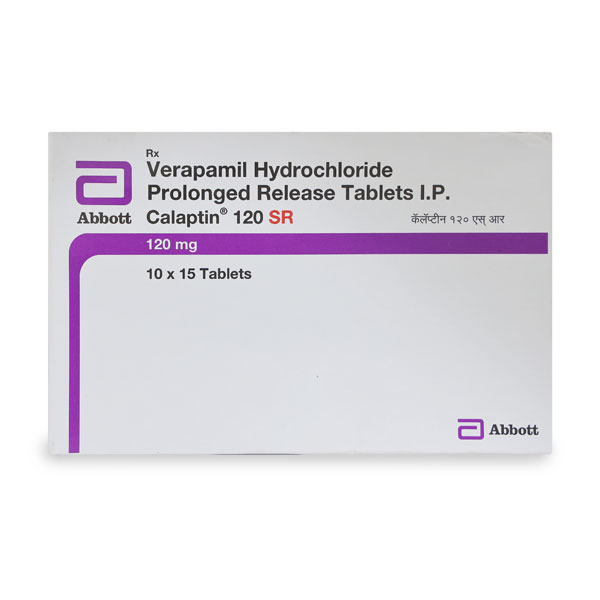
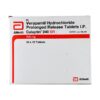
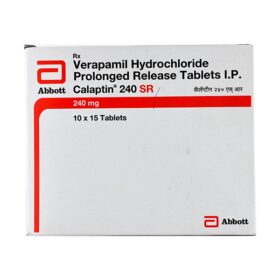
Calaptin SR is verapamil 120 / 240 mg sustained-release tablets — once- to twice-daily non-DHP CCB for hypertension (target 240-480 mg/day), cluster headache prophylaxis (one of the few effective options), supraventricular tachycardia prophylaxis, AF rate control, hypertrophic obstructive cardiomyopathy. Swallow whole; do NOT crush. DO NOT combine with beta-blocker; contraindicated in HF-REF.
✓ Medically reviewed by Morgan Ellis — Pharmacy Researcher · 8 years experience · Last reviewed: May 2026
⚡ Quick Answer — What is Calaptin SR?
Calaptin SR is a 120 / 240 mg SR verapamil sustained-release / CD / XL tablet from Piramal — a phenylalkylamine non-dihydropyridine CCB. Unlike dihydropyridines (amlodipine, nifedipine) which act almost purely on arterial smooth muscle, verapamil has Strong cardiac depressant — substantial slowing of AV nodal conduction, significant reduction in heart rate, and notable negative inotropy (reduced cardiac contractility). More cardiac effect than diltiazem, less peripheral vasodilation. This profile makes it useful for hypertension combined with heart-rate control (atrial fibrillation, chronic angina, PSVT). Plasma half-life IR 3-7 hours (TDS); SR/ER 10-12 hours effective (once or twice daily). Typical hypertension dose: IR 40-80 mg three times daily; SR 120-180 mg once daily, target IR 80-120 mg TDS (240-480 mg/day); SR 240-480 mg once or twice daily. Do NOT combine verapamil with a beta-blocker — additive bradycardia and heart-block risk. Contraindicated in heart failure with reduced ejection fraction (HF-REF), second/third-degree AV block, severe bradycardia, cardiogenic shock, and sick sinus syndrome without pacemaker.
📦 Every order is covered by our Reshipment Assurance Policy — if your parcel does not arrive within 20 business days, we reship it.
Why order from MedsBase
Our generic medications are sourced from WHO-GMP certified manufacturers and shipped worldwide in discreet, plain packaging — no medication name on the parcel exterior. Card payments are routed through a regulated processor (statement descriptors include a regulated card-payment processor — never “MedsBase” or any medication name). Crypto and SEPA bank transfer are also accepted. Every order is backed by our Reshipment Assurance Policy.
What Is Calaptin SR?
Calaptin SR is an oral 120 / 240 mg SR verapamil tablet from Piramal, supplied in 30-180 tablets. Introduced 1967 (Knoll as Isoptin) — the oldest CCB in use, and the one with the strongest cardiac effect.
Verapamil belongs to the non-dihydropyridine calcium-channel blocker subclass, distinguished from the dihydropyridines (amlodipine, nifedipine) by its direct cardiac effects — slowing AV nodal conduction, reducing heart rate, and (more for verapamil than diltiazem) reducing cardiac contractility. This profile makes non-DHPs useful when hypertension coexists with conditions needing rate control (atrial fibrillation, supraventricular tachycardia, chronic angina).
How Verapamil Works
Verapamil blocks L-type voltage-gated calcium channels in BOTH vascular smooth muscle AND cardiac muscle + conduction tissue (unlike DHPs, which are vascular-selective). This produces:
- Arterial vasodilation — reduced systemic vascular resistance, lower BP
- Reduced AV nodal conduction velocity — slower ventricular rate in atrial fibrillation/flutter; termination of reentrant SVT
- Negative chronotropy — slower sinus heart rate
- Negative inotropy — reduced cardiac contractility (significant for verapamil, modest for diltiazem)
- Reduced myocardial oxygen demand — the anti-anginal effect
- Relaxation of coronary vasospasm — first-line for Prinzmetal/variant angina
Approved and Evidence-Based Uses
- Hypertension
- Paroxysmal supraventricular tachycardia (PSVT) — acute termination via IV; chronic oral prophylaxis
- Atrial fibrillation / flutter rate control — when beta-blockers are contraindicated
- Chronic stable angina
- Cluster headache prophylaxis — one of the few effective options; typically 240-480 mg/day SR
- Hypertrophic obstructive cardiomyopathy (reduces outflow gradient by negative inotropy)
- Migraine prophylaxis — occasional use when calcium-channel-blocker preventive is preferred and flunarizine is not available
Verapamil has the strongest negative inotropic and AV-blocking effect of the CCBs. NEVER combine with a beta-blocker outside of a specialist cardiology setting. Contraindicated in heart failure with reduced ejection fraction (HF-REF) — can precipitate decompensation.
Calaptin SR Dosage
Hypertension:
- Starting dose: IR 40-80 mg three times daily; SR 120-180 mg once daily
- Target dose: IR 80-120 mg TDS (240-480 mg/day); SR 240-480 mg once or twice daily
- Titrate every 1-2 weeks
Administration: with or without food. Swallow whole — do NOT crush or split extended-release (SR/CD/XL) formulations.
Monitoring:
- Pulse and BP at baseline, 2 weeks, 4 weeks, and periodically thereafter
- Watch for bradycardia (<50 bpm = dose reduction)
- ECG at baseline and if any symptomatic change (consider PR prolongation / AV block)
- Baseline and periodic LFTs (hepatic metabolism)
- In patients on digoxin: check digoxin level (both non-DHPs raise digoxin levels ~70%)
Discontinuation: taper over 1-2 weeks if on high-dose chronic therapy — abrupt stop can cause rebound angina in CAD patients.
Side Effects
Common:
- Bradycardia (pulse <50 bpm) — dose-related; primary reason for dose reduction
- Constipation — particularly verapamil (up to 40% of users); less common with diltiazem
- Dizziness, fatigue
- Headache (less than DHPs)
- Flushing (less than DHPs)
- Peripheral oedema (less than DHPs; still possible)
- Nausea, abdominal discomfort
Important but uncommon:
- Heart block (PR prolongation, first-to-third degree AV block) — particularly when combined with beta-blockers, digoxin, or in pre-existing conduction disease
- Worsening heart failure — non-DHPs are contraindicated in HF-REF because of their negative inotropy
- Gingival hyperplasia (long-term; less common than nifedipine)
- Hepatic enzyme elevation (usually mild, reversible)
- Erectile dysfunction (more common with verapamil)
- Increased prolactin, galactorrhoea (rare)
Contraindications
- Heart failure with reduced ejection fraction (HF-REF) — non-DHPs are contraindicated; can precipitate acute decompensation
- Second or third-degree AV block without a functioning pacemaker
- Sinus bradycardia <50 bpm
- Sick sinus syndrome without pacemaker
- Cardiogenic shock
- Severe aortic stenosis
- Wolff-Parkinson-White syndrome with atrial fibrillation — can precipitate rapid conduction via the accessory pathway and ventricular fibrillation
- Concurrent beta-blocker (routine practice) — additive bradycardia / heart-block
- Known hypersensitivity to verapamil
Pregnancy: not routine first-line. Verapamil has been used in maternal SVT and fetal SVT (crosses placenta). Diltiazem is generally avoided in pregnancy. For antihypertensive use in pregnancy, labetalol, methyldopa, and nifedipine MR are the safer options.
Breastfeeding: small amounts excreted in milk; generally considered acceptable with infant monitoring.
Drug Interactions
- Beta-blockers — contraindicated in routine practice. Additive bradycardia, heart block, acute heart-failure precipitation. If both are essential, requires cardiology supervision, ECG monitoring, and sometimes pacemaker backup.
- Digoxin — non-DHPs raise digoxin levels by ~70% (both diltiazem and verapamil inhibit P-glycoprotein). Reduce digoxin dose by 30-50% when adding a non-DHP; check levels.
- Amiodarone — additive AV-block risk
- Strong CYP3A4 inhibitors (ketoconazole, clarithromycin, ritonavir, grapefruit juice) — raise non-DHP levels
- Strong CYP3A4 inducers (rifampicin, phenytoin, carbamazepine) — reduce non-DHP levels
- Simvastatin, lovastatin — both non-DHPs raise statin levels; cap simvastatin at 20 mg/day (10 mg/day with verapamil)
- Cyclosporin, tacrolimus — raised by non-DHPs (used therapeutically in transplant medicine to reduce calcineurin-inhibitor dose)
- Dabigatran — verapamil increases dabigatran exposure; avoid or reduce dose
- Lithium — non-DHPs can cause lithium neurotoxicity; monitor lithium levels
- Grapefruit juice — CYP3A4 inhibition raises non-DHP plasma levels 1.5-2×
DHP vs Non-DHP CCBs
| DHPs (amlodipine, nifedipine) | Non-DHPs (verapamil) | |
|---|---|---|
| Primary action | Arterial vasodilation | Vasodilation + cardiac depression |
| Effect on heart rate | Mild reflex ↑ | ↓ (useful for AF rate control) |
| Combine with beta-blocker? | Yes (standard in angina) | NO (additive bradycardia, block) |
| Safe in HF-REF? | Amlodipine: yes | NO (negative inotropy) |
| Peripheral oedema | Common (10-25%) | Less common (5-10%) |
| Constipation | Uncommon | Common (particularly verapamil) |
Storage
Store below 25°C. Keep out of reach of children.
Frequently Asked Questions
Why can’t I take Calaptin SR with a beta-blocker?
Non-DHP CCBs and beta-blockers BOTH slow AV nodal conduction and reduce cardiac contractility. Combining them produces additive effects: bradycardia, PR prolongation, second- or third-degree heart block, and precipitation of heart failure in susceptible patients. Fatal outcomes have been reported. If BP/HR control requires both mechanisms, switch to a dihydropyridine CCB (amlodipine, nifedipine retard) which is safe with beta-blockers.
Why do I have new constipation on Calaptin SR?
Non-DHP CCBs reduce gastrointestinal smooth-muscle motility (the same mechanism that relaxes vascular smooth muscle). Constipation affects up to 40% of verapamil users and a smaller percentage of diltiazem users. Management: increase dietary fibre, adequate fluid, gentle laxative (lactulose, macrogol). If severe, consider switching to a DHP or diltiazem (if on verapamil).
Can I take Calaptin SR if I have atrial fibrillation?
Yes — non-DHP CCBs are one of the standard options for AF rate control, particularly in patients where beta-blockers are contraindicated (asthma, severe peripheral vascular disease). Diltiazem and verapamil both slow AV nodal conduction and reduce the ventricular response rate. Contraindicated in AF with Wolff-Parkinson-White syndrome — can precipitate VF.
Can I take Calaptin SR if I have heart failure?
Generally no. Non-DHP CCBs have negative inotropic effects that can precipitate decompensation in heart failure with reduced ejection fraction (HF-REF). If you have HF-REF, avoid non-DHP CCBs. Amlodipine is the CCB of choice if one is needed in HF-REF (safe profile per PRAISE and V-HeFT-III trials).
Can I use verapamil for cluster headache prophylaxis?
Yes — verapamil is one of the few evidence-based preventives for cluster headache. Typical dose 240-480 mg/day (SR formulation), sometimes titrated higher (up to 960 mg/day) under cardiology/neurology supervision with ECG monitoring for PR prolongation. It is more effective than lithium, topiramate, or ergotamine for chronic and episodic cluster headache.
Can I drink alcohol on Calaptin SR?
Moderate alcohol is generally acceptable but alcohol potentiates the hypotensive and bradycardic effects. Heavy drinking independently raises BP and should be avoided.
What about grapefruit juice?
Grapefruit (juice and fresh fruit) inhibits CYP3A4 metabolism and can raise verapamil plasma levels by 1.5-2×. Avoid on treatment days, or consume consistently — sporadic grapefruit disrupts BP/HR control.
Where can I buy Calaptin SR online?
You can buy Calaptin SR (verapamil 120 / 240 mg SR, 30-180 tablets) from MedsBase with discreet packaging and worldwide shipping.
Related Antihypertensives on MedsBase
- Cardipin Retard — Nifedipine 20 mg ER
- Concor — Bisoprolol beta-blocker
- Depin — Nifedipine 5/10 mg
- Dilzem CD — Diltiazem CD 120/180 mg
- Losar — Losartan (ARB alternative)
- Ramcor — Ramipril (ACEi alternative)
- Browse all High Blood Pressure Medications
Related Alternatives
Other products in Chronic Conditions that customers also view:
More options in High Blood Pressure Medication
Ranked by recent MedsBase order volume — what other customers in this category are picking.
| Strength | 120 mg, 240 mg |
|---|---|
| Quantity | 30 Tablet/s, 60 Tablet/s, 90 Tablet/s, 180 Tablet/s |
 Calaptin SR
Q & A
Calaptin SR
Related products


Reviews
There are no reviews yet