







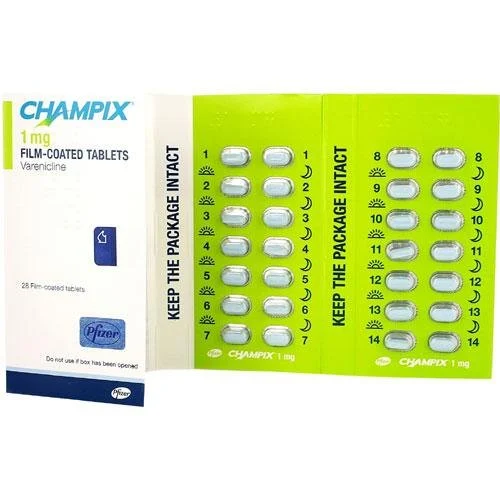
Champix
✅ Reduces nicotine cravings
✅ Helps quit smoking
✅ Decreases withdrawal symptoms
✅ Increases quitting success
✅ Improves long-term abstinence
Champix contains Varenicline.
✓ Medically reviewed by Morgan Ellis — Pharmacy Researcher · 8 years experience · Last reviewed: May 2026
⚡ Quick Answer — Champix — varenicline 1 mg for smoking cessation
Champix is varenicline 1 mg, an α4β2 nicotinic-acetylcholine partial agonist that reduces nicotine cravings and the rewarding effect of smoking. Set a quit date 8–14 days into a 12-week course; titrate from 0.5 mg once daily up to 1 mg twice daily. Most effective when combined with behavioural support; the 2016 EAGLES trial removed the historical neuropsychiatric black-box.
📦 Every order is covered by our Reshipment Assurance Policy — if your parcel does not arrive within 20 business days, we reship it.
Why order from MedsBase
Our generic medications are sourced from WHO-GMP certified manufacturers and shipped worldwide in discreet, plain packaging — no medication name on the parcel exterior. Card payments are routed through a regulated processor (statement descriptors include a regulated card-payment processor — never “MedsBase” or any medication name). Crypto and SEPA bank transfer are also accepted. Every order is backed by our Reshipment Assurance Policy.
What is Champix?
Champix is a smoking-cessation aid containing varenicline 1 mg (film-coated tablets), supplied by Pfizer. It is a selective partial agonist at the α4β2 subtype of the neuronal nicotinic acetylcholine receptor — the same receptor nicotine binds — and is one of the most effective monotherapies for tobacco dependence, with cessation rates roughly two to three times those of placebo and consistently superior to single-agent nicotine-replacement therapy in head-to-head trials.
How varenicline works
Varenicline binds the α4β2 nicotinic receptor with both agonist and antagonist properties: as a partial agonist it produces about 30–60% of nicotine’s dopamine release, dampening cravings and withdrawal; as an antagonist it occupies the receptor and blocks the dopaminergic surge from any cigarette smoked while on therapy, so a cigarette during the course feels much less rewarding than usual. This dual action distinguishes it from bupropion (an atypical antidepressant with weak nicotinic antagonism) and from nicotine-replacement therapy (full agonism only).
How Champix is used
The standard adult course is 12 weeks. Set a quit date 8–14 days into the course — do not stop smoking on day 1. An alternative “flexible quit” approach lets the smoker reduce gradually over the first 12 weeks and quit any time before the end.
| Days | Dose | Notes |
|---|---|---|
| Days 1–3 | 0.5 mg once daily | After breakfast |
| Days 4–7 | 0.5 mg twice daily | 12 hours apart |
| Day 8 onwards (week 2–12) | 1 mg twice daily | Maintenance; quit date in this window |
| Optional 12-week extension | 1 mg twice daily | For those who quit successfully — doubles 1-year abstinence rates |
Take with a full glass of water after a meal — nausea is the most common reason for discontinuation and is reduced by food and adequate hydration. If 1 mg twice daily is not tolerated, dropping back to 0.5 mg twice daily is acceptable and still active.
Renal-dose adjustment
Varenicline is excreted ~92% unchanged in urine. Dose adjustment is required in significant renal impairment:
| eGFR (mL/min/1.73 m²) | Maximum dose |
|---|---|
| ≥ 30 (mild–moderate impairment) | Standard 1 mg BID |
| < 30 (severe impairment) | 1 mg once daily (titrate from 0.5 mg daily) |
| Haemodialysis | 0.5 mg once daily, may titrate to 1 mg once daily |
Common side effects
- Nausea (~30%, usually mild–moderate, abates within 2–3 weeks; take with food and water)
- Vivid or abnormal dreams (~13%, often fade after week 4)
- Insomnia, headache, dyspepsia, dry mouth
- Constipation, flatulence, taste disturbance
- Fatigue or somnolence (caution with driving until tolerance established)
Drug interactions
Varenicline has a remarkably clean interaction profile because it is renally cleared and does not significantly inhibit or induce CYP enzymes. Notable points:
- Nicotine-replacement therapy (NRT): combination is sometimes used in heavy smokers but increases nausea and headache — weigh benefit case-by-case.
- Cimetidine reduces varenicline renal clearance ~29%; reduce dose in concurrent severe renal impairment.
- Alcohol: case reports of altered intoxication or aggression on varenicline — counsel patients to use alcohol cautiously, especially while titrating.
- Warfarin: smoking cessation itself raises INR (cigarette smoke induces CYP1A2, accelerating warfarin metabolism); monitor INR more closely after quitting, regardless of varenicline.
Contraindications and special populations
- Hypersensitivity to varenicline.
- Pregnancy: avoid — limited human safety data; counsel cessation via behavioural support and NRT preferentially.
- Breastfeeding: avoid; small amounts excreted in breast milk in animal studies, no human data.
- Severe renal impairment: dose-reduce as above.
- Cardiovascular disease: a small numerical excess of cardiovascular events in stable cardiovascular patients was seen in the original Pfizer trial; subsequent meta-analyses have not confirmed a causal link, and current guidelines support use after weighing the much larger cardiovascular harm of continued smoking.
Combine with behavioural support
Pharmacotherapy alone roughly doubles quit rates over willpower; pharmacotherapy plus structured behavioural support (text-message programmes, group counselling, telephone quit-lines, app-based CBT) roughly triples them. Even brief structured advice from a clinician at the start of therapy meaningfully raises 1-year abstinence.
Storage
Store at room temperature (15–30 °C / 59–86 °F), in the original blister, away from direct light and moisture. Keep out of reach of children.
Frequently Asked Questions
When does varenicline start working?
Receptor effects begin within hours of the first dose, but the clinically relevant craving reduction usually emerges by the second week as titration reaches the full 1 mg twice-daily dose. Setting a quit date 8–14 days into the course allows that effect to be present at the moment cessation is attempted.
Why is the quit date not on day 1?
Day 1 is too early — receptor occupancy is partial at the 0.5 mg starting dose. Quitting at 8–14 days hits the curve at full antagonist coverage, when a cigarette smoked is much less rewarding and craving suppression is strongest.
Is varenicline more effective than nicotine patches?
Direct head-to-head trials (notably EAGLES, 2016) showed varenicline produced significantly higher 9–12 week and 6-month abstinence rates than the nicotine patch alone, NRT plus bupropion combinations narrow the gap. Combination NRT (patch + lozenge) may match varenicline in some studies. The best therapy is the one the patient will use consistently for 12 weeks.
What if I have one cigarette while on varenicline?
It is a setback, not a failure. Most smokers slip at least once during a quit attempt. The cigarette will feel notably less satisfying because of varenicline’s receptor blockade — this is mechanistic, not motivational. Continue the medication and re-engage your behavioural plan; a single slip does not predict relapse.
How long should I stay on it?
The licensed course is 12 weeks. Smokers who have successfully quit and complete a second 12-week extension (24 weeks total) have roughly double the 1-year abstinence rate of those who stop at week 12. Discuss extension with your prescriber.
Can I take it with bupropion?
Combination is sometimes used in highly dependent smokers who fail monotherapy, particularly with comorbid depression, but the evidence base is thinner and adverse-event rates rise. This is a specialist decision rather than a routine option.
Is the neuropsychiatric warning still on the label?
No — the FDA removed the boxed warning in December 2016 after the EAGLES trial, the largest randomised cessation trial ever conducted, found no significant excess of serious neuropsychiatric events. Routine clinical monitoring for mood change remains sensible because cessation itself unmasks symptoms in vulnerable patients.
Will it interfere with alcohol?
A small number of post-marketing reports describe altered intoxication or out-of-character aggression while drinking on varenicline. Use alcohol cautiously, especially during titration, and consider avoiding it if you are escalating to the full 1 mg twice-daily dose.
Does it cause weight gain?
Some weight gain is typical after quitting smoking regardless of cessation method (~3–5 kg average). Varenicline does not directly cause weight gain and may slightly attenuate it compared with placebo by reducing appetite-driven post-quit eating in some patients.
Can I drive while on it?
Yes, but be cautious until you know how it affects you — somnolence, dizziness, and abnormal dreams that disrupt sleep can all impair concentration. If you experience these, avoid driving and discuss with your prescriber.
Related Alternatives
Other products in General Health that customers also view:
More options in Alcohol and Drug Treatment
Ranked by recent MedsBase order volume — what other customers in this category are picking.
| Strength | 1 mg |
|---|---|
| Quantity | 28 Tablet/s, 56 Tablet/s, 84 Tablet/s, 168 Tablet/s |
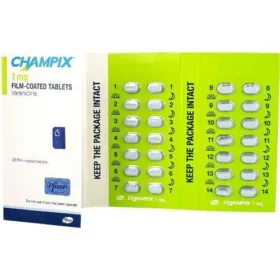 Champix
Q & A
Champix
Related products



Reviews
There are no reviews yet