








Cipcal
✅ Boosts bone health
✅ Prevents osteoporosis
✅ Supports muscle function
✅ Enhances overall wellness
✅ Combats vitamin deficiency
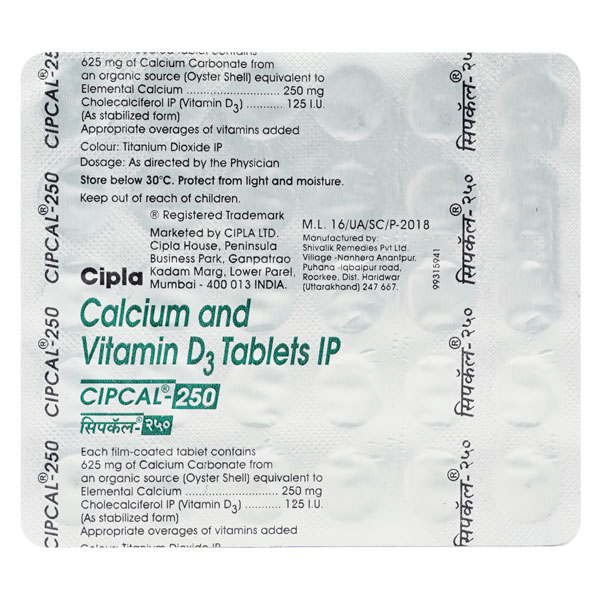
Cipcal contains calcium and multivitamins.
✓ Medically reviewed by Morgan Ellis — Pharmacy Researcher · 8 years experience · Last reviewed: May 2026
Quick Answer
Cipcal (calcium carbonate 500 mg + multivitamins (Cipla)) is a calcium carbonate plus multivitamin tablet for prevention and treatment of calcium deficiency, postmenopausal bone health, and as an adjunct in osteoporosis treatment.
- Calcium carbonate 500 mg elemental + cofactor vitamins
- Take with food (acid environment improves carbonate absorption)
- Maximum 500–600 mg per dose — split daily intake into two
- WHO-GMP certified manufacturer (Cipla)
📦 Every order is covered by our Reshipment Assurance Policy — if your parcel does not arrive within 20 business days, we reship it.
Every order is covered by our Reshipment Assurance Policy.
Why order from MedsBase
Cipcal is sourced from a WHO-GMP certified manufacturer. Every order ships in discreet, unbranded packaging worldwide and is covered by our Reshipment Assurance Policy. Pay securely with credit card, SEPA bank transfer, or cryptocurrency. See our 1,400+ verified customer reviews.
What is Cipcal?
Cipcal is a calcium carbonate tablet supplemented with vitamin cofactors that support bone health. Calcium carbonate provides 40% elemental calcium by weight (a 1,250 mg carbonate tablet = 500 mg elemental calcium). It requires gastric acid for ionisation and absorption, so it is best taken with meals.
Indications
- Dietary calcium insufficiency — particularly in lactose-intolerant, vegan, or low-dairy diets
- Postmenopausal bone health alongside vitamin D
- Adjunct to bisphosphonates in osteoporosis treatment
- Pregnancy and lactation if dietary intake is inadequate
- Adolescent peak bone mass support in low-calcium diets
- Hypocalcaemia (mild, dietary — severe hypocalcaemia needs specialist management)
How to take
One tablet once or twice daily with meals. Do not exceed 500–600 mg elemental calcium per single dose — absorption efficiency drops above this and the excess just passes through. If two doses are needed, split them across the day rather than taking both together.
Calcium chelates many drugs in the gut and reduces their absorption to clinically meaningful degrees. The 4-hour separation rule applies in BOTH directions — not just from calcium to the other drug. Levothyroxine and bisphosphonates in particular need an empty stomach window, so take Cipcal at lunch and dinner, leaving morning empty for thyroid or bone-active medication.
Side effects
- Constipation — the most common; increase fluids and fibre, or switch to calcium citrate (less constipating but more expensive)
- Belching, flatulence — carbonate releases CO2 on contact with stomach acid
- Hypercalcaemia — uncommon at standard doses; risk rises with thiazide diuretics, granulomatous disease, or concurrent high-dose vitamin D
- Kidney stones in predisposed patients — total daily calcium 1,200 mg from diet plus supplement is the usual ceiling
Drug interactions
- Levothyroxine — chelation; separate by 4 hours
- Fluoroquinolones, tetracyclines — chelation; separate by 4 hours
- Oral iron — reduced absorption of both; separate by 4 hours
- Bisphosphonates (alendronate, risedronate) — absolutely separate; bisphosphonates need a 30–60-minute empty-stomach window before food/drink
- Thiazide diuretics — reduced calcium excretion; cumulative hypercalcaemia possible at high supplement doses
- PPIs and H2 blockers — reduce stomach acid and thus carbonate absorption; switch to calcium citrate (acid-independent absorption) if on long-term PPI
- Digoxin — hypercalcaemia amplifies toxicity
Contraindications
- Hypercalcaemia, hypercalciuria
- Severe renal impairment without specialist supervision
- Active sarcoidosis or other granulomatous disease
- Calcium-oxalate kidney stones (relative; specialist input)
Storage
Store below 25°C, dry, in original packaging.
Frequently Asked Questions
How much calcium do I actually need?
Total daily intake (food + supplement) targets: adults 19–50 = 1,000 mg/day; adults 51+ = 1,200 mg/day; pregnancy and lactation = 1,000–1,300 mg/day. Most adults already get 600–800 mg from diet, so a single Cipcal tablet daily often closes the gap.
Why split the dose?
Calcium absorption is saturable — above 500–600 mg in a single dose, fractional absorption drops sharply. Two 500 mg doses give better total absorption than one 1,000 mg dose.
Calcium carbonate vs calcium citrate?
Carbonate is cheap, contains 40% elemental calcium (high density), but needs stomach acid — take with meals. Citrate is acid-independent (good for PPI users and the elderly), gentler on the gut, less constipating — but more expensive and less calcium per tablet (21% elemental).
Will Cipcal prevent osteoporosis?
Calcium plus vitamin D plus weight-bearing exercise reduces fracture risk in older adults; on its own, calcium alone is much weaker. For diagnosed osteoporosis, treatment-grade interventions (bisphosphonates, denosumab, teriparatide) are the actual treatment — Cipcal supports them.
Is calcium supplementation linked to heart attacks?
Some observational studies have flagged a small cardiovascular signal at high supplemental doses (>1,000 mg/day from supplements alone), but the evidence is mixed and dietary calcium has no such signal. Practical advice: prioritise dietary calcium; use supplements only to close the gap, not to push intake above 1,200–1,500 mg total/day.
Can I take it with food?
Yes — with food is preferred for carbonate. Calcium does compete with iron, zinc, magnesium, and some other minerals for absorption, so if dietary mineral content matters (e.g. you are anaemic and using oral iron), separate Cipcal from iron-rich meals.
What about kidney stones?
Dietary calcium with meals actually reduces kidney stone risk by binding oxalate in the gut. Calcium supplements taken away from food may increase stone risk in susceptible patients. Take Cipcal with meals and stay well-hydrated.
Pregnancy: how much is too much?
Pregnancy targets are 1,000–1,300 mg/day total. Avoid going above 2,500 mg/day. Most prenatal multivitamins already contain 200–300 mg calcium — don’t double up beyond targets.
Should I take it forever?
Reassess annually. If diet improves (more dairy, leafy greens, tofu, sardines), supplementation may not be needed. If on long-term PPI, anticonvulsant, or steroid therapy, ongoing supplementation is usually appropriate.
How does Cipcal compare to Topcal M?
Cipcal is calcium + vitamin cofactors. Topcal M adds magnesium and vitamin D explicitly — useful when magnesium intake is low or when bone-targeted bundling is desired. Both are reasonable; choice is preference.
Other Vitamins & Minerals
- Cipcal — calcium carbonate + multivitamins
- Topcal M — calcium + magnesium + vitamin D
- Calcirol — cholecalciferol 60,000 IU sachet
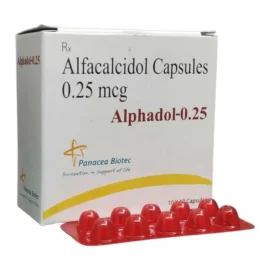
- Alphadol — alfacalcidol for CKD-related deficiency
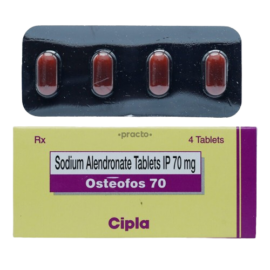
- Osteofos — alendronic acid for osteoporosis
- Arachitol 6L Injection — cholecalciferol IM depot
Medical Disclaimer
More options in Vitamins and Minerals
Ranked by recent MedsBase order volume — what other customers in this category are picking.
| Strength | 250 mg |
|---|---|
| Quantity | 30 Tablet/s, 60 Tablet/s, 90 Tablet/s, 180 Tablet/s |
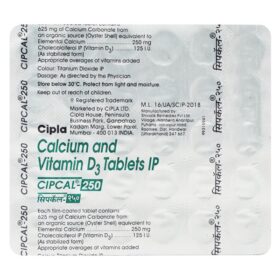 Cipcal
Q & A
Cipcal
Related products



Reviews
There are no reviews yet