







Cronotol
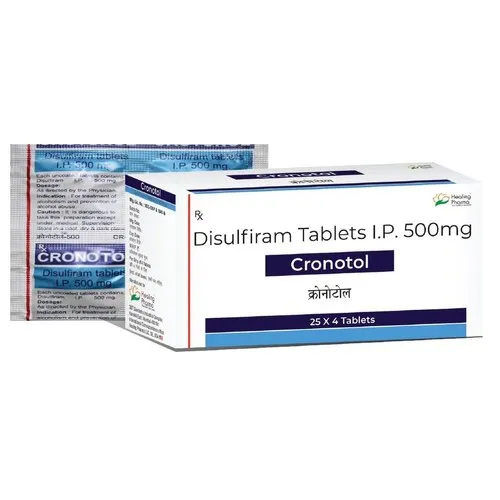
✅ Supports Alcohol Abstinence
✅ Manages Alcohol Dependence
✅ Oral Administration
✅ Helps Prevent Relapse
✅ Prescribed by Healthcare Providers
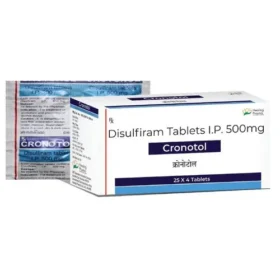
Cronotol contains Disulfiram.
✓ Medically reviewed by Morgan Ellis — Pharmacy Researcher · 8 years experience · Last reviewed: May 2026
⚡ Quick Answer — Cronotol — disulfiram 500 mg for alcohol use disorder
Cronotol is disulfiram 500 mg — the higher loading-dose strength used in the first 1–2 weeks of therapy. It blocks aldehyde dehydrogenase, so any alcohol consumed produces acetaldehyde build-up and the unpleasant disulfiram–ethanol reaction (flushing, nausea, palpitations, hypotension). It works by deterrence, not craving reduction. You must be alcohol-free for at least 12 hours before the first dose. Best paired with supervised dosing and behavioural support.
📦 Every order is covered by our Reshipment Assurance Policy — if your parcel does not arrive within 20 business days, we reship it.
Why order from MedsBase
Our generic medications are sourced from WHO-GMP certified manufacturers and shipped worldwide in discreet, plain packaging — no medication name on the parcel exterior. Card payments are routed through a regulated processor (statement descriptors include a regulated card-payment processor — never “MedsBase” or any medication name). Crypto and SEPA bank transfer are also accepted. Every order is backed by our Reshipment Assurance Policy.
What is Cronotol?
Cronotol is an alcohol-aversion medication containing disulfiram 500 mg (tablets), supplied by WHO-GMP certified manufacturer. It is the oldest licensed pharmacotherapy for alcohol use disorder (in clinical use since 1949) and remains useful as an adjunct in motivated patients with structured supervision — it does not reduce craving directly, but the credible threat of an unpleasant reaction acts as a robust behavioural deterrent.
How disulfiram works
Alcohol metabolism is a two-step process: ethanol → acetaldehyde (via alcohol dehydrogenase) → acetate (via aldehyde dehydrogenase, ALDH). Disulfiram irreversibly inhibits ALDH, so even small amounts of ethanol cause acetaldehyde to accumulate to many times normal levels. Acetaldehyde is responsible for the toxic component of a hangover; at sustained high levels it produces the disulfiram–ethanol reaction (DER): facial flushing, throbbing headache, nausea, vomiting, palpitations, dyspnoea, sweating, hypotension. Severe reactions can include arrhythmia, MI, seizures, coma. The intensity is roughly proportional to the alcohol dose — even a glass of wine usually triggers a moderate reaction.
Because ALDH inhibition is covalent, it persists for up to 14 days after the last disulfiram dose. The DER can still be triggered up to two weeks after stopping the drug.
How Cronotol is used
The 500 mg strength of Cronotol is used during the loading phase — the first 1–2 weeks of therapy when receptor inhibition is being established. After loading, dose is reduced to a maintenance level using a 250 mg formulation:
| Phase | Daily dose | Duration |
|---|---|---|
| Loading (with 500 mg Cronotol) | 500 mg once daily | 1–2 weeks |
| Maintenance (switch to 250 mg) | 125–250 mg once daily | Typically 6–12 months, occasionally longer |
Some clinicians prescribe maintenance at 250 mg in patients who can tolerate it, others step down to 125 mg if side effects appear. The lowest dose that produces a credible DER on alcohol exposure is the goal — some patients require 500 mg maintenance to maintain a clinically meaningful reaction, others get full effect at 125 mg.
Take in the morning with water; an evening dose is acceptable if morning drowsiness is a problem. Supervised dosing (a partner, family member, or pharmacist watches the dose go down) substantially raises adherence and is a cornerstone of disulfiram’s evidence base.
Side effects (independent of alcohol)
Even without an alcohol reaction, disulfiram has its own adverse-effect profile:
- Drowsiness, fatigue in the first 1–2 weeks (most common; usually settles)
- Metallic or garlic-like aftertaste — characteristic and often persistent
- Headache, dizziness, dermatitis
- Reduced libido, erectile difficulty (uncommon)
- Hepatotoxicity (rare but serious) — idiosyncratic hepatitis, sometimes fatal. Baseline LFTs, repeat at 2 weeks, then monthly for the first 3 months, then 3-monthly. Stop immediately if jaundice, dark urine, RUQ pain, or marked transaminase rise.
- Peripheral neuropathy and rarely optic neuritis at higher doses or longer courses — report numbness, tingling, or visual changes
- Disulfiram-induced psychosis — rare; usually associated with very high doses or pre-existing schizophrenia
Drug interactions
| Drug / class | Effect / risk | Action |
|---|---|---|
| Metronidazole, tinidazole | Confusion, psychosis — potentiated CNS toxicity | Avoid combination |
| Isoniazid | Ataxia, irritability, psychosis | Avoid; if essential, monitor closely and use lowest effective dose |
| Warfarin | INR rises (CYP2C9 inhibition); bleeding risk | Reduce warfarin dose; monitor INR weekly initially |
| Phenytoin | Phenytoin level rises (CYP2C9/2C19 inhibition); toxicity | Reduce phenytoin dose; monitor levels |
| Theophylline | Theophylline level rises | Monitor or use alternative bronchodilator |
| Benzodiazepines (CYP-metabolised: diazepam, alprazolam, midazolam) | Sedation potentiated | Use lorazepam or oxazepam (non-CYP) if sedative needed |
| Tricyclic antidepressants | Acute organic brain syndrome reports | Use with caution |
| Amitriptyline | May enhance DER intensity | Use cautiously |
| Cannabis | Hypomania reports | Counsel patient |
| Levodopa | Reduced effect | Monitor Parkinsonian control |
Contraindications
- Severe coronary artery disease, recent MI, serious arrhythmia — the cardiovascular component of the DER may be dangerous
- Active psychosis or severe personality disorder where reaction-induced distress could be destabilising
- Pregnancy — teratogenic concerns; avoid
- Severe hepatic impairment
- Active alcohol intoxication (the 12-hour rule above)
- Recent metronidazole, isoniazid, or paraldehyde use
- Hypersensitivity to thiuram derivatives (rubber industry workers may be sensitised)
Where disulfiram fits
Disulfiram works best as a structured deterrent for highly motivated patients with abstinence (not reduction) as their goal, ideally with a partner or family member who supervises each daily dose. It does not act on craving or reward circuits, so it pairs well with naltrexone (which dampens reward) or acamprosate (which reduces post-cessation craving) in tougher cases. It is not first-line in modern guidelines — naltrexone and acamprosate are usually preferred — but it remains the most effective option for the right patient profile, particularly where craving-reduction agents have failed.
Storage
Store at room temperature (15–30 °C / 59–86 °F), in the original blister, away from direct light and moisture. Keep out of reach of children — accidental ingestion in a child can produce a severe reaction.
Frequently Asked Questions
How long after stopping disulfiram is it safe to drink?
ALDH inhibition is irreversible — the body must synthesise new enzyme to recover function. Avoid all alcohol for at least 14 days after the last disulfiram dose. Some sensitive patients describe mild reactions up to three weeks later.
Will I have a reaction from cooking with wine?
Most cooked alcohol is largely volatilised and a brief simmer will not usually trigger a reaction, but a flambe, a sauce reduced for only a few minutes, or a tiramisu can. The safest position is to avoid alcohol-containing recipes entirely while on therapy.
Can I drink non-alcoholic beer?
Many “0.0%” alcohol-free beers contain trace ethanol (0.05–0.5%). Some patients on disulfiram have reactions to several bottles in one session. Truly alcohol-free brands (genuine 0.0%) are usually safe but read the label carefully.
Why does my mouth taste metallic?
Disulfiram is metabolised to carbon disulfide, which is excreted partly through the breath and saliva — this produces a characteristic metallic or garlic taste. It is harmless and most people adapt.
Is it safe with my heart medication?
Most antihypertensives are compatible. The chief concern is the cardiovascular load of a disulfiram–ethanol reaction itself in patients with serious coronary or cerebrovascular disease — not the daily medication interaction. Disclose your full cardiac history before starting.
How is it different from naltrexone?
Naltrexone works on opioid receptors to reduce the reward of drinking — it does not produce a reaction. Disulfiram has no effect on craving but produces a strong aversive reaction if alcohol is consumed. They can be combined in some patients.
Do I need supervised dosing?
Strongly recommended — supervised disulfiram has the strongest evidence base. Adherence is the single biggest determinant of effectiveness; an unsupervised patient who quietly stops the drug a few days before drinking gets no protection. A partner or pharmacist watching the dose go down each day raises 6-month abstinence rates substantially.
What if I have a reaction by accident?
Mild reactions (flushing, mild nausea, headache) usually resolve in 1–2 hours with rest and oral fluids. A severe reaction (hypotension, severe vomiting, chest pain, dyspnoea, fainting) is a medical emergency — call emergency services. Do not “wait it out”.
Does it work for opioid dependence?
No. Disulfiram is specific to alcohol metabolism. For opioid use disorder, naltrexone, buprenorphine, and methadone are the licensed options.
How long should I stay on it?
6–12 months is typical. Longer courses are used in some patients, particularly with high-stress relapse risk. Stopping is a planned decision with the prescriber based on stable abstinence, behavioural-support engagement, and life-circumstance review.
Related Alternatives
Other products in General Health that customers also view:
More options in Alcohol and Drug Treatment
Ranked by recent MedsBase order volume — what other customers in this category are picking.
| Strength | 500 mg |
|---|---|
| Quantity | 28 Tablet/s, 56 Tablet/s, 84 Tablet/s, 168 Tablet/s |
 Cronotol
Q & A
Cronotol
Related products


Reviews
There are no reviews yet