







Dilantin
✅ Seizure control
✅ Prevents convulsions
✅ Manages epilepsy
✅ Stabilizes brain activity
✅ Reduces seizure frequency
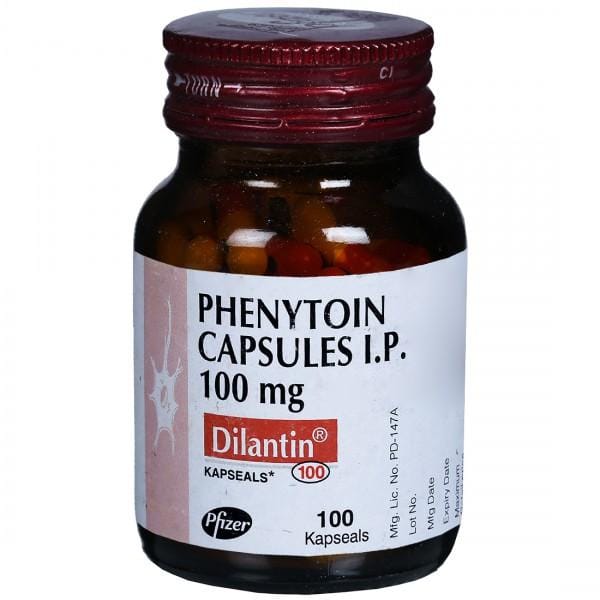
Dilantin contains Phenytoin.
✓ Medically reviewed by Morgan Ellis — Pharmacy Researcher · 8 years experience · Last reviewed: May 2026
⚡ Quick Answer — What is Dilantin?
Dilantin is an oral phenytoin sodium (100 mg) extended-release capsule — a first-generation hydantoin anticonvulsant used for tonic-clonic (grand mal) seizures, complex partial seizures, and seizure prevention after neurosurgery. It works by blocking voltage-gated sodium channels in neurons, stabilising the inactivated state and preventing repetitive firing. Usual adult dose: 300–400 mg/day in 1–2 divided doses (extended-release allows once-daily dosing). Therapeutic range: 10–20 µg/mL — requires monitoring due to nonlinear (saturable) pharmacokinetics. Common side effects: gingival hyperplasia, ataxia, nystagmus, hirsutism, coarsening of facial features. Many drug interactions via CYP2C9/2C19 induction.
📦 Every order is covered by our Reshipment Assurance Policy — if your parcel does not arrive within 20 business days, we reship it.
Why order from MedsBase
Our generic medications are sourced from WHO-GMP certified manufacturers and shipped worldwide in discreet, plain packaging — no medication name on the parcel exterior. Card payments are routed through a regulated processor (statement descriptors include a regulated card-payment processor — never “MedsBase” or any medication name). Crypto and SEPA bank transfer are also accepted. Every order is backed by our Reshipment Assurance Policy.
What Is Dilantin?
Dilantin is an oral extended-release capsule containing phenytoin sodium 100 mg. Phenytoin is one of the oldest and most widely used anticonvulsants, in continuous clinical use since 1938 — making it one of the most extensively studied drugs in medicine.
Phenytoin stabilises neuronal membranes by blocking voltage-gated sodium channels, preventing the repetitive firing that underlies seizure propagation. It is on the WHO Model List of Essential Medicines and remains a first-line option for tonic-clonic and focal seizures. Dilantin is the original brand developed by Parke-Davis (now Pfizer) and is the reference standard for all phenytoin generics.
Phenytoin is unique among anticonvulsants for its zero-order (saturable) kinetics at therapeutic doses: small dose changes can produce disproportionately large changes in blood levels. This is why therapeutic drug monitoring (TDM) is mandatory with phenytoin — a feature that makes it more demanding to prescribe than newer agents but also the most fine-tuneable when used by experienced clinicians.
How Does Dilantin (Phenytoin) Work?
Phenytoin blocks voltage-gated sodium channels by preferentially binding to their inactivated state. This prolongs the refractory period of neurons, preventing the rapid repetitive firing that underlies seizure propagation. Unlike newer anticonvulsants that act on multiple targets, phenytoin is a relatively selective sodium-channel blocker.
Critically, phenytoin exhibits nonlinear (zero-order, saturable) pharmacokinetics described by the Michaelis-Menten equation. This means small dose increases near saturation can produce disproportionately large rises in blood levels, making therapeutic drug monitoring essential.
Indications
- Generalised tonic-clonic (grand mal) seizures
- Complex partial (focal) seizures
- Status epilepticus (IV loading dose — not this oral form)
- Post-neurosurgery/traumatic brain injury seizure prophylaxis
- Trigeminal neuralgia (second-line, off-label)
Dosing and Therapeutic Drug Monitoring
| Parameter | Value |
|---|---|
| Usual adult dose | 300–400 mg/day (once daily or divided) |
| Loading dose (if needed) | 1,000 mg divided over 3 doses in 24 h (oral loading) |
| Therapeutic range (total) | 10–20 µg/mL |
| Free (unbound) level | 1–2 µg/mL (check in hypoalbuminaemia, renal failure) |
| Dose adjustments | 25–50 mg increments only (nonlinear kinetics) |
| Time to steady state | 5–14 days (longer at higher doses) |
Important: Extended-release (Dilantin Kapseals) capsules should be swallowed whole, not chewed or crushed. Generic extended-release phenytoin is not always interchangeable with brand — discuss switching with your healthcare provider.
Side Effects
Common: gingival hyperplasia (gum overgrowth, up to 50% of long-term users), nystagmus, ataxia, slurred speech, drowsiness, hirsutism, acne, coarsening of facial features.
Dose-related toxicity signs (in order of appearance):
| Serum Level | Signs |
|---|---|
| >20 µg/mL | Nystagmus |
| >30 µg/mL | Ataxia, slurred speech |
| >40 µg/mL | Confusion, lethargy |
| >50 µg/mL | Seizures (paradoxical), coma |
Serious/long-term: osteomalacia (vitamin D metabolism interference), megaloblastic anaemia (folate depletion), Stevens-Johnson syndrome/TEN (rare — higher risk in HLA-B*1502 carriers, common in Southeast Asian populations), hepatotoxicity, purple glove syndrome (IV extravasation — not applicable to oral use), cerebellar atrophy (chronic supratherapeutic levels).
Warnings and Precautions
- Therapeutic drug monitoring is mandatory. Target total phenytoin: 10–20 µg/mL (free phenytoin: 1–2 µg/mL). Zero-order kinetics means a small dose increase (e.g., 300 to 330 mg/day) can push levels into the toxic range. Check levels 7–10 days after any dose change.
- Suicidal behaviour — class warning. All anticonvulsants carry an FDA warning for increased suicidal ideation. Monitor mood, especially in the first 3 months.
- Severe cutaneous adverse reactions (SCARs). Phenytoin carries a risk of Stevens-Johnson syndrome (SJS) and toxic epidermal necrolysis (TEN), particularly in patients with HLA-B*15:02 (common in Southeast Asian populations). Screen for HLA-B*15:02 before starting phenytoin in at-risk populations.
- DRESS syndrome. Drug Reaction with Eosinophilia and Systemic Symptoms — onset typically 2–8 weeks after starting. Presents as fever, rash, lymphadenopathy, and organ involvement (liver, kidneys). Discontinue immediately.
- Gingival hyperplasia. Occurs in ~50% of chronic users. Meticulous oral hygiene reduces severity. Consider alternative agents in young patients with cosmetic concerns.
- Hepatotoxicity. Rare but can be severe, especially with DRESS. Monitor LFTs if fever or rash develops.
- Pregnancy — category D. Phenytoin is teratogenic (fetal hydantoin syndrome: craniofacial, nail and digit anomalies, growth restriction). Use only if no alternative controls seizures. Folate 5 mg/day from pre-conception. Vitamin K 10 mg/day in the last month (phenytoin depletes fetal vitamin K → neonatal haemorrhage).
- Osteoporosis. Long-term phenytoin induces CYP enzymes that metabolise vitamin D, leading to osteomalacia. Supplement vitamin D 1,000–2,000 IU/day and monitor DEXA scans.
- Enteral feeding. Tube feeds reduce phenytoin absorption by up to 70%. Hold feeds 2 hours before and after the dose.
Contraindications — Who Should NOT Take Dilantin
- Known hypersensitivity to phenytoin, other hydantoins or any excipient
- Concurrent use of delavirdine (HIV NNRTI — phenytoin reduces delavirdine to subtherapeutic levels)
- Sinus bradycardia, sino-atrial block, second/third-degree AV block, Adams-Stokes syndrome
- Patients positive for HLA-B*15:02 (unless no alternative exists and benefit clearly outweighs SJS/TEN risk)
- Porphyria
Drug Interactions
Phenytoin is both a substrate and inducer of CYP2C9, CYP2C19, and CYP3A4, making it one of the most interaction-prone anticonvulsants:
- Drugs that increase phenytoin levels: fluconazole, isoniazid, omeprazole, amiodarone, fluoxetine, valproate, trimethoprim
- Drugs whose levels phenytoin decreases: warfarin (paradoxical: phenytoin initially displaces then induces metabolism), oral contraceptives, cyclosporine, dexamethasone, theophylline, doxycycline, lamotrigine, carbamazepine, methadone
- Enteral feeds: Continuous tube feeding reduces phenytoin absorption — hold feeds 2 hours before and after dosing
- Alcohol: Chronic use induces metabolism (lower levels); acute intoxication inhibits metabolism (higher levels)
Storage Instructions
- Store at room temperature, 15–30°C. Protect from moisture and light.
- Keep capsules in original blister packaging until use.
- Do not store in the bathroom.
- Keep out of reach of children — phenytoin overdose is a medical emergency (nystagmus → ataxia → coma).
- Do not use after the expiry date.
Related Categories on MedsBase
Frequently Asked Questions
What is Dilantin used for?
Dilantin contains phenytoin 100 mg and is used to control and prevent tonic-clonic and complex partial seizures in epilepsy, and for seizure prevention after brain surgery or head injury.
Why does phenytoin need blood level monitoring?
Phenytoin has nonlinear pharmacokinetics — the enzyme system that metabolises it becomes saturated at therapeutic doses. A small dose increase (e.g., 300 → 350 mg) can cause a disproportionately large jump in blood level, from therapeutic to toxic. Regular monitoring keeps the level in the 10–20 µg/mL therapeutic window.
What is gingival hyperplasia and can it be prevented?
Gingival hyperplasia is overgrowth of the gums, occurring in up to 50% of patients on long-term phenytoin. Good oral hygiene (regular brushing, flossing, dental check-ups) reduces severity but does not eliminate it. Switching to a different anticonvulsant is the definitive solution when gum changes become problematic.
Can I switch between brand and generic phenytoin?
Phenytoin extended-release formulations may differ in absorption characteristics between manufacturers. Some guidelines recommend not switching between brands/generics without level monitoring, as even small changes in bioavailability can push levels outside the narrow therapeutic window.
Why should phenytoin be avoided in absence seizures?
Phenytoin (and carbamazepine) can worsen absence (petit mal) seizures by altering thalamocortical rhythms. First-line treatments for absence seizures are ethosuximide, valproate, or lamotrigine.
Does phenytoin affect bone health?
Yes — long-term phenytoin use induces CYP enzymes that accelerate vitamin D metabolism, leading to osteomalacia and increased fracture risk. Patients on long-term phenytoin should take vitamin D and calcium supplements and undergo periodic bone density screening.
Is Dilantin safe during pregnancy?
Phenytoin is a known teratogen (fetal hydantoin syndrome: growth restriction, craniofacial abnormalities, limb defects). It should be replaced with a safer anticonvulsant (lamotrigine or levetiracetam) before conception when possible. If phenytoin must be continued, high-dose folate supplementation and specialist monitoring are essential.
What should I do if I miss a dose of Dilantin?
Take it as soon as you remember. If it is close to the next scheduled dose, skip the missed dose. Never double up — due to nonlinear kinetics, doubling a dose can push levels into the toxic range.
Why is HLA-B*1502 testing mentioned with phenytoin?
The HLA-B*1502 allele (common in Southeast Asian populations) is strongly associated with phenytoin- and carbamazepine-induced Stevens-Johnson syndrome (SJS) and toxic epidermal necrolysis (TEN) — potentially fatal skin reactions. Testing is recommended before starting phenytoin in at-risk populations.
Can I take antacids with Dilantin?
Calcium- and aluminium-containing antacids can reduce phenytoin absorption. Separate them by at least 2 hours.
Is Dilantin the same as Epanutin?
Both contain phenytoin. Dilantin and Epanutin are brand names used in different markets. This product uses the Dilantin name and contains the same 100 mg phenytoin sodium formulation.
Related Alternatives
Other products in Chronic Conditions that customers also view:
More options in Neurological Conditions and Epilepsy
Ranked by recent MedsBase order volume — what other customers in this category are picking.

| Strength | 100 mg |
|---|---|
| Quantity | 100 Capsule/s, 200 Capsule/s, 300 Capsule/s, 600 Capsule/s |
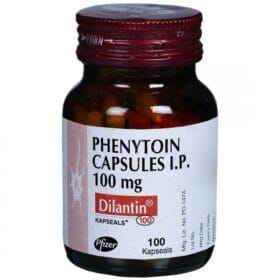 Dilantin
Q & A
Dilantin
Related products




Reviews
There are no reviews yet