








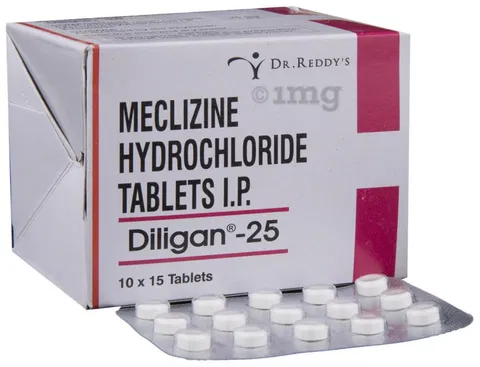
Diligan
✅ Alleviates motion sickness
✅ Relieves vertigo symptoms
✅ Reduces nausea
✅ Controls dizziness
✅ Treats vomiting
Diligan contains Meclizine.
✓ Medically reviewed by Morgan Ellis — Pharmacy Researcher · 8 years experience · Last reviewed: May 2026
⚡ Quick Answer — What is Diligan?
Diligan is a meclizine 25 mg tablet from a first-generation H1 antihistamine with anticholinergic and central anti-emetic action. It is taken 1 hour before travel to prevent motion sickness (cars, boats, planes), and short-course (≤ 72 h) to suppress acute peripheral vertigo from labyrinthitis or vestibular neuritis. Typical adult dose is 25–50 mg one hour before travel, repeated every 24 hours if needed. Causes drowsiness — do not drive or operate machinery for 8–12 hours after a dose.
Why order from MedsBase
📦 Every order is covered by our Reshipment Assurance Policy — if your parcel does not arrive within 20 business days, we reship it.
Diligan is the WHO-GMP generic equivalent of Antivert / Bonine, supplied as 25 mg tablets and chewable tablets. Meclizine has a 60+ year track record for motion sickness and is one of the few drugs with FDA Pregnancy Category B status for nausea/vomiting in pregnancy when other agents are contraindicated.
What Diligan Is Used For
- Motion sickness prevention — first-line for car, sea, and air travel; take 1 hour before exposure
- Acute peripheral vertigo — vestibular neuritis, labyrinthitis, BPPV first attack — short course (≤ 72 hours) only, then stop to allow central compensation
- Acute Meniere’s vertigo episode — rescue dose; chronic management uses betahistine instead
- Post-operative nausea — off-label adjunct after middle-ear surgery
Meclizine is not the right drug for chronic Meniere’s disease (use Vertin or Betavert), central vertigo (brain-origin), or general lightheadedness from postural drop or cardiac arrhythmia.
Why order from MedsBase
Diligan is dispensed from a WHO-GMP-certified manufacturer, blister-packed and discreetly shipped worldwide. Every order is covered by our Reshipment Assurance Policy — if it does not arrive within 20 business days we reship at our cost. Over 1,400 verified customers — read reviews.
How Diligan Works
Meclizine is a piperazine-class first-generation H1 antihistamine that crosses the blood-brain barrier. In the central vestibular pathways it dampens the firing of the vestibular nuclei in response to abnormal sensory input, which is what produces the spinning sensation in motion sickness and acute peripheral vertigo. Its anticholinergic activity also blunts the autonomic component (nausea, sweating, pallor) that accompanies vestibular stimulation.
Onset is 30–60 minutes, peak effect at 1–2 hours, duration 8–12 hours. This is why dosing is one hour before travel and repeated daily on long journeys.
Dosing
| Indication | Dose | Notes |
|---|---|---|
| Motion sickness prevention | 25–50 mg, 1 hour before travel | Repeat every 24 h on long trips; max 100 mg/day |
| Acute peripheral vertigo | 25–50 mg twice daily | Maximum 72 hours — longer use delays vestibular compensation |
| Meniere’s acute episode | 25 mg as needed | Add to betahistine maintenance during attack only |
| Children < 12 years | Avoid | Limited paediatric data; use dimenhydrinate or cinnarizine instead |
| Elderly | Start 12.5–25 mg | Higher anticholinergic-burden risk; falls and confusion are real concerns |
| Pregnancy | 25 mg as needed | FDA Category B; one of the safer antiemetic options when first-line doxylamine + B6 fails |
Important — Do Not Use Beyond 72 Hours for Vertigo
Side Effects
| Frequency | Effect |
|---|---|
| Common (> 10%) | Drowsiness, sedation, dry mouth |
| Common (1–10%) | Blurred vision, constipation, urinary hesitancy, fatigue |
| Uncommon | Tachycardia, palpitations, restlessness in elderly (paradoxical), headache |
| Rare | Acute angle-closure glaucoma, urinary retention, anaphylaxis |
Contraindications and Cautions
- Closed-angle glaucoma — anticholinergic effect can precipitate acute angle-closure attack
- Prostatic hypertrophy / urinary retention — worsens outflow obstruction
- Severe asthma / COPD — thickens bronchial secretions
- Children under 12 — insufficient data; alternatives exist
- Concurrent sedatives or alcohol — additive CNS depression
- Pregnancy and breastfeeding — FDA Category B; small amounts in breast milk — preferred over scopolamine if needed
Drug Interactions
| Drug / Class | Interaction |
|---|---|
| Alcohol, opioids, benzodiazepines, hypnotics | Additive sedation; avoid combining at full motion-sickness doses |
| Other anticholinergics (oxybutynin, scopolamine, TCAs, first-gen antihistamines) | Cumulative anticholinergic burden — dry mouth, constipation, urinary retention, confusion in elderly |
| MAO inhibitors | Prolong and intensify anticholinergic effects |
| Levodopa | Antihistamine may reduce levodopa effect; rarely clinically important at single doses |
| Cinnarizine, betahistine | Pharmacological antagonism; do not combine routinely — pick one strategy |
Storage
- Below 25 °C in a dry place, away from direct sunlight
- Keep in original blister, out of reach of children
- Do not use after expiry
Frequently Asked Questions
When should I take Diligan before travel?
One hour before exposure to motion. The 25–50 mg dose reaches peak plasma level at 1–2 hours and lasts 8–12 hours, so a single dose covers a full day of travel. For multi-day journeys, repeat once every 24 hours.
Diligan vs Vertin — which one do I need?
Diligan (meclizine) is for acute, short-term vestibular suppression: motion sickness, the first 48–72 hours of a peripheral vertigo episode, or a Meniere’s acute attack. Vertin / Betavert (betahistine) is for chronic maintenance of Meniere’s disease — reducing the frequency of future attacks over weeks to months. They have opposite roles.
Can I take Diligan during pregnancy?
Meclizine has FDA Pregnancy Category B classification — one of the safer antiemetics when first-line doxylamine + pyridoxine fails. Discuss with your obstetrician before regular use.
Does Diligan make you drowsy?
Yes — sedation is the most common side effect, occurring in over 10% of users. Do not drive or operate machinery for 8–12 hours after a dose. Take the first dose at home before travel day to learn your individual reaction.
How is Diligan different from Phenergan / Avomine?
Promethazine (Phenergan, Avomine) is a phenothiazine with stronger sedation and antiemetic effect — preferred when nausea is the dominant symptom, but more sedating and not safe in children under 2 years. Meclizine has a milder sedation profile and longer duration, making it more practical for an adult travel day.
Can children take Diligan?
Meclizine is not recommended for children under 12 years — safety data are limited. For paediatric motion sickness, dimenhydrinate or cinnarizine are typically used instead, under medical guidance.
Will Diligan stop a Meniere’s attack?
It blunts the vertigo and nausea of an active episode but does not change the underlying disease. For chronic Meniere’s management, betahistine (Vertin or Betavert), salt restriction, and hydration are the maintenance strategy. Meclizine is rescue only.
Is Diligan addictive?
No — meclizine is not a controlled substance and has no dependence potential. The main long-term concern is the anticholinergic burden in elderly users (dry mouth, constipation, cognitive effects).
Does Diligan help BPPV?
Only short-term during the most severe symptoms. BPPV is mechanical — a displaced otolith crystal in a semicircular canal — and the definitive treatment is a canalith-repositioning manoeuvre (Epley, Semont). Meclizine masks symptoms; it does not relocate the crystal. Use it for the first 24–48 hours, then have someone perform the Epley manoeuvre.
Can I drink alcohol on Diligan?
Avoid alcohol while taking meclizine. Combined CNS depression worsens drowsiness, balance, and reaction time — a real fall and accident risk, especially in older adults.
How long does Diligan take to start working?
30–60 minutes to perceptible effect; peak at 1–2 hours; duration 8–12 hours. Take it 1 hour before exposure for prevention — taking it after motion sickness is established is much less effective than preventing it before.
Meclizine in Diligan is a longer-acting, less-sedating option for daytime motion sickness, but when stronger sedation is wanted overnight on a ferry or coach a single Avimax (promethazine 25 mg) taken pre-travel delivers heavier antihistamine antiemetic cover with reliable drowsiness.
Other Vertigo & Motion Sickness Treatments
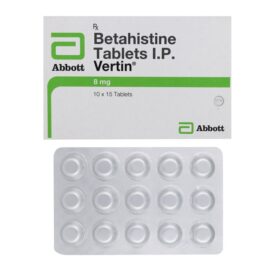
- Vertin (betahistine 8 mg) — chronic Meniere’s disease maintenance
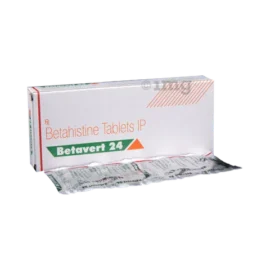
- Betavert (betahistine 8 / 16 mg) — alternative betahistine brand
- Betavert Tab (betahistine 24 mg) — higher-strength once-daily option
- Avomine (promethazine 25 mg) — alternative motion-sickness antihistamine
- Stemetil MD (prochlorperazine 5 mg ODT) — acute vertigo & nausea rescue
Medical Disclaimer
This page is for informational purposes only and is not a substitute for advice from a qualified clinician. Sudden severe vertigo with neurological symptoms (sudden hearing loss, double vision, slurred speech, weakness, numbness, severe headache, or unsteady gait) needs urgent medical evaluation — these can signal stroke or central pathology rather than an inner-ear cause. Discuss new vertigo symptoms with a doctor before self-treating.
More options in Vertigo & Motion Sickness Treatment
Ranked by recent MedsBase order volume — what other customers in this category are picking.
| Strength | 25 mg |
|---|---|
| Quantity | 30 Tablet/s, 60 Tablet/s, 90 Tablet/s, 180 Tablet/s |
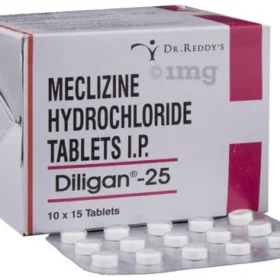 Diligan
Q & A
Diligan
Related products





Reviews
There are no reviews yet