









Erythego Gel
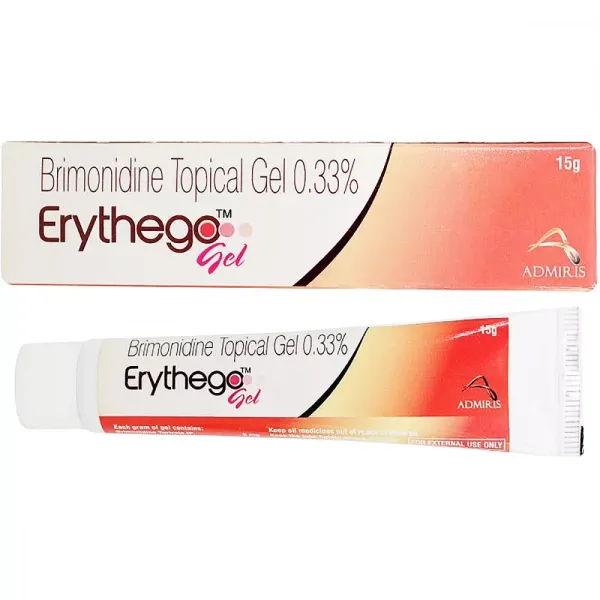
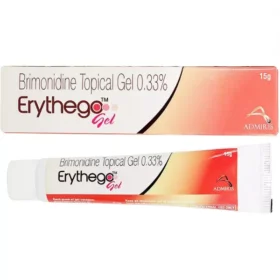
Erythego Gel is a topical brimonidine 0.33% gel (generic Mirvaso) from Ego Pharmaceuticals — FDA-approved for persistent facial erythema of rosacea in adults. Apply once daily; visible redness reduction at 30 minutes, peak pallor at 3–6 hours, effect lasts 12 hours. Pairs well with azelaic acid or topical ivermectin for mixed-subtype rosacea.
✓ Medically reviewed by Morgan Ellis — Pharmacy Researcher · 8 years experience · Last reviewed: May 2026
⚡ Quick Answer — What is Erythego Gel?
Erythego Gel is a topical gel containing brimonidine tartrate 0.33% from Ego Pharmaceuticals — the generic equivalent of Mirvaso. It is FDA-approved for the persistent facial erythema (background redness) of rosacea in adults and is the only topical specifically licensed to reduce the flushing and redness component, rather than the papules and pustules. Apply a pea-sized amount once daily in the morning to clean, dry skin. Onset: 30 minutes. Peak effect: 3–6 hours. Duration: approximately 12 hours. The effect wears off smoothly over the day. Brimonidine is an α2-adrenergic receptor agonist that causes local vasoconstriction of the superficial facial blood vessels — it does not treat the underlying inflammation of rosacea, so it is typically layered with azelaic acid 20% or ivermectin 1% (applied at night) for patients who have both erythema and inflammatory lesions. Rebound redness is the most talked-about side effect: about 10–20% of users experience it in the first weeks, and it almost always settles with continued daily use.
📦 Every order is covered by our Reshipment Assurance Policy — if your parcel does not arrive within 20 business days, we reship it.
Why order from MedsBase
Our generic medications are sourced from WHO-GMP certified manufacturers and shipped worldwide in discreet, plain packaging — no medication name on the parcel exterior. Card payments are routed through a regulated processor (statement descriptors include a regulated card-payment processor — never “MedsBase” or any medication name). Crypto and SEPA bank transfer are also accepted. Every order is backed by our Reshipment Assurance Policy.
What Is Erythego Gel?
Erythego Gel is a topical gel containing brimonidine tartrate 0.33%, manufactured by Ego Pharmaceuticals and supplied in a 30 g tube. It is the generic equivalent of Galderma’s Mirvaso (US) / Mirvaso (EU) — the first and still the only topical approved specifically to treat the persistent erythema (background redness) of rosacea in adults 18 and over.
Brimonidine is an α2-adrenergic receptor agonist. Applied to rosacea-affected facial skin, it binds receptors on the walls of superficial blood vessels and causes them to constrict, reducing the visible diameter and flow — giving a visibly less-red face within 30 minutes of application and holding that effect for most of the day.
How Brimonidine Works on Rosacea Redness
The persistent redness of rosacea comes from two mechanisms: (1) permanent dilation (ectasia) of the superficial dermal blood vessels of the face, and (2) episodic vasodilator flushes triggered by heat, spicy food, alcohol, emotional stress, sun, and inflammatory mediators.
Brimonidine directly activates α2 receptors on the smooth muscle lining these vessels, triggering physiological constriction. This reduces the amount of red-coloured blood visible through the skin, so the face visibly pales within 30 minutes of application. It is a cosmetic/symptomatic effect — brimonidine does not treat the underlying rosacea inflammation or fibrovascular remodelling. Stopping the daily application returns the skin to its baseline redness.
Importantly, this means brimonidine is complementary to — not a replacement for — azelaic acid, topical ivermectin, or topical metronidazole, which address the inflammatory papule-and-pustule component of rosacea. A large share of rosacea patients have both components and benefit from combined therapy.
Approved Use
- Persistent facial erythema of rosacea in adults 18+ — US FDA-approved indication (2013); EMA-approved indication (2014).
Not approved for: papules, pustules, telangiectasia (visible broken capillaries do not constrict under brimonidine — they need laser or IPL), phymatous thickening, or ocular rosacea.
Erythego Gel Dosage and How to Apply
Standard dose: a pea-sized amount once daily. Maximum 1 g (approximately five pea-sized amounts) across the whole face per 24 hours.
- Wash the face with a gentle non-foaming cleanser; pat dry.
- Squeeze out a pea-sized amount of gel.
- Apply a thin, smooth layer across the whole face (forehead, cheeks, nose, chin) — not just the red spots. Blending across the full face prevents a visible border between treated and untreated skin.
- Allow 30 minutes before applying moisturiser, makeup, or sunscreen on top.
- Avoid the eyes, lips, and inside of the nostrils. Wash hands after application.
- Do not exceed once-daily application — doubling up does not increase effect and significantly raises the risk of rebound redness.
Expected effect curve (single application): visible redness reduction at 30 minutes; peak pallor at 3–6 hours; effect wears off smoothly over 10–12 hours.
Side Effects
Common (>3%):
- Flushing / rebound erythema (10–20%) — a paradoxical worsening of redness a few hours after application, or on the following day. Usually mild; settles with continued daily use. Do not treat the rebound by re-applying more brimonidine — that worsens the cycle.
- Application-site erythema, burning, or pruritus
- Contact dermatitis
- Dry skin
Uncommon: worsening of rosacea symptoms, paraesthesia of the application area, dryness of the mouth, headache, dizziness, nasal congestion.
Rare but important: systemic α2 effects — bradycardia, hypotension, drowsiness. Almost never seen with recommended once-daily facial dosing. Severe cases have been reported in children who accidentally ingested the gel.
Managing Rebound Redness
Rebound redness is the main reason people discontinue brimonidine. The single best strategy is to start low — in the first week, use only a quarter of a pea-sized amount mixed into your morning moisturiser, then gradually build to a full pea over 2 weeks. This lets the vasculature adapt without triggering the steep constrict-then-rebound cycle.
If rebound does occur, do not re-apply brimonidine during the rebound — it escalates the cycle. Cold compresses, a break from spicy food/alcohol/heat for 48 hours, and maintenance azelaic acid or ivermectin will settle the flare. Restart brimonidine at a lower dose on your next scheduled morning.
Contraindications & Interactions
- Hypersensitivity to brimonidine or any gel excipient
- Children under 2 years (case reports of serious systemic adverse events from accidental ingestion)
- Caution with concomitant monoamine oxidase inhibitors (MAOIs), tricyclic antidepressants, or other CNS depressants — theoretical risk of systemic sympathomimetic interaction
- Caution in severe cardiovascular disease, unstable angina, cerebral or coronary insufficiency, orthostatic hypotension, Raynaud’s phenomenon, thromboangiitis obliterans, scleroderma, or Sjögren’s syndrome
Pregnancy and breastfeeding: brimonidine is FDA Pregnancy Category B. Systemic absorption from facial application is very low. Reasonable in pregnancy when the benefit exceeds the minimal risk; discuss with your obstetrician.
Erythego Gel vs Other Rosacea Topicals
| Topical | Target symptom | Onset |
|---|---|---|
| Erythego Gel (brimonidine 0.33% gel) | Background redness & flushing | 30 min, lasts 12 h |
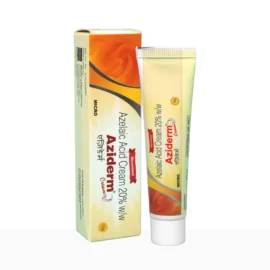
| Azelaic acid 20% (Aziderm) | Papules & pustules | 4–12 weeks |
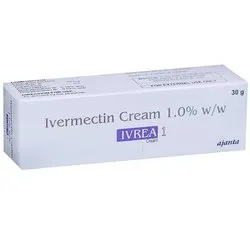
| Ivermectin 1% (Ivrea) | Papules & pustules (Demodex) | 4–8 weeks |
| Oxymetazoline 1% (Rhofade) | Background redness (alternative to brimonidine) | 1 hour |
| Topical metronidazole 0.75–1% | Mild rosacea (first-line) | 8–12 weeks |
Storage
Store below 25°C. Do not freeze. Keep out of reach of children (accidental oral ingestion of brimonidine gel has caused serious systemic effects in young children). Use within 6 months of opening.
Frequently Asked Questions
How quickly does Erythego Gel work?
You should see visibly reduced facial redness within 30 minutes of the first application. Peak pallor is at 3–6 hours, and the effect smoothly wears off over 10–12 hours. It is the fastest-acting rosacea topical available.
Will Erythego Gel stop rosacea permanently?
No. Brimonidine is a daily symptomatic treatment — it constricts visible blood vessels so the face looks less red while it is on the skin. It does not treat the underlying inflammation or repair dilated capillaries. Stopping daily application returns the skin to its baseline redness. For the inflammatory component of rosacea, use azelaic acid, ivermectin, or metronidazole.
What is the rebound flushing I keep reading about?
About 10–20% of new users experience a paradoxical flushing/rebound a few hours after application or the following day, during the first 2–4 weeks. It usually settles with continued daily use. To minimise it, start with a quarter-pea amount blended into moisturiser and build up over 2 weeks. Never re-apply brimonidine during a rebound — it worsens the cycle.
Can I combine Erythego Gel with azelaic acid or ivermectin?
Yes — and that’s the normal combination for mixed-subtype rosacea. Apply brimonidine in the morning for flushing / background redness, and azelaic acid or ivermectin at night for papules / pustules. Allow 30 minutes between applications. Most dermatologists treating rosacea use exactly this split protocol.
Is Erythego Gel the same as Mirvaso?
Pharmacologically yes — both are brimonidine tartrate 0.33% gel. Mirvaso is the original Galderma brand in the US and EU; Erythego Gel (Ego Pharmaceuticals) is a generic equivalent at a substantially lower price. Clinical response is equivalent at equivalent strengths.
Does Erythego Gel work on telangiectasia (visible broken capillaries)?
No. Telangiectasia are permanently dilated small blood vessels — they do not respond meaningfully to α2 agonist constriction. Laser or IPL (intense pulsed light) are the definitive treatments for visible broken capillaries.
Can I use Erythego Gel under makeup?
Yes. Apply brimonidine first, wait 30 minutes for it to absorb and produce pallor, then apply moisturiser, sunscreen, and makeup as usual. Many patients find their makeup covers more smoothly over brimonidine-reduced redness than over baseline rosacea skin.
Can I use Erythego Gel in pregnancy?
Brimonidine is FDA Pregnancy Category B. Systemic absorption from facial application is very low. Reasonable in pregnancy where benefit exceeds minimal risk; discuss with your obstetrician. If you prefer a zero-risk option, azelaic acid 20% is the pregnancy-first option for rosacea.
Where can I buy Erythego Gel online?
You can buy Erythego Gel (brimonidine 0.33% gel, 30 g tube) from MedsBase with discreet packaging and worldwide shipping.
Related Treatments on MedsBase
- Aziderm Cream — Azelaic Acid 20%
- Ivrea Cream — Ivermectin 1% Topical
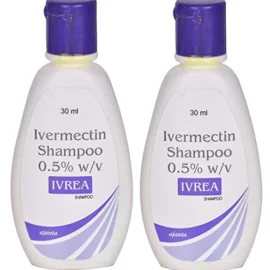
- Ivrea Shampoo — Ivermectin 1%
- Verpin — Ivermectin 6 mg Tablets
- Browse all Rosacea Treatments
Related Alternatives
Other products in Chronic Conditions that customers also view:
More options in Rosacea Treatment
Ranked by recent MedsBase order volume — what other customers in this category are picking.

| Strength | 15 g |
|---|---|
| Quantity | 1 Tube/s, 2 Tube/s, 3 Tube/s, 6 Tube/s |
 Erythego Gel
Q & A
Erythego Gel
Related products



Reviews
There are no reviews yet