







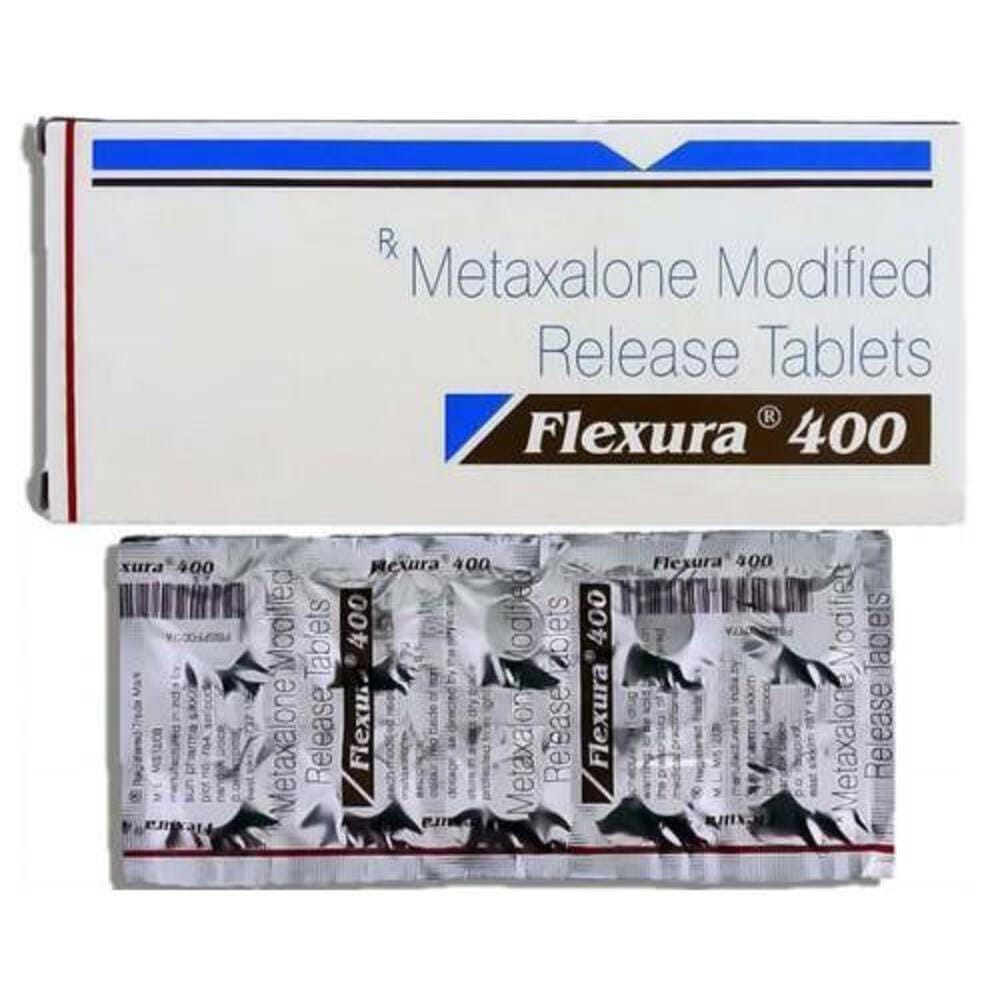
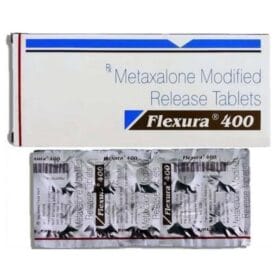
Flexura
✅ Relieves muscle spasms
✅ Eases muscle stiffness
✅ Enhances mobility
✅ Alleviates muscle pain
✅ Improves muscle flexibility
Flexura contains Metaxalone.
✓ Medically reviewed by Morgan Ellis — Pharmacy Researcher · 8 years experience · Last reviewed: May 2026
⚡ Quick Answer — What is Flexura?
Flexura is a metaxalone 400 mg tablet, a centrally-acting muscle relaxant used for acute musculoskeletal conditions — low back pain, muscle strain, and spasm — as a short-course adjunct to rest and physical therapy. Usual adult dose is 800 mg (two tablets) three to four times daily for 1–3 weeks. Metaxalone is usually the muscle relaxant of choice when the patient needs to stay alert, because it causes less drowsiness than cyclobenzaprine, tizanidine, or baclofen.
📦 Every order is covered by our Reshipment Assurance Policy — if your parcel does not arrive within 20 business days, we reship it.
Why order from MedsBase
Our generic medications are sourced from WHO-GMP certified manufacturers and shipped worldwide in discreet, plain packaging — no medication name on the parcel exterior. Card payments are routed through a regulated processor (statement descriptors include a regulated card-payment processor — never “MedsBase” or any medication name). Crypto and SEPA bank transfer are also accepted. Every order is backed by our Reshipment Assurance Policy.
Flexura 400 mg is a tablet form of metaxalone, a centrally-acting skeletal muscle relaxant. Metaxalone has been used clinically since the 1960s. Its exact mechanism is not fully characterised, but the drug appears to produce its muscle-relaxant effect through general central nervous system depression of polysynaptic reflexes rather than by direct action on the neuromuscular junction or on muscle tissue itself.
Flexura’s clinical niche is the patient who needs a short-course oral muscle relaxant but cannot afford the significant drowsiness that accompanies cyclobenzaprine or tizanidine — for example, a professional driver, a student, or anyone managing a household while recovering from low-back injury. In head-to-head and comparative studies, metaxalone consistently comes out as one of the least-sedating centrally-acting muscle relaxants available.
What Is Flexura Used For?
- Acute low back pain with muscle spasm
- Acute neck pain / cervical strain
- Muscle strain — hamstring, calf, quadriceps, shoulder
- Torticollis (“wry neck”)
- Post-traumatic muscle spasm
- Musculoskeletal pain in the context of soft-tissue injury or whiplash
- Tension headache with prominent cervical muscle component (as adjunct)
Flexura is not indicated for chronic back pain, fibromyalgia, or spasticity due to upper motor neuron disease (for that, baclofen or tizanidine are preferred).
How Does Flexura Work?
Metaxalone depresses polysynaptic reflexes in the spinal cord and brainstem, reducing the guarding muscle spasm that accompanies painful musculoskeletal injury. It does not act directly on muscle fibres, on the neuromuscular junction, or on the brain in the way that benzodiazepines do — which is why it usually produces less sedation, less cognitive impairment, and no dependence.
Flexura Dosing
- Adults and children ≥ 13 years: 800 mg (two 400 mg tablets) three to four times daily, with or without food
- Total daily dose: up to 3,200 mg (8 tablets) as divided doses
- Duration: typically 5–14 days; not intended for long-term use
- Elderly patients: start at 400 mg QID and titrate up only if needed
- Renal or hepatic impairment: use with caution; avoid in severe impairment
Take Flexura with water. Food can be taken alongside. If you miss a dose, take it when you remember unless your next dose is due within 2 hours — then skip. Never double up.
Driving and CNS safety for Flexura. Centrally-acting muscle relaxants cause drowsiness, dizziness, and slowed reaction time — especially in the first few days of treatment. Do not drive, operate machinery, or make safety-critical decisions until you know how you react to this medicine. The effect is stronger with alcohol, opioid pain medication, sleeping tablets, or anti-anxiety medication — avoid these combinations unless your doctor has cleared them. Muscle relaxants are short-course medicines — typically used for 1–3 weeks at the start of a musculoskeletal injury while physiotherapy and exercise do the longer-term work.
Who Should Not Take Flexura?
- Known hypersensitivity to metaxalone
- Known tendency to drug-induced haemolytic anaemia
- Severely impaired hepatic function
- Severely impaired renal function
- Pregnancy (unless benefit clearly outweighs risk) and breastfeeding
- Children under 13 years
Side Effects
- Common: drowsiness (less than other muscle relaxants but still possible), dizziness, headache, nervousness, nausea, vomiting, abdominal discomfort
- Uncommon: rash, pruritus, elevated liver enzymes, irritability, hypotension
- Rare but serious: jaundice, haemolytic anaemia, leukopenia, anaphylactoid reactions
Stop Flexura and seek medical advice if you develop yellowing of the skin or eyes, dark urine, unusual fatigue, or signs of an allergic reaction (facial swelling, difficulty breathing, widespread rash).
Drug Interactions
- CNS depressants — alcohol, benzodiazepines, opioids, sleep medications: additive sedation and respiratory depression. Avoid combinations where possible.
- MAOIs — limited data but caution is recommended.
- Other serotonergic drugs — tramadol, SSRIs: theoretical risk of serotonergic effects.
Flexura vs Flexabenz vs Other Muscle Relaxants
| Drug | Mechanism | Sedation | Best use |
|---|---|---|---|
| Flexura (metaxalone) | Spinal polysynaptic reflex depression | Low to moderate | Acute muscle spasm, daytime use |
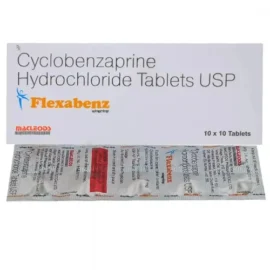
| Flexabenz (cyclobenzaprine) | Central brainstem alpha-MN modulation | High | Short course, bedtime dose |
| Tizanidine | Central α2-adrenergic agonist | Moderate to high | Spasticity, MS/stroke |
| Baclofen | GABA-B agonist (spinal) | Moderate | Spasticity (upper motor neuron) |
| Methocarbamol | Polysynaptic reflex depression | Low to moderate | Acute muscle spasm |
Ordering & Delivery
MedsBase offers worldwide shipping on every order. Orders are dispatched in discreet packaging and arrive in branded manufacturer packs. If your preferred pack size is out of stock, contact customer support for an ETA.
Medical disclaimer. The information on this page is provided for general education only. It is not a substitute for advice from your own doctor or pharmacist. Talk to a qualified healthcare professional before starting, stopping, or changing therapy, especially if you have a history of ulcer disease, heart disease, kidney disease, asthma, liver disease, or are pregnant.
Frequently Asked Questions
What is Flexura used for?
Flexura (metaxalone 400 mg) is used for acute muscle spasm associated with musculoskeletal injury — low back pain, neck strain, torticollis, and muscle strain injuries. It is a short-course adjunct to rest, physiotherapy, and NSAID therapy.
Does Flexura make you sleepy?
Metaxalone is one of the least-sedating centrally-acting muscle relaxants. Some drowsiness is still possible — especially in the first few days, with higher doses, or when combined with alcohol, opioids, or benzodiazepines. Assess your response before driving.
How long should I take Flexura?
Typical course is 5 to 14 days. Muscle relaxants are not intended for long-term use; if pain persists beyond 2–3 weeks, the pain drivers should be reassessed.
Is Flexura addictive?
Metaxalone is not a controlled substance and is not considered to carry meaningful addiction or dependence potential. It is not a benzodiazepine.
Can I take Flexura with ibuprofen or paracetamol?
Yes. Muscle relaxants are commonly combined with an NSAID (ibuprofen, diclofenac) or paracetamol to address pain and spasm simultaneously. This combination is standard practice for acute low back pain.
Can I drink alcohol on Flexura?
Avoid alcohol. The combination increases drowsiness, dizziness, and the risk of falls. If you must drink, keep to small amounts and never in the first few hours after a dose.
Can I drive while taking Flexura?
Test your response first. Many patients drive safely on metaxalone after day 1–2, once the initial drowsiness settles. Do not drive on day 1 and do not drive if you feel dizzy or slow.
Is Flexura safe in pregnancy?
Flexura should be avoided during pregnancy unless the benefit clearly outweighs the risk. Breastfeeding: limited data — use only on medical advice.
What if I miss a dose of Flexura?
Take it when you remember, unless your next dose is due within 2 hours — then skip the missed dose. Never double up.
Can I stop Flexura suddenly?
Yes — unlike benzodiazepines, metaxalone does not cause withdrawal. You can simply stop when symptoms have settled, ideally after a short taper if you have been on high-dose therapy for more than 2 weeks.
Is Flexura the same as cyclobenzaprine or Flexabenz?
No. Flexura is metaxalone; Flexabenz is cyclobenzaprine. Both are centrally-acting muscle relaxants but with different mechanisms, different side-effect profiles, and different sedation levels. Flexura causes less drowsiness; Flexabenz is stronger but more sedating.
For chronic muscle-spasm management beyond metaxalone’s 2–3 week recommended course, Synaptol (tolperisone 150 mg) can be used longer-term and is the preferred European choice for ongoing musculoskeletal pain syndromes.
See also: Synaptol (tolperisone) — tolperisone alternative when cyclobenzaprine sedation is unacceptable — centrally acting without H1 antihistamine drowsiness.
Related Alternatives
Other products in Chronic Conditions that customers also view:
More options in Pain Relief Medication
Ranked by recent MedsBase order volume — what other customers in this category are picking.
| Strength | 400 mg |
|---|---|
| Quantity | 30 Tablet/s, 60 Tablet/s, 90 Tablet/s, 180 Tablet/s |
 Flexura
Q & A
Flexura
Related products




Reviews
There are no reviews yet