








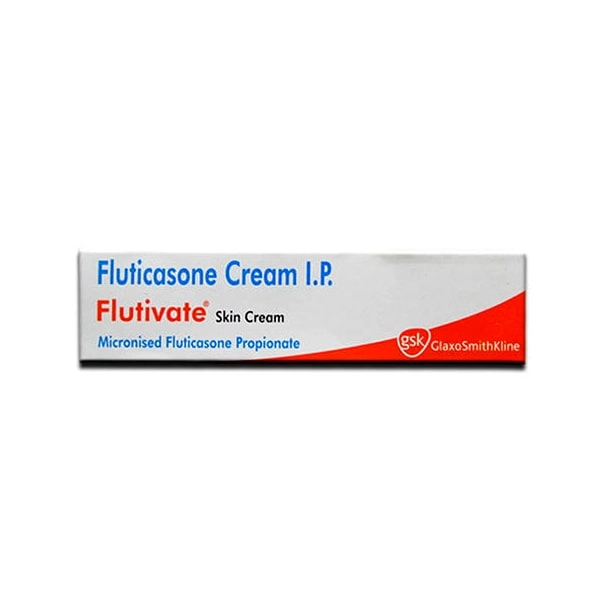
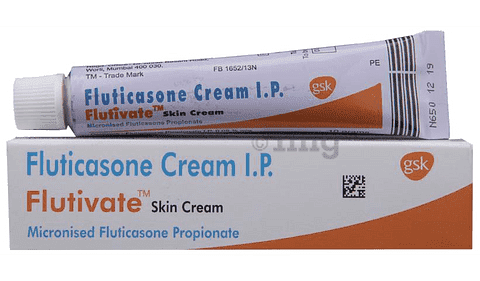
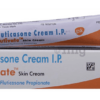
Flutivate Cream
✅ Skin inflammation relief
✅ Itch and redness reduction
✅ Convenient cream format
✅ Improved skin comfort
Contains Fluticasone Propionate
✓ Medically reviewed by Morgan Ellis — Pharmacy Researcher · 8 years experience · Last reviewed: May 2026
⚡ Quick Answer — What is Flutivate Cream?
Flutivate Cream contains fluticasone propionate 0.05% as a topical cream from Glaxo SmithKline — a potent topical corticosteroid (UK Class III / US Class III) used for the short-term treatment of inflammatory and steroid-responsive skin conditions including eczema (atopic dermatitis), psoriasis, contact dermatitis, lichen planus, discoid lupus, seborrhoeic dermatitis, and other dermatoses where topical steroid therapy is indicated. Apply a thin film once or twice daily to affected areas; use the fingertip-unit (FTU) rule for accurate dosing. Maximum continuous course typically 2-4 weeks without medical supervision; longer courses require dermatology input and a planned step-down. Do NOT apply to the face, eyelids, armpits, groin, or genital area for more than a few days — thin-skin areas have much higher absorption and risk of steroid atrophy / telangiectasia / perioral dermatitis. Most common side effects: mild local burning or itching, skin thinning with prolonged use, telangiectasia, hypopigmentation. Tacrolimus or pimecrolimus (topical calcineurin inhibitors) are the steroid-sparing alternatives for thin-skin areas and long-term maintenance.
📦 Every order is covered by our Reshipment Assurance Policy — if your parcel does not arrive within 20 business days, we reship it.
Why order from MedsBase
Our generic medications are sourced from WHO-GMP certified manufacturers and shipped worldwide in discreet, plain packaging — no medication name on the parcel exterior. Card payments are routed through a regulated processor (statement descriptors include a regulated card-payment processor — never “MedsBase” or any medication name). Crypto and SEPA bank transfer are also accepted. Every order is backed by our Reshipment Assurance Policy.
What Is Flutivate Cream?
Flutivate Cream is a topical fluticasone propionate 0.05% cream from Glaxo SmithKline, supplied in a 20 g tube. fluticasone propionate is a synthetic glucocorticoid (corticosteroid) classified as UK Class III / US Class III on the topical-steroid potency ladder.
Topical Steroid Potency — Where Flutivate Cream Sits
Topical corticosteroids are categorised by potency. Flutivate Cream is in the potent tier:
| UK Class | US Class | Potency tier | Examples |
|---|---|---|---|
| I (mild) | VII | Mild | Hydrocortisone 0.5-1% |
| II | VI-V | Moderate | Clobetasone butyrate, betamethasone valerate 0.025% |
| III | III-II | Potent | Fluticasone propionate 0.05%, fluocinolone acetonide 0.025%, mometasone 0.1%, betamethasone valerate 0.1% |
| IV | I | Very potent | Clobetasol propionate 0.05% (Tenovate, Dermovate) |
Use the lowest potency that controls the condition. Step down to a milder steroid (or to a non-steroidal option like a topical calcineurin inhibitor) as soon as the flare is controlled.
How Flutivate Cream Works
fluticasone binds to intracellular glucocorticoid receptors in keratinocytes, dermal fibroblasts, and infiltrating inflammatory cells. The activated receptor translocates to the nucleus where it suppresses transcription of pro-inflammatory cytokines (IL-1, IL-2, IL-6, TNF-α), inhibits phospholipase A2 (reducing prostaglandin and leukotriene synthesis), and promotes apoptosis of T-lymphocytes infiltrating the inflamed skin. The result is rapid suppression of the inflammatory cascade driving conditions like eczema and psoriasis.
Onset of clinical effect: within 24-48 hours; full response usually within 1-2 weeks at the right potency.
Approved Uses
- Atopic dermatitis (eczema) — flare control on body sites (trunk, limbs); avoid prolonged use on face/folds
- Contact dermatitis (allergic and irritant) — short courses to control flares
- Psoriasis (limited and stable plaque type) — thicker plaques on body sites
- Lichen planus, lichen simplex chronicus
- Discoid lupus erythematosus
- Seborrhoeic dermatitis (selected cases)
- Photoallergic and severe insect-bite reactions
- Granuloma annulare, necrobiosis lipoidica (selected cases; sometimes used)
Flutivate Cream Dosage and How to Apply — the FTU Rule
Topical steroid dosing uses the fingertip unit (FTU): the amount squeezed from a standard 5 mm-nozzle tube along the length of an adult index finger from the tip to the first crease. 1 FTU ≈ 0.5 g and treats an area approximately the size of two adult palms.
Application steps:
- Wash and dry your hands
- Wash and gently pat dry the affected area
- Squeeze out the appropriate FTU amount for the body region being treated
- Apply a thin film — rub in gently until absorbed; do NOT use thick layers (more steroid is not more effective and dramatically increases systemic absorption)
- Wash hands after application unless treating the hands
- Allow the steroid to absorb fully before applying any emollient or moisturiser; allow at least 30 minutes between
- Once or twice daily as directed
- Do NOT cover with airtight dressings unless specifically directed — occlusion increases absorption ten-fold
FTU per body region in adults:
- One hand (front and back): 1 FTU
- One arm: 3 FTU
- One foot (top and bottom): 2 FTU
- One leg: 6 FTU
- Front of trunk: 7 FTU
- Back of trunk and buttocks: 7 FTU
Maximum continuous course without medical review: 2-4 weeks. Longer courses, application to large body areas, or use under occlusion all require dermatology supervision and a planned step-down (transition to a less potent steroid, or to a topical calcineurin inhibitor like tacrolimus).
Where NOT to Apply Flutivate Cream
Avoid the following areas unless specifically directed by a dermatologist:
- Face — risk of perioral dermatitis, steroid-induced rosacea, telangiectasia, irreversible atrophy. For facial inflammatory dermatoses, use a low-potency steroid (hydrocortisone 1%) or a topical calcineurin inhibitor (tacrolimus, pimecrolimus) instead.
- Eyelids and around the eyes — absorption is extremely high; risk of glaucoma and posterior subcapsular cataract from chronic use
- Armpits, groin, genitals, perineum, intertriginous folds — high absorption, high risk of striae, atrophy, intertrigo aggravation
- Under nappies / occlusive dressings — occlusion increases absorption ten-fold
- Broken, infected, or weeping skin — do not apply over untreated bacterial, fungal, or viral infection (impetigo, tinea, herpes simplex). Treat the infection first.
- Acne, perioral dermatitis, rosacea — topical steroids worsen these conditions
Side Effects & Safety
Local skin side effects (more common with prolonged use, occlusion, or use on thin/sensitive skin):
- Skin atrophy — thinning, paper-fragile skin, easy bruising (often irreversible)
- Striae (stretch marks) — permanent
- Telangiectasia (visible small blood vessels)
- Hypopigmentation (depigmented patches), particularly visible in darker skin types
- Perioral dermatitis, steroid-induced rosacea, steroid-acne (especially face)
- Hypertrichosis (increased hair growth at application site)
- Tinea incognito — masking and worsening of an underlying fungal infection
- Contact dermatitis to the steroid molecule itself or to excipients
- Burning, stinging, or itching at the application site
- Steroid rebound on abrupt withdrawal — flare worse than the original
Systemic side effects (rare with short-term appropriate use; real risk with high-dose, large-area, prolonged, or occlusive use):
- HPA-axis suppression with extensive use
- Iatrogenic Cushing’s syndrome with severe overuse
- Hyperglycaemia / glucosuria
- Glaucoma and posterior subcapsular cataract from periocular use
- Growth retardation in children
Contraindications & Warnings
Do not use Flutivate Cream if you have:
- Hypersensitivity to fluticasone or any excipient
- Untreated bacterial, fungal, or viral skin infection — impetigo, tinea, herpes simplex, herpes zoster, chickenpox, scabies, perianal/vulvar candidiasis, primary syphilis
- Acne vulgaris, rosacea, perioral dermatitis
- Pruritus without documented inflammatory dermatosis
- Children under 12 months for any potent steroid
Pregnancy: avoid extensive or prolonged use during pregnancy. Brief use over a small area for an essential indication is generally considered acceptable. High cumulative topical-steroid exposure during pregnancy has been associated with low birth weight.
Breastfeeding: if applied to the breast area, wash off thoroughly before each feed.
How to Stop — Avoiding the Rebound Flare
Stopping a potent topical steroid abruptly after >2-3 weeks of regular use commonly causes a steroid rebound flare — the original dermatosis returns, often more severe than at baseline, sometimes accompanied by burning, redness, and “topical steroid withdrawal syndrome” (TSWS).
Your doctor will typically plan one of the following step-down strategies:
- Stepdown to a moderate-potency steroid (e.g. clobetasone butyrate, betamethasone valerate 0.025%) for 1-2 weeks, then to a mild steroid (hydrocortisone 1%) before stopping
- Intermittent “weekend therapy” — potent steroid applied on Saturday and Sunday only, with a moderate steroid or emollient on weekdays
- Switch to a steroid-sparing agent — topical calcineurin inhibitor (tacrolimus 0.1%, pimecrolimus), or systemic therapy in severe cases
- Continuous emollient use alongside any of the above to reduce steroid requirement
How Flutivate Cream Compares to Alternatives
| Drug | Potency | Notable feature |
|---|---|---|
| Flutivate Cream (fluticasone 0.05%) | potent | Body sites; 2-4 week courses |
| Clobetasol propionate 0.05% (Tenovate) | Very potent | Most potent class; severe flares only; 2-week max |
| Hydrocortisone 1% | Mild | Face / paediatric / sensitive sites; OTC in many countries |
| Tacrolimus 0.1% / 0.03% (Tacroz) | N/A (TCI) | Steroid-sparing; thin skin areas; long-term maintenance |
Storage & Shelf Life
Store Flutivate Cream below 25°C in the original tube. Replace the cap tightly after each use. Keep out of reach of children. Once opened, use within the manufacturer-stated period (typically 3-6 months) or before the expiry date, whichever is sooner.
Other Topical Corticosteroids on MedsBase
- Topinate Cream — clobetasol propionate 0.05% (super-high potency for resistant plaques)
- Halovate Cream — halobetasol propionate 0.05% (super-high potency, alternative to clobetasol)
- Eumosone Cream — clobetasone butyrate (mid-potency, gentler for face and folds)
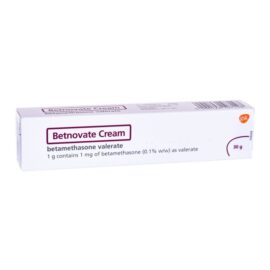
- Betnovate Cream — betamethasone valerate 0.1% (potent steroid, comparable to fluticasone)
- Topgraf Ointment — tacrolimus calcineurin inhibitor (steroid-sparing alternative for face and eczema)
Frequently Asked Questions
Can I use Flutivate Cream on my face?
Generally no — for routine use. Flutivate Cream is a potent steroid; potent steroids on the face cause perioral dermatitis, steroid-induced rosacea, telangiectasia, and irreversible atrophy. For facial inflammatory dermatoses, low-potency steroids (hydrocortisone 1%) for short courses, or topical calcineurin inhibitors (tacrolimus, pimecrolimus), are the appropriate choice.
How long does Flutivate Cream take to work?
You should see improvement within 24-72 hours of starting. Full response is usually within 1-2 weeks. If you see no improvement after 2 weeks, stop and review with your doctor — misdiagnosis (fungal infection mistaken for eczema, for example) is the most common reason.
Why do I need a 2-4 week limit?
Beyond 2-4 weeks of continuous potent-steroid use, the cumulative risk of skin atrophy, telangiectasia, and HPA-axis suppression rises substantially. Treatment beyond this should be reviewed by a doctor or dermatologist who can decide whether to continue, step down, or switch agent (often to tacrolimus for ongoing maintenance).
Can I cover Flutivate Cream with a bandage?
No — occlusion (covering with cling film, bandage, or any airtight dressing) increases systemic absorption of topical steroid up to ten-fold and dramatically increases the risk of HPA-axis suppression and skin atrophy. Occluded steroids are a specific dermatology technique used only under supervision.
My eczema came back worse after I stopped — why?
This is the classic steroid rebound flare from abrupt discontinuation. Restart treatment, then plan a tapered stepdown with your doctor — typically transitioning to a moderate-potency steroid for 1-2 weeks, then a mild steroid, then emollient maintenance ± a steroid-sparing agent like tacrolimus.
Can children use Flutivate Cream?
Children have more permeable skin and a higher risk of HPA-axis suppression, growth retardation, and atrophy from potent topical steroids. Generally not used in children under 12 months. For ages 1-12, use under direct paediatric supervision; mild-to-moderate potency steroids (hydrocortisone 1%, clobetasone butyrate) are the standard choice. Tacrolimus 0.03% is the steroid-sparing alternative for children 2+.
Can I use Flutivate Cream during pregnancy?
Avoid extensive or prolonged use. Brief use over a small area for an essential indication is generally considered acceptable. High cumulative topical-steroid exposure during pregnancy has been associated with low birth weight. Discuss with your doctor before starting any topical steroid in pregnancy.
What’s the difference between potent and very-potent steroids?
Very-potent steroids (clobetasol, the only one in this tier) are roughly 5-10 times more potent than the potent class (fluticasone, mometasone, betamethasone valerate 0.1%). Very-potent steroids are reserved for severe flares (psoriasis, lichen sclerosus) where the potent class is insufficient. They have the same family of side effects, just more concentrated, with a stricter 2-week ceiling.
Where can I order Flutivate Cream online?
You can order Flutivate Cream from MedsBase in standard pack sizes (20 g tube). Orders ship worldwide with discreet packaging. Topical corticosteroids are restricted to specialist supervision in most countries.
More options in Eczema & Psoriasis Treatment
Ranked by recent MedsBase order volume — what other customers in this category are picking.
| Strength | Fluticasone Propionate (0.05% w/w) |
|---|---|
| Quantity | 1 Tube/s, 3 Tube/s, 6 Tube/s |
| Pharma Form | Tube/s |
| Manufacturer | Glaxo SmithKline |
| Treatment | Allergy symptoms, Asthma |
| Generic Brand | Fluticasone Propionate |
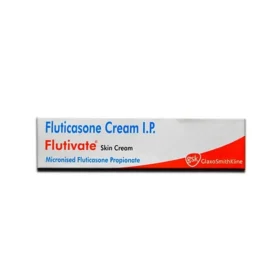 Flutivate Cream
Q & A
Flutivate Cream
Related products


Reviews
There are no reviews yet