







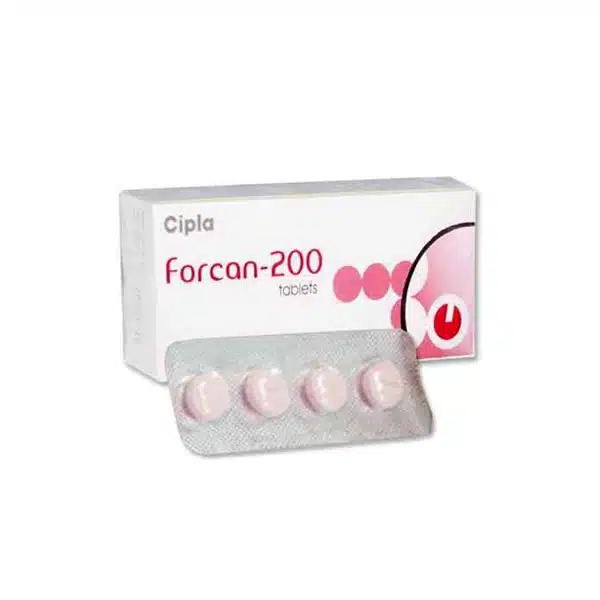
Forcan


✅ Potent Against Fungal Infections
✅ Fast-Acting Symptom Relief
✅ Effective for Severe Cases
✅ Prophylactic Use Possible
✅ Easy and Convenient
Forcan contains Fluconazole
✓ Medically reviewed by Morgan Ellis — Pharmacy Researcher · 8 years experience · Last reviewed: May 2026
💡 Quick Answer
Forcan is fluconazole 150 mg oral tablet — a systemic triazole antifungal. Single 150 mg dose for vaginal candidiasis; 50–400 mg/day for invasive Candida, oesophageal thrush, and prophylaxis in immunocompromised patients. Inhibits fungal CYP51 (lanosterol 14-α-demethylase). Long half-life (~30 h) allows once-daily or weekly dosing. Major drug interactions via CYP3A4 / CYP2C9 / CYP2C19 inhibition — review warfarin, statins, sulfonylureas, phenytoin, oral contraceptives.
WHO-GMP
certified manufacturer
📦 Every order is covered by our Reshipment Assurance Policy — if your parcel does not arrive within 20 business days, we reship it.
Why order from MedsBase
Our generic medications are sourced from WHO-GMP certified manufacturers and shipped worldwide in discreet, plain packaging — no medication name on the parcel exterior. Card payments are routed through a regulated processor (statement descriptors include a regulated card-payment processor — never “MedsBase” or any medication name). Crypto and SEPA bank transfer are also accepted. Every order is backed by our Reshipment Assurance Policy.
Discreet packaging
plain envelope
Worldwide shipping
to most countries
🔒 Why order Forcan from MedsBase
- WHO-GMP certified manufacturer — sourced from a regulated facility, finished pack with batch number and expiry.
- Discreet packaging — plain envelope, no medication name on the outside.
- Worldwide shipping to most countries with Reshipment Assurance.
- Loyalty points — 1 point per $1 spent (excludes peptides/shipping); 100 points = $5 off your next order.
Uses & indications
Forcan (fluconazole 150 mg, Cipla) is a triazole antifungal used for both superficial and systemic Candida and Cryptococcus infections. Compared to topical-only options, oral fluconazole reaches all body compartments (including CSF, ~80% of plasma level) — making it the workhorse for any infection that is not strictly skin-deep.
| Indication | Typical regimen |
|---|---|
| Vaginal candidiasis (uncomplicated) | Single 150 mg dose orally |
| Recurrent vulvovaginal candidiasis | 150 mg every 72 h × 3 doses, then 150 mg weekly × 6 months |
| Oropharyngeal candidiasis | 200 mg day 1, then 100 mg/day × 7–14 days |
| Oesophageal candidiasis | 200–400 mg/day × 14–21 days |
| Invasive candidiasis | 800 mg day 1, then 400 mg/day × 14 days minimum (after first negative blood culture) |
| Cryptococcal meningitis (consolidation) | 400 mg/day × 8 weeks, then 200 mg/day maintenance |
| Prophylaxis in haematology / transplant | 200–400 mg/day |
How to take
- Tablets can be taken with or without food.
- For single-dose vaginal candidiasis: take one 150 mg tablet with water — symptoms usually settle within 24–72 h.
- For weekly maintenance: take the same day each week (e.g. every Sunday) — set a reminder to avoid missed doses.
- Do not double up after a missed dose — take the missed dose as soon as you remember unless it is close to the next dose.
How it works
Fluconazole selectively inhibits fungal cytochrome P-450 enzyme CYP51 (lanosterol 14-α-demethylase). This blocks the conversion of lanosterol to ergosterol — the principal sterol in fungal cell membranes. The resulting ergosterol-poor membrane becomes leaky and the fungal cell loses integrity. Selectivity for fungal vs. mammalian CYP enzymes is what makes fluconazole much better tolerated than the older imidazole antifungals.
Side effects & monitoring
| Frequency | Typical effects |
|---|---|
| Common (≥1/100) | Headache, nausea, abdominal pain, diarrhoea, transient ALT/AST rise, rash |
| Uncommon | Vomiting, dyspepsia, taste disturbance, dizziness, mild neutropenia |
| Rare but serious | Hepatotoxicity (cholestatic or hepatocellular — discontinue if AST/ALT >3× ULN), Stevens-Johnson syndrome / TEN, QT prolongation / torsades, anaphylaxis, alopecia (long courses) |
Drug interactions (the important ones)
| Drug class / drug | Effect | Practical action |
|---|---|---|
| Warfarin | INR rises 2–4-fold (CYP2C9 inhibition) | Check INR within 3–5 days; reduce warfarin dose 25–50% |
| Phenytoin | Phenytoin levels rise 75% (CYP2C9 inhibition) | Monitor levels; reduce phenytoin |
| Sulfonylureas (glipizide/glibenclamide) | Hypoglycaemia risk | Monitor glucose closely |
| Simvastatin / atorvastatin / lovastatin | Statin levels rise (CYP3A4) → myopathy / rhabdomyolysis | Switch to pravastatin / rosuvastatin or hold statin during course |
| Tacrolimus / ciclosporin / sirolimus | Levels rise — nephrotoxicity, neurotoxicity | Reduce dose; trough monitoring |
| Oral contraceptives | Slight rise in ethinylestradiol / levonorgestrel | Continue as normal — efficacy not reduced |
| Amiodarone, sotalol, citalopram, methadone, ondansetron | Additive QT prolongation | Avoid combinations > 200 mg/day if possible; ECG if symptomatic |
| Rifampicin / rifabutin | Fluconazole levels fall (induction) | Increase fluconazole dose or switch to voriconazole |
Who should not take fluconazole
- Documented hypersensitivity to fluconazole or other azoles.
- Co-administration with terfenadine, astemizole, cisapride, pimozide, quinidine, or erythromycin (QT prolongation).
- Concurrent simvastatin, atorvastatin, or lovastatin at full dose.
- Caution in active liver disease, congenital long-QT syndrome, and severe renal impairment (dose-adjust below).
Renal dose adjustment
| CrCl (mL/min) | Adjustment |
|---|---|
| > 50 | No change |
| ≤ 50 (no dialysis) | Give standard loading dose, then 50% of the maintenance dose |
| Haemodialysis | Give 100% dose after each dialysis session |
Pregnancy & breastfeeding
Single 150 mg dose for vaginal candidiasis is generally considered low-risk in pregnancy after the first trimester, but topical clotrimazole is preferred when possible. High-dose fluconazole (≥ 400 mg/day) in the first trimester has been associated with a recognised pattern of congenital anomalies (cardiac, craniofacial, skeletal) and should be avoided. Fluconazole is excreted in breast milk at concentrations close to maternal plasma — a single 150 mg dose is compatible with breastfeeding; continuous high-dose courses are not.
Frequently Asked Questions
How long until I feel better?
Vaginal candidiasis: itch and discharge usually settle within 24–72 hours of a single 150 mg dose. Oral thrush: noticeable improvement in 3–5 days. Invasive candidaemia: clinical response is judged at 5–7 days.
Can I drink alcohol with fluconazole?
There is no specific disulfiram-like reaction, but both alcohol and fluconazole are processed by the liver. Heavy or chronic alcohol use raises the risk of hepatotoxicity — keep intake light, ideally avoid alcohol during the course, especially for treatment longer than 7 days.
Why is one 150 mg dose enough for thrush?
Fluconazole has a long elimination half-life (~30 hours) and concentrates well in vaginal fluid. After a single 150 mg dose, fungicidal levels persist for 72 hours or more — long enough to clear an uncomplicated Candida albicans infection.
Is fluconazole the same as Diflucan?
Yes — Diflucan is the original Pfizer brand of fluconazole. Forcan contains the same active ingredient, manufactured by Cipla under WHO-GMP. Bioequivalent generic.
Can I take fluconazole if I have liver disease?
Caution. Mild compensated liver disease usually permits short courses with LFT monitoring. Decompensated cirrhosis or active hepatitis — discuss with a clinician; alternative agents may be preferred.
I have recurrent yeast infections — what’s the maintenance plan?
After a 3-dose induction (150 mg every 72 h × 3), maintenance is 150 mg once weekly for 6 months. This regimen reduces recurrence by ~80% compared to placebo (Sobel 2004 NEJM).
What if my partner has thrush?
Vulvovaginal candidiasis is not a sexually-transmitted infection. Routine partner treatment is not recommended unless the male partner has symptomatic balanitis (treated with topical clotrimazole).
Will fluconazole interact with my contraceptive pill?
No — fluconazole modestly raises ethinylestradiol and levonorgestrel levels but contraceptive efficacy is preserved. Continue your normal pill regimen.
What if my symptoms come back after one dose?
If symptoms persist beyond 7 days or recur within 4 weeks, the diagnosis may be incorrect (bacterial vaginosis, trichomonas, dermatitis), or you may have azole-resistant Candida glabrata or Candida krusei — see a clinician for swab and culture.
Can I take fluconazole and clotrimazole pessaries together?
Yes — combining oral fluconazole with topical clotrimazole is safe and is sometimes used in severe or recurrent vaginal candidiasis. There is no drug-interaction concern between the two.
Storage
Store the tablets at room temperature (below 25 °C / 77 °F) in the original blister pack, away from direct sunlight, heat, and moisture. Keep out of reach of children. Do not use after the expiry date printed on the pack.
Other Antifungal Medications you may be interested in
If Forcan is unavailable or you need a different formulation, here are alternatives — same molecule from a different manufacturer or a different drug class for indications where fluconazole is not first-line.
- Zocon (fluconazole 150 mg) — Single-dose oral standard for vaginal candidiasis.
- Forcan (fluconazole 150 mg) — Same molecule, different manufacturer.
- Fluka (fluconazole 150 mg) — Cipla brand; bioequivalent.
- Clocip (clotrimazole 1% cream) — Topical relief for vulval / cutaneous Candida itch.
- Sporanox (itraconazole) — Alternative oral azole for fluconazole-resistant infection.
More options in Anti Fungal
Ranked by recent MedsBase order volume — what other customers in this category are picking.

| Strength | 200 mg |
|---|---|
| Quantity | 16 Tablet/s, 32 Tablet/s, 64 Tablet/s |
| Pharma Form | Tablet/s |
| Manufacturer | Cipla Inc |
| Treatment | Fungal infections |
| Generic Brand | Fluconazole |
 Forcan
Q & A
Forcan
Related products


Reviews
There are no reviews yet