







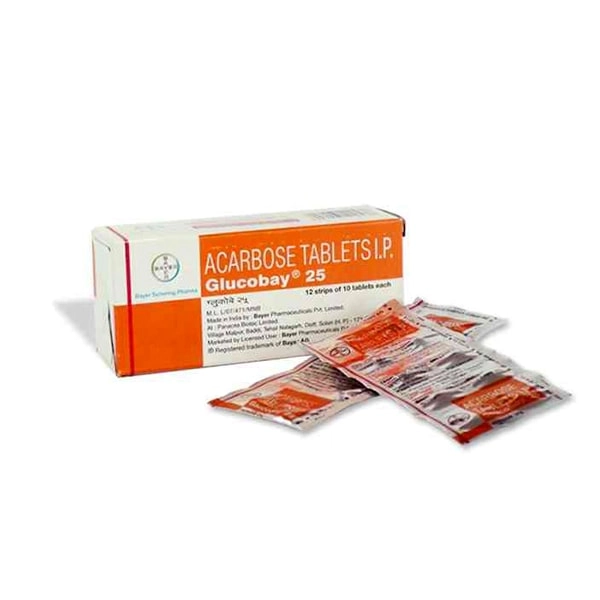
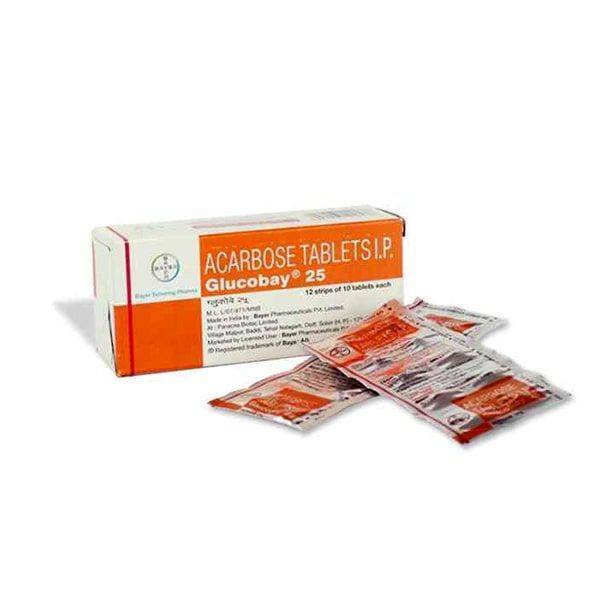
Glucobay
✅ Helps control blood sugar
✅ Manages post-meal spikes
✅ Supports weight management
✅ Reduces diabetes-related complications
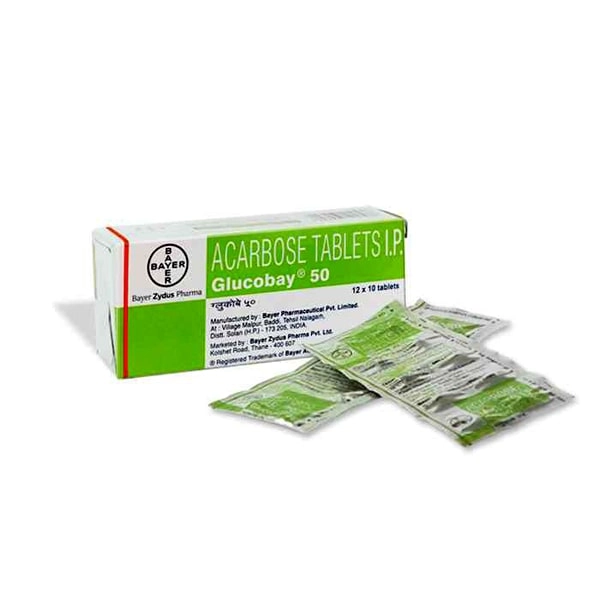
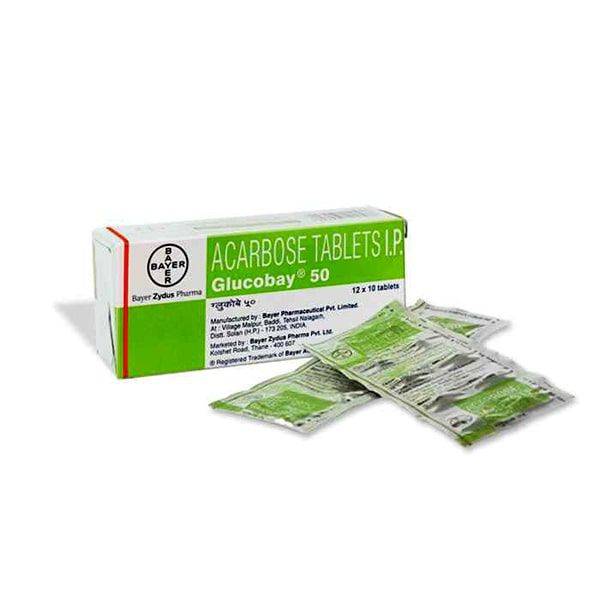
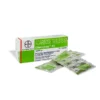
Glucobay contains Acarbose
✓ Medically reviewed by Morgan Ellis — Pharmacy Researcher · 8 years experience · Last reviewed: May 2026
⚡ Quick Answer — What is Glucobay?
Glucobay is a brand of acarbose (25 mg or 50 mg), an alpha-glucosidase inhibitor used for type 2 diabetes and prediabetes. It works in the gut: it slows the breakdown of complex carbohydrates into glucose, blunting the post-meal blood-sugar spike. It does not cause hypoglycaemia on its own. HbA1c reduction: 0.5–0.8 percentage points — modest but particularly useful for people with high post-meal glucose (and normal fasting glucose). Take the tablet with the very first bite of each main meal. Inhibits both alpha-amylase and alpha-glucosidase — broadest carb-blocking action of the class. Main side effects are entirely GI: flatulence, bloating, diarrhoea (improves after 2–4 weeks on gradual up-titration). Avoid in inflammatory bowel disease, chronic intestinal disorders, severe renal impairment, and pregnancy.
📦 Every order is covered by our Reshipment Assurance Policy — if your parcel does not arrive within 20 business days, we reship it.
Why order from MedsBase
Our generic medications are sourced from WHO-GMP certified manufacturers and shipped worldwide in discreet, plain packaging — no medication name on the parcel exterior. Card payments are routed through a regulated processor (statement descriptors include a regulated card-payment processor — never “MedsBase” or any medication name). Crypto and SEPA bank transfer are also accepted. Every order is backed by our Reshipment Assurance Policy.
What Is Glucobay?
Glucobay is an oral antidiabetic medicine containing acarbose (25 mg or 50 mg), manufactured by Bayer India. Available in packs of 30, 60, 90 or 180 tablets. acarbose is an alpha-glucosidase inhibitor — a class that acts locally in the small intestine to slow carbohydrate digestion. First approved in 1990 (EU) / 1995 (US). Widely used in East Asia for post-meal glucose control; originator brand Glucobay (Bayer).
Alpha-glucosidase inhibitors are a good fit for patients whose main problem is post-meal glucose spikes (especially on carbohydrate-heavy diets) while fasting glucose is close to normal — a pattern common in Asian populations.
How Does Glucobay Work?
When you eat a carbohydrate meal, enzymes in the small intestine (alpha-amylase and alpha-glucosidases at the brush border) break complex carbohydrates into simple sugars (glucose) that can then be absorbed into the bloodstream.
acarbose competitively inhibits those enzymes. The effect is:
- Delayed carbohydrate digestion — glucose is released more gradually over the 2–3 hours after a meal
- Lower post-meal glucose peak (by 40–60 mg/dL on average)
- Reduced demand for post-meal insulin release — may preserve beta-cell function over time
- No direct effect on fasting glucose or insulin release — so no hypoglycaemia as monotherapy
Because the drug acts entirely within the gut lumen (systemic absorption is minimal for acarbose and voglibose), it has very few systemic side effects. Typical HbA1c reduction: 0.5–0.8 percentage points. Fasting glucose is essentially unchanged.
Dosage and Administration
Dose: 25 mg three times daily with the first bite of each main meal. Titrate every 4–8 weeks in 25 mg steps. Usual maintenance: 50–100 mg three times daily. Max 300 mg/day.
- Take with the first bite of the meal. Taking after the meal is much less effective — the enzymes are already acting.
- Start low, titrate slowly. The commonest reason for stopping is GI side effects. Starting at the lowest dose and titrating over 4–8 weeks dramatically improves tolerability.
- Skip the dose if you skip the meal.
- Hypoglycaemia rescue: if hypoglycaemia occurs on combination therapy (with sulfonylurea or insulin), use pure glucose (dextrose) — not sucrose, bread, or fruit juice. Alpha-glucosidase inhibitors block sucrose breakdown, so table sugar acts too slowly.
- Renal: avoid if eGFR < 25–30.
Side Effects
Almost all side effects are GI and due to unabsorbed carbohydrates fermenting in the colon:
Common (up to 30% in first weeks; improves to < 10% with slow titration):
- Flatulence
- Bloating, abdominal discomfort
- Soft stools or diarrhoea
- Borborygmi (audible gut rumbling)
Uncommon: transient liver-enzyme elevations (mostly with acarbose at high doses), rash, hypersensitivity.
Because acarbose does not stimulate insulin release, it does not cause hypoglycaemia on its own. Hypoglycaemia risk only appears when combined with a sulfonylurea, meglitinide, or insulin.
Drug Interactions
- Digestive enzyme preparations (pancreatin, amylase) — counteract the drug’s effect; do not combine.
- Sulfonylureas, meglitinides, insulin — additive glucose-lowering with hypoglycaemia risk. Use glucose (dextrose), not cane sugar, to treat a hypo.
- Thiazide diuretics, corticosteroids, thyroid hormones — may reduce glucose-lowering effect.
- Digoxin — acarbose may reduce digoxin absorption; separate by 2 hours.
- Neomycin, antibiotics affecting gut flora — may worsen GI side effects.
Who Should Not Take Glucobay?
- Inflammatory bowel disease (Crohn’s, ulcerative colitis)
- Chronic intestinal disorders, partial intestinal obstruction
- Malabsorption syndromes
- Large hiatus hernias or conditions worsened by increased gas formation
- Severe renal impairment (eGFR < 25–30)
- Severe hepatic impairment
- Pregnancy and breastfeeding
- Children (safety not established)
- Diabetic ketoacidosis
- Known hypersensitivity
Storage
Store Glucobay below 25°C in a dry place, in the original blister. Keep out of reach of children.
Frequently Asked Questions
Is acarbose better than voglibose or miglitol?
All three alpha-glucosidase inhibitors have similar HbA1c effect (0.5–0.8 points) and identical targets. Acarbose has the strongest evidence base (including the STOP-NIDDM prediabetes trial) but also the most GI side effects (flatulence, diarrhoea). Voglibose produces less GI upset and is popular in Japan and India. Miglitol has slightly better systemic absorption.
Why do I have so much gas on Glucobay?
Because unabsorbed carbohydrates travel to the colon, where gut bacteria ferment them into gases (hydrogen, methane, CO2). This is expected and usually improves within 2–4 weeks if you titrate slowly. Eating fewer concentrated sweets and sugars during the adjustment period also helps.
Can Glucobay help me lose weight?
Modestly, if at all — alpha-glucosidase inhibitors are weight-neutral or result in mild weight loss (0.5–1.5 kg). SGLT-2 inhibitors and GLP-1 agonists are much stronger weight-loss agents.
Does Glucobay cause hypoglycaemia?
Not on its own. When combined with a sulfonylurea or insulin, the combination can cause hypoglycaemia — and then it is important to use glucose tablets or dextrose, not table sugar, because acarbose blocks sucrose digestion.
Can Glucobay be used for prediabetes?
Acarbose has good evidence in prediabetes (the STOP-NIDDM trial showed a 36% reduction in progression to type 2 diabetes), and it is used off-label for this indication in some regions. Metformin is the usual first choice.
Where can I buy Glucobay online?
You can order Glucobay (25 mg or 50 mg) from MedsBase in packs of 30, 60, 90 or 180 tablets. We ship worldwide, with discreet packaging and genuine WHO-GMP certified manufacturer stock.
Related Diabetes Medications
- Glucobay — Acarbose 25/50 mg (Bayer)
- Voglibite — Voglibose 0.2/0.3 mg
- PPG — Voglibose (Abbott)
- Mignar — Miglitol (Glenmark)
- Glycomet SR — Metformin sustained-release
- Januvia — Sitagliptin (DPP-4 inhibitor)
- Browse all Diabetes Medications
Related Alternatives
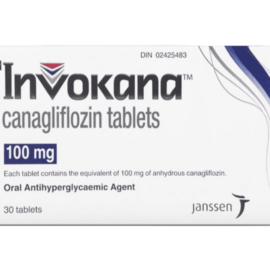
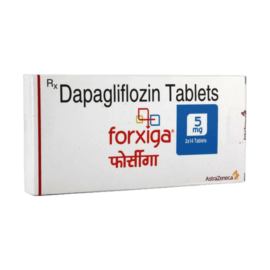
Other products in Chronic Conditions that customers also view:
More options in Diabetes
Ranked by recent MedsBase order volume — what other customers in this category are picking.

| Strength | 25 mg, 50 mg |
|---|---|
| Quantity | 30 Tablet/s, 60 Tablet/s, 90 Tablet/s |
| Pharma Form | Tablet/s |
| Manufacturer | Bayer India |
| Treatment | Type 2 diabetes |
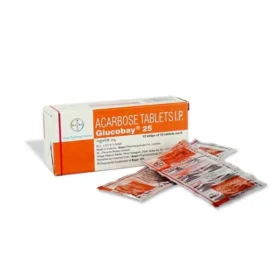 Glucobay
Q & A
Glucobay
Related products


Reviews
There are no reviews yet