







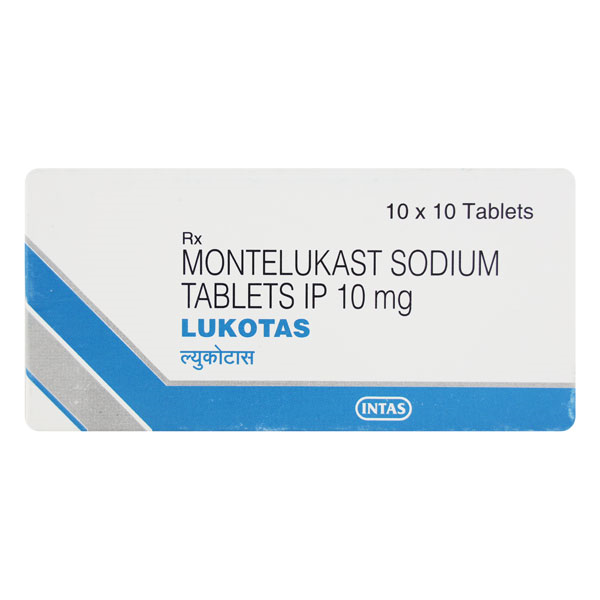
Lukotas
✅ Manages allergies
✅ Relieves asthma symptoms
✅ Reduces bronchoconstriction
✅ Controls wheezing
✅ Prevents airway inflammation
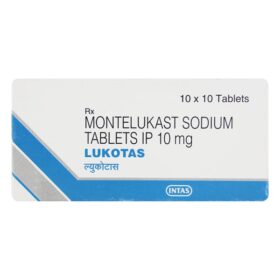
Lukotas contains Montelukast.
✓ Medically reviewed by Morgan Ellis — Pharmacy Researcher · 8 years experience · Last reviewed: May 2026
⚡ Quick Answer — What is Lukotas?
Lukotas contains montelukast, an oral preventer for asthma and allergic rhinitis. Montelukast blocks cysteinyl leukotriene receptors (CysLT1), mediators released by mast cells and eosinophils that drive bronchoconstriction, mucus production, and airway oedema. Used as add-on preventer therapy for asthma, especially exercise-induced and allergy-triggered asthma, and for allergic rhinitis. Each tablet contains 4 / 5 / 10 mg, manufactured by Intas Pharmaceuticals. Taken once daily in the evening.
Important — neuropsychiatric warning: the FDA added a black-box warning in 2020 noting reports of mood changes, sleep disturbance, anxiety, depression, and (rarely) suicidal ideation with montelukast. Discuss any new mood symptoms with your prescriber.
📦 Every order is covered by our Reshipment Assurance Policy — if your parcel does not arrive within 20 business days, we reship it.
Why order from MedsBase
Our generic medications are sourced from WHO-GMP certified manufacturers and shipped worldwide in discreet, plain packaging — no medication name on the parcel exterior. Card payments are routed through a regulated processor (statement descriptors include a regulated card-payment processor — never “MedsBase” or any medication name). Crypto and SEPA bank transfer are also accepted. Every order is backed by our Reshipment Assurance Policy.
What Is Lukotas?
Lukotas is a montelukast (LTRA) preparation manufactured by Intas Pharmaceuticals at WHO-GMP certified facilities. Internationally montelukast is sold as Singulair (MSD). Available as 4 mg, 5 mg, and 10 mg tablets — strengths chosen by age and indication.
How Does Lukotas Work?
Cysteinyl leukotrienes (LTC4, LTD4, LTE4) are inflammatory lipid mediators released by mast cells, eosinophils, and basophils when activated by allergen, exercise, cold air, or aspirin. They bind CysLT1 receptors on airway smooth muscle, eosinophils, and bronchial epithelium — driving bronchoconstriction, eosinophil recruitment, airway oedema, and mucus hypersecretion. Montelukast selectively blocks CysLT1, breaking this cascade.
Uses and Indications
- Persistent asthma — add-on preventer in patients not controlled by ICS alone (alternative to LABA or LAMA add-on)
- Exercise-induced asthma — particularly effective; taken 2 hours before exercise
- Aspirin-exacerbated respiratory disease (AERD) — leukotrienes are central to this phenotype
- Allergic rhinitis — both seasonal (hay fever) and perennial
- Allergic conjunctivitis adjunct
- Chronic urticaria — montelukast as adjunct to high-dose antihistamine
Lukotas Dosage
| Patient | Dose | Frequency |
|---|---|---|
| Adults & children >15 yr | 10 mg | Once daily in the evening |
| Children 6–14 yr | 5 mg chewable | Once daily in the evening |
| Children 2–5 yr | 4 mg chewable / granules | Once daily in the evening |
| Children 6 mo – 2 yr | 4 mg granules | Once daily — specialist supervision |
Side Effects of Lukotas
- Headache
- Mild abdominal pain or nausea
- Sleep disturbance (vivid dreams, insomnia)
- Mood changes — irritability, anxiety, depression (FDA black-box warning, 2020)
- Upper respiratory infection symptoms
- Rash
Serious — stop and seek help:
- Severe allergic reaction / angio-oedema
- Suicidal ideation or severe depression — STOP and seek urgent psychiatric review
- Churg-Strauss syndrome (eosinophilic vasculitis) — rare; suspect in ICS-tapering patients with new vasculitic features (rash, neuropathy, eosinophilia)
- Hepatitis (rare)
Warnings and Precautions
- Black-box warning — neuropsychiatric events. If new mood changes, anxiety, sleep disturbance, agitation, depression, or suicidal thoughts occur, stop Lukotas and contact your prescriber.
- Not a rescue medication. Do not use in acute asthma attacks — onset is too slow.
- Continue ICS if previously prescribed; montelukast does not replace inhaled corticosteroids.
- Hepatic impairment: use cautiously in moderate-to-severe disease.
- Pregnancy and breastfeeding: reasonable safety data; use when benefits outweigh risks.
- Children may show increased risk of behavioural changes — counsel parents to monitor mood.
Contraindications
- Hypersensitivity to montelukast or excipients
- Severe hepatic impairment — relative
Drug Interactions
| Interacting drug | Effect | What to do |
|---|---|---|
| Phenobarbital, phenytoin, rifampicin | Induce CYP enzymes — reduce montelukast levels | Monitor asthma control |
| Gemfibrozil | Inhibits CYP2C8 — increases montelukast levels | Use with caution |
| Warfarin | Theoretical INR change reported in case reports | Monitor INR after starting/stopping |
Storage
- Store below 25°C in a cool, dry place away from direct sunlight.
- Keep in original packaging until use to protect from moisture and light.
- Do not use after the expiry date printed on the strip.
- Keep out of reach of children.
Related Alternatives on MedsBase
- Asthalin Inhaler — salbutamol reliever
- Budecort Inhaler — budesonide ICS preventer
- Foracort Inhaler — budesonide + formoterol ICS-LABA
- Tiova Inhaler — tiotropium LAMA for COPD
- Montair — montelukast LTRA tablet
Frequently Asked Questions
When should I take montelukast?
Once daily in the evening, with or without food. Evening dosing matches the typical overnight rise in leukotriene mediators and gives best protection against early-morning symptoms.
How long until montelukast works?
Some symptom relief within 24–48 hours. Full effect on asthma exacerbation rate develops over 4–8 weeks.
Should I worry about the FDA black-box warning?
The 2020 FDA black-box warning highlighted reports of mood changes, sleep disturbance, anxiety, depression, and rarely suicidal ideation — particularly in children. The absolute risk is low but real. Watch for any new mood symptoms in yourself or your child; stop the drug and contact your prescriber if they appear.
Can montelukast replace my inhaler?
No — montelukast is an add-on preventer. It does not replace inhaled corticosteroids (Budecort, Beclate, Foracort, Seretide). Continue ICS as prescribed.
Is montelukast a rescue medication?
No — onset is too slow. Use a SABA (Asthalin, Levolin) for acute attacks.
Can children take montelukast?
Yes from 6 months of age in age-appropriate strengths (4 mg granules, 4 mg or 5 mg chewable, 10 mg tablet). Counsel parents to monitor mood and behaviour.
Is montelukast safe in pregnancy?
Reasonable observational data; use when benefits outweigh risks, particularly in patients whose asthma is well-controlled on it.
Does montelukast help allergic rhinitis?
Yes — montelukast is licensed for both asthma and allergic rhinitis. Particularly useful when both coexist (United Airways disease).
Should I stop montelukast if I feel better?
No — continue daily for as long as your prescriber advises. Stopping leads to gradual return of symptoms over days-to-weeks.
Related Alternatives
Other products in Chronic Conditions that customers also view:
More options in Asthma/COPD Treatment
Ranked by recent MedsBase order volume — what other customers in this category are picking.


| Strength | 10 mg |
|---|---|
| Quantity | 30 Tablet/s, 60 Tablet/s, 90 Tablet/s, 180 Tablet/s |
 Lukotas
Q & A
Lukotas
Related products




Reviews
There are no reviews yet