







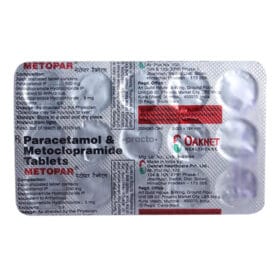
Metopar
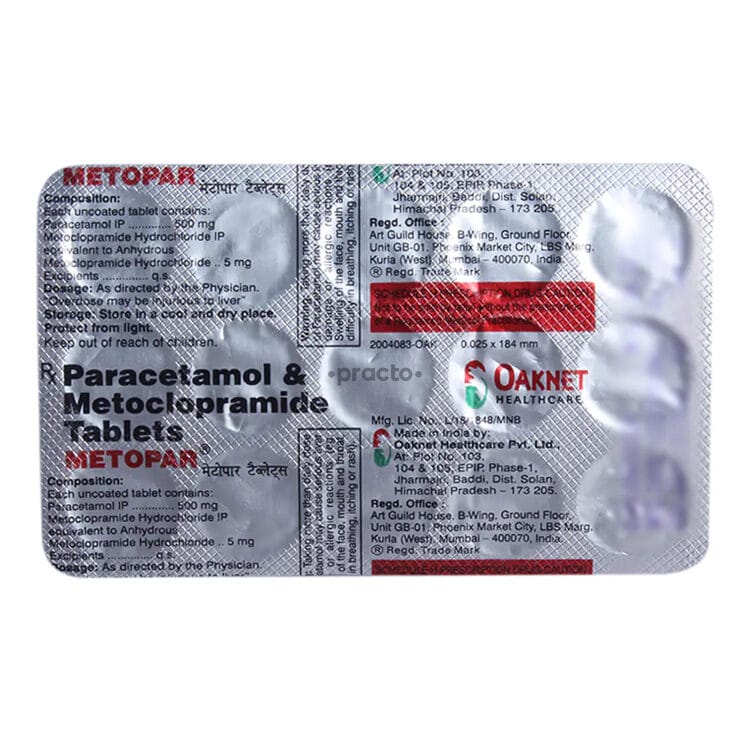
Metopar (Paracetamol 500 mg + Metoclopramide 5 mg) — combination tablet for acute migraine with nausea. Metoclopramide overcomes migraine gastric stasis so paracetamol absorbs faster.
✓ Medically reviewed by Morgan Ellis — Pharmacy Researcher · 8 years experience · Last reviewed: May 2026
⚡ Quick Answer — What is Metopar?
Metopar is a fixed-dose combination of paracetamol 500 mg + metoclopramide 5 mg designed for acute migraine attacks with nausea. Paracetamol provides simple analgesia; metoclopramide accelerates gastric emptying (which is paralysed during migraine, otherwise blunting absorption of any oral analgesic) and acts centrally as a D2 antagonist antiemetic. Manufactured by Macleods under WHO-GMP standards. Onset 30–60 minutes; usual dose 1–2 tablets every 4–6 hours, max 4 tablets/day.
📦 Every order is covered by our Reshipment Assurance Policy — if your parcel does not arrive within 20 business days, we reship it.
Why order from MedsBase
Our generic medications are sourced from WHO-GMP certified manufacturers and shipped worldwide in discreet, plain packaging — no medication name on the parcel exterior. Card payments are routed through a regulated processor (statement descriptors include a regulated card-payment processor — never “MedsBase” or any medication name). Crypto and SEPA bank transfer are also accepted. Every order is backed by our Reshipment Assurance Policy.
Why combine paracetamol with metoclopramide for migraine?
During an acute migraine attack, gastric motility slows or stops (gastric stasis). This means oral analgesics are absorbed slowly and incompletely — explaining why some patients say “paracetamol does nothing for my migraine”. Adding metoclopramide does three things:
- Restores gastric motility — the paracetamol is now absorbed at normal rate and reaches therapeutic plasma levels.
- Treats the nausea/vomiting directly via D2 antagonism at the chemoreceptor trigger zone.
- Direct anti-migraine action — metoclopramide alone has been shown to reduce migraine pain in IV trials (mechanism not fully understood, possibly D2 antagonism in the trigeminocervical complex).
The combination is well established in UK and European migraine guidelines as a first-step treatment before triptans for moderate attacks.
Why order from MedsBase
Metopar is supplied from a WHO-GMP certified manufacturer. Every order ships discreetly worldwide and is covered by our Reshipment Assurance Policy — if it does not arrive within 20 business days, we reship at no cost. Metopar pairs the most-used analgesic with the most-used prokinetic antiemetic in a single tablet calibrated to overcome migraine-induced gastric stasis — a clinical pharmacology problem that simple paracetamol alone cannot solve.
Mechanism of action
Paracetamol (acetaminophen) works mainly through central inhibition of prostaglandin synthesis (likely via COX-3 in the CNS or peroxide-dependent COX-1/COX-2 inhibition) and activation of the descending serotonergic pain-modulating pathway. It is a weaker analgesic than NSAIDs but lacks the gastric/renal/cardiovascular toxicity of NSAIDs and is safe in pregnancy.
Metoclopramide is a D2 dopamine receptor antagonist that crosses the blood-brain barrier (unlike domperidone). It acts centrally at the chemoreceptor trigger zone (antiemetic) and the nigrostriatal system (giving its EPS risk), and peripherally on D2 receptors in the gut wall to accelerate gastric emptying and tighten the lower-oesophageal sphincter. The 5 mg per tablet in this combination is well below the 10 mg standard antiemetic dose — a single combination tablet contains a low-dose metoclopramide, allowing 1–2 tablets per dose without exceeding daily limits.
Indications
- Acute migraine attack with nausea — first-line oral therapy
- Migraine prophylaxis adjunct — during predictable triggers (menstrual, jet lag) over short course
- Tension-type headache with nausea — less common indication
- Other moderate pain with associated nausea — off-label, for short courses
Dose
| Patient group | Dose |
|---|---|
| Adults | 1–2 tablets at onset of migraine, then 1–2 tablets every 4–6 h as needed; max 4 tablets/day |
| Course length | Use only during acute migraine attacks; do not exceed 5 days FDA / 12 weeks EMA total metoclopramide exposure (covered by combined products too) |
| Older adults (> 65 y) | Use cautiously — higher EPS and falls risk; start at 1 tablet |
| Children and adolescents (< 18 y) | Avoid — metoclopramide EPS risk is highest in this group |
| Hepatic impairment | Reduce paracetamol dose; severe disease — avoid both components |
| Renal impairment | Reduce metoclopramide dose; CrCl < 30 ml/min — metoclopramide 50% reduction |
Side effects
- Common (paracetamol): rare at therapeutic doses
- Common (metoclopramide): drowsiness, fatigue, restlessness, dizziness
- Significant (metoclopramide): akathisia (motor restlessness), acute dystonic reactions (oculogyric crisis, torticollis — especially in young women), parkinsonism
- Rare but serious: tardive dyskinesia (FDA black-box; risk increases with cumulative duration); neuroleptic malignant syndrome; methaemoglobinaemia (high-dose metoclopramide)
- Rare (paracetamol): hepatotoxicity in overdose, severe skin reactions (SJS, TEN — very rare)
Drug interactions
- Other paracetamol-containing products (cold/flu remedies, codeine combinations, other branded analgesics): risk of accidental paracetamol overdose — do not exceed 4 g/day total.
- Levodopa, dopamine agonists: antagonised by metoclopramide — avoid in Parkinson’s disease.
- Antipsychotics: additive EPS risk and tardive dyskinesia — avoid combination.
- SSRIs, SNRIs, MAOIs: rare serotonin syndrome with metoclopramide; counsel patients to recognise the symptoms.
- Alcohol: additive sedation and increased paracetamol hepatotoxicity at high alcohol intake.
- Warfarin: regular paracetamol > 2 g/day for several days raises INR — check INR if combined long-term.
- Anticholinergics (TCAs, oxybutynin, hyoscine): antagonise the prokinetic effect of metoclopramide.
Frequently Asked Questions
How quickly does Metopar work?
Metoclopramide accelerates gastric emptying within 30 minutes, so the paracetamol fraction is absorbed faster than from plain paracetamol alone. Most users report onset of pain and nausea relief in 30–60 minutes — faster than a comparable dose of plain paracetamol during an active migraine.
Is Metopar stronger than plain paracetamol for migraine?
The paracetamol dose is identical, but the metoclopramide overcomes the gastric stasis that otherwise blunts paracetamol absorption during migraine. Trials show the combination is consistently superior to plain paracetamol for acute migraine pain.
Should I take Metopar or a triptan?
Metopar is reasonable first-line for moderate migraines with nausea. Triptans (sumatriptan, zolmitriptan, rizatriptan) are more potent and are first-line for severe migraines or when Metopar fails. The combination of Metopar + a triptan can be used in the same attack — the metoclopramide also helps absorption of the triptan.
Can children take Metopar?
Avoid in patients under 18. Metoclopramide-induced extrapyramidal reactions (acute dystonia) are most common in adolescents and young adults. Paediatric migraine should be treated with paracetamol or ibuprofen alone, plus pre-emptive non-drowsy antiemetic if needed (ondansetron is preferred to metoclopramide in children).
Can I take Metopar every day?
No. Metopar is for acute migraine attacks only. Frequent use of any acute migraine drug (more than 10 days/month for paracetamol or more than 4 days/month for triptans) leads to medication-overuse headache — a chronic daily headache that worsens with continued treatment. If you need Metopar more than 8–10 days/month, you need migraine prophylaxis (propranolol, topiramate, amitriptyline, candesartan, or CGRP antibodies) under specialist review.
Can I take Metopar in pregnancy?
Paracetamol is the analgesic of choice in pregnancy. Metoclopramide has a reasonable safety record in pregnancy and is used for nausea-vomiting of pregnancy as second-line after doxylamine+B6 (Doxinate, Pregnidoxin NU). Discuss with a clinician before use.
What is an acute dystonic reaction?
A sudden involuntary muscle contraction — commonly oculogyric crisis (eyes roll up), torticollis (neck twists), or jaw spasm. Risk is highest in women under 30 receiving IV/IM metoclopramide, but oral metoclopramide can also trigger it. Stop the drug, get medical help — treatment is IV procyclidine or diphenhydramine. Reactions resolve in 15–30 minutes after the antidote.
Is Metopar addictive?
No. Neither paracetamol nor metoclopramide is addictive or controlled. However, frequent use can cause medication-overuse headache (rebound) which feels like worsening migraine and creates a cycle of more drug use.
Can I drink alcohol with Metopar?
Avoid — alcohol increases paracetamol hepatotoxicity (especially with chronic intake or fasting), and adds to metoclopramide sedation. Alcohol is also a common migraine trigger.
How is Metopar stored?
Store tablets at room temperature (below 25°C), protected from light and moisture. Keep out of reach of children — paracetamol overdose in small children causes potentially fatal liver failure.
Other Nausea Treatments
- Dompewal (domperidone — gastric stasis without central effects)
- Ondem (ondansetron — serotonin-driven nausea)
- Stemetil MD (prochlorperazine ODT — migraine nausea)
- Suminat (sumatriptan — specific migraine drug)
- Avomine (promethazine — sedating antiemetic)
- Browse all Nausea Treatments
More options in Nausea Treatment
Ranked by recent MedsBase order volume — what other customers in this category are picking.



| Strength | 500+5 mg |
|---|---|
| Quantity | 30 Tablet/s, 60 Tablet/s, 90 Tablet/s, 180 Tablet/s |
 Metopar
Q & A
Metopar
Related products





Reviews
There are no reviews yet