







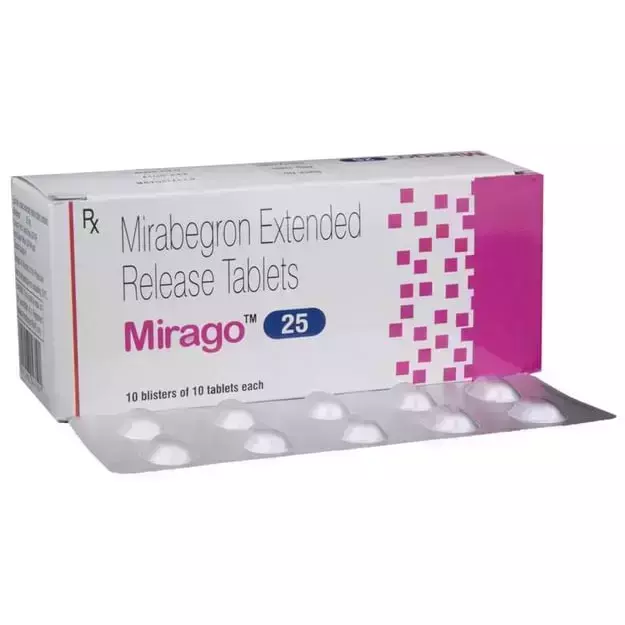
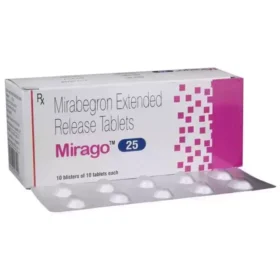
Mirago
✅ Relieves bladder symptoms
✅ Controls urinary frequency
✅ Reduces urge incontinence
✅ Improves bladder capacity
✅ Enhances urinary control
Mirago contains Mirabegron.
✓ Medically reviewed by Morgan Ellis — Pharmacy Researcher · 8 years experience · Last reviewed: May 2026
Quick Answer — What is Mirago?
Mirago contains mirabegron 25 mg (extended-release tablet) — the first-in-class beta-3 (β3) adrenergic receptor agonist for the treatment of overactive bladder (OAB). Unlike older anticholinergic OAB drugs (oxybutynin, tolterodine, solifenacin), mirabegron works by relaxing detrusor smooth muscle DURING bladder filling rather than blocking acetylcholine receptors. The result: similar efficacy without the dry mouth, constipation, blurred vision, cognitive slowing, and fall risk that limit anticholinergics in older patients. Standard dose: one 25 mg tablet once daily; can be increased to 50 mg/day after 4-8 weeks if response is inadequate. Take with or without food. The 2023 American Geriatrics Society Beers Criteria flags all anticholinergic OAB drugs as “potentially inappropriate” in adults aged 65+ — making mirabegron the preferred first-line OAB drug in this population. Most common side effects: small increase in blood pressure (monitor BP at start), tachycardia, urinary tract infection, headache, nasopharyngitis. Contraindicated in severe uncontrolled hypertension.
📦 Every order is covered by our Reshipment Assurance Policy — if your parcel does not arrive within 20 business days, we reship it.
Why order from MedsBase
Every batch is sourced from a WHO-GMP certified manufacturer. Orders are dispatched in plain, unbranded packaging from our fulfilment partners and covered by our Reshipment Assurance Policy: if a parcel does not arrive within 20 business days we send a free reshipment, no questions asked.
What is Mirago?
Mirago is a brand of mirabegron 25 mg extended-release tablet. Mirabegron is the first — and remains the dominant — β3-adrenergic receptor agonist for the treatment of overactive bladder. Internationally branded as Myrbetriq (US), Betmiga (UK / EU), Mirabegron generic. Pack sizes available at MedsBase: 30, 60, 90 or 180 tablets.
How mirabegron works
The bladder detrusor muscle has both contractile (M3 muscarinic acetylcholine receptors) and relaxant (β3 adrenergic receptors) inputs. During bladder filling, sympathetic nerve activity stimulates β3 receptors, allowing the detrusor to relax and the bladder to accommodate increasing volumes without triggering urgency or contraction.
In overactive bladder, this filling-phase relaxation is impaired — the detrusor contracts inappropriately at low volumes, producing urgency, frequency, and urge incontinence. Mirabegron is a selective β3 agonist: it amplifies the natural relaxation signal during filling, increasing functional bladder capacity and reducing the urgency-frequency-incontinence triad.
Crucially, mirabegron does NOT block muscarinic acetylcholine receptors — so it does not cause the dry mouth, constipation, blurred vision, urinary retention, cognitive slowing, or anticholinergic fall risk that have always limited oxybutynin, tolterodine, solifenacin, and the other antimuscarinic OAB drugs. This benefit is most relevant in older adults and in patients on multiple anticholinergic medications.
When mirabegron is used
- Overactive bladder syndrome (OAB) — symptoms of urgency, frequency, nocturia, with or without urge incontinence, in adults. The licensed indication.
- Neurogenic detrusor overactivity in adults and children aged 3+ (Myrbetriq US licensure)
- OAB in older adults — increasingly preferred over anticholinergics due to absence of cognitive and fall-risk side effects (American Geriatrics Society Beers Criteria 2023)
- OAB in patients on multiple anticholinergic medications (mood stabilisers, antipsychotics, allergy drugs, sleep aids) — avoids stacking anticholinergic burden
- Combination therapy with solifenacin — recent evidence supports adding mirabegron to a low-dose anticholinergic for refractory OAB symptoms (BESIDE trial)
Dosage & how to take
- Starting dose: 25 mg once daily (one tablet of Mirago). Take with or without food, at approximately the same time each day.
- Swallow whole with water — do not chew, split, or crush (extended-release formulation)
- Effect develops gradually over 4-8 weeks. If response is inadequate after 4-8 weeks, the dose may be increased to 50 mg once daily.
- Renal impairment: mild-to-moderate — standard dosing. Severe (eGFR 15-29) — maximum 25 mg/day. End-stage / dialysis — not recommended.
- Hepatic impairment: mild — standard dosing. Moderate (Child-Pugh B) — maximum 25 mg/day. Severe (Child-Pugh C) — not recommended.
- Elderly: standard dosing (this is the preferred age group)
- If you miss a dose, take it as soon as you remember unless less than 6 hours remain before the next dose. Do not double up.
Side effects & safety
- Common (1 in 10): small increase in heart rate (~1 bpm), small increase in blood pressure (~1 mmHg), urinary tract infection, headache, nasopharyngitis, dry mouth (much less common than with anticholinergics)
- Less common: palpitations, atrial fibrillation, constipation, nausea, joint or muscle pain, rash, dizziness
- Rare: angioedema (face, lips, tongue swelling) — STOP immediately and seek emergency care, urinary retention (especially in patients with bladder outlet obstruction), Stevens-Johnson syndrome
- NOT typical: anticholinergic side effects — minimal dry mouth, no significant constipation, no cognitive slowing, no contribution to fall risk
Blood pressure monitoring
Mirabegron causes a small but measurable increase in blood pressure (typically 1-3 mmHg systolic at standard doses, slightly more at 50 mg). For most patients this is clinically irrelevant. For patients with pre-existing hypertension:
- Measure baseline BP before starting
- Re-measure at 4-6 weeks and at any dose increase
- Do not start mirabegron in severe uncontrolled hypertension (systolic >180 OR diastolic >110)
- If BP rises significantly on mirabegron, optimise antihypertensive therapy or switch to an anticholinergic OAB drug
Contraindications & warnings
Do not take mirabegron if you have:
- Severe uncontrolled hypertension (SBP ≥180 OR DBP ≥110)
- End-stage renal disease (eGFR <15) or on dialysis
- Severe hepatic impairment (Child-Pugh C)
- Hypersensitivity to mirabegron
- Concurrent strong CYP2D6 substrates with narrow therapeutic index (caution; mirabegron is a moderate CYP2D6 inhibitor)
Use with caution if you have: bladder outlet obstruction (urinary retention risk, especially when combined with anticholinergic OAB drugs), congenital or acquired QT prolongation, controlled hypertension, history of angioedema.
Drug interactions
- Strong CYP2D6 substrates with narrow therapeutic index (metoprolol, propafenone, flecainide, desipramine, thioridazine) — mirabegron is a moderate CYP2D6 inhibitor, may increase plasma levels; dose adjustment may be needed
- Digoxin — mirabegron increases digoxin levels modestly; monitor digoxin levels and consider dose reduction
- Warfarin — minimal interaction at standard doses; INR check recommended after starting
- Anticholinergic OAB drugs (solifenacin, tolterodine, oxybutynin) — combination is well-supported (BESIDE trial) for refractory OAB; monitor for urinary retention
- Strong CYP3A4 inhibitors (ketoconazole, ritonavir) — modestly increase mirabegron exposure; reduce to 25 mg/day if combined
Mirabegron vs anticholinergic OAB drugs
| Feature | Mirabegron (β3 agonist) | Oxybutynin / tolterodine / solifenacin (anticholinergic) |
|---|---|---|
| Efficacy | Equivalent | Equivalent |
| Dry mouth | Minimal | Common (10-30%) |
| Constipation | No | Common |
| Cognitive effects in elderly | No | Yes — falls, delirium, dementia risk (Beers Criteria) |
| Blood pressure | Small increase | Usually neutral |
| Cost | More expensive (newer) | Cheaper (generic) |
Other relevant pages on this site: Oxyspas (oxybutynin), Roliten (tolterodine IR), Terol LA (tolterodine extended-release), Urispas (flavoxate antispasmodic).
Storage & shelf life
Store Mirago tablets below 25°C in the original blister. Protect from moisture and light. Keep out of reach of children. Do not use after the expiry date printed on the carton.
Frequently Asked Questions
How quickly does mirabegron work?
Modest improvements in urgency and frequency are usually noticeable within 1-2 weeks; the full effect develops over 4-8 weeks. If symptoms have not improved meaningfully after 8 weeks at 25 mg, the dose can be increased to 50 mg/day; if still inadequate, alternative drugs (anticholinergic OAB or combination therapy) should be considered.
Why is mirabegron preferred for older adults?
The 2023 American Geriatrics Society Beers Criteria classifies all anticholinergic OAB drugs as “potentially inappropriate” in adults aged 65+ because of cumulative anticholinergic burden — which is associated with increased fall risk, delirium, cognitive decline, and possibly long-term dementia risk. Mirabegron is not anticholinergic, avoids these risks, and is therefore the preferred first-line OAB drug in older patients.
Will mirabegron raise my blood pressure?
Mirabegron causes a small average increase in BP (1-3 mmHg systolic at 25 mg, slightly more at 50 mg) — usually clinically irrelevant. Patients with controlled hypertension can take it with periodic BP monitoring. It is contraindicated in severe uncontrolled hypertension (≥180/110).
Can mirabegron be combined with oxybutynin or solifenacin?
Yes — this combination is well-evidenced (BESIDE trial showed solifenacin 5 mg + mirabegron 50 mg produced significantly greater symptom reduction than either alone for refractory OAB). The combination needs careful monitoring for urinary retention, particularly in men with bladder outlet obstruction.
Can I take mirabegron with antidepressants?
Mirabegron is a moderate CYP2D6 inhibitor, so it may modestly increase plasma levels of some tricyclic antidepressants (desipramine, nortriptyline) and beta-blockers (metoprolol). For most patients on antidepressants this is not clinically significant, but discuss with your prescriber if you are on metoprolol, propafenone, flecainide, or thioridazine — these may need dose adjustment.
Does mirabegron cause dry mouth like oxybutynin?
Minimal — mirabegron does not block acetylcholine receptors, so dry mouth is uncommon and usually mild. This is the principal practical advantage of mirabegron over the anticholinergic OAB drugs (oxybutynin, tolterodine, solifenacin), where dry mouth affects 10-30% of users and is the leading reason for discontinuation.
Will mirabegron help my urge incontinence?
Yes — clinical trials show mirabegron reduces the average number of incontinence episodes per week by 40-60%, similar to anticholinergics. As with all OAB drugs, response is variable; some patients see large improvements, others modest. A 4-8 week trial is reasonable to assess response.
Can mirabegron be taken long-term?
Yes — OAB is typically a chronic condition and mirabegron is intended for long-term use. Periodic review (annually) is recommended to confirm ongoing benefit and check BP and renal function.
Where can I order Mirago online?
You can order Mirago 25 mg tablets from MedsBase in pack sizes of 30, 60, 90 or 180 tablets. Orders ship worldwide with discreet packaging. Mirabegron is specialist-supervised worldwide.
Related Alternatives
Other products in General Health that customers also view:
More options in Bladder Prostate
Ranked by recent MedsBase order volume — what other customers in this category are picking.
| Strength | 25 mg |
|---|---|
| Quantity | 30 Tablet/s, 60 Tablet/s, 90 Tablet/s, 180 Tablet/s |
 Mirago
Q & A
Mirago
Related products



Reviews
There are no reviews yet