




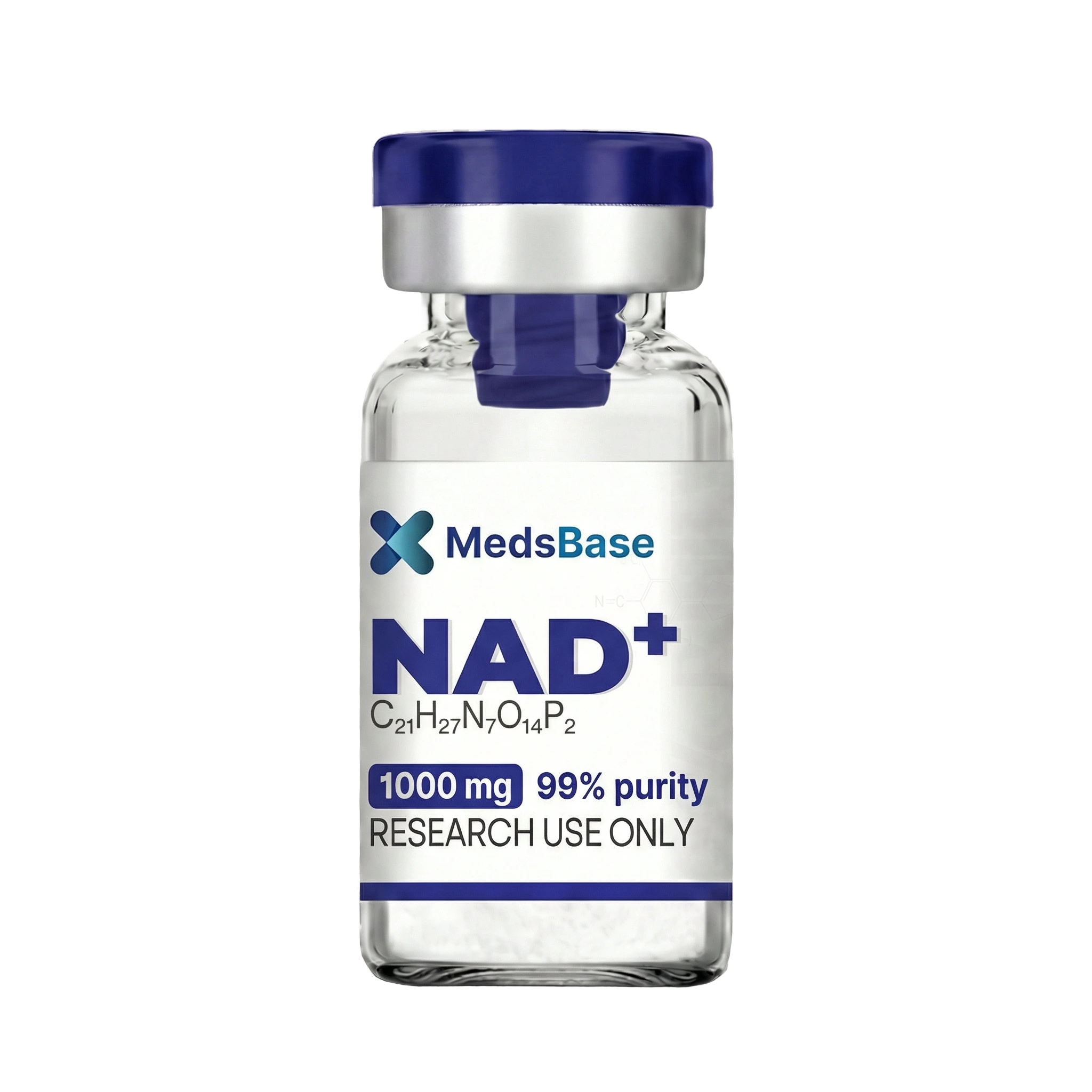
NAD⁺
✅ Enhances cellular energy
✅ Supports mitochondrial function
✅ Promotes metabolic balance
✅ Boosts cellular repair
✅ Improves vitality pathways
NAD⁺ contains synthetic peptide compound.
✓ Medically reviewed by Morgan Ellis — Pharmacy Researcher · 8 years experience · Last reviewed: May 2026
Quick Answer — What is NAD+?
NAD+ (nicotinamide adenine dinucleotide) is a fundamental coenzyme present in every cell, central to energy metabolism, sirtuin-pathway longevity signaling, and PARP-mediated DNA repair. Cellular NAD+ levels decline markedly with age, making it one of the most-studied molecules in longevity studies. Supplied in 100 mg to 1000 mg lyophilized vials.
📦 Every order is covered by our Reshipment Assurance Policy — if your parcel does not arrive within 20 business days, we reship it.
| Specification | Detail |
|---|---|
| CAS Number | 53-84-9 |
| Molecular Formula | C21H27N7O14P2 |
| Molecular Weight | 663.43 Da |
| Sequence | n/a (dinucleotide coenzyme — not a peptide) |
| Form | Lyophilized powder (or as supplied) |
| Purity | ≥99% (HPLC verified, COA on request) |
| Storage | Lyophilized: 2–8 °C (refrigerator) for working stock; −20 °C for long-term storage of unopened vials. Reconstituted: 2–8 °C, use within ~30 days. Protect from light — NAD+ oxidizes readily. Do not freeze–thaw the reconstituted solution. |
| Solubility | Bacteriostatic water (recommended) or sterile water for shorter use windows |
What Is NAD+?
NAD+ (nicotinamide adenine dinucleotide) is not strictly a peptide — it is a dinucleotide coenzyme composed of two nucleotides joined through their phosphate groups. But it is the most widely researched single molecule in the longevity and cellular-aging literature, and is commonly supplied through peptide-studies suppliers alongside peptide compounds for convenience of users working on multi-factor cellular-aging studies. NAD+ is found in every living cell and functions as a substrate for three major enzyme families: oxidoreductases (energy metabolism), sirtuins (longevity signaling, gene silencing), and PARPs (DNA damage response). Cellular NAD+ levels decline by approximately 50% between age 30 and 70 in most tissues — the “NAD+ decline” — and restoring this decline is a central hypothesis in the longevity studies community (Yoshino, Baur & Imai, Cell Metab 2018). Molecular weight 663.4 Da, empirical formula C21H27N7O14P2. Supplied as a high-purity lyophilized powder for reconstitution with bacteriostatic water. For deeper mechanism, longevity-context, and alternative precursor compounds (NR, NMN), see our full NAD+ guide.
Mechanism of Action — Three Essential Pathways
NAD+ participates in cellular biology through three mechanistically distinct but interdependent enzyme families:
- Redox coenzyme (energy metabolism) — NAD+ is the central electron carrier in glycolysis, the TCA cycle, and oxidative phosphorylation. Every step that extracts energy from food ultimately transfers electrons to NAD+ (forming NADH) which then drives ATP synthesis in mitochondria. Without sufficient NAD+, cells cannot produce energy efficiently.
- Sirtuin activation (longevity signaling) — the seven mammalian sirtuins (SIRT1–SIRT7) are NAD+-dependent deacetylases that regulate gene silencing, stress response, mitochondrial biogenesis, and DNA repair. When NAD+ levels decline, sirtuin activity drops, which is one proposed mechanistic link between NAD+ decline and aging phenotypes (Rajman, Chwalek & Sinclair, Cell Metab 2018).
- PARP-mediated DNA repair — the poly(ADP-ribose) polymerase (PARP) family of enzymes uses NAD+ as substrate for the DNA-damage response. Declining NAD+ levels mean less available substrate for DNA repair, creating a feedback loop where DNA damage further depletes NAD+.
Because these three pathways together touch energy metabolism, gene regulation, and genome maintenance, NAD+ restoration is investigated across an unusually broad range of cellular-aging contexts — from metabolic syndrome to neurodegeneration to muscle function.
Published Evidence
NAD+ is used in clinical contexts that investigate:
- Longevity studies — sirtuin-pathway activation and cellular-aging biomarkers in rodent aging studies (Yoshino et al., Cell Metab 2018)
- Cellular energy / mitochondrial function — ATP production and mitochondrial biogenesis in cellular-stress studies
- Neuroprotection studies — cognitive-decline and neurological-aging models in rodent studies
- Metabolic health — insulin sensitivity, glucose homeostasis, and metabolic-syndrome studies
- DNA repair studies — PARP-pathway activity and genome-maintenance in DNA-damage models
- Anti-aging studies — composite cellular-aging markers across multiple tissue systems
- Comparative precursor studies — side-by-side with NR (nicotinamide riboside) and NMN (nicotinamide mononucleotide) precursors to isolate the direct-NAD+ effect
For broader context on longevity and cellular-aging peptides see peptide stacks for metabolic support and the full peptides catalog.
Available Strengths and Concentrations
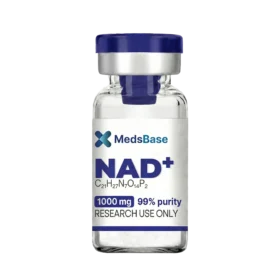
MedsBase stocks NAD+ in the following lyophilized vial sizes. Each variation ships in 10-vial, 20-vial, or 30-vial pack formats:
| Vial Strength | Typical Use Case | Pack Sizes |
|---|---|---|
| 100 mg | Pilot dosing or short-duration protocols | 10, 20, or 30 vials |
| 500 mg | Standard strength, supports multi-week protocols | 10, 20, or 30 vials |
| 1000 mg | Extended studies, IV protocols, bulk prep | 10, 20, or 30 vials |
NAD+ requires larger absolute doses than most peptides (grams rather than micrograms) because it is a coenzyme operating at cellular-pool concentrations, not a signaling molecule operating at receptor-level concentrations. Supplied as lyophilized powder at 99%+ HPLC purity.
How It Compares — NAD+ vs NR vs NMN
Three molecules dominate the NAD+ studies space. Each feeds into the same salvage pathway but at different entry points:
| Criterion | NAD+ | NR (Nicotinamide Riboside) | NMN (Nicotinamide Mononucleotide) |
|---|---|---|---|
| Role | End-product coenzyme (direct) | Precursor (oral) | Precursor (oral or SC) |
| Route | SC, IM, IV in studies | Oral primarily | Oral, SC |
| Typical dose | 50–1000 mg | 250–500 mg oral | 250–1000 mg oral/SC |
Users typically choose direct NAD+ over precursors when they want to bypass variable enzymatic conversion rates (some precursors convert inefficiently in certain tissues) or when they need rapid plasma elevation. Precursors are preferred in sustained-dosing oral-administration studies.
Storage and Reconstitution
Before reconstitution: store lyophilized vials refrigerated at 2–8 °C in original packaging, stable up to 36 months. NAD+ is light-sensitive — keep original foil packaging intact. Reconstitution procedure: inject bacteriostatic water down the side wall of the vial per the chart above. NAD+ vials use larger reconstitution volumes than peptide vials because of the larger absolute dose. Swirl gently — do not shake — and allow 5–10 minutes for full dissolution. After reconstitution: store refrigerated at 2–8 °C, protected from light, and use within 30 days. Reconstituted NAD+ can degrade more rapidly than peptides — a yellow-to-brown colour shift indicates oxidation and should trigger discard.
Frequently Asked Questions
What is NAD+ used for in studies?
NAD+ is used in studies investigating cellular-aging, sirtuin-pathway activation, mitochondrial function, DNA repair via PARP, neuroprotection, and metabolic-health models. It is not FDA-approved for therapeutic use and is sold here strictly for clinical studies use only.
Is NAD+ a peptide?
No. NAD+ is a dinucleotide coenzyme, not a peptide. It is commonly supplied through peptide-studies suppliers because longevity users frequently use it alongside peptide protocols, and both categories share the lyophilized-powder-with-BAC-water reconstitution format.
What is the typical NAD+ dose?
Published preclinical protocols vary widely by context. Common ranges: 50–100 mg SC/IM daily for longevity studies, 250–500 mg for cellular-energy studies, and up to 1,000 mg in IV protocols. A 500 mg vial reconstituted with 5.0 mL bacteriostatic water yields 100 mg/mL — 50 ticks on a U-100 syringe delivers 50 mg.
Is NAD+ FDA approved?
No. NAD+ is not an FDA-approved therapeutic. It has been studied in clinical contexts (including IV “NAD+ therapy” wellness clinics) but has not received FDA approval for any specific indication. All NAD+ sold by specialist suppliers is for clinical investigation.
How is NAD+ different from NR or NMN?
NR (nicotinamide riboside) and NMN (nicotinamide mononucleotide) are precursors that cells convert to NAD+ via the salvage pathway. Direct NAD+ bypasses this conversion step. Users choose direct NAD+ when they want to control plasma levels precisely; precursors are used for sustained oral dosing studies where enzymatic conversion is acceptable.
How should NAD+ be stored?
Lyophilized vials: refrigerated at 2–8 °C in original packaging, protected from light. Stable up to 36 months. Reconstituted solution: refrigerated at 2–8 °C, light-protected, use within 30 days. NAD+ is more light- and oxidation-sensitive than most peptides.
How do I reconstitute NAD+?
Follow the reconstitution chart above. Add bacteriostatic water down the side wall of the vial, swirl gently, and allow 5–10 minutes for full dissolution. NAD+ requires larger reconstitution volumes than peptides because of the larger absolute dose. Do not shake.
Can NAD+ be stacked with peptides in studies?
Yes. NAD+ is frequently studied alongside GHK-Cu (cellular energy studies), ipamorelin (metabolic-axis studies), and other longevity peptides. Because NAD+ operates at the coenzyme level rather than at receptors, pharmacological interactions with peptides are minimal.
What strengths does MedsBase stock?
MedsBase carries NAD+ in 100 mg, 500 mg, and 1000 mg lyophilized vials. Each strength is available in 10-vial, 20-vial, or 30-vial pack sizes. All vials are supplied at 99%+ HPLC purity with a certificate of analysis on request.
Does NAD+ cause side reported effects?
The most commonly reported effect in studies and clinical use is a “flushing” sensation during IV administration with rapid infusion rates — believed to be transient vascular effect. Other off-target effects appear minimal at typical doses. Because NAD+ is an endogenous coenzyme, pharmacological concerns are generally lower than for exogenous xenobiotic compounds.
What is the biological half-life of NAD+?
Endogenous NAD+ has a biological half-life of approximately 1–2 hours in most cell types, varying significantly by tissue. In preclinical IV administration studies, exogenous NAD+ is rapidly taken up by tissues and converted to downstream metabolites (NADH, NAAD, ADPR). The lyophilized form for clinical reconstitution is typically used in acute supplementation or cell culture study models.
How does direct NAD+ supplementation compare to NMN and NR in studies?
NMN (nicotinamide mononucleotide) and NR (nicotinamide riboside) are NAD+ precursors converted to NAD+ intracellularly. Direct NAD+ supplementation is studied for study models where precursor conversion may be rate-limited. All three approaches are active areas of longevity and bioenergetics studies, with different bioavailability and metabolic conversion profiles.
Can I order NAD+ for international shipping?
Yes. MedsBase ships NAD+ worldwide from our dedicated peptide shipping network. NAD+ orders qualify for our standalone peptide shipping service. Orders ship in temperature-controlled, light-protected packaging with full tracking.
Other Peptides for Recovery and Performance
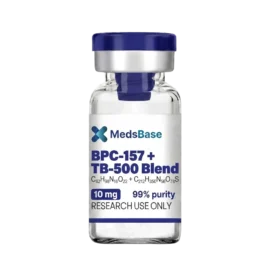
- BPC-157 — Body Protection Compound — tendon, ligament, gut recovery
- TB-500 — Thymosin Beta-4 fragment — soft tissue and vascular recovery
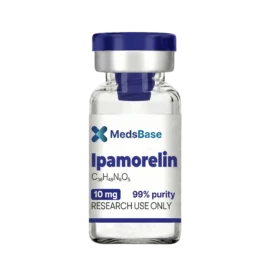
- Ipamorelin — Selective ghrelin agonist — clean GH pulse without cortisol/prolactin
- CJC-1295 with DAC — GHRH analog with extended half-life
- GHK-Cu — Copper peptide — skin and connective tissue regeneration
Further Reading
📖 Learn the science behind this coenzyme
Read our complete evidence-based guide: NAD+ — mechanism, longevity studies & the honest science. Covers sirtuin and PARP biology, the NAD+ decline hypothesis, precursor comparison (NR / NMN), published studies dosing ranges, reconstitution protocols, and safety notes.
More options in Peptides
Ranked by recent MedsBase order volume — what other customers in this category are picking.
| Strength | 100 mg, 500 mg, 1000 mg |
|---|---|
| Quantity | 10 Vials, 20 Vials, 30 Vials |
 NAD⁺
Q & A
NAD⁺
Related products
Reviews
There are no reviews yet