







Nitroderm TTS

✅ Manages chest pain
✅ Dilates blood vessels
✅ Improves blood flow
✅ Treats angina pectoris
✅ Long-lasting relief
Nitroderm TTS contains Nitroglycerin.
✓ Medically reviewed by Morgan Ellis — Pharmacy Researcher · 8 years experience · Last reviewed: May 2026
⚡ Quick Answer — What is Nitroderm TTS?
Nitroderm TTS is a transdermal nitroglycerin patch used for prophylaxis of chronic stable angina. Apply once daily to clean, hairless skin on the chest or upper arm. A patch-free interval of 8–12 hours every 24 hours is required to prevent tolerance. Available in 5, 10, and 15 mg/24h strengths. Not for acute angina attacks.
📦 Every order is covered by our Reshipment Assurance Policy — if your parcel does not arrive within 20 business days, we reship it.
Why order from MedsBase
Our generic medications are sourced from WHO-GMP certified manufacturers and shipped worldwide in discreet, plain packaging — no medication name on the parcel exterior. Card payments are routed through a regulated processor (statement descriptors include a regulated card-payment processor — never “MedsBase” or any medication name). Crypto and SEPA bank transfer are also accepted. Every order is backed by our Reshipment Assurance Policy.
Nitroderm TTS is a transdermal nitroglycerin (glyceryl trinitrate) patch that delivers a steady, controlled dose of medication through the skin over 24 hours. Each patch contains 5 mg of nitroglycerin and is used to prevent angina pectoris (chest pain caused by reduced blood flow to the heart) in patients with stable coronary artery disease. Nitroderm TTS is bioequivalent to leading international brands such as Nitro-Dur, Deponit, and Transiderm-Nitro.
Unlike short-acting sublingual tablets or sprays — which are used during an acute angina attack — Nitroderm TTS is a preventive therapy. Applied once daily, the patch gradually releases nitroglycerin into the bloodstream to dilate coronary and systemic blood vessels, reducing the workload on the heart and the frequency of chest-pain episodes.
What Is Nitroderm TTS?
Nitroderm TTS is a transdermal therapeutic system (TTS) — a medicated adhesive patch that releases its active ingredient, glyceryl trinitrate (GTN) / nitroglycerin, at a constant rate through the skin. Nitroglycerin has been used as an anti-anginal medication for over 140 years and remains the cornerstone of angina management worldwide.
Nitroderm TTS is most commonly prescribed for:
- Long-term prophylaxis of stable angina pectoris — preventing chest pain attacks in coronary artery disease
- Unstable angina (under hospital supervision, as part of combination therapy)
- Heart failure with angina — to reduce both afterload and preload
- Raynaud’s phenomenon (off-label use for circulation)
- Anal fissure management (specific low-dose formulations — not typically Nitroderm TTS)
How Does Nitroderm TTS Work?
Nitroglycerin is a nitric oxide donor — when it is absorbed by vascular smooth muscle, it is converted to nitric oxide (NO), the body’s natural vasodilator. Here is how the preventive effect is achieved:
- Nitroglycerin diffuses from the patch through the skin into the bloodstream at a steady rate
- In vascular smooth muscle, it is converted to nitric oxide (NO)
- NO activates guanylate cyclase, raising intracellular cyclic GMP (cGMP) levels
- Elevated cGMP causes vasodilation — both venous and arterial
- Venous dilation reduces the amount of blood returning to the heart (preload), lowering heart wall tension
- Coronary artery dilation improves oxygen delivery to heart muscle
- Together, these effects reduce the heart’s oxygen demand and prevent angina
A 5 mg/24 h patch releases approximately 0.2 mg of nitroglycerin per hour, giving steady plasma levels over the wearing period.
Uses and Indications
- Stable angina pectoris — to prevent predictable exertion-related chest pain
- Mixed angina — combined with short-acting sublingual GTN for breakthrough symptoms
- Coronary artery disease with anginal episodes
- Congestive heart failure — to reduce preload and afterload
- Adjunctive therapy in patients already on beta-blockers or calcium channel blockers who still have angina
Nitroderm TTS Dosage and Patch Schedule
| Indication / Patient | Starting Patch | Usual Range |
|---|---|---|
| Stable angina (new patient) | 5 mg/24 h | 5–15 mg/24 h based on response |
| More severe angina | 10 mg/24 h | 10–15 mg/24 h |
| Heart failure (adjunct) | 5 mg/24 h | Adjusted under cardiology guidance |
| Elderly / fragile skin | 5 mg/24 h | Rotate patch site carefully; monitor for hypotension |
The Nitrate-Free Interval — Why It Matters
A crucial feature of transdermal nitroglycerin therapy is the nitrate-free interval. The body quickly develops tolerance to nitrates when levels are kept continuously elevated, and after a few days the anti-anginal effect diminishes. To avoid this:
- Wear Nitroderm TTS for 10–14 hours per day (usually during the day when angina is more likely)
- Remove the patch at night for at least 10–12 hours of nitrate-free time
- If your angina is typically nocturnal or at rest, your doctor may reverse the schedule — wear the patch overnight and remove during the day
How to Apply Nitroderm TTS
- Choose a clean, dry, hairless area — upper chest, upper arm, or outer thigh
- Avoid skin creases, scars, cuts, irritated areas, or areas that will be subjected to significant rubbing
- Do not apply to the lower leg or below the elbow — absorption is poorer from these areas
- Cut open the pouch, peel off the protective backing, and press the patch firmly onto the skin for 10 seconds
- Rotate the site each day — do not apply to the same spot within 7 days; this prevents skin sensitisation
- Showering and bathing with the patch on is generally fine — avoid very hot baths, saunas, or sunbeds, which can accelerate drug release
- When removing the patch, fold it sticky-side together and discard out of reach of children or pets — residual drug in a used patch can be harmful if chewed
- Wash the skin gently after removal; adhesive residue can usually be removed with mild soap
Side Effects of Nitroderm TTS
| Severity | Side Effect |
|---|---|
| Very common (≥1 in 10) | Headache (especially in the first few days), flushing, mild skin redness at the patch site |
| Common (≥1 in 100) | Dizziness, orthostatic hypotension, light-headedness on standing, nausea, tachycardia |
| Uncommon | Local contact dermatitis, allergic skin reaction, mild burning or itching at the site |
| Rare | Severe hypotension, syncope, paradoxical angina, methaemoglobinaemia (with excessive doses) |
The headache that many patients experience early in therapy is called a “nitrate headache” and usually improves within a few days as the body adjusts. Paracetamol can help; if the headache is severe or persistent, speak to your doctor about dose adjustment.
Warnings and Precautions
- Nitroderm TTS is NOT for acute angina attacks. If you develop sudden chest pain, use a fast-acting sublingual nitroglycerin tablet or spray. Call emergency services if chest pain persists for more than 10–15 minutes or is worse than usual
- Do not combine with PDE5 inhibitors (sildenafil, tadalafil, vardenafil, avanafil) — this can cause life-threatening hypotension. Wait at least 24 hours after the last dose of sildenafil/vardenafil and 48 hours after tadalafil before applying a GTN patch
- Cardiovascular contraindications: severe anaemia, hypertrophic obstructive cardiomyopathy, severe aortic stenosis, cardiac tamponade, constrictive pericarditis
- Alcohol intensifies the hypotensive effect — limit intake
- Standing still for long periods after patch application can cause dizziness or fainting; move to a sitting or lying position if you feel light-headed
- Avoid defibrillation through the patch — electrical discharge through the foil can cause burns. Remove the patch before defibrillation or cardioversion
- MRI scanning: remove the patch before MRI, as it contains metal backing
- Pregnancy and breastfeeding: use only if clearly needed and under specialist supervision
Contraindications
- Known hypersensitivity to nitrates or any patch component
- Concurrent use of PDE5 inhibitors or riociguat
- Severe hypotension or hypovolaemia
- Raised intracranial pressure (e.g. after head injury or cerebral haemorrhage)
- Severe aortic or mitral stenosis, cardiac tamponade, hypertrophic obstructive cardiomyopathy
- Closed-angle glaucoma (relative contraindication)
Drug Interactions
| Drug / Class | Interaction |
|---|---|
| Sildenafil, tadalafil, vardenafil (PDE5 inhibitors) | Absolutely contraindicated — risk of severe, potentially fatal hypotension |
| Riociguat (Adempas) | Contraindicated — severe hypotension risk |
| Other antihypertensives (ACE inhibitors, beta-blockers, calcium channel blockers, diuretics) | Additive hypotensive effect — often intentional, but monitor BP |
| Tricyclic antidepressants | Enhanced hypotension |
| Alcohol | Enhanced orthostatic hypotension |
| Heparin | GTN may reduce heparin’s anticoagulant effect — monitor aPTT |
| Aspirin | May increase GTN plasma levels |
What to Do if the Patch Falls Off
- If the patch falls off and still looks intact, reapply it to a nearby clean, dry area of skin
- If the patch is damaged or the adhesive is compromised, apply a new patch
- Do not double up — use only one patch at a time unless specifically prescribed higher doses
Storage and Handling
- Store below 25 °C in a dry place, in the original sealed pouch
- Do not refrigerate or freeze
- Keep out of reach of children and pets — used patches still contain residual drug and should be disposed of securely
- Do not use after the printed expiry date
- Open the pouch only when you are ready to apply
Related Products on MedsBase
- GTN Spray — fast-acting nitroglycerin for acute angina attacks
- Heart & Blood Pressure Medications
Frequently Asked Questions
Can I wear Nitroderm TTS 24 hours a day?
No. Continuous wear leads to nitrate tolerance, where the patch loses its anti-anginal effect within a few days. A nitrate-free interval of 10–12 hours each day is essential.
Can I use Nitroderm TTS during an angina attack?
No. The patch releases medication slowly and cannot stop an attack that is already under way. Acute chest pain should be treated with sublingual GTN tablets or a GTN spray. If the pain does not settle within 10–15 minutes, call emergency services.
Can I swim or shower with the patch on?
Yes — the patch is water-resistant. Avoid scrubbing the area directly. Very hot baths, saunas, and sunbeds should be avoided because heat accelerates drug release and can cause hypotension.
Where should I stick the patch?
Upper chest, upper arm, or outer thigh work best. Avoid skin creases, hair, scars, cuts, sunburned skin, or areas where clothing rubs. Rotate the site each day — do not reuse the same spot within 7 days.
What if I get a headache from the patch?
Nitrate headaches are very common in the first few days and usually improve as your body adjusts. Paracetamol can help. If severe or persistent, speak to your doctor about dose adjustment.
Can I use Nitroderm TTS with Viagra or Cialis?
No — this is extremely dangerous. PDE5 inhibitors (sildenafil, tadalafil, vardenafil, avanafil) combined with nitrates can cause life-threatening hypotension. Never use the two together. If you take sildenafil/vardenafil, wait at least 24 hours; for tadalafil wait at least 48 hours before applying a GTN patch.
Can I stop Nitroderm TTS suddenly?
No. Abrupt discontinuation can cause rebound angina. Your doctor will taper the dose gradually if therapy needs to be stopped.
Is Nitroderm TTS the same as Nitro-Dur or Deponit?
All three contain nitroglycerin in the same transdermal format and at comparable dose strengths. Nitroderm TTS is the Novartis international brand and is bioequivalent to the others.
Can I do electrical medical procedures with the patch on?
No. Remove the patch before defibrillation, cardioversion, MRI, or diathermy — the metallic backing can cause burns or imaging artefacts.
What should I do if I miss applying a patch?
Apply the missed patch as soon as you remember, then return to the usual schedule the next day. Do not double up to “catch up”.
Related Alternatives
Other products in Chronic Conditions that customers also view:
More options in Heart & Blood Pressure
Ranked by recent MedsBase order volume — what other customers in this category are picking.
| Strength | 5 mg / 24 h |
|---|---|
| Quantity | 10 Patches, 20 Patches, 30 Patches, 60 Patches |
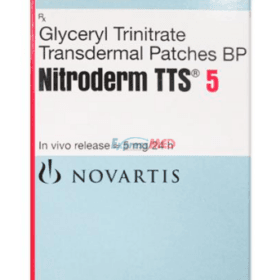 Nitroderm TTS
Q & A
Nitroderm TTS
Related products


Reviews
There are no reviews yet