







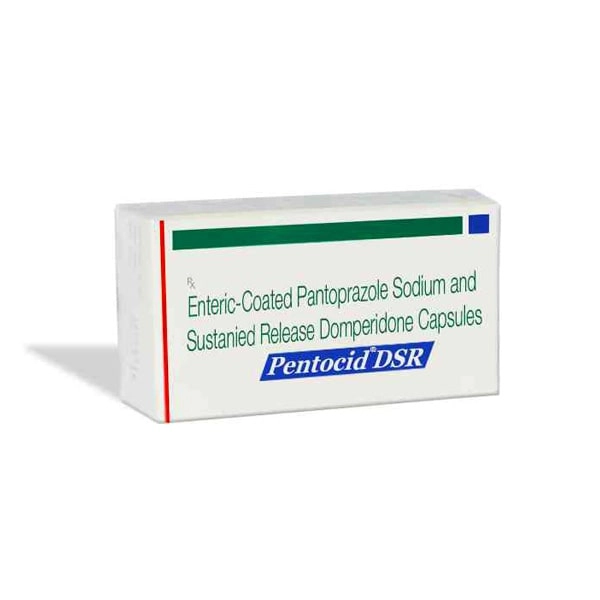
Pantocid Dsr
✅ Reduces stomach acid
✅ Treats acid reflux
✅ Prevents stomach ulcers
✅ Eases heartburn symptoms
✅ Manages gastroesophageal disease
contains Pantoprazole & Domperidone
✓ Medically reviewed by Morgan Ellis — Pharmacy Researcher · 8 years experience · Last reviewed: May 2026
⚡ Quick Answer — What is Pantocid DSR?
Pantocid DSR is a fixed-dose combination of pantoprazole 40 mg + domperidone 30 mg sustained-release in a single capsule, made by Sun Pharma from a WHO-GMP certified manufacturer. The pantoprazole component reduces stomach acid (proton-pump inhibition); the domperidone component is a peripherally acting D2 dopamine receptor antagonist that increases gastric emptying and reduces regurgitation. Used for: GERD with prominent regurgitation or post-prandial fullness, gastroparesis (diabetic, opioid-induced, post-surgical), and functional dyspepsia where motility is the dominant problem. Standard dose: one capsule once daily, 30–60 minutes before breakfast. Important safety note: domperidone has a dose-dependent QT-prolongation signal — the European Medicines Agency restricted long-term use to a maximum of 10 mg three times daily for up to 7 days. Avoid in significant cardiac disease, electrolyte disturbance, or concurrent QT-prolonging drugs (azole antifungals, macrolide antibiotics, antiarrhythmics).
📦 Every order is covered by our Reshipment Assurance Policy — if your parcel does not arrive within 20 business days, we reship it.
Why order from MedsBase
Our generic medications are sourced from WHO-GMP certified manufacturers and shipped worldwide in discreet, plain packaging — no medication name on the parcel exterior. Card payments are routed through a regulated processor (statement descriptors include a regulated card-payment processor — never “MedsBase” or any medication name). Crypto and SEPA bank transfer are also accepted. Every order is backed by our Reshipment Assurance Policy.
What Pantocid DSR Is
Pantocid DSR is a Sun Pharma fixed-dose combination capsule containing 40 mg of pantoprazole (a proton-pump inhibitor, in delayed-release pellet form) and 30 mg of domperidone (a peripheral dopamine D2 antagonist, in sustained-release pellet form). The “DSR” in the brand name reflects the modified-release technology used to deliver both components from one capsule.
How Pantocid DSR Works
Pantoprazole irreversibly inhibits the H+/K+-ATPase proton pump in stomach parietal cells, reducing acid secretion for 24–72 hours per dose. Domperidone antagonises peripheral D2 receptors in the upper gastrointestinal tract, which increases lower-oesophageal-sphincter tone, accelerates gastric emptying, and reduces post-prandial regurgitation. Domperidone does not cross the blood-brain barrier well, so it lacks the central extrapyramidal side effects of metoclopramide. The two mechanisms are complementary: pantoprazole reduces the volume and acidity of refluxed material; domperidone reduces how much material refluxes in the first place.
Indications — When Pantocid DSR Is Useful
1. GERD with prominent regurgitation or post-prandial fullness
Where heartburn is well controlled by a PPI but regurgitation, water-brash, or feeling of food sitting on the chest persists, a prokinetic adds clinical benefit. Pantocid DSR addresses both problems with one capsule.
2. Gastroparesis
Diabetic gastroparesis (long-standing type 1 or type 2 diabetes), post-surgical gastroparesis (after vagotomy or fundoplication), and opioid-induced gastroparesis. Domperidone is one of the few prokinetics with reasonable evidence in gastroparesis, though most authorities now advocate the lower 10 mg three-times-daily dose limited to 7 days at a time.
3. Functional dyspepsia — post-prandial distress subtype
For patients whose dominant symptom is early satiety, post-prandial fullness, or bloating, a PPI alone often gives an incomplete response. Adding a prokinetic improves the response in this subgroup.
Dosing
| Patient | Dose | Notes |
|---|---|---|
| Standard adult dose | One capsule once daily, 30–60 min before breakfast | 4–8 weeks; review and step down |
| Severe gastroparesis (specialist-led) | One capsule once daily | Re-assess every 4 weeks |
| Hepatic impairment | Reduce or avoid — specialist input needed | Both components affected |
| Renal impairment (CrCl < 30) | Avoid — risk of domperidone accumulation | Switch to plain PPI |
| Age > 60 | Avoid combination — QT-prolongation risk increased | Switch to plain PPI |
Swallow the capsule whole — do not break, crush or chew. The pellet technology depends on intact capsule architecture for delayed and sustained release. Take 30–60 minutes before breakfast.
Side Effects
From the pantoprazole component (1–10%): headache, diarrhoea, nausea, abdominal pain, mild rash. Long-term: B12 deficiency, magnesium deficiency, fracture, fundic gland polyps.
From the domperidone component:
- Hyperprolactinaemia — raised serum prolactin, causing menstrual disturbance, breast tenderness, galactorrhoea (milk discharge), and rarely gynaecomastia in men. Usually reversible on stopping.
- Dry mouth, headache, abdominal cramps
- QT-interval prolongation — dose-related, more common in older patients and those with electrolyte disturbance
- Rare ventricular arrhythmia and sudden cardiac death (the basis of the EMA restriction)
- Rare extrapyramidal effects (despite limited blood-brain barrier penetration, occasional cases reported)
Drug Interactions
| Drug / class | Interaction | Action |
|---|---|---|
| Azole antifungals (ketoconazole, itraconazole, voriconazole) | CYP3A4 inhibition raises domperidone levels and QT risk | Avoid combination |
| Macrolide antibiotics (erythromycin, clarithromycin) | Both QT prolongation and CYP3A4 inhibition | Avoid combination; choose azithromycin if a macrolide is needed |
| Class I and III antiarrhythmics (amiodarone, sotalol, quinidine) | Additive QT prolongation | Avoid |
| Methadone, some SSRIs (citalopram, escitalopram), some antipsychotics (haloperidol) | Additive QT prolongation | Use with caution; ECG monitoring |
| Anticholinergic drugs | Counter the prokinetic effect of domperidone | Limit clinical benefit; consider alternative |
| Levodopa, dopamine agonists | Antagonised by domperidone | Avoid combination in Parkinson’s — use plain PPI instead |
| Clopidogrel | Pantoprazole has a small CYP2C19 effect; minor interaction | Acceptable; pantoprazole is the preferred PPI in clopidogrel users |
| Atazanavir, nelfinavir | Acid-dependent absorption reduced by PPI | Avoid combination — use H2 antagonist alternative |
Contraindications
- Known hypersensitivity to pantoprazole or domperidone
- Significant cardiac disease — long-QT syndrome, recent myocardial infarction, decompensated heart failure
- Hypokalaemia, hypomagnesaemia (correct first)
- Concurrent strong CYP3A4 inhibitor (azole antifungal, macrolide antibiotic, certain HIV antivirals)
- Concurrent QT-prolonging drug (Class I/III antiarrhythmic, methadone, citalopram > 20 mg, haloperidol)
- Severe hepatic impairment
- Bowel obstruction, perforation, or active GI haemorrhage (prokinetic contraindicated)
- Prolactinoma (relative)
Pregnancy, Breastfeeding, and Children
Pregnancy: Avoid during pregnancy unless benefits clearly outweigh risks. Plain pantoprazole or omeprazole is preferred where PPI is needed in pregnancy.
Breastfeeding: Domperidone passes into breast milk in small amounts; avoid in breastfeeding mothers, particularly because of the QT signal. Domperidone has historically been used off-label as a galactagogue in some markets, but this practice is now discouraged because of cardiac safety concerns.
Children: Avoid in children < 12 years and in children < 35 kg — weight-based dosing exists but the EMA restricted paediatric domperidone after the QT signal emerged.
Storage
Store at 15–30 °C in the original blister, protected from moisture. Keep out of reach of children. Do not use beyond expiry date.
Frequently Asked Questions
When is Pantocid DSR better than a plain PPI?
When motility is the dominant problem — post-prandial fullness, regurgitation, or bloating that persists despite acid control with a PPI alone — the prokinetic component of Pantocid DSR adds value. For straightforward GERD or peptic ulcer disease where heartburn is the main symptom and there is no significant motility issue, a plain PPI (Pantodac, Pan, Omez) is safer and equally effective.
Why was domperidone restricted by the EMA?
A 2014 EMA review of cardiac safety data concluded that domperidone has a small but real signal for QT prolongation, ventricular arrhythmia and sudden cardiac death, particularly at higher doses, in older patients, in cardiac disease, in electrolyte disturbance, and with concurrent QT-prolonging drugs. The EMA restricted domperidone to a maximum of 10 mg three times daily for up to 7 days for nausea/vomiting. Pantocid DSR contains 30 mg sustained-release domperidone — this exceeds the EMA dose cap and should not be used long-term.
Can it cause breast discharge?
Yes — domperidone raises prolactin, which can cause breast tenderness, milk discharge (galactorrhoea), and menstrual disturbance in women, and very rarely gynaecomastia in men. The effect usually reverses within weeks of stopping. If it occurs, switch to plain PPI.
Should I have an ECG before starting?
If you are aged > 60, have known cardiac disease, take any QT-prolonging drug, have low potassium or magnesium, or have a family history of unexplained sudden cardiac death, an ECG before starting is reasonable. The QT interval (QTc) should be < 450 ms in men and < 470 ms in women before starting domperidone.
How long should I take Pantocid DSR?
The EMA-recommended limit on domperidone is 7 days for nausea/vomiting. For motility-driven GERD or gastroparesis, 4 weeks is a reasonable initial course, with reassessment of need afterwards. Long-term continuous use is not recommended — if symptoms persist beyond 4–8 weeks, step down to a plain PPI and reassess for an alternative diagnosis (eosinophilic oesophagitis, cardiac chest pain, achalasia).
Can I drink alcohol with it?
No direct dangerous interaction with alcohol, but alcohol relaxes the lower oesophageal sphincter and worsens reflux. If reflux is the indication, cutting back on alcohol substantially improves the response.
Can I take it with antibiotics?
Avoid combination with macrolide antibiotics (erythromycin, clarithromycin) and azole antifungals (ketoconazole, itraconazole) — they raise domperidone levels and QT risk. Azithromycin is the safer macrolide choice; amoxicillin and tetracyclines are unaffected.
Is Pantocid DSR safe for diabetic gastroparesis?
Domperidone is one of the few prokinetics with reasonable evidence in diabetic gastroparesis, but specialist gastroenterology supervision is appropriate. Monitor blood glucose because gastroparesis itself causes erratic post-prandial glucose readings. ECG screening before starting is reasonable.
Can I switch to a plain PPI?
Yes — if motility symptoms (regurgitation, fullness, bloating) are not bothersome, switch to plain pantoprazole 40 mg (Pantodac) once daily. The acid-suppression component is unchanged. This is the safer long-term strategy.
Will it interact with my Parkinson’s medication?
Yes — domperidone is a dopamine D2 antagonist, the same mechanism that levodopa and dopamine agonists work against. Pantocid DSR will antagonise Parkinson’s therapy. Switch to a plain PPI if you have Parkinson’s disease.
Other Acid Reflux Medications at MedsBase
- Pantodac — pantoprazole 40 mg — standard once-daily PPI; minimal CYP impact
- Esoprol — esomeprazole 20/40 mg — S-isomer of omeprazole; ~30% AUC advantage with less inter-individual variability
- Razo — rabeprazole 10/20 mg — quicker pH rise on day 1; less CYP-dependent
- Omez — omeprazole 10/40 mg — broad strength range; lower 10 mg dose useful for step-down
- Famocid — famotidine 20/40 mg — H2 antagonist; the safe modern substitute for ranitidine; useful for nocturnal acid breakthrough
More options in Anti Emetic
Ranked by recent MedsBase order volume — what other customers in this category are picking.


| Strength | 40 mg + 30 mg |
|---|---|
| Quantity | 30 Tablet/s, 60 Tablet/s, 90 Tablet/s |
| Pharma Form | Tablet/s |
| Manufacturer | Sun Pharma |
| Treatment | Acidity, Heartburn, Stomach ulcers |
| Generic Brand | Pazopanib |
 Pantocid Dsr
Q & A
Pantocid Dsr
Related products




Reviews
There are no reviews yet