







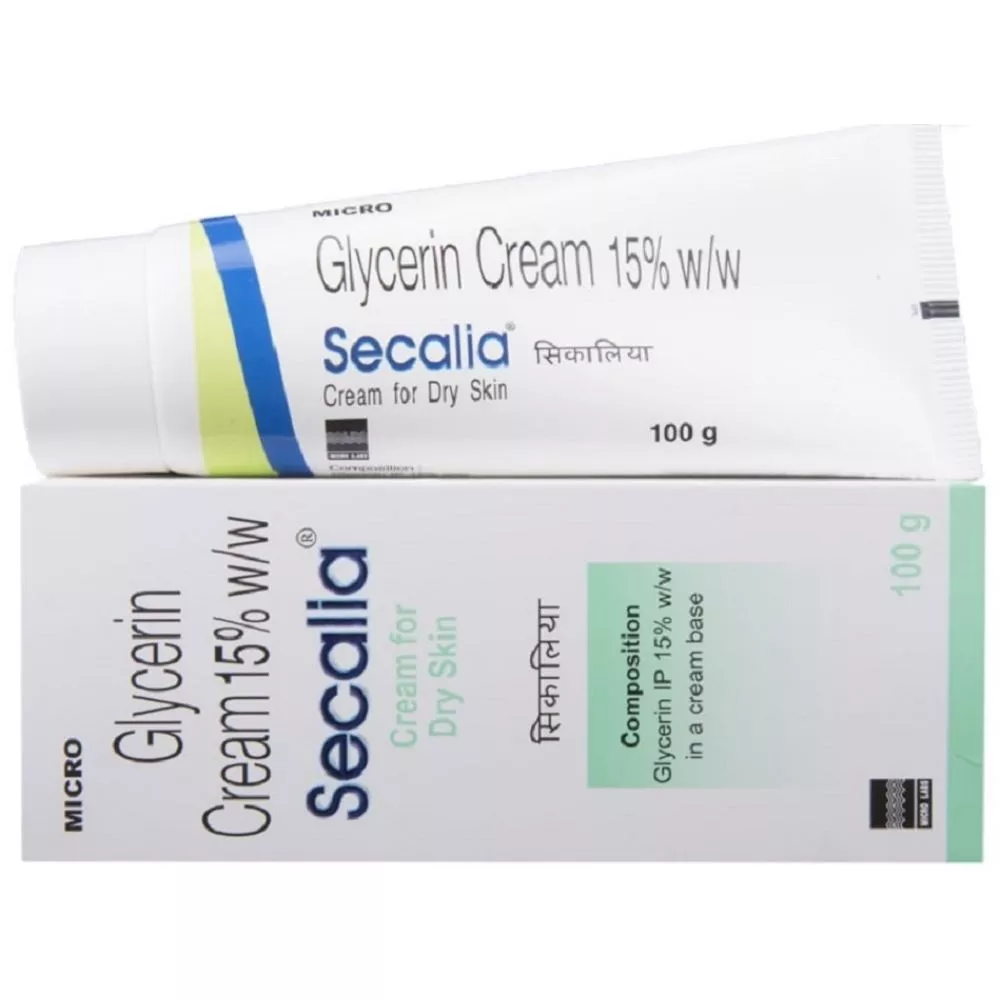
Secalia Cream
✅ Moisturizes dry skin
✅ Soothes irritation
✅ Restores skin barrier
✅ Enhances hydration
✅ Softens rough patches
Secalia Cream contains Glycerin.
✓ Medically reviewed by Morgan Ellis — Pharmacy Researcher · 8 years experience · Last reviewed: May 2026
⚡ Quick Answer — What is Secalia Cream?
Secalia Cream is an emollient dermatological moisturiser from Yash Pharma containing glycerin 15% w/w in a fragrance-free, hypoallergenic base. Used for dry, rough, flaky, sensitive, atopic, or barrier-disrupted skin — either as a daily moisturiser for constitutionally dry skin or as an adjunct during active treatment of eczema, psoriasis, or after procedures (peels, laser). Apply liberally 2-3 times daily to clean skin and immediately after bathing (within 60 seconds, to trap water in the stratum corneum). Glycerin is a humectant that draws water into the stratum corneum from the dermis and from ambient humidity; the emollient base provides an occlusive seal that reduces transepidermal water loss. Not a medicated cream — does not contain corticosteroid, calcineurin inhibitor, or other prescription actives. For eczema or psoriasis flares, a medicated topical is still needed alongside regular emollient use.
📦 Every order is covered by our Reshipment Assurance Policy — if your parcel does not arrive within 20 business days, we reship it.
Why order from MedsBase
Our generic medications are sourced from WHO-GMP certified manufacturers and shipped worldwide in discreet, plain packaging — no medication name on the parcel exterior. Card payments are routed through a regulated processor (statement descriptors include a regulated card-payment processor — never “MedsBase” or any medication name). Crypto and SEPA bank transfer are also accepted. Every order is backed by our Reshipment Assurance Policy.
What Is Secalia Cream?
Secalia Cream is a dermatological emollient cream from Yash Pharma, supplied in a 100 g tube. The headline active is glycerin 15% w/w formulated in a bland, fragrance-free, hypoallergenic emollient base. Emollients sit between cosmetic daily moisturisers and medicated topicals in the dermatology toolkit — they do not contain pharmacological actives (corticosteroid, calcineurin inhibitor, retinoid) but they are more deeply nourishing and barrier-repairing than a standard cosmetic moisturiser, and they are a cornerstone of chronic dry-skin and eczema management.
In clinical dermatology, regular emollient use is the single most important intervention for eczema and chronic dry skin. Used liberally and consistently, emollients reduce the frequency and severity of eczema flares, reduce the need for topical corticosteroid, and maintain the improvement achieved by prescription treatments.
How Does Secalia Cream Work?
- Humectant action (glycerin) — glycerin is a small hygroscopic molecule that sits in the stratum corneum and draws water both from deeper dermal tissue and from ambient humidity >60%. This increases the water content of the outermost skin layer and restores its plasticity.
- Occlusive emollient base — the cream base (typically a mix of paraffin, mineral oil, dimethicone, or ceramide-containing lipids depending on the specific formulation) forms a thin occlusive layer that reduces transepidermal water loss (TEWL). The water that glycerin attracts is held in place rather than evaporating.
- Barrier repair — regular emollient use supports the natural reconstitution of the stratum corneum lipid bilayers (ceramides, cholesterol, free fatty acids). In atopic dermatitis, where there is a genetic defect in filaggrin and ceramide-synthesis pathways, emollients partly compensate for this barrier fragility.
- Reduces itch — well-moisturised skin is less itchy. The itch-scratch cycle that drives eczema flares can be partially broken by keeping the skin well-hydrated.
- Fragrance-free, hypoallergenic — minimises the risk of allergic or irritant contact dermatitis, which is higher in atopic patients than in the general population.
When Secalia Cream Is Used
- Chronic dry skin (xerosis) — constitutional dry skin, age-related skin dryness, low-humidity-environment dryness
- Atopic dermatitis / eczema — daily maintenance emollient therapy is the single most important non-prescription intervention. Apply liberally 2-3 times daily to all affected areas and prone-to-flare areas (elbows, knees, neck, wrists).
- Contact dermatitis recovery phase — once acute inflammation has settled, emollient maintenance supports barrier repair
- Psoriasis (adjunct) — emollient use reduces scale, makes treatment with medicated topicals more effective, and improves comfort
- Ichthyosis and other chronic dry-skin conditions — daily emollient is the foundation of management
- Chemotherapy / radiation-related skin dryness — emollients support skin through treatment
- Post-procedure skin — after chemical peel, laser resurfacing, microneedling, during the healing phase
- Senior skin care — age-related stratum corneum thinning and reduced sebum production benefit from regular emollient use
- Paediatric dry skin including baby eczema (following paediatric dermatology advice)
Secalia Cream is NOT a treatment for:
- Active eczema flares or psoriasis plaques in isolation — these need medicated topicals (corticosteroid, calcineurin inhibitor, topical phototherapy). Emollient is the daily background; medicated topical is the flare treatment.
- Fungal skin infection (tinea, candidiasis) — needs anti-fungal treatment
- Bacterial skin infection (impetigo, infected eczema) — needs antibiotic
- Severe weeping or oozing dermatitis — use short-term wet-wrap protocols and prescription topical steroids first; add emollient once the skin is dry
Secalia Cream How to Apply
- Apply liberally. Emollients are most effective when used generously. A typical adult body requires 250-500 g of emollient per week during active eczema management — use more, not less.
- Apply at least 2-3 times daily to affected and flare-prone areas. For eczema maintenance, many dermatologists recommend application on waking, after bathing, and at bedtime.
- The 60-second rule: apply immediately after bathing while the skin is still slightly damp. Within the first 60 seconds after a bath or shower is when the skin loses water most rapidly; emollient applied at this point traps water in the stratum corneum. Pat dry (do not rub) and apply emollient while skin is still slightly damp.
- Apply in the direction of hair growth, with gentle strokes — not circular rubbing. This reduces the risk of folliculitis (blocked hair follicles).
- A thin film is enough. The skin should look slightly shiny and feel supple; there should not be a thick visible layer of cream. Over-application wastes product and can contribute to folliculitis.
- Combining with medicated topicals: apply the medicated product first (corticosteroid, tacrolimus, calcipotriol) to the affected area, wait 15-30 minutes, then apply emollient over the top and on surrounding unaffected skin. This is the standard “treat-and-moisturise” protocol.
- Keep using when the skin has calmed. Continuing daily emollient during the “good” phases is what prevents the next flare — it is prevention, not just treatment.
Children: safe for paediatric use; liberal application is the cornerstone of infant and childhood eczema management. Pregnancy and breastfeeding: safe; liberal use is recommended for pregnancy-related skin dryness.
Side Effects
- Common: none expected with normal use
- Uncommon: mild stinging on broken or severely inflamed skin, transient blockage of hair follicles leading to mild folliculitis (apply in direction of hair growth to minimise)
- Rare: allergic contact dermatitis to a specific excipient or preservative (true allergy to pure glycerin is extremely rare; allergy to the emulsifying or preservative components is the more common pattern)
- Fire safety note: paraffin-based emollients in very heavy application can be absorbed by dressings and clothing; these garments become flammable. Keep away from open flames, cigarettes, and strong heat sources. This is a well-documented safety concern with large-surface-area emollient use.
Contraindications & Warnings
- Known allergy to glycerin or any excipient/preservative in the base
- Use on actively infected skin — treat the infection first (antibiotic for bacterial, anti-fungal for fungal) before routine emollient use
- Direct application into open wounds, deep cuts, or surgical incisions — use surgical wound-care products instead
- Fire safety — paraffin-based emollients saturate clothing and dressings, which become flammable; avoid open flames
Compatibility With Other Products
Emollients have no systemic absorption and no clinically relevant drug interactions. Compatibility with other topicals:
- Topical corticosteroids — apply steroid first, wait 15-30 minutes, then emollient over the top. The steroid reaches the inflamed skin directly; emollient extends coverage and reduces transepidermal water loss.
- Tacrolimus / pimecrolimus — same “treat first, moisturise second” approach
- Calcipotriol (psoriasis) — same
- Topical retinoids — emollient over retinoid reduces irritation; many patients can only tolerate tretinoin / adapalene with emollient applied on top 10-15 minutes later
- Sunscreen — apply emollient first; allow to absorb for 5-10 minutes; then apply sunscreen. Do not mix in the palm.
Storage and Shelf Life
Store Secalia Cream below 25°C in a cool dry place, away from direct sunlight. Replace cap tightly. Use within 12 months of first opening or before the printed expiry, whichever is sooner. Discard if consistency, colour, or smell changes noticeably.
Frequently Asked Questions
How often should I apply Secalia Cream?
At least 2-3 times daily for chronic dry skin or eczema maintenance. For severe eczema or psoriasis, 4-6 times daily is appropriate. Always apply within 60 seconds of bathing to trap water. For healthy, non-dry skin, once daily (typically after evening shower) is enough.
How much should I use?
Adults with active eczema should use approximately 250-500 g per week across the whole body — much more than most people imagine. For face, half a fingertip-unit per cheek is enough; for limbs, a few fingertip-units per segment. The common error is under-application; liberal use is the whole point.
Will Secalia Cream treat my eczema?
Emollient alone is the maintenance background of eczema care. For active flares, you still need a medicated topical (low- or mid-potency corticosteroid, or a calcineurin inhibitor like tacrolimus/pimecrolimus) alongside the emollient. The combination — medicated topical during flares + daily emollient for prevention — is the standard of care. Emollient alone reduces flare frequency and severity but does not treat active flares.
Can I use Secalia Cream on my face?
Yes — glycerin-based emollients are safe on facial skin and are often recommended for atopic dermatitis of the face, perioral dermatitis recovery phase, or post-retinoid dryness. Apply a thin layer; do not occlude heavily at bedtime on the face (can contribute to acneiform eruptions in acne-prone individuals).
Is Secalia Cream safe for babies and children?
Yes — paediatric emollient use is safe and is the cornerstone of infant eczema management. Apply liberally after bathing and at least twice daily during flares. For infants under 1 year, paediatric dermatology advice is preferred on specific product choice.
Can I use Secalia Cream in pregnancy?
Yes — emollient use is safe in pregnancy and is recommended for the dry skin and abdominal itch commonly experienced during the second and third trimesters. Safe during breastfeeding; avoid the nipple area or wipe clean before feeding.
What is the difference between Secalia Cream and a regular moisturiser?
A regular cosmetic moisturiser is typically lighter, more cosmetically elegant, contains fragrance, and is designed for healthy skin daily use. An emollient (like Secalia Cream) is heavier, fragrance-free, hypoallergenic, and formulated to repair a compromised skin barrier. For healthy skin, a regular moisturiser is fine; for eczema, psoriasis, or chronic dry skin, an emollient is the right tool. Many patients use an emollient at night and a lighter moisturiser in the morning.
Where can I order Secalia Cream online?
You can order Secalia Cream from MedsBase in standard pack sizes (100 g tube). Orders ship worldwide with discreet packaging.
Related Products on MedsBase
- Blise Face Wash — gentle daily cleanser to pair with this emollient
- Tacroz Ointment (tacrolimus 0.03%) — prescription non-steroidal eczema treatment
- Tacroz Forte (tacrolimus 0.1%) — stronger TCI for adults
- Tenovate Cream (clobetasol) — very-potent topical steroid for severe eczema flares
Helpful reading: MedsBase customer reviews.
Related Alternatives
Other products in General Health that customers also view:
More options in Beauty & Skin Care
Ranked by recent MedsBase order volume — what other customers in this category are picking.


| Strength | 15% w/w |
|---|---|
| Quantity | 1 Tube/s, 2 Tube/s, 3 Tube/s, 6 Tube/s |
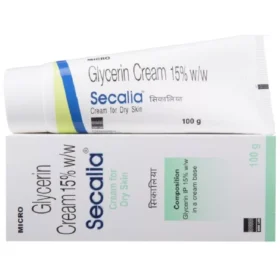 Secalia Cream
Q & A
Secalia Cream
Related products


Reviews
There are no reviews yet