







Sulpitac
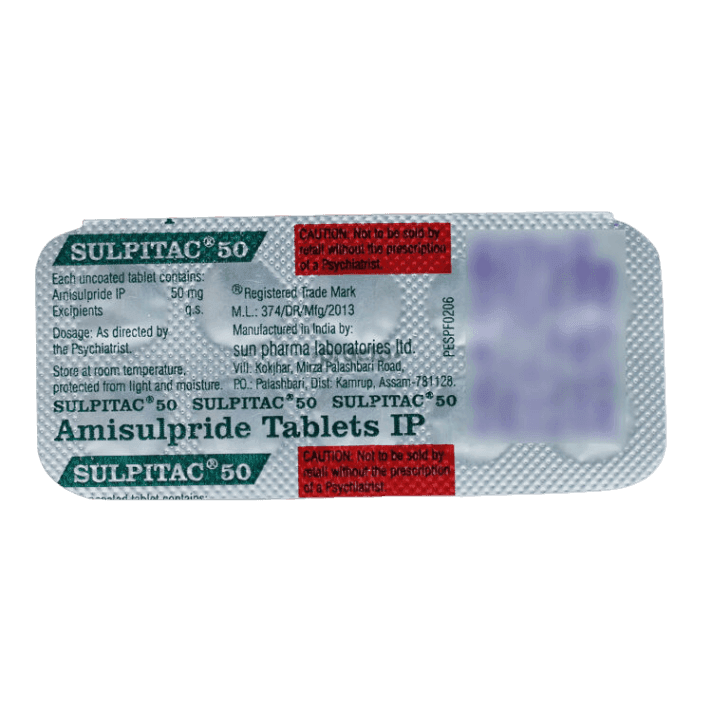


Sulpitac (Amisulpride 50–400 mg) — D2/D3-selective benzamide atypical for schizophrenia (negative or positive symptoms). dose-dependent dual mechanism — 50–300 mg for negative symptoms.
✓ Medically reviewed by Morgan Ellis — Pharmacy Researcher · 8 years experience · Last reviewed: May 2026
⚡ Quick Answer
Sulpitac (Amisulpride 50 / 100 / 200 / 400 mg) is a benzamide atypical antipsychotic for schizophrenia. Dose-dependent dual mechanism — low doses (50–300 mg) treat negative symptoms; higher doses (400–1200 mg) treat positive symptoms. Largely renally cleared. Available across Europe and Asia; not FDA-approved.
📦 Every order is covered by our Reshipment Assurance Policy — if your parcel does not arrive within 20 business days, we reship it.
Why order from MedsBase
Sulpitac at MedsBase is supplied directly from a WHO-GMP certified manufacturer in plain, discreet packaging. Every order is covered by our Reshipment Assurance Policy — 20-business-day arrival window or we reship at no charge — and qualifies for our customer loyalty programme. Worldwide shipping is available to most destinations.
What Sulpitac is and how it works
Sulpitac is an amisulpride tablet supplied by Sun Pharma. Available strengths: 50 / 100 / 200 / 400 mg. Amisulpride is a benzamide atypical with selective D2/D3 antagonism — no significant action at 5-HT2A, H1, M1, or α-adrenergic receptors. The unique feature is dose-dependent action on dopamine: at low doses (50–300 mg) it preferentially blocks pre-synaptic D2 autoreceptors, increasing dopamine release in the prefrontal cortex (treats negative symptoms); at higher doses (400–1200 mg) it blocks postsynaptic D2 receptors (treats positive symptoms).
Approved across Europe and Asia for schizophrenia; not FDA-approved (oral). The intravenous formulation is FDA-approved for postoperative nausea/vomiting under a different brand name (Barhemsys) but with no oral availability in the US.
Indications and dosing
| Indication | Starting | Target | Max |
|---|---|---|---|
| Predominantly negative symptoms | 50 mg OD | 50–300 mg/day | 300 mg |
| Predominantly positive symptoms | 200 mg BID | 400–800 mg/day | 1200 mg |
| Mixed presentation | 200 mg BID | 400–800 mg/day | 1200 mg |
| Renal impairment (CrCl 30–60) | halve dose | — | — |
| Renal impairment (CrCl 10–30) | one-third normal dose | — | — |
Important safety considerations
All atypical antipsychotics carry an FDA black-box warning for increased mortality (mostly cardiovascular and infectious) when used to treat behavioural disturbance in older adults with dementia. Atypicals are not approved for dementia-related psychosis or agitation. Use in this population is off-label, last-resort, time-limited, and requires explicit risk-benefit conversation.
Amisulpride produces dose-dependent QT prolongation — meaningful at higher doses. Pre-treatment ECG advised. Avoid in known long QT, hypokalaemia/hypomagnesaemia, recent MI, uncompensated heart failure, and concurrent QT-prolonging therapy.
Amisulpride raises prolactin substantially — comparable to risperidone. Same downstream effects: amenorrhoea, galactorrhoea, sexual dysfunction, accelerated osteoporosis. Switch to aripiprazole if symptomatic.
EPS rises sharply above 800 mg/day.
Common side effects
- Hyperprolactinaemia and downstream effects — common.
- EPS / akathisia — dose-dependent.
- Weight gain — modest.
- Insomnia, anxiety — at low doses (presynaptic D2 stimulation).
- QT prolongation — dose-dependent.
Drug interactions
- Other QT-prolonging drugs — additive risk; avoid combination.
- Antihypertensives — additive hypotension.
- Levodopa — antagonism; avoid in Parkinson’s.
- Renally-cleared drugs — additive renal burden.
Pregnancy, breastfeeding, paediatric
Pregnancy: limited data; weigh against untreated illness. Breastfeeding: passes into milk; usually requires monitoring. Paediatric: not licensed in most countries.
Storage
Store at 15–30 °C in original packaging.
Frequently Asked Questions
How does Sulpitac’s dose-dependent action work?
At low doses, amisulpride preferentially blocks presynaptic D2 autoreceptors, which actually increases dopamine release in the prefrontal cortex — useful for negative symptoms (apathy, blunting, withdrawal). At higher doses, it occupies postsynaptic D2 receptors and produces classical antipsychotic blockade for positive symptoms. The dose-response curve is unique among atypicals.
Why is Sulpitac not FDA-approved?
Amisulpride was developed by Sanofi in France and approved across Europe and much of Asia from 1986. Sanofi did not pursue FDA approval for the oral formulation. The IV formulation is FDA-approved for postoperative nausea (Barhemsys) but the oral psychiatric form is not available in the US.
Will Sulpitac affect my fertility?
Yes — amisulpride raises prolactin, with the same fertility, menstrual, sexual, and bone-density effects as risperidone. Switch to aripiprazole if hyperprolactinaemia is symptomatic.
How long until Sulpitac works?
Acute effect on agitation in days. Antipsychotic effect on positive symptoms 1–2 weeks; full effect at 4–6 weeks. Negative symptoms (low-dose use) may take weeks to months.
Will Sulpitac make me gain weight?
Modest — typically 1–3 kg over 6 months. Less than olanzapine/quetiapine.
Does Sulpitac prolong the QT interval?
Yes — meaningful at higher doses. Pre-treatment ECG is recommended. Avoid in patients with QT risk factors.
Can Sulpitac be combined with other antipsychotics?
Generally avoid — additive QT and prolactin risk. Specialist supervision required.
What about driving on Sulpitac?
Sedation is mild compared to olanzapine or quetiapine. Most patients drive normally on stable doses.
Can Sulpitac be stopped abruptly?
Taper over 2–4 weeks. Relapse risk in schizophrenia is the main concern.
Why does Sulpitac need renal dose adjustment?
Amisulpride is largely renally cleared (50–60%). Renal impairment raises levels substantially, increasing EPS, hyperprolactinaemia, and QT risk. Dose adjustment is mandatory in CrCl < 60.
Other Mental Health Medications
- Aripicon (Aripiprazole — D2 partial agonist)
- Olanzap (Olanzapine — robust antipsychotic)
- Risdone (Risperidone)
- Seroquit (Quetiapine — bipolar depression)
- Atlura (Lurasidone — metabolically clean)
More options in Mental Health and Psychiatric Medications
Ranked by recent MedsBase order volume — what other customers in this category are picking.
| Quantity | 30 Tablet/s, 60 Tablet/s, 90 Tablet/s, 180 Tablet/s |
|---|---|
| Stength | 50 mg, 100 mg |
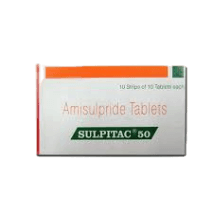 Sulpitac
Q & A
Sulpitac
Related products




Reviews
There are no reviews yet