







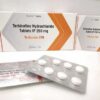
Terbicip

✅ Fights fungal infections
✅ Relieves itching and burning
✅ Promotes healthy nails
✅ Treats athlete’s foot
✅ Clears skin infections
Terbicip contains Terbinafine.
✓ Medically reviewed by Morgan Ellis — Pharmacy Researcher · 8 years experience · Last reviewed: May 2026
💡 Quick Answer
Terbicip is terbinafine 250 mg oral tablet — an allylamine antifungal and the first-line oral treatment for dermatophyte onychomycosis (toenail / fingernail fungus) and tinea capitis. 250 mg once daily × 6 weeks (fingernails) or 12 weeks (toenails). Concentrates in skin and nails — persists in the nail bed for weeks after the last dose. Best cure rates of any oral antifungal for dermatophyte infections (~76%). LFT monitoring required; rare but serious hepatotoxicity. Not effective against Candida or non-dermatophyte yeasts — confirm dermatophyte before starting.
WHO-GMP
certified manufacturer
📦 Every order is covered by our Reshipment Assurance Policy — if your parcel does not arrive within 20 business days, we reship it.
Why order from MedsBase
Our generic medications are sourced from WHO-GMP certified manufacturers and shipped worldwide in discreet, plain packaging — no medication name on the parcel exterior. Card payments are routed through a regulated processor (statement descriptors include a regulated card-payment processor — never “MedsBase” or any medication name). Crypto and SEPA bank transfer are also accepted. Every order is backed by our Reshipment Assurance Policy.
Discreet packaging
plain envelope
Worldwide shipping
to most countries
🔒 Why order Terbicip from MedsBase
- WHO-GMP certified manufacturer — sourced from a regulated facility, finished pack with batch number and expiry.
- Discreet packaging — plain envelope, no medication name on the outside.
- Worldwide shipping to most countries with Reshipment Assurance.
- Loyalty points — 1 point per $1 spent (excludes peptides/shipping); 100 points = $5 off your next order.
Uses & indications
Terbicip (terbinafine 250 mg, Cipla) is the standard oral therapy for dermatophyte fungal infections of the skin and nails. It is fungicidal against dermatophytes (Trichophyton, Epidermophyton, Microsporum), fungistatic against most Candida species (so not used for yeast infections), and active against some moulds.
| Indication | Typical regimen |
|---|---|
| Onychomycosis — fingernails | 250 mg once daily × 6 weeks |
| Onychomycosis — toenails | 250 mg once daily × 12 weeks |
| Tinea capitis (scalp ringworm) — adults | 250 mg once daily × 4 weeks |
| Tinea capitis — children > 4 y | Weight-based: 62.5 mg (10–20 kg) / 125 mg (20–40 kg) / 250 mg (> 40 kg) once daily × 4 weeks |
| Tinea pedis / cruris / corporis (extensive or topical-refractory) | 250 mg once daily × 2–6 weeks |
| Tinea manuum | 250 mg once daily × 2–4 weeks |
How to take
- Take with or without food — absorption is not significantly affected.
- Take at the same time each day to maintain steady plasma levels.
- Do not stop early — even when the visible nail looks normal, dermatophytes may persist deep in the nail matrix.
- The dead, fungus-affected nail will keep growing out for 9–12 months after a successful 12-week course. This is normal.
How it works
Terbinafine inhibits squalene epoxidase — an enzyme earlier in the ergosterol biosynthesis pathway than the CYP51 target of azoles. This causes squalene to accumulate inside the fungal cell (toxic effect) AND ergosterol depletion (membrane disruption) — the dual mechanism is why terbinafine is fungicidal against dermatophytes. Highly lipophilic — concentrates in stratum corneum, hair follicles, sebum, and nail at concentrations many times plasma. Persists in the nail for weeks after dosing.
Side effects & monitoring
| Frequency | Effects |
|---|---|
| Very common (≥10%) | Headache, gastrointestinal symptoms (nausea, abdominal pain, diarrhoea), mild rash |
| Common | Taste disturbance / loss of taste (~3% — usually reversible over weeks to months but can be persistent), arthralgia, myalgia |
| Uncommon | Hepatic enzyme rise, depression, peripheral neuropathy |
| Rare but serious | Severe hepatotoxicity (idiosyncratic, can be fatal — discontinue if AST/ALT > 3× ULN or any symptoms), severe skin reactions (SJS, TEN, AGEP), drug-induced lupus, agranulocytosis, neutropenia |
Drug interactions
Terbinafine has fewer interactions than the azoles, but is a moderate inhibitor of CYP2D6:
| Drug class | Effect | Action |
|---|---|---|
| Tricyclic antidepressants (amitriptyline, nortriptyline) | Levels rise — anticholinergic / cardiac toxicity | Reduce dose; monitor |
| SSRIs / SNRIs (paroxetine, fluoxetine, venlafaxine, duloxetine) | Levels rise | Monitor for serotonin syndrome / side effects |
| Beta-blockers (metoprolol, propranolol, carvedilol) | Levels rise — bradycardia, hypotension | Monitor pulse / BP |
| Antiarrhythmics (flecainide, propafenone) | Levels rise — proarrhythmia | Avoid combination if possible |
| Codeine, tramadol | Reduced analgesic effect (CYP2D6 activates these) | Switch to morphine or non-opioid analgesia |
| Rifampicin | Terbinafine clearance increased | Increase terbinafine dose 50% or extend duration |
| Cimetidine | Reduces terbinafine clearance | No dose change usually needed |
| Caffeine | Levels rise — jitteriness | Reduce caffeine intake |
Who should not take oral terbinafine
- Active or chronic liver disease — particularly cirrhosis, active hepatitis.
- Severe renal impairment (CrCl < 50 mL/min — limited data).
- Hypersensitivity to terbinafine.
- Caution in patients with autoimmune disease — terbinafine can precipitate cutaneous lupus.
- Caution in pregnancy and breastfeeding (limited data; defer treatment of onychomycosis until after).
Pregnancy & breastfeeding
Limited human pregnancy data. Animal studies do not show teratogenicity. Onychomycosis is not life-threatening — defer treatment until after pregnancy and breastfeeding. Terbinafine is excreted in breast milk; not recommended during breastfeeding except if benefit clearly outweighs risk.
Frequently Asked Questions
How long until my toenail looks normal?
The drug clears the fungus within the 12-week course but the dead, discoloured nail keeps growing out from the cuticle. Toenails take 9–12 months to look fully normal; fingernails 4–6 months. Photo at month 0, 3, 6, 12 to track objectively.
Why do I have to confirm it’s a dermatophyte first?
Terbinafine is highly active against dermatophytes (Trichophyton, Epidermophyton) but only weakly active against Candida and most non-dermatophyte moulds. ~50% of nail discolouration is something other than dermatophyte fungus (psoriasis, lichen planus, trauma, melanoma). A nail clipping for microscopy and culture (or PCR) before starting saves 12 weeks of useless therapy.
Why am I tasting metal / can’t taste my food?
Taste disturbance affects ~3% of patients on oral terbinafine. The mechanism is not fully understood. It is usually reversible over weeks to a few months after stopping, but ~10% of cases can be persistent or permanent. If taste change starts during therapy, balance the impact against the cure rate — sometimes worth completing the course, sometimes worth switching to itraconazole.
Terbinafine vs itraconazole — which one for my toenail?
Terbinafine is first-line for dermatophyte onychomycosis: higher cure rate (~76% vs ~63%), fewer drug interactions, no acid-absorption rule. Itraconazole pulse is preferred for non-dermatophyte mould or mixed Candida onychomycosis, or when terbinafine is contraindicated.
Can I drink alcohol while taking terbinafine?
Both alcohol and terbinafine are processed by the liver. Heavy drinking raises hepatotoxicity risk. Light intake is generally accepted; avoid binge-drinking and cut alcohol entirely if you have any pre-existing liver concern. A 12-week treatment course is a reasonable time to reduce alcohol intake.
What about my child with scalp ringworm?
Terbinafine is licensed for tinea capitis in children > 4 years (weight-based dosing). For Trichophyton tonsurans (the common UK / US cause) it is first-line — 4-week course, higher cure rate than griseofulvin and shorter duration. For Microsporum canis, griseofulvin is preferred.
I’ve had alopecia areata before — does terbinafine make it worse?
Terbinafine is rarely associated with new-onset hair loss (telogen effluvium). Pre-existing alopecia areata is not a contraindication. If significant hair loss develops, discuss with a dermatologist.
Why do my muscles ache on terbinafine?
Myalgia and arthralgia are recognised side effects (~5%). Usually mild and resolve on continuation. Severe muscle pain, dark urine, or weakness — stop the drug and seek medical advice (rare rhabdomyolysis or drug-induced myopathy).
Can I exercise on terbinafine?
Yes — normal exercise is fine. The mild myalgia some patients experience is not exercise-related. If you develop unusual leg pain or dark urine after exercise, hold the drug and get a CK level.
Is Terbicip the same as Lamisil?
Yes — Lamisil is the original Novartis brand of terbinafine. Terbicip contains the same active ingredient, manufactured by Cipla under WHO-GMP. Bioequivalent.
Storage
Store tablets at 15–30 °C, away from moisture and light. Keep in original blister. Do not use after expiry. Keep out of reach of children.
Other Antifungal Medications you may be interested in
If Terbicip is unavailable, here are alternatives — same molecule from a different manufacturer, plus options for indications where terbinafine is not first-line.
- Zimig (terbinafine 250 mg) — First-line for dermatophyte onychomycosis; ~76% cure rate.
- Sporanox (itraconazole 100 mg) — Pulse therapy for non-dermatophyte mould or mixed Candida onychomycosis.
- Grisovin FP (griseofulvin) — Tinea capitis caused by Microsporum (paediatric).
- Loceryl (amorolfine 5%) — Topical lacquer for mild distal-edge nail fungus.
- Zocon (fluconazole 150 mg) — Standard oral therapy for Candida (vaginal, oral, oesophageal thrush).
More options in Anti Fungal
Ranked by recent MedsBase order volume — what other customers in this category are picking.
| Strength | 250 mg |
|---|---|
| Quantity | 7 Tablet/s, 14 Tablet/s, 21 Tablet/s, 28 Tablet/s |
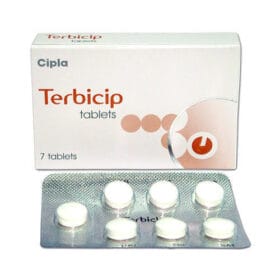 Terbicip
Q & A
Terbicip
Related products




Reviews
There are no reviews yet