







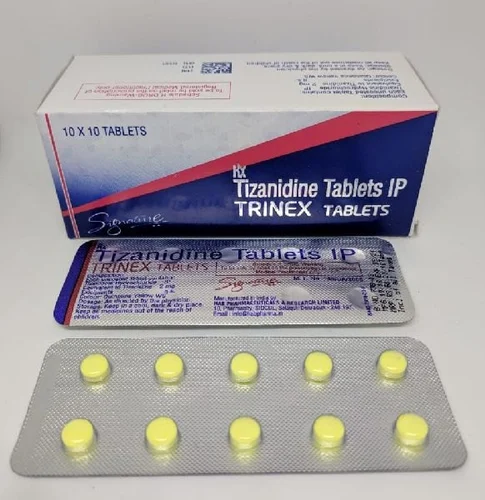
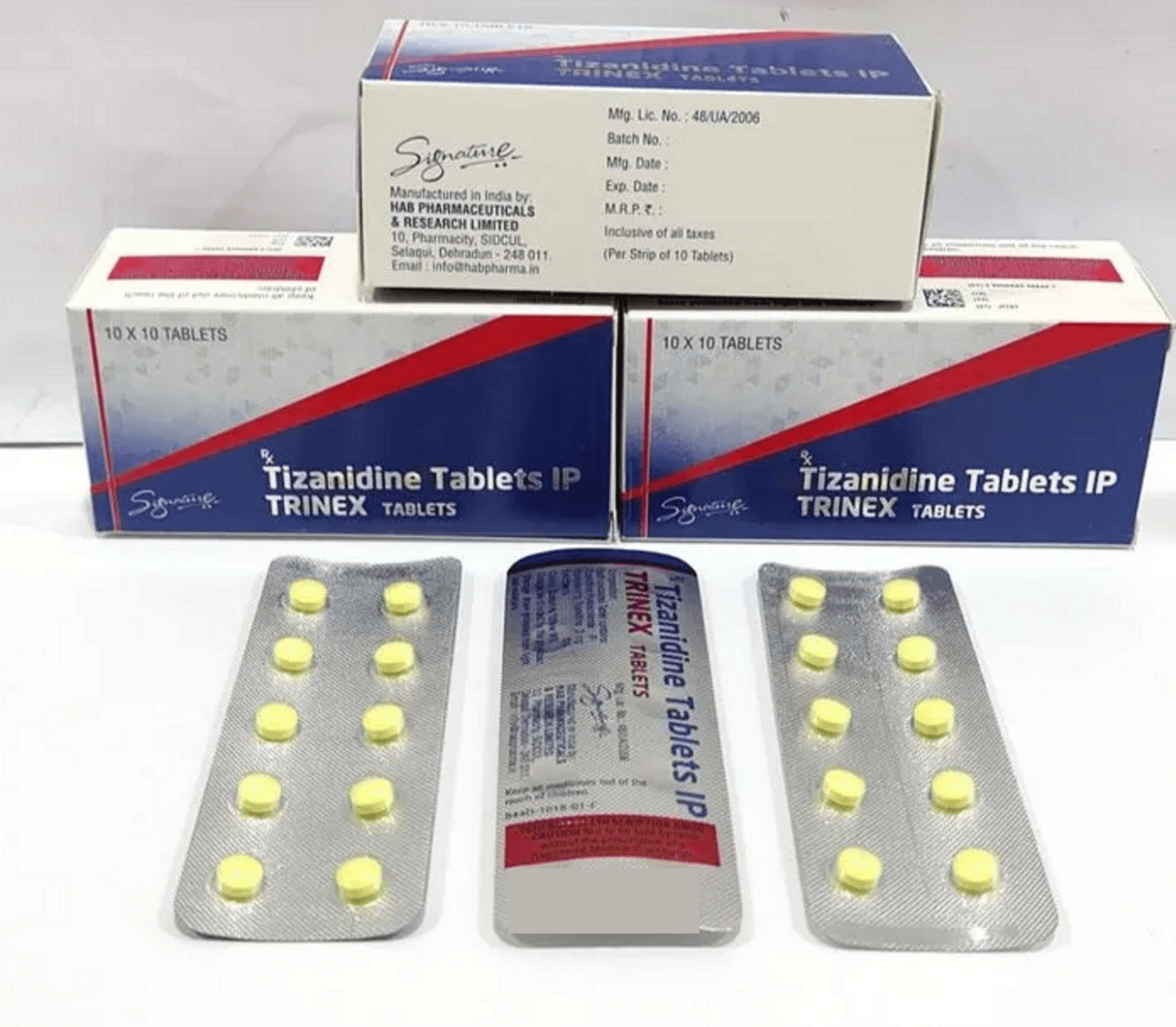
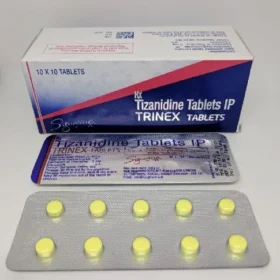
Trinex
✅ Relieves muscle spasms
✅ Reduces muscle stiffness
✅ Enhances mobility
✅ Alleviates pain
✅ Improves muscle function
Trinex contains Tizanidine.
✓ Medically reviewed by Morgan Ellis — Pharmacy Researcher · 8 years experience · Last reviewed: May 2026
⚡ Quick Answer — What is Trinex?
Trinex is a tizanidine 2 mg tablet, a centrally-acting alpha-2 adrenergic agonist muscle relaxant used for spasticity (muscle stiffness from upper motor neuron disease) and acute painful musculoskeletal spasm. Usual starting dose is 2 mg three times daily, titrated slowly up to a maximum of 36 mg/day in 3–4 divided doses. Tizanidine has a short half-life (~2.5 hours), so frequent dosing is needed. The most common side effect is drowsiness; never combine with ciprofloxacin or fluvoxamine (10-fold increase in blood levels).
📦 Every order is covered by our Reshipment Assurance Policy — if your parcel does not arrive within 20 business days, we reship it.
Why order from MedsBase
Our generic medications are sourced from WHO-GMP certified manufacturers and shipped worldwide in discreet, plain packaging — no medication name on the parcel exterior. Card payments are routed through a regulated processor (statement descriptors include a regulated card-payment processor — never “MedsBase” or any medication name). Crypto and SEPA bank transfer are also accepted. Every order is backed by our Reshipment Assurance Policy.
Trinex 2 mg is an oral tablet of tizanidine, a centrally-acting skeletal muscle relaxant. Unlike cyclobenzaprine (a tricyclic-derived CNS depressant) or methocarbamol and metaxalone (general polysynaptic-reflex depressants), tizanidine works through a different and more targeted mechanism: it is an alpha-2 adrenergic receptor agonist, closely related to the antihypertensive clonidine but with a more selective effect on spinal motor reflexes.
Tizanidine is one of the first-line medications for spasticity — the muscle stiffness that develops in multiple sclerosis, spinal cord injury, stroke, cerebral palsy, and traumatic brain injury. It is also used for acute painful musculoskeletal spasm (low back pain, neck pain, muscle strain) and as an adjunct in chronic pain management.
What Is Trinex Used For?
- Spasticity in multiple sclerosis — one of the most common indications
- Spasticity after stroke (hemiplegic spasticity)
- Spasticity from spinal cord injury
- Spasticity in cerebral palsy (children, under paediatric specialist care)
- Acute low back pain and muscle spasm
- Acute neck pain, cervical strain, torticollis
- Tension-type headache with prominent cervical muscle component
- Myofascial pain syndrome — as adjunct
- Fibromyalgia — off-label, bedtime dosing
- Trigeminal neuralgia — as adjunct to carbamazepine
- Chronic neuropathic pain — off-label adjunct therapy
How Does Tizanidine Work?
Tizanidine is a central alpha-2 adrenergic receptor agonist. It acts at the spinal cord level, where alpha-2 receptors on presynaptic terminals of excitatory interneurons reduce the release of excitatory amino acids (glutamate, aspartate) onto motor neurons. This lowers the reflex excitability of spinal motor neurons, reducing muscle tone and spasticity without significantly affecting muscle strength or the nerve-muscle junction itself.
Unlike baclofen (GABA-B agonist, also used for spasticity), tizanidine does not cause the same degree of muscle weakness — which is why patients often prefer it when they still need to use the affected limb.
Trinex Dosing
- Starting dose: 2 mg three times daily
- Titration: increase by 2–4 mg every 1–4 days as tolerated
- Effective dose range: 2–8 mg three to four times daily
- Maximum: 36 mg per day, in 3–4 divided doses, not more than 12 mg per dose
- Half-life: approximately 2.5 hours — this is why dosing must be frequent (3–4 times daily) for sustained effect
- Renal impairment (CrCl < 25 mL/min): start at 2 mg once daily; titrate very cautiously
- Hepatic impairment: use with caution; monitor liver enzymes
- Elderly: start at 2 mg once or twice daily; titrate carefully
Take tizanidine consistently: either always with food, or always without food — not both. Food changes peak plasma concentration by up to 30%, and switching between fed and fasted states mid-course will cause unpredictable effects. Most patients find it more tolerable with food.
Critical drug interactions. Tizanidine is metabolised almost exclusively by the liver enzyme CYP1A2. Drugs that block CYP1A2 can raise tizanidine blood levels 10-fold or more — causing severe hypotension, extreme drowsiness, or loss of consciousness. Never combine tizanidine with: ciprofloxacin, fluvoxamine (SSRI). Use extreme caution with: norfloxacin, mexiletine, zileuton, oral contraceptives, cimetidine, propafenone, amiodarone, and ticlopidine. Always tell any new prescriber that you are on tizanidine.
Who Should Not Take Trinex?
- Known hypersensitivity to tizanidine
- Concurrent use of ciprofloxacin or fluvoxamine — absolute contraindication
- Severe hepatic impairment
- Concurrent alpha-2 agonist use (clonidine, guanfacine, dexmedetomidine) — additive hypotension
- Use with extreme caution in: hypotension, bradycardia, QT prolongation, severe renal impairment, elderly patients
- Pregnancy and breastfeeding — insufficient data; avoid unless clearly necessary
Side Effects
- Very common (> 10%): drowsiness (especially in first week), dry mouth, fatigue, dizziness
- Common: hypotension (postural, especially in first 2 weeks), bradycardia, muscle weakness, asthenia, insomnia (paradoxical), constipation
- Uncommon: elevated liver enzymes, hallucinations (visual, especially in first week), urinary frequency
- Rare but serious: severe hepatotoxicity, acute hepatitis (reversible on stopping), syncope, QT prolongation
Never stop tizanidine abruptly after prolonged use. Withdrawal can cause rebound hypertension, tachycardia, and acute increase in spasticity. Any course longer than 2–3 weeks must be tapered down over 1–2 weeks under medical supervision.
Trinex vs Other Muscle Relaxants
| Drug | Mechanism | Best for | Main side effect |
|---|---|---|---|
| Tizanidine (Trinex) | α2-adrenergic agonist | Spasticity (MS, stroke, SCI); acute spasm | Drowsiness, hypotension |
| Baclofen | GABA-B agonist | Spasticity (upper motor neuron) | Muscle weakness, drowsiness |
| Cyclobenzaprine (Flexabenz) | Central brainstem | Acute musculoskeletal spasm | Drowsiness, anticholinergic |
| Methocarbamol (Robinax) | Spinal polysynaptic reflex | Acute spasm, daytime use | Drowsiness, dizziness |
| Metaxalone (Flexura) | Spinal polysynaptic reflex | Acute spasm, low-sedation need | Mild drowsiness |
| Tolperisone (Synaptol) | Na⁺/Ca²⁺ channel modulation | Spasticity; acute spasm; non-sedating | Minimal sedation |
Ordering & Delivery
MedsBase offers worldwide shipping on every order. Orders are dispatched in discreet packaging and arrive in branded manufacturer packs. If your preferred strength or pack size is out of stock, contact customer support for an ETA.
Medical disclaimer. The information on this page is provided for general education only. It is not a substitute for advice from your own doctor or pharmacist. Talk to a qualified healthcare professional before starting, stopping, or changing therapy.
Frequently Asked Questions
What is Trinex used for?
Trinex (tizanidine 2 mg) is used for spasticity — muscle stiffness from multiple sclerosis, stroke, spinal cord injury, or cerebral palsy — and for acute painful musculoskeletal spasm (low back pain, neck pain). It is also used off-label for tension-type headache and fibromyalgia.
How does tizanidine differ from other muscle relaxants?
Tizanidine is an alpha-2 adrenergic agonist (like clonidine), while most other oral muscle relaxants are general CNS depressants. The mechanistic difference means tizanidine is more targeted at spasticity and causes less generalised sedation than cyclobenzaprine, but more hypotension and more drug interactions than metaxalone or methocarbamol.
Why does my doctor say to avoid ciprofloxacin with Trinex?
Ciprofloxacin blocks the liver enzyme CYP1A2, which is the only pathway that breaks down tizanidine. Combining the two can raise tizanidine levels 10-fold or more, causing severe hypotension, heavy sedation, or unconsciousness. This is an absolute contraindication.
How long does Trinex take to work?
Muscle-relaxing effect begins within 1–2 hours of a dose and peaks around 1 hour. Because the half-life is short (~2.5 hours), the effect wears off within 4–6 hours — which is why dosing is 3–4 times a day.
Should I take Trinex with food?
Be consistent — either always with food or always without food. Food changes peak plasma concentration by up to 30%, and switching between fed and fasted states will cause unpredictable effects. Most patients find taking it with food more tolerable.
Does Trinex cause drowsiness?
Yes — drowsiness affects more than 1 in 3 users, especially in the first 1–2 weeks and after each dose increase. It usually improves with continued use. Do not drive or operate machinery until you know how you respond.
Can I take Trinex with blood pressure tablets?
Yes but with caution. Tizanidine can lower blood pressure, particularly when combined with ACE inhibitors, ARBs, calcium channel blockers, or diuretics. Monitor BP closely in the first 1–2 weeks and during any dose increase.
Can I stop Trinex suddenly?
No — not after prolonged use. Abrupt withdrawal can cause rebound hypertension, tachycardia, and a sharp increase in spasticity. Courses longer than 2–3 weeks must be tapered down over at least 1–2 weeks.
Is Trinex addictive?
Tizanidine is not a controlled substance and does not cause the same kind of physical dependence as benzodiazepines or opioids. However, long-term therapy does require a taper for physiological reasons (rebound).
Can I drink alcohol on Trinex?
Avoid alcohol. It adds to drowsiness, dizziness, and hypotension — including the risk of falls.
Is Trinex safe in pregnancy?
Data are limited. Avoid in pregnancy and breastfeeding unless your doctor considers it clearly necessary.
For patients on tizanidine who want to avoid the hypotension and somnolence common to alpha-2 agonists, Synaptol (tolperisone 150 mg) provides muscle-spasm relief through a different mechanism with a much milder side-effect profile.
See also: Synaptol 150 mg — tolperisone alternative when cyclobenzaprine sedation is unacceptable — centrally acting without H1 antihistamine drowsiness.
Related Alternatives
Other products in Chronic Conditions that customers also view:
More options in Pain Relief Medication
Ranked by recent MedsBase order volume — what other customers in this category are picking.


| Strength | 2 mg |
|---|---|
| Quantity | 30 Tablet/s, 60 Tablet/s, 90 Tablet/s, 180 Tablet/s |
 Trinex
Q & A
Trinex
Related products










Reviews
There are no reviews yet