








Ventab XL
✅ Fast-acting relief
✅ Extended release
✅ Mood stabilization
✅ Improved focus
✅ Reduced anxiety
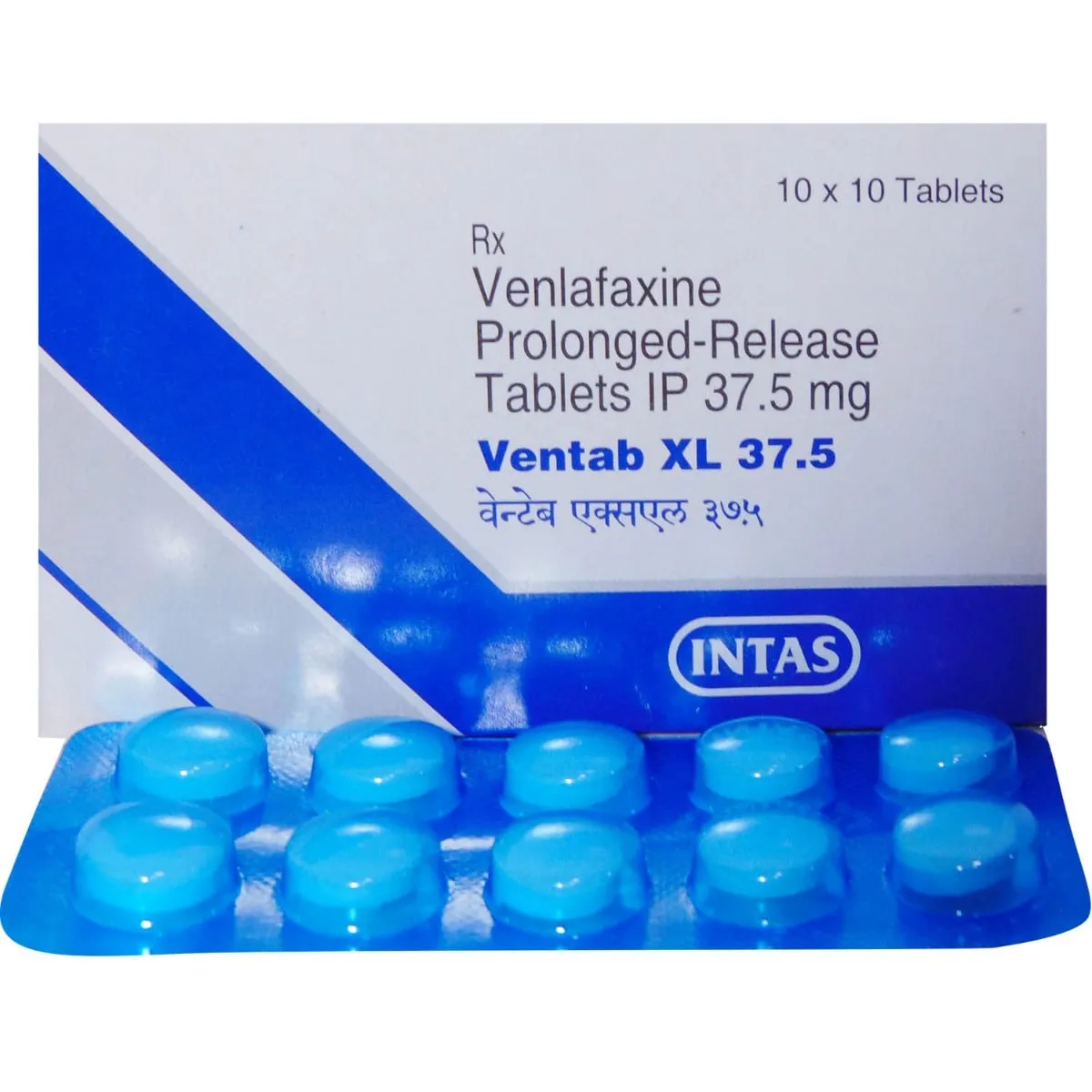
Ventab XL contains Venlafaxine.
✓ Medically reviewed by Morgan Ellis — Pharmacy Researcher · 8 years experience · Last reviewed: May 2026
⚡ Quick Answer — What is Ventab XL?
Ventab XL contains venlafaxine ER (37.5 / 75 / 150 mg ER) from a WHO-GMP certified manufacturer (Intas Pharmaceuticals) — an SNRI with broad evidence in depression and anxiety-spectrum disorders. Standard start: 75 mg once daily with food; titrate to 150–225 mg/day for full SNRI activity (max 375 mg in MDD, 225 mg in GAD/social anxiety/panic). Onset: 2–4 weeks. Below 150 mg the drug behaves mostly as an SSRI; norepinephrine reuptake inhibition appears at higher doses. Important: dose-dependent blood-pressure rise (BP must be monitored at > 225 mg). Has a severe discontinuation syndrome — mandatory taper. More dangerous in overdose than SSRIs (cardiac toxicity, seizures).
📦 Every order is covered by our Reshipment Assurance Policy — if your parcel does not arrive within 20 business days, we reship it.
Why order from MedsBase
Our generic medications are sourced from WHO-GMP certified manufacturers and shipped worldwide in discreet, plain packaging — no medication name on the parcel exterior. Card payments are routed through a regulated processor (statement descriptors include a regulated card-payment processor — never “MedsBase” or any medication name). Crypto and SEPA bank transfer are also accepted. Every order is backed by our Reshipment Assurance Policy.
What Is Ventab XL?
Ventab XL is an oral extended-release tablet/capsule of venlafaxine (37.5 / 75 / 150 mg ER) manufactured by Intas Pharmaceuticals under WHO-GMP certification. Venlafaxine (US brand Effexor XR) is the prototype serotonin-norepinephrine reuptake inhibitor (SNRI). It blocks both the serotonin transporter (SERT) at lower doses and the norepinephrine transporter (NET) at higher doses, producing a dose-dependent shift from SSRI-like to SNRI-like pharmacology.
It is a first-line option in NICE and APA guidelines for major depression and is one of the most-evidenced antidepressants for generalised anxiety disorder.
Approved Indications
- Major depressive disorder (MDD) — including treatment-resistant depression at higher doses
- Generalised anxiety disorder (GAD)
- Social anxiety disorder (chronic / generalised)
- Panic disorder — with and without agoraphobia
- Off-label: diabetic neuropathy, chronic fatigue, fibromyalgia, vasomotor symptoms of menopause
Dosing
| Indication | Start | Typical effective range | Maximum | Notes |
|---|---|---|---|---|
| MDD | 75 mg/day with food | 150–225 mg/day | 375 mg/day | Increase by 75 mg every 2 weeks |
| GAD, social anxiety, panic | 37.5–75 mg/day | 75–225 mg/day | 225 mg/day | Slower up-titration in panic to avoid early agitation |
| Elderly / hepatic / renal impairment | 37.5 mg/day | Up to 75–150 mg with caution | — | Reduce by 25–50% in moderate hepatic impairment |
Mechanism by Dose
Pharmacology shifts as dose climbs
| Daily dose | Pharmacology | Clinical relevance |
|---|---|---|
| 37.5–75 mg | Predominantly serotonergic (SSRI-like) | Useful as a starting / sub-therapeutic dose for tolerability |
| 75–150 mg | Mostly serotonergic with emerging noradrenergic activity | Lower end of antidepressant efficacy range |
| 150–225 mg | Combined SERT + NET inhibition (true SNRI) | Standard effective dose for most adults; full SNRI benefit |
| 225–375 mg (MDD only) | Strong SERT + NET inhibition | Used in treatment-resistant depression; BP and cardiac monitoring required |
Side Effects
Common, persistent, and rare side effects
| Frequency | Effect | Notes / management |
|---|---|---|
| Common | Nausea (dose-dependent) | Take with food; usually subsides over 1–2 weeks |
| Common | Headache, dizziness | Transient; adequate hydration |
| Common | Insomnia or somnolence | Often dose in the morning if activating |
| Common | Dry mouth, constipation, sweating | Sweating may persist; can be marked |
| Common | Sexual dysfunction | Similar prevalence to SSRIs |
| Less common | Increased blood pressure (dose-dependent) | Check BP at baseline and periodically; significant rise above 225 mg/day in 5–10% — may need dose reduction or switch |
| Less common | Increased pulse, palpitations | Caution in patients with cardiac disease |
| Less common | Weight changes (modest) | Less weight gain than paroxetine or mirtazapine |
| Rare | Hyponatraemia (SIADH) | Older adults at greatest risk |
| Rare | Bleeding risk | Caution with NSAIDs, anticoagulants |
| Rare | Serotonin syndrome | See interactions |
| Rare | Mydriasis / acute angle-closure glaucoma | Caution in narrow-angle glaucoma |
Discontinuation Syndrome
Venlafaxine has a short half-life (parent ~5 h; active metabolite desvenlafaxine ~11 h). Discontinuation symptoms are severe and rapid, second only to paroxetine: brain zaps, dizziness, nausea, sweating, irritability, insomnia, vivid dreams, flu-like aches. Often appear within 24–48 hours of a missed dose.
Mandatory slow taper: reduce by 75 mg every 2–4 weeks; below 75 mg use the smallest available capsule and consider every-other-day or hyperbolic tapering. Never stop abruptly. Patients on long-term venlafaxine often spend months on tapering — this is normal.
Drug Interactions
Absolute contraindications: MAOIs, linezolid, methylene blue. 14-day washout.
Serotonergic interactions: triptans, tramadol, pethidine, dextromethorphan, St John’s wort, lithium — serotonin syndrome risk.
CYP2D6 substrate: levels rise with strong CYP2D6 inhibitors (paroxetine, fluoxetine, bupropion, quinidine). Consider dose reduction.
Bleeding risk: NSAIDs, aspirin, warfarin, DOACs.
Cardiac and Overdose Considerations
Venlafaxine is more dangerous in overdose than SSRIs: cardiac conduction abnormalities, QT prolongation, seizures, and serotonin syndrome have been reported. Provide only short supplies to patients at acute suicide risk. Pre-existing significant cardiac disease, recent MI, or uncontrolled hypertension are relative contraindications.
Frequently Asked Questions
How long does Ventab XL take to work?
Anxiety symptoms often improve in 2–3 weeks; mood response in MDD typically appears at 4–6 weeks. Patients on sub-therapeutic doses (< 150 mg) may need dose escalation before seeing full benefit.
Why does the dose matter so much for venlafaxine?
Below 150 mg/day, venlafaxine acts mostly like an SSRI — norepinephrine reuptake inhibition appears only at higher doses. Patients who don’t respond at 75 mg often respond once titrated to 150 mg or above.
Will Ventab XL raise my blood pressure?
Possibly — venlafaxine causes dose-dependent BP increases. Below 150 mg the effect is small; above 225 mg, 5–10% of patients see clinically significant increases. BP should be monitored at baseline and after dose escalations.
Can I stop Ventab XL abruptly?
No — venlafaxine has one of the worst discontinuation syndromes in the antidepressant class (brain zaps, dizziness, nausea, sweating). Mandatory taper, often over months for long-term users.
Is Ventab XL safe in pregnancy?
Limited data — not the first-choice antidepressant in pregnancy. Sertraline is preferred. Late-third-trimester exposure carries a small risk of neonatal adaptation syndrome and persistent pulmonary hypertension of the newborn.
Does Ventab XL cause weight gain?
Less than paroxetine or mirtazapine. Some patients see modest weight changes; others lose weight from initial GI side effects. Less metabolic burden than antipsychotics.
Can I drink alcohol on Ventab XL?
Light, occasional alcohol is generally tolerated. Heavy alcohol use worsens depression / anxiety, increases sedation, and is implicated in disinhibited behaviour.
What happens if I miss a dose?
Take it as soon as you remember unless close to the next dose. Withdrawal symptoms can begin within 24–48 hours of a missed dose — do not skip multiple doses.
How is Ventab XL different from duloxetine or desvenlafaxine?
All are SNRIs. Duloxetine has a different binding profile (more SNRI even at lower doses, hepatic concerns), is also approved for diabetic neuropathy and fibromyalgia. Desvenlafaxine is the active metabolite of venlafaxine — bypasses CYP2D6 metabolism, more predictable plasma levels.
How should Ventab XL be stored?
Store at 15–30 °C in the original blister packaging, away from moisture and sunlight. Keep out of reach of children — venlafaxine overdose is medically significant.
Related Alternatives
Other products in Chronic Conditions that customers also view:
More options in Situational Anxiety Treatment
Ranked by recent MedsBase order volume — what other customers in this category are picking.


| Strength | 37.5 mg |
|---|---|
| Quantity | 30 Tablet/s, 60 Tablet/s, 90 Tablet/s, 180 Tablet/s |
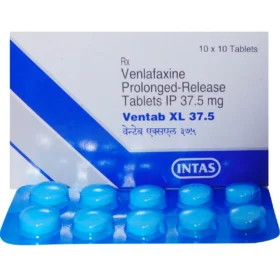 Ventab XL
Q & A
Ventab XL
Related products

Reviews
There are no reviews yet