








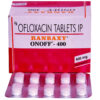
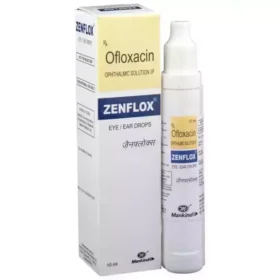
Zenflox Eye Drops
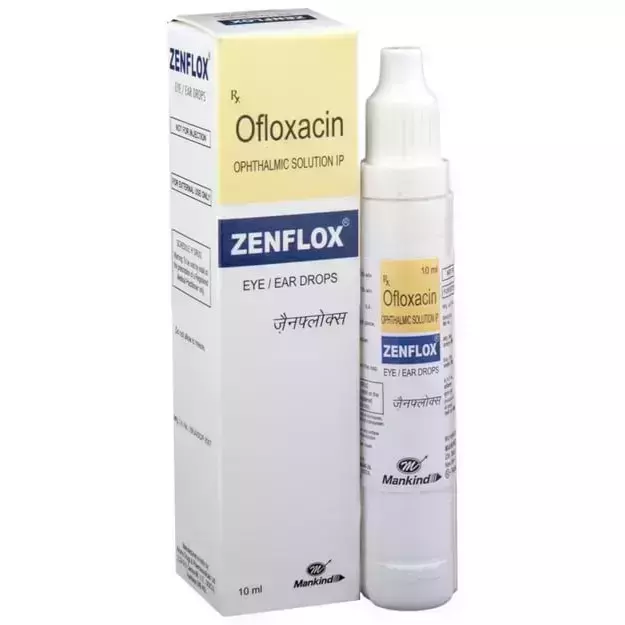
Zenflox (ofloxacin 0.3%) — fluoroquinolone eye drop for bacterial conjunctivitis and corneal ulcers. Day-1 loading every 30 min, then four-times-daily. Stewardship advised.
✓ Medically reviewed by Morgan Ellis — Pharmacy Researcher · 8 years experience · Last reviewed: May 2026
⚡ Quick Answer — What is Zenflox Eye Drops?
Zenflox Eye Drops is Ofloxacin 0.3%, a 2nd-generation fluoroquinolone antibiotic eye drop for bacterial conjunctivitis, blepharitis, and corneal ulcers. Used 4–6 times daily for 5–7 days. Best reserved for confirmed bacterial infection — most acute conjunctivitis is viral or self-limiting.
📦 Every order is covered by our Reshipment Assurance Policy — if your parcel does not arrive within 20 business days, we reship it.
Why order from MedsBase
Zenflox Eye Drops is sourced from a WHO-GMP certified manufacturer and shipped worldwide in plain, discreet packaging. Every order is covered by our Reshipment Assurance Policy — if it has not arrived after 20 business days we reship at no extra cost. Backed by 1,400+ verified customer reviews.
What is Zenflox Eye Drops?
Zenflox Eye Drops is manufactured by FDC and contains Ofloxacin 0.3% as a sterile ophthalmic solution. It is a 2nd-generation fluoroquinolone antibiotic used for bacterial eye infections.
How It Works
Ofloxacin inhibits bacterial DNA gyrase (topoisomerase II) and topoisomerase IV, the enzymes responsible for unwinding and re-coiling bacterial DNA. Without these enzymes the bacterium cannot replicate or repair DNA damage, leading to bacterial cell death. Because the eye has no equivalent enzymes, host cells are unaffected at therapeutic concentrations.
Indications
- Bacterial conjunctivitis — confirmed or strongly suspected (purulent discharge, mattered lashes on waking, no concurrent upper-respiratory symptoms)
- Bacterial blepharitis — when conservative lid hygiene fails
- Bacterial corneal ulcer / keratitis — under ophthalmologist supervision; intensive hourly dosing required
- Pre-/post-operative prophylaxis — cataract, corneal transplant, vitrectomy
- Contact-lens-associated keratitis — Pseudomonas coverage is critical
Dosing
| Indication | Dose |
|---|---|
| Bacterial conjunctivitis | 1–2 drops every 2 hours while awake for 2 days, then 1–2 drops every 4 hours for 5 more days |
| Corneal ulcer (specialist) | 2 drops every 15 minutes for the first 6 hours, then every 30 minutes through day 1, then hourly through day 2, then 4 times daily |
| Pre-operative prophylaxis | 1 drop QID for 1–3 days before surgery |
| Post-operative | 1 drop QID for 7–14 days after surgery |
Side Effects
Local: stinging, burning on instillation (most common), conjunctival hyperaemia, foreign body sensation, lid margin crusting, ocular pruritus, photophobia.
Systemic (rare): headache, nausea, taste disturbance.
Allergic reactions: immediate-type hypersensitivity is rare but reported. Discontinue if rash, swelling, or severe itching develops.
Warnings & Contraindications
- Hypersensitivity to fluoroquinolones (ciprofloxacin, levofloxacin, moxifloxacin, norfloxacin, ofloxacin)
- Viral keratitis (herpes simplex, varicella zoster) — fluoroquinolones do not treat viral infections; concurrent viral keratitis can worsen if topical steroids are added inappropriately
- Fungal keratitis
- Acanthamoeba keratitis (especially in contact-lens users)
- Pregnancy / breastfeeding — minimal systemic absorption from eye drops; usually acceptable, but discuss with prescriber
- Children — usually safe from age 1 year for conjunctivitis; corneal ulcer dosing requires specialist supervision
Storage
Store at 15–25°C protected from light. Discard 28 days after first opening. Do not touch the dropper tip to your eye or any surface.
Frequently Asked Questions
When should I use Zenflox Eye Drops?
When bacterial conjunctivitis is suspected: thick yellow-green purulent discharge, mattered lashes on waking, no upper-respiratory symptoms, often unilateral. Most red eyes are viral or allergic — antibiotic drops are not first-line for those.
How long should I use Zenflox Eye Drops?
5–7 days for conjunctivitis. Symptoms usually improve within 48 hours; complete the full course even if eyes look normal. Prolonged use (> 14 days) drives resistance.
Can I wear contact lenses while using Zenflox Eye Drops?
No. Stop wearing lenses for the duration of treatment and for at least 24 hours after symptoms resolve. Contact-lens-associated keratitis specifically requires lens cessation as part of cure.
What is the white precipitate I see in the eye?
Should be uncommon with Ofloxacin. If you see crystalline deposits, contact your ophthalmologist.
Is Zenflox Eye Drops safe in pregnancy?
Topical absorption is minimal and ophthalmic fluoroquinolones are generally considered safe in pregnancy when clearly indicated. Discuss with your prescriber.
What if symptoms don't improve in 48 hours?
Re-evaluate the diagnosis. The infection may be viral, fungal, or amoebic — fluoroquinolones don’t treat any of those. Persistent or worsening symptoms warrant urgent ophthalmology review.
Why not just use Zenflox Eye Drops for any red eye?
Most acute conjunctivitis is viral (adenovirus) or allergic. Topical antibiotics provide no benefit for those and contribute to fluoroquinolone-resistant strains of S. pneumoniae and S. aureus.
What if I get an allergic reaction?
Stop the drop immediately and contact your prescriber. Symptoms include increasing redness, lid swelling, severe itching, or rash spreading from the eye. Switch to a different antibiotic class.
Can Zenflox Eye Drops be used with other eye drops?
Yes, but separate by 5 minutes. If you use a steroid eye drop alongside, ensure the diagnosis is bacterial and not viral — steroids can devastate herpetic keratitis.
Why is this called a fluoroquinolone?
Ofloxacin is a synthetic antibiotic in the fluoroquinolone class — characterised by a fluorine atom on a quinolone ring. The class includes ciprofloxacin, levofloxacin, moxifloxacin, ofloxacin, and norfloxacin.
Other Eye-Care Medications
Customers viewing this product also consider these alternatives in our Eye Care range:
- Ciplox-D Eye Drops (cipro+dex)
- Gate P Eye Drops (gatifloxacin)
- Genticyn Eye Drop (gentamicin)
- Milflox Eye Drop (moxifloxacin)
- Oflox Eye Drop (ofloxacin)
Medical Disclaimer
The information on this page is for educational purposes only and is not a substitute for medical advice from a qualified ophthalmologist or optometrist. Eye conditions can rapidly threaten sight — sudden vision loss, severe pain, or trauma is an ophthalmology emergency. Always consult an eye-care professional before starting, stopping, or changing any treatment.
More options in Eye Care
Ranked by recent MedsBase order volume — what other customers in this category are picking.
| Strength | 10 ml |
|---|---|
| Quantity | 1 Bottle/s, 2 Bottle/s, 3 Bottle/s, 6 Bottle/s |
 Zenflox Eye Drops
Q & A
Zenflox Eye Drops
Related products



Reviews
There are no reviews yet