








✓ Medically reviewed by · Last reviewed: May 2026
Pharmacy Researcher · 8 years experience
Pharmacy researcher with 8 years reviewing clinical drug information, generic formulation equivalence, and international pharmaceutical standards. Focuses on patient-facing accuracy in medication education.
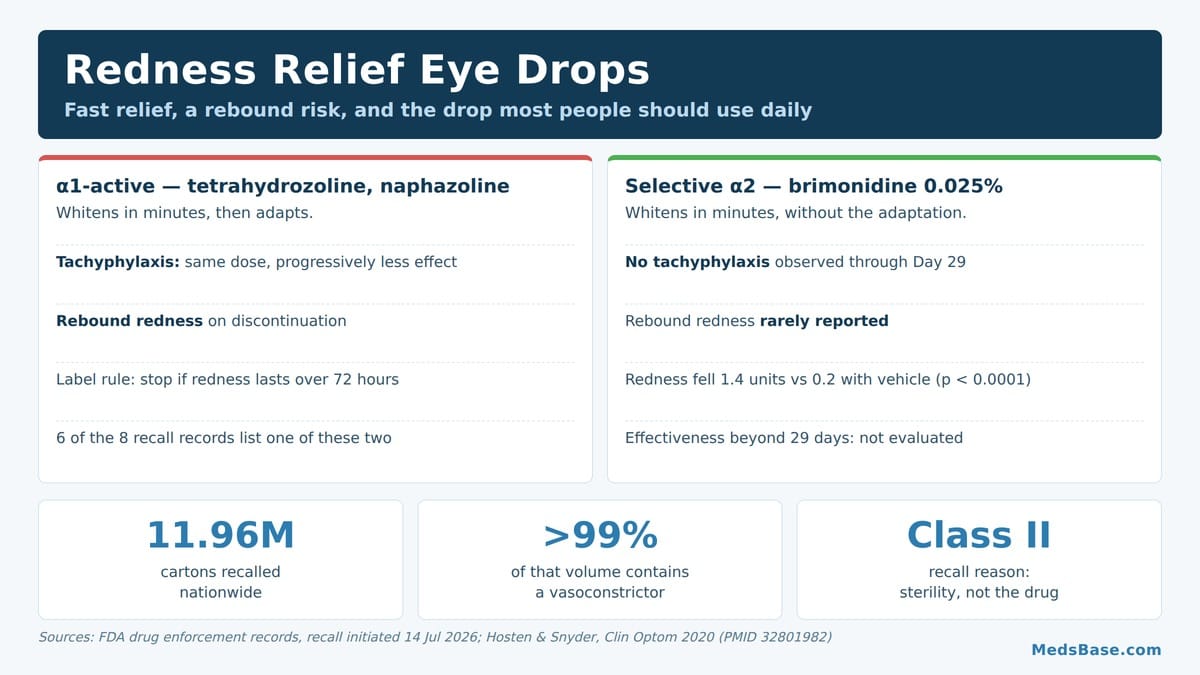
Almost 12 million cartons of cooling eye drops were pulled from US shelves last month, and more than 99% of them shared one thing: an ingredient designed to squeeze your eye’s blood vessels shut. The recall itself was about sterility, not about that ingredient. But it put a question in front of millions of people that almost nobody answers honestly at the pharmacy shelf — what are redness relief eye drops actually doing to an eye that gets them every day?
Here is the short version: they work, they work fast, and the most common type has a documented habit of making the problem worse over time. By the end of this article you will know which ingredient on the back of the box predicts that rebound, how long is genuinely safe, and which drop most daily users should be reaching for instead.
One of those answers will probably annoy you, because the right daily choice is the least exciting product in the aisle. We will get to it.
- Nearly 12 million cartons were recalled on 14 July — but for sterility, not for the redness ingredient everyone is now asking about
- Three decongestant molecules are sold over the counter, and only one of them avoided rebound in trials
- “Rebound redness” has a mechanism, not just anecdotes — and the receptor it acts on predicts it
- There is a hard time limit printed on these labels that most people have never read
- The drop most daily users actually need costs less and contains no decongestant at all
- One pattern of redness means stop self-treating today — it is in the safety section
What Are Redness Relief Eye Drops?
Redness relief eye drops are over-the-counter eye drops containing a topical decongestant — a drug that narrows the small blood vessels in the white of your eye, so visible redness fades within minutes. They treat the appearance of redness, not its cause. In the United States, three molecules are sold for this purpose: tetrahydrozoline, naphazoline and brimonidine.
That last sentence is the whole article in miniature, so it is worth slowing down. Those three ingredients are often shelved together, priced similarly, and marketed with near-identical language. Pharmacologically they are not interchangeable.
A 2020 review in Clinical Optometry reviewed the three decongestants sold over the counter in the US and set out the differences plainly: tetrahydrozoline is a selective α1 receptor agonist, naphazoline is a mixed α1/α2 agonist, and brimonidine 0.025% is a selective α2 agonist. All three narrow conjunctival blood vessels. All three reduce redness quickly. What separates them is what happens on day 10, not day one.
The receptor is the story. The brand on the box is not.
Why this came up now
On 14 July 2026, Rohto-Mentholatum (Vietnam) Co., Ltd. began a nationwide recall of its Cooling Eye Drops range for “Lack of Assurance of Sterility” — eight separate enforcement records covering six named products. The FDA’s enforcement record for the recall classifies it as Class II — the FDA’s designation for a product where serious harm is unlikely and any health effects are expected to be temporary or reversible — and lists it as ongoing.
Adding the individual records together gives 11,960,623 cartons. Six of those eight records list naphazoline or tetrahydrozoline among the active ingredients, and by volume they account for more than 99% of everything recalled — only one product in the range, a lubricant drop, contains no vasoconstrictor at all. So while the recall was not caused by the decongestant, it did hand roughly twelve million people a reason to look at what is in the bottle.
Most of them will not like what they find.
How Do Redness Relief Eye Drops Work?
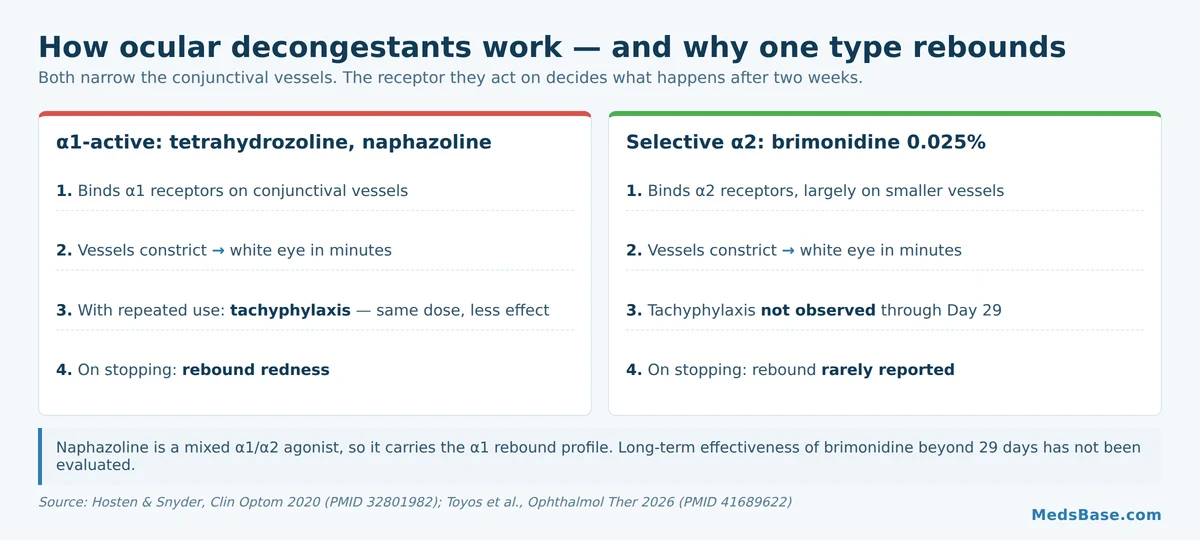
Think of the blood vessels in the white of your eye as garden hoses with an adjustable collar. When your eye is irritated — smoke, dust, pollen, a screen-lit night, a swimming pool — those vessels widen to deliver more blood, and the extra blood is what you see as redness. A decongestant tightens the collar. Less blood in the vessel, less visible red, and the effect shows up in minutes.
The complication is that your eye adapts to being told what to do.
With the α1-active agents, two things are documented over repeated use. The first is tachyphylaxis: the same drop produces progressively less whitening, so people instinctively use more. The second is rebound redness: when the drug is stopped, redness returns — sometimes looking worse than the original problem. The 2020 review states this directly, noting that decongestants with α1-adrenergic agonist activity “can be associated with loss of effectiveness with continued use (ie, tachyphylaxis) and rebound redness upon treatment discontinuation”.
Here is where it gets interesting. That same review reports that in clinical trials of brimonidine 0.025% — the selective α2 agent — tachyphylaxis was not observed, and rebound redness was rarely reported.
If you have ever felt that your drops “stopped working”, you were not imagining it, and you were not doing anything wrong.
Key Uses — And When These Drops Are the Wrong Tool
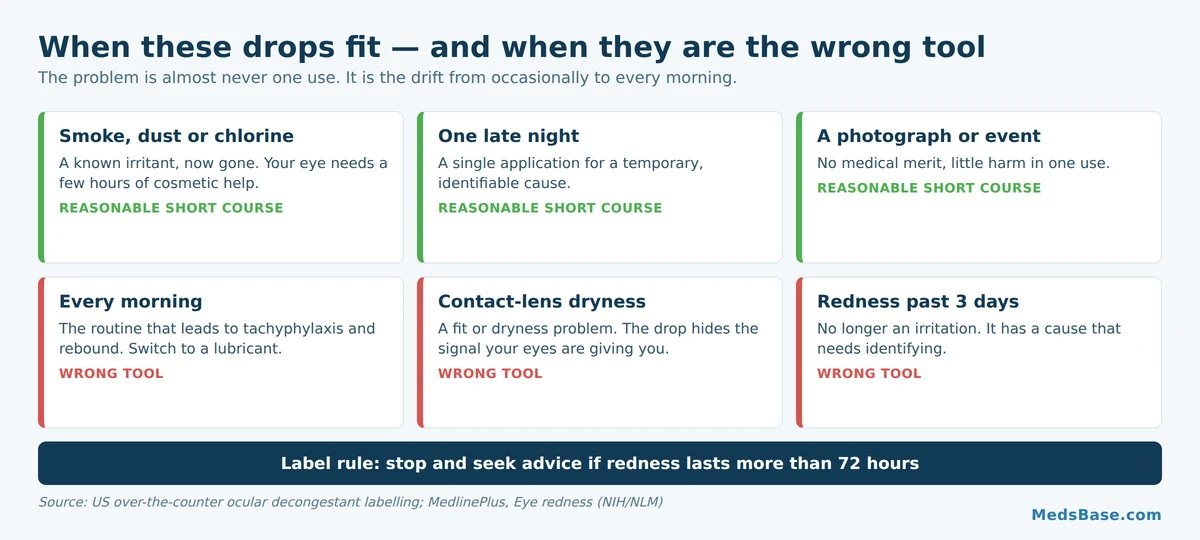
Used the way the label intends, an ocular decongestant is a reasonable product. The problem is almost never a single use. It is the drift from “occasionally” to “every morning”, which happens quietly over a few months.
Short-term irritation from an obvious cause
Smoke, dust, chlorine, a dry aeroplane cabin, one late night. The irritant is identifiable, it is gone, and your eye needs a few hours of cosmetic help while it settles. This is the intended use case and these drops are good at it.
An event where appearance matters
A wedding, a presentation, a photograph. There is no medical merit here, but there is also little harm in a single application, and pretending otherwise makes health advice easy to ignore.
Contact-lens wearers — with a caveat
Lens-related redness is usually a dryness or fit problem. A decongestant will hide it while the underlying irritation continues. Many redness formulations also should not go in with lenses in place. Read your specific bottle rather than assuming.
Where they are simply the wrong tool
If your redness is caused by dry eye disease, allergic conjunctivitis, blepharitis or infection, a decongestant treats none of them. It removes the visible signal that something needs attention, which is close to the opposite of useful.
Safety Profile, Side Effects and the 72-Hour Rule
Time to resolve the loop from the introduction: the hard limit almost nobody reads is 72 hours. US over-the-counter labelling for ocular decongestants instructs users to stop and consult a doctor if redness persists for more than 72 hours, and manufacturers of specific products commonly narrow that to 3–5 consecutive days. Past that point you are no longer treating an irritation; you are managing a condition without knowing what it is.
Published trials of these agents generally report mild and transient ocular effects, with no significant systemic effects. The realistic risks are these:
| Side effect | Frequency | Severity | What to do |
|---|---|---|---|
| Transient stinging or burning on instillation | Common | Mild | Expected; settles within a minute. Persistent burning suggests a preservative sensitivity |
| Rebound redness after stopping | Documented with α1-active agents; rarely reported with brimonidine 0.025% | Mild to moderate, but self-perpetuating | Stop the drops; expect several uncomfortable days. Substitute a lubricant drop |
| Tachyphylaxis — needing more for the same effect | Documented with α1-active agents; not observed with brimonidine through Day 29 | Mild, but drives escalation | Treat as a stop signal, not a dosing signal |
| Pupil dilation, blurred vision | Uncommon | Mild | More likely in lighter irises; avoid before driving at night |
| Raised eye pressure / angle-closure risk | Rare, but serious in susceptible eyes | Serious | Do not use if you have glaucoma or narrow angles without ophthalmic advice |
| Systemic effects (heart rate, blood pressure, drowsiness in children) | Rare at ocular doses | Potentially serious in children | Keep bottles out of reach; ingestion by a child is a medical emergency |
The pattern that means stop today
MedlinePlus explains when eye redness needs a doctor rather than a drop. Seek medical assessment promptly if redness comes with pain, light sensitivity, discharge, any change in vision, a recent eye injury, or if it simply will not clear. Redness on its own is a symptom. Redness plus any of those is a sign.
A pharmacist’s observation: the people who most need to hear this are rarely the ones who use the drops recklessly. They are the ones who used them sensibly for a legitimate reason two years ago and never quite stopped — and who now describe their eyes as “just naturally red”.
What Does the Research Say?
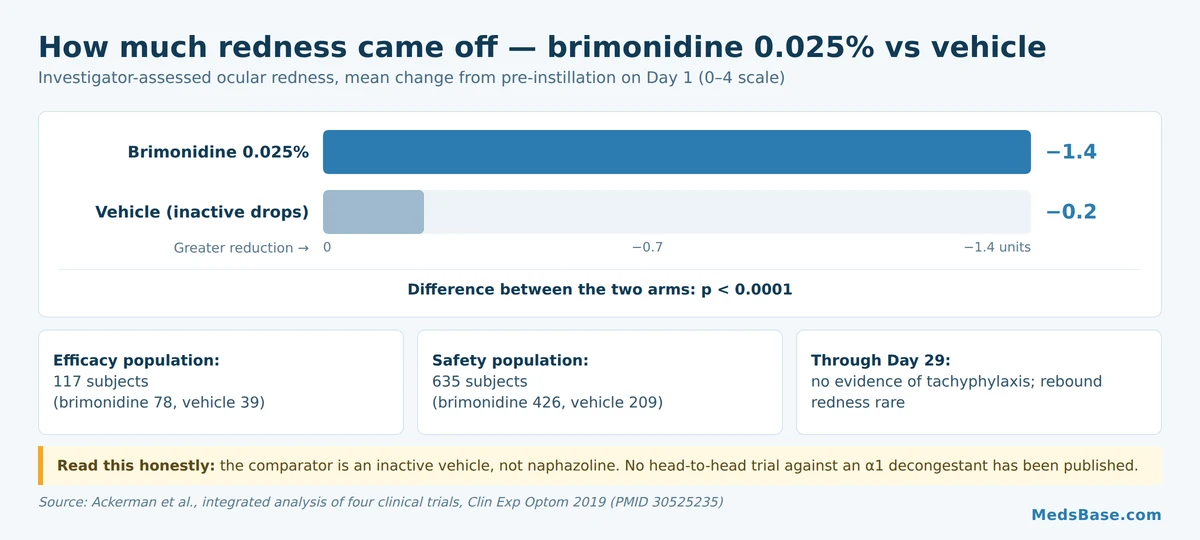
The evidence base here is smaller than the shelf space suggests. Most published work is vehicle-controlled — drug versus inactive solution — rather than head-to-head between molecules, which matters when you are trying to choose between two bottles.
| Study | Year | Finding | Source |
|---|---|---|---|
| Hosten & Snyder, review of OTC ocular decongestants (Clin Optom) | 2020 | Tetrahydrozoline is selective α1; naphazoline mixed α1/α2; brimonidine selective α2. α1-active agents can cause tachyphylaxis and rebound; with brimonidine 0.025%, tachyphylaxis was not observed and rebound was rarely reported | PMID 32801982 |
| Ackerman et al., an integrated analysis of four clinical trials (Clin Exp Optom) | 2019 | Investigator-assessed redness fell by a mean of 1.4 units with brimonidine vs 0.2 units with vehicle on Day 1 (p less than 0.0001); no evidence of tachyphylaxis through Day 29; rebound rare. Safety population 635 subjects | PMID 30525235 |
| Toyos et al., international review of noninfectious conjunctival hyperemia (Ophthalmol Ther) | 2026 | Confirms the α1 vs α2 split across nine countries; notes that longer-term effectiveness of brimonidine has not been evaluated, and flags patient education about recalls as an unmet need | PMID 41689622 |
| Kim & Salamon, brimonidine 0.025% safety and efficacy overview (Expert Rev Clin Pharmacol) | 2022 | Independent narrative overview reaching the same directional conclusion on tachyphylaxis and rebound | PMID 35951740 |
What this means for you: the trial evidence supports “this reduces redness” far more strongly than it supports “this one is better than that one”. The 1.4-versus-0.2-unit result is a real, statistically robust effect — but it is a comparison against an inactive solution, not against the naphazoline drop in your bathroom cabinet. That head-to-head trial has not been done. Anyone telling you the exact margin between the two is guessing.
Worth noting too: a 2026 international review of conjunctival redness explicitly states that brimonidine’s longer-term effectiveness has not been evaluated. Twenty-nine days of clean data is genuinely reassuring. It is not the same as a year.
Redness Relief Eye Drops vs the Alternatives
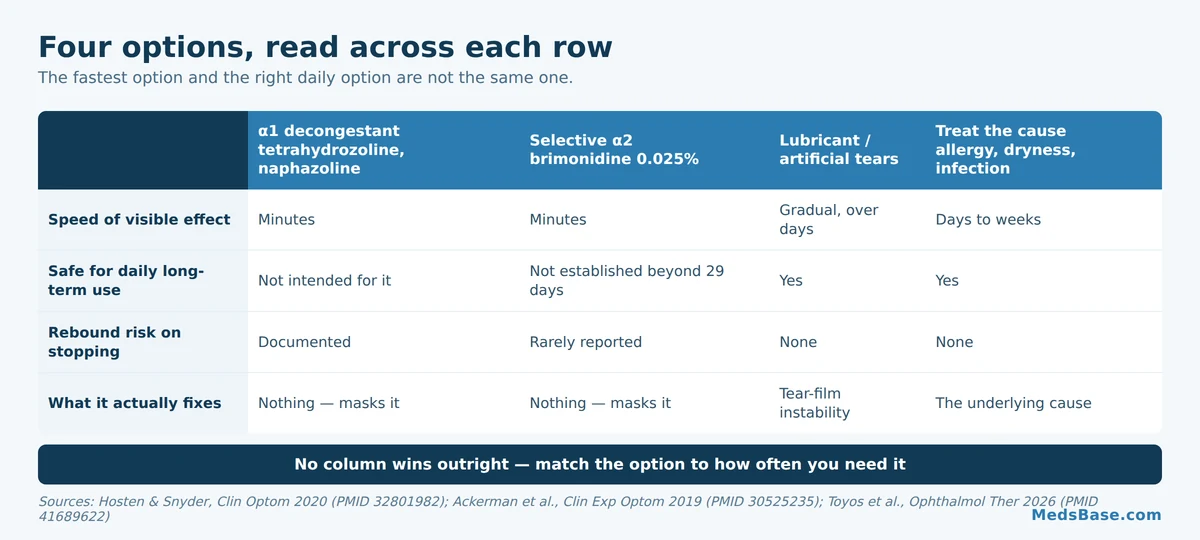
Four options compete for the same moment at the shelf.
| α1 decongestant (tetrahydrozoline, naphazoline) | Selective α2 (brimonidine 0.025%) | Lubricant / artificial tears | Treat the cause | |
|---|---|---|---|---|
| Speed of visible effect | Minutes | Minutes | Gradual, over days | Days to weeks |
| Safe for daily long-term use | Not intended for it | Not established beyond 29 days | Yes | Yes |
| Rebound risk on stopping | Documented | Rarely reported in trials | None | None |
| What it actually fixes | Nothing — masks the appearance | Nothing — masks the appearance | Tear-film instability and surface dryness | The underlying cause |
| Best moment to use it | A one-off, with an end date | Occasional cosmetic use | Every day, indefinitely | The correct first move for persistent redness |
Which one fits which situation. For a single irritated evening, an α1 decongestant is fine and cheap, provided you stop. If you want redness control more than occasionally and can obtain brimonidine 0.025%, the trial data on tachyphylaxis and rebound are meaningfully better — with the honest caveat that long-term data do not exist. If your eyes are red most days, neither is your answer: you have a chronic surface problem, and the correct move is a lubricant plus a diagnosis. And if dryness is driving it, treating that directly is what changes the picture — our guide to what to do when dryness is the real driver covers the short-course prescription option for genuine dry-eye flares.
Take Marcus, 38 — an illustrative example, not a real patient. He started using a redness drop for hay-fever season three springs ago. It worked. Autumn came, he kept using it, and by winter he needed two applications to get the same effect. He assumed his eyes had got worse with age. What had actually changed was his receptors’ response — a textbook tachyphylaxis-and-rebound loop. The fix was uncomfortable and boring: stop the decongestant, use a lubricant four to six times daily, and accept roughly a week of looking worse before looking better.
How to Use an Ocular Decongestant Without Creating a Cycle
- Establish why your eye is red before you treat it. Known irritant, gone now? Proceed. Unknown cause, or lasting more than a few days? Stop here and get it looked at.
- Wash your hands, and do not touch the dropper tip to your eye, lashes or fingers. This is precisely the failure mode behind sterility recalls — a contaminated tip turns a clean bottle into a reservoir.
- Tilt your head back, pull the lower lid into a small pocket, and place one drop in it. Squeezing drops directly onto the cornea makes most of it run down your cheek.
- Close your eye gently for 30–60 seconds and press lightly at the inner corner. This keeps the drug on the eye instead of draining into your nose and body.
- Write the date on the bottle the first time you use it. This single habit prevents more rebound cycles than any advice in this article.
- Stop at 72 hours, or 3–5 days at the outside. If redness persists past that, the drops are not the answer to the question you are asking.
Mistakes to avoid
- Using it as a morning routine. The most common path to rebound. Routine use is the signal to switch products.
- Escalating the dose when it stops working. That is tachyphylaxis. More drug makes the loop tighter.
- Using redness drops for allergy. An antihistamine or mast-cell stabiliser addresses the actual mechanism.
- Wearing lenses during application unless the specific product allows it.
- Sharing a bottle. Eye infections transfer efficiently on a dropper tip.
- Keeping a bottle past its discard date. Preservatives do not last indefinitely once opened.
If you have realised while reading this that you are a daily user, the switch is straightforward: replace the decongestant with a plain lubricant drop that is safe for long-term daily use — carmellose sodium 0.5%, no vasoconstrictor, usable four to eight times a day for as long as you need it. Expect several days of worse-looking eyes while the rebound clears. That period is temporary and it is the price of getting out of the loop.
- How prescription steroid drops differ — what the “strong” option is for, and why redness alone is not it
- What to do when dryness is the real driver — the short-course option for genuine dry-eye flares
- Browse the full eye care range — lubricants, allergy drops and prescription options in one place
Frequently Asked Questions
Q: Do redness relief eye drops make redness worse?
A: They can, with repeated use. Decongestants acting on α1 receptors — tetrahydrozoline and naphazoline — are associated with rebound redness when stopped, meaning your eyes look redder than before you started. This is documented pharmacology, not an anecdote. A single short course rarely causes it; daily use for weeks commonly does. In trials of selective α2 brimonidine 0.025%, rebound was rarely reported.
Q: How often can you use redness relief eye drops?
A: Follow the bottle, and treat 72 hours as the outer limit for continuous use. US over-the-counter labelling directs users to stop and seek advice if redness lasts more than 72 hours, and individual products commonly specify no more than 3–5 consecutive days. If you find yourself needing them beyond that window, the redness has a cause that needs identifying rather than masking.
Q: What is rebound redness from eye drops?
A: Rebound redness is the return of eye redness — often worse than the original — after stopping a decongestant drop that has been used repeatedly. The vessels have been held narrow artificially, and when the drug is withdrawn they dilate. Combined with tachyphylaxis, where the same dose produces progressively less effect, it creates a self-sustaining cycle. Breaking it means stopping the drops and tolerating roughly a week of redness.
Q: Are redness relief eye drops safe to use daily?
A: Not the decongestant type. They are designed for short-term cosmetic relief, not for daily maintenance, and daily use is exactly the pattern associated with tachyphylaxis and rebound. If you want something for every day, a preservative-managed lubricant drop is designed for indefinite use and contains no vasoconstrictor at all. If you feel you need a decongestant daily, that itself is the symptom worth investigating.
Q: What is the difference between redness drops and artificial tears?
A: Redness drops contain a vasoconstrictor that narrows blood vessels to hide redness. Artificial tears contain a lubricant — carmellose, hypromellose or similar — that supplements your own tear film and improves the eye surface. One changes how your eye looks; the other changes how your eye works. Many people buy the first when the second is what their symptoms call for.
Q: Why are my eyes red when I stop using eye drops?
A: That is the classic presentation of rebound. Your eyes have adapted to a drug that keeps their vessels constricted, and removing it lets those vessels open wider than baseline for a period. It typically settles within one to two weeks without treatment. Reaching for the drops again resets the clock and deepens the dependency — the way out is through.
Q: Were the recalled eye drops dangerous?
A: The FDA classified the July 2026 recall as Class II, its designation for situations where the probability of serious adverse consequences is remote and any health effects are likely to be temporary or reversible. The stated reason was lack of assurance of sterility, not a problem with the active ingredient. If you have an affected bottle, stop using it and check the manufacturer’s lot list — but the classification indicates the risk of serious harm was considered low.
Q: Can I use redness drops with contact lenses?
A: Often not, and it depends on the specific product — some are explicitly not for use while lenses are in place, and preservatives can accumulate in soft lens material. Beyond the technical question, lens-related redness is usually a dryness or fit problem, so a decongestant hides a signal your eyes are giving you. A lubricant formulated for lens wear, or a conversation about your lens fit, addresses more.
The Bottom Line
Redness relief eye drops do exactly what they promise: they make a red eye white, quickly, for a few hours. That is a genuinely useful thing on the right day. The problem is that the most widely sold versions — the α1-active ones that made up the bulk of last month’s twelve-million-carton recall — come with a documented tendency toward tachyphylaxis and rebound, and nothing on the front of the box tells you that the product works best if you barely use it.
The honest verdict: keep one for occasional use if you like, respect the 72-hour rule as a genuine limit, and if you are reaching for it more than once or twice a month, you are treating the wrong problem with the wrong tool.
One thing to do today: go and look at the bottle you already own. Find the active ingredient. If it says tetrahydrozoline or naphazoline and you have been using it most days, that is your answer — and switching to a lubricant is a change you can make this week.
Still working out what is actually causing the redness? Our guide to what to do when dryness is the real driver is the natural next step if your eyes feel gritty as well as look red. Wondering how the prescription-strength options differ? How prescription steroid drops differ explains what they treat and why redness alone is not on that list. And if you would rather just see the sensible daily option alongside everything else, browse the full eye care range.
Medical disclaimer: This article is for general information and does not replace personalised medical advice. Eye redness can signal conditions ranging from trivial irritation to sight-threatening disease, and no article can distinguish between them for you. Speak to a doctor, optometrist or pharmacist about your own symptoms — particularly if redness comes with pain, discharge, light sensitivity or any change in vision.

Written by
Sophie ChenPharmaceutical Content Researcher · 8 years experience
Sophie Chen is a pharmaceutical content researcher with 8 years covering generic medication access and clinical pharmacology. She specialises in international regulatory frameworks, bioequivalence standards, and patient-facing education on therapeutic drug classes. She is not a clinician.