







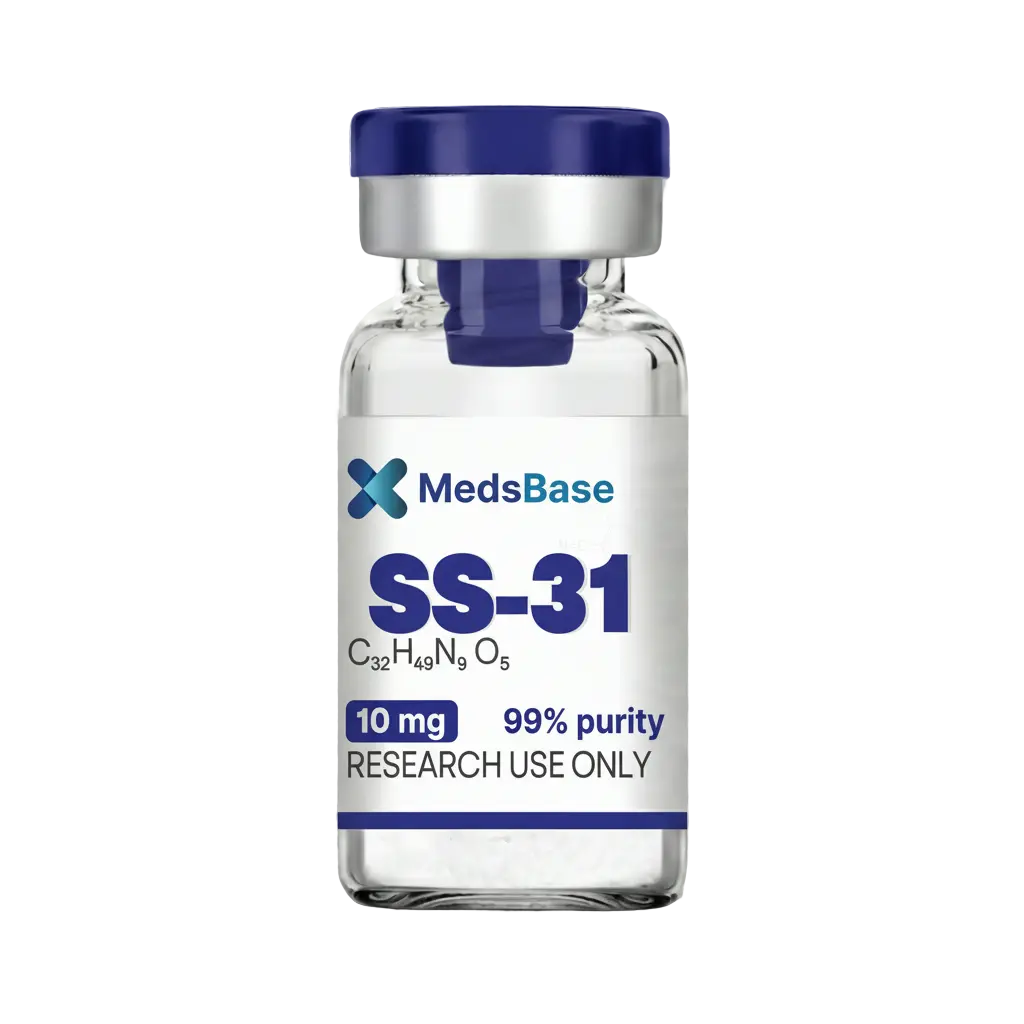
SS-31 (Elamipretide)
✅ Enhances cellular energy
✅ Supports mitochondrial function
✅ Reduces oxidative stress
✅ Improves tissue resilience
✅ Promotes metabolic efficiency
SS-31 contains synthetic peptide compound.
✓ Medically reviewed by Morgan Ellis — Pharmacy Researcher · 8 years experience · Last reviewed: May 2026
Quick Answer — What is SS-31 (Elamipretide)?
SS-31 (also called Elamipretide or Bendavia) is a synthetic tetrapeptide that selectively binds cardiolipin on the inner mitochondrial membrane, stabilizing mitochondrial function under stress. Developed by the Szeto-Schiller lab and now in late-stage clinical development by Stealth BioTherapeutics with FDA orphan-drug designation for rare mitochondrial disease. Supplied in 5 mg to 50 mg lyophilized vials.
📦 Every order is covered by our Reshipment Assurance Policy — if your parcel does not arrive within 20 business days, we reship it.
| Specification | Detail |
|---|---|
| CAS Number | 736992-21-5 |
| Molecular Formula | C32H49N9O5 |
| Molecular Weight | 639.80 Da |
| Sequence | D-Arg-2′,6′-Dmt-Lys-Phe-NH2 (Bendavia, MTP-131) |
| Form | Lyophilized powder (or as supplied) |
| Purity | ≥99% (HPLC verified, COA on request) |
| Storage | Lyophilized: 2–8 °C (refrigerator) for working stock; −20 °C for long-term storage of unopened vials. Reconstituted: 2–8 °C, use within ~30 days. Protect from light. Do not freeze–thaw the reconstituted solution. |
| Solubility | Bacteriostatic water (recommended) or sterile water for shorter use windows |
What Is SS-31 (Elamipretide)?
SS-31 is a synthetic cell-permeable tetrapeptide (D-Arg-2’6′-dimethyl-L-Tyr-L-Lys-L-Phe, also abbreviated Szeto-Schiller 31) developed by Hazel Szeto and Peter Schiller at Cornell’s Weill Medical College starting in the 1990s. It is also known by its pharmaceutical-development names Elamipretide and Bendavia, and is being developed clinically by Stealth BioTherapeutics. Unlike most peptides that bind cell-surface receptors, SS-31 is a mitochondria-targeted agent that crosses cell and organelle membranes to reach the inner mitochondrial membrane, where it binds cardiolipin — a phospholipid unique to that location. This selective lipid binding underpins its mechanism of action and distinguishes SS-31 from virtually every other peptide. Molecular weight approximately 640 Da. SS-31 has FDA orphan-drug designation for primary mitochondrial myopathy and has been the subject of multiple human clinical trials — placing it further along the clinical development pipeline than most peptides. It is supplied here as a high-purity lyophilized powder for clinical studies use only (Stealth’s clinical product is a separate regulated therapeutic). For deeper mechanism, Szeto lab studies history, and clinical-trial context, see our SS-31 guide.
Mechanism of Action — Cardiolipin-Targeted Mitochondrial Stabilization
SS-31’s mechanism is unique among peptides because its target is a phospholipid, not a receptor protein. Three interconnected effects define its pharmacology:
- Cardiolipin binding — SS-31 selectively binds cardiolipin on the inner mitochondrial membrane. Cardiolipin is a signature lipid found almost exclusively at this location and is essential for the architecture of the cristae (the folded inner-membrane surface where electron-transport-chain complexes cluster). SS-31 binding stabilizes cristae morphology during stress that would otherwise cause cristae disruption and mitochondrial dysfunction.
- ROS reduction and ETC preservation — by preserving cristae architecture, SS-31 maintains the proper organization of electron-transport-chain complexes, preserving ATP synthesis and reducing electron “leakage” that generates reactive oxygen species. In ischemia-reperfusion study models, this translates to reduced oxidative damage and preserved mitochondrial function.
- Prevention of cytochrome c release — mitochondrial apoptosis begins with cytochrome c release from the inner membrane space into the cytoplasm. By preserving cristae structure, SS-31 preserves cytochrome c localization and blocks a critical apoptotic trigger. This is central to its cardiac ischemia-reperfusion signal.
The practical studies implication: SS-31 is the reference mitochondria-targeted peptide. Where other peptides act at cell-surface receptors, SS-31 acts inside the organelle, preserving mitochondrial function in study models of metabolic stress, ischemia, and aging.
Published Evidence
SS-31 is used in clinical contexts that investigate:
- Primary mitochondrial disease studies — rare mitochondrial myopathy studies including Barth syndrome; SS-31 has FDA orphan-drug designation for this indication
- Cardiac studies — heart failure, ischemia-reperfusion, cardiomyopathy, and cardiotoxicity rescue studies (Szeto, AAPS J 2014)
- Renal studies — acute kidney injury, ischemia-reperfusion, and chronic kidney disease studies (Birk et al., J Am Soc Nephrol 2013)
- Aging studies — age-related mitochondrial dysfunction, skeletal-muscle aging (sarcopenia), and general cellular-aging markers
- Neuroprotection studies — ischemic-stroke and neurodegeneration studies where mitochondrial dysfunction is a driver
- Sarcopenia studies — skeletal-muscle mitochondrial function and age-related muscle loss studies
- Comparative mitochondrial-agent studies — side-by-side with NAD+ (mitochondrial coenzyme) and MitoQ (another mitochondria-targeted antioxidant) to isolate mechanism
For broader context on longevity and mitochondrial-compounds see the peptides catalog.
Available Strengths and Concentrations
MedsBase stocks SS-31 (Elamipretide) in the following lyophilized vial sizes:
| Vial Strength | Typical Use Case | Pack Sizes |
|---|---|---|
| 5 mg | Short protocols, low-dose rodent work | 10, 20, or 30 vials |
| 10 mg | Standard strength, extended rodent studies | 10, 20, or 30 vials |
| 50 mg | Large-scale studies, clinical-trial-matched doses (40 mg/day), lowest per-mg cost | 10, 20, or 30 vials |
The 50 mg vial size matches the clinical-trial 40 mg/day dose used in Stealth BioTherapeutics’s human studies. Preclinical rodent studies typically uses smaller vials matched to 1–5 mg/kg body weight. All strengths are supplied as lyophilized powder at 99%+ HPLC purity.
How It Compares — SS-31 vs Other Mitochondrial / Longevity Compounds
SS-31 is part of a small but growing class of mitochondria-targeted studies agents. Key comparisons:
| Criterion | SS-31 (Elamipretide) | NAD+ | Epitalon |
|---|---|---|---|
| Primary target | Cardiolipin (inner mitochondrial membrane lipid) | Sirtuins, PARP enzymes, ETC | Gene expression, pineal signaling |
| Mechanistic evidence | Strong (multiple labs, clinical trials) | Very strong (well-characterised biochemistry) | Narrow group (Khavinson) |
| Clinical status | FDA orphan-drug, Phase 3 (Barth syndrome) | Not approved (IV-therapy use) | Not approved |
| Strongest signal | Cardiac ischemia, renal, sarcopenia | Longevity, energy, DNA repair | Telomere, circadian |
| Typical dose | 5–40 mg daily (clinical); 1–5 mg/kg (preclinical) | 50–100 mg daily | 5–10 mg SC daily |
SS-31 is distinct because it is the only peptide targeting a mitochondrial lipid directly. Users often study it alongside NAD+ (for complementary sirtuin-pathway coverage) and Epitalon in multi-pathway longevity protocols.
Storage and Reconstitution
Before reconstitution: store lyophilized vials refrigerated at 2–8 °C in original packaging, stable up to 36 months. Avoid freeze-thaw cycles on the powder. Reconstitution procedure: inject bacteriostatic water down the side wall of the peptide vial per the chart above. Swirl gently — do not shake — and allow 5–10 minutes for full dissolution. Solution should be clear and colourless. After reconstitution: store refrigerated at 2–8 °C and use within 30 days. Do not freeze reconstituted solution.
Frequently Asked Questions
What is SS-31 used for in studies?
SS-31 (Elamipretide) is used in studies investigating mitochondrial disease (including Barth syndrome), cardiac ischemia-reperfusion, heart failure, acute kidney injury, chronic kidney disease, age-related mitochondrial dysfunction, sarcopenia, and neuroprotection. It has FDA orphan-drug designation but is not yet FDA-approved for therapeutic use. Sold here strictly for clinical studies use only.
How is SS-31 different from other peptides?
SS-31 is unique because its target is cardiolipin — a phospholipid on the inner mitochondrial membrane — not a cell-surface receptor. It is cell-permeable and reaches the mitochondrial matrix to stabilize cristae architecture and preserve electron-transport-chain function. Virtually every other peptide binds receptors on the cell surface.
What is the typical SS-31 dose?
Stealth BioTherapeutics’ clinical trials have used 40 mg SC daily. Preclinical rodent studies typically uses 1–5 mg/kg body weight daily. A 10 mg vial reconstituted with 2.0 mL bacteriostatic water yields 5.0 mg/mL — 100 ticks on a U-100 syringe delivers 5 mg.
Is SS-31 FDA approved?
SS-31 (Elamipretide) has FDA orphan-drug designation for primary mitochondrial myopathy and is in late-stage clinical development by Stealth BioTherapeutics. It is not yet fully FDA-approved. All SS-31 sold by specialist suppliers is for clinical investigation, not the clinical-trial therapeutic product.
What does the “SS-31” abbreviation mean?
SS-31 stands for Szeto-Schiller compound 31, after the Cornell users Hazel Szeto and Peter Schiller who developed the SS-series of mitochondria-targeted peptides in the 1990s and 2000s. The “31” is simply the compound number in their synthesis series. The compound was later licensed to Stealth BioTherapeutics and renamed Elamipretide (and Bendavia) for clinical development.
How should SS-31 be stored?
Lyophilized vials: refrigerated at 2–8 °C in original packaging, stable up to 36 months. Reconstituted solution: refrigerated at 2–8 °C, use within 30 days. Do not freeze reconstituted solution.
How do I reconstitute SS-31?
Follow the reconstitution chart above. Add bacteriostatic water down the side wall of the vial, swirl gently, and allow 5–10 minutes for full dissolution. Do not shake.
Can SS-31 be stacked with NAD+ in studies?
Yes — this is a common multi-pathway mitochondrial studies combination. SS-31 stabilizes cristae architecture and cardiolipin-dependent ETC function; NAD+ provides coenzyme substrate for the electron-transport chain and downstream sirtuin/PARP signaling. The mechanisms are complementary and non-overlapping.
What strengths does MedsBase stock?
MedsBase carries SS-31 (Elamipretide) in 5 mg, 10 mg, and 50 mg lyophilized vials. Each strength is available in 10-vial, 20-vial, or 30-vial pack sizes. All vials are supplied at 99%+ HPLC purity with a certificate of analysis on request.
Does SS-31 cause side reported effects?
Published preclinical and clinical-trial has reported a favorable safety profile. Most commonly reported effects in the clinical-trial literature are injection-site reactions. Because SS-31 has been studied in multiple human trials (Phase 2 and Phase 3), its safety profile is better-characterised than most peptides.
Is SS-31 the same as Bendavia or Elamipretide?
Yes. The same compound carries three names: SS-31 (original Szeto-Schiller studies designation), Bendavia (Stealth BioTherapeutics early development name), and Elamipretide (international nonproprietary name / INN). Studies literature uses SS-31 predominantly; clinical-trial literature uses Elamipretide or Bendavia.
What is the half-life of SS-31?
SS-31 (elamipretide) has a short plasma half-life of approximately 30–60 minutes following subcutaneous administration, but demonstrates prolonged mitochondrial accumulation due to its affinity for cardiolipin in the inner mitochondrial membrane. Tissue half-life in mitochondria-rich organs such as cardiac and skeletal muscle is estimated at several hours beyond plasma clearance.
How does SS-31 target mitochondria specifically?
SS-31 is a Szeto-Schiller peptide with an alternating aromatic-cationic structure (D-Arg-dimethyl-Tyr-Lys-Phe-NH₂). This sequence drives accumulation in the inner mitochondrial membrane approximately 1,000-fold above cytoplasmic levels, mediated by electrostatic attraction to the negatively charged cardiolipin phospholipid. Cardiolipin binding stabilises electron transport chain complexes and reduces reactive oxygen species (ROS) production.
Can I order SS-31 for international shipping?
Yes. MedsBase ships SS-31 worldwide from our dedicated peptide shipping network. Peptide-only orders qualify for our standalone peptide shipping service. Orders ship in temperature-controlled packaging with full tracking.
Other Peptides for Recovery and Performance
- BPC-157 — Body Protection Compound — tendon, ligament, gut recovery
- TB-500 — Thymosin Beta-4 fragment — soft tissue and vascular recovery
- Ipamorelin — Selective ghrelin agonist — clean GH pulse without cortisol/prolactin
- CJC-1295 with DAC — GHRH analog with extended half-life
- GHK-Cu — Copper peptide — skin and connective tissue regeneration
Further Reading
📖 Learn the science behind this peptide
Read our complete evidence-based guide: SS-31 (Elamipretide) — cardiolipin targeting, mitochondrial studies & clinical trials. Covers Szeto-Schiller mechanism studies, Stealth BioTherapeutics clinical development, cardiac/renal/neurological applications, and realistic context.
More options in Peptides
Ranked by recent MedsBase order volume — what other customers in this category are picking.
| Strength | 5 mg, 10 mg, 50 mg |
|---|---|
| Quantity | 10 Vials, 20 Vials, 30 Vials |
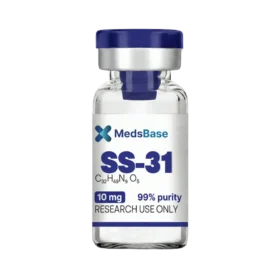 SS-31 (Elamipretide)
Q & A
SS-31 (Elamipretide)
Related products
Reviews
There are no reviews yet