







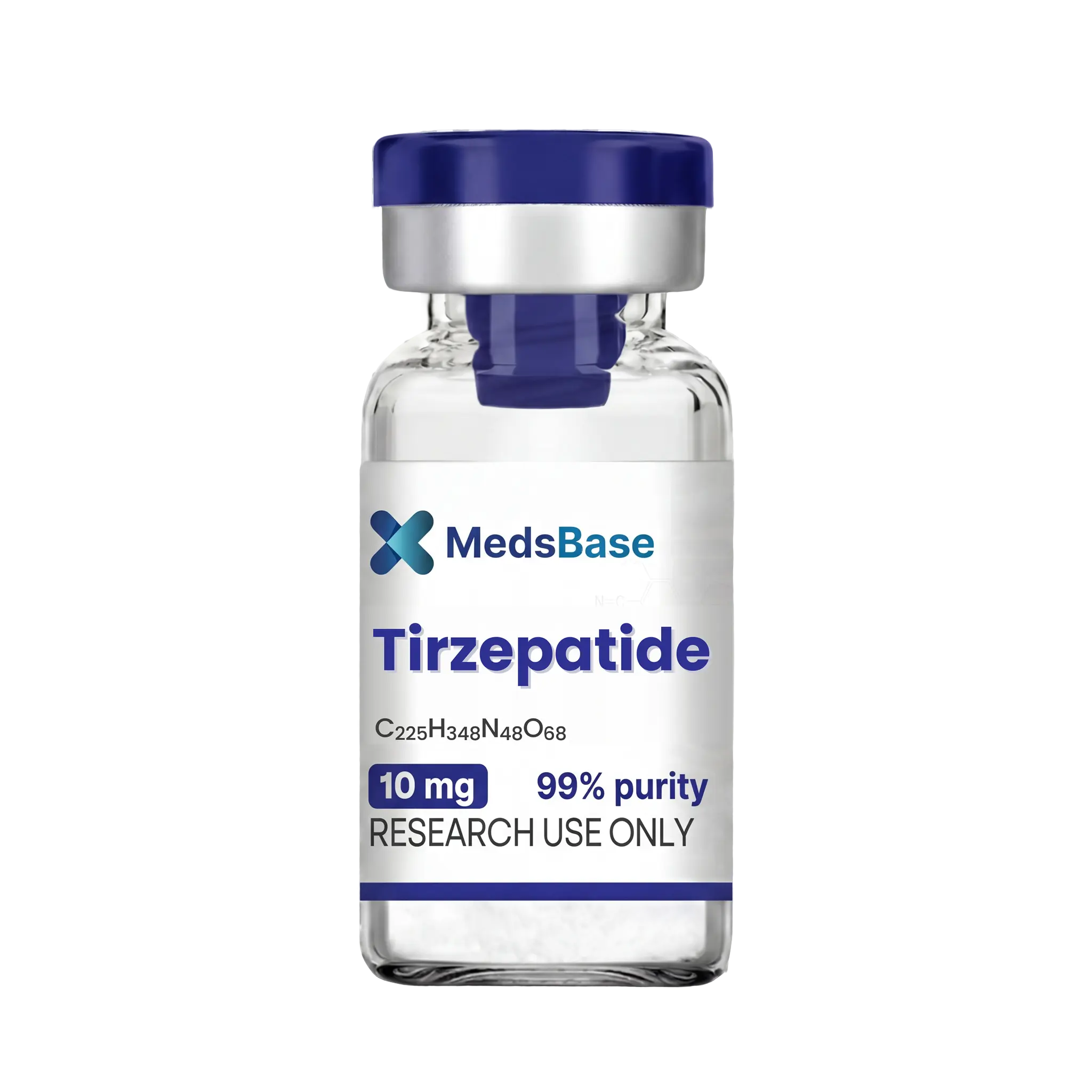
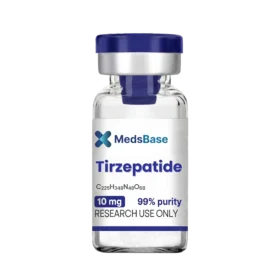
Tirzepatide
✅ Dual GLP-1 + GIP receptor co-agonist
✅ Largest single-peptide body-weight effect
✅ Supports glycaemic control
✅ Adipocyte lipolysis & energy expenditure
✅ Once-weekly dosing protocols
Tirzepatide contains synthetic peptide compound.
✓ Medically reviewed by Morgan Ellis — Pharmacy Researcher · 8 years experience · Last reviewed: May 2026
Quick Answer — What is Tirzepatide?
Tirzepatide is a 39-amino-acid dual GLP-1 and GIP receptor co-agonist peptide and the active studies molecule behind Mounjaro and Zepbound. It produces the largest body-weight and glycaemic effect of any single peptide in current published studies, with the dual-receptor profile delivering a meaningfully greater response than single GLP-1 agonists in head-to-head trials such as SURPASS-2. Plasma half-life is approximately 120 hours (~5 days), enabling once-weekly dosing. Supplied in 5 mg to 120 mg lyophilized vials.
📦 Every order is covered by our Reshipment Assurance Policy — if your parcel does not arrive within 20 business days, we reship it.
| Specification | Detail |
|---|---|
| CAS Number | 2023788-19-2 |
| Molecular Formula | C225H348N48O68 |
| Molecular Weight | 4813.45 Da |
| Sequence | Y-Aib-EGTFTSDYSI-Aib-LDKIAQKAFVQWLIAGGPSSGAPPPS (39 aa, GIP-based backbone with Aib2, Aib13, and Lys20-C20 fatty diacid acylation via γGlu-γGlu spacer) |
| Form | Lyophilized powder (white to off-white) |
| Purity | ≥99% (HPLC verified, COA on request) |
| Storage | Lyophilized: 2–8 °C (refrigerator) for working stock; −20 °C for long-term storage of unopened vials. Reconstituted: 2–8 °C, use within ~30 days. Protect from light. Do not freeze–thaw the reconstituted solution. |
| Solubility | Bacteriostatic water (recommended) or sterile water for shorter use windows |
What Is Tirzepatide?
Tirzepatide is a 39-amino-acid dual incretin receptor co-agonist that activates both the glucagon-like peptide-1 (GLP-1) and glucose-dependent insulinotropic polypeptide (GIP) receptors with comparable potency. Developed by Eli Lilly and disclosed in 2018, it was the first dual-incretin agonist to reach regulatory approval (Mounjaro for type 2 diabetes in 2022, Zepbound for chronic weight management in 2023). Tirzepatide is built on the GIP peptide backbone — not the GLP-1 backbone used by semaglutide — with two α-aminoisobutyric acid (Aib) substitutions at positions 2 and 13 that resist DPP-4 cleavage and a C20 fatty diacid attached at lysine 20 via two γ-glutamic acid spacers. The C20 acyl chain is one carbon longer than semaglutide’s C18, producing tighter albumin binding and a slightly different pharmacokinetic profile. Tirzepatide’s well-characterised structure has empirical formula C225H348N48O68 with average molecular weight 4813.45 Da. Plasma half-life is approximately 120 hours (~5 days), enabling once-weekly subcutaneous dosing in published studies. The compound is supplied as a high-purity lyophilized powder for reconstitution with bacteriostatic water. For broader incretin studies, see our Semaglutide and Retatrutide product pages.
Mechanism of Action — Dual GLP-1 / GIP Receptor Co-Agonism
What differentiates tirzepatide from earlier single-incretin peptides is its balanced co-activation of two distinct receptors, each contributing complementary metabolic effects observed in published studies:
- GLP-1 receptor activation — satiety, β-cell insulin secretion, gastric emptying — Tirzepatide binds the GLP-1 receptor with affinity comparable to native GLP-1, activating Gαs-coupled adenylyl cyclase and downstream cAMP/PKA signaling. This produces the canonical GLP-1 effects: glucose-dependent potentiation of insulin secretion from pancreatic β-cells, suppression of glucagon from α-cells, delayed gastric emptying, and central appetite-suppression effects via arcuate-nucleus POMC neurons. This arm overlaps with semaglutide’s mechanism.
- GIP receptor activation — adipocyte lipolysis, energy expenditure, β-cell support — The GIP component is what makes tirzepatide pharmacologically distinct. GIP receptor activation enhances insulin secretion in a glucose-dependent manner (complementary to GLP-1’s effect), but also acts on adipocytes to promote lipolysis under fasting conditions while supporting triglyceride storage in the fed state. Studies suggests GIP-receptor signaling also raises resting energy expenditure modestly and acts in CNS regions distinct from GLP-1, including the dorsomedial hypothalamus. The net effect is an additive body-weight signal beyond what GLP-1 alone produces.
- Receptor balance and structural fine-tuning — In radioligand-binding assays, tirzepatide shows higher affinity for the GIP receptor than for the GLP-1 receptor — an unusual ratio that distinguishes it from earlier dual-agonist candidates. The asymmetry is intentional: the GIP backbone allows higher GIP-receptor potency while the engineered modifications preserve sufficient GLP-1 activity. Tirzepatide is sometimes described as “GIP-biased” in receptor pharmacology, which has implications for the differential signalling observed in study models.
The C20 fatty diacid acyl tether at lysine 20 binds reversibly to circulating serum albumin, forming a peptide depot that protects tirzepatide from renal clearance and produces the ~120-hour plasma half-life. The double Aib substitution (positions 2 and 13) prevents DPP-4 cleavage at two distinct sites, providing redundant proteolytic protection. Together these structural features convert what would otherwise be a short-acting incretin into a once-weekly peptide.
Published Evidence
Tirzepatide is used in clinical contexts that investigate:
- Glycaemic control and insulin sensitivity — head-to-head with semaglutide and other GLP-1 monoagonists (Frias et al., NEJM 2021 SURPASS-2); db/db, ZDF, and high-fat-diet rodent models; effects on HbA1c surrogates, fasting glucose, and hyperinsulinaemic-euglycaemic clamp parameters
- Body weight and adiposity studies — the SURMOUNT-1 trial showed ~22% body weight reduction at 15 mg weekly over 72 weeks, the largest single-peptide effect documented in clinical studies at the time; rodent DIO models, body composition (DEXA / MRI), respiratory exchange ratio
- MASLD/MASH (metabolic-dysfunction-associated liver disease) — hepatic triglyceride content, ALT/AST, fibrosis staging; SYNERGY-NASH trial dataset
- Cardiovascular studies — effects on blood pressure, lipid profiles, atherosclerosis progression in ApoE-/- models; SURPASS-CVOT cardiovascular outcomes data
- Sleep apnoea studies — obstructive sleep apnoea severity, apnoea-hypopnoea index in the SURMOUNT-OSA dataset
- Renal protection in diabetic nephropathy models — albuminuria, glomerular filtration rate, mesangial expansion in streptozotocin-induced and Akita mouse diabetic kidney disease
- Comparative incretin peptide studies — benchmark for dual-agonist vs single-agonist vs triple-agonist comparisons. See our Retatrutide vs Tirzepatide guide and the Semaglutide product page for sibling comparators.
For broader context on where tirzepatide fits within the metabolic-peptide landscape, see Retatrutide (triple GLP-1/GIP/glucagon agonist, the next-generation comparator) and our Ozempic vs Mounjaro guide. Browse the full peptides catalog for related compounds.
Available Strengths and Concentrations
MedsBase stocks Tirzepatide in eleven lyophilized vial strengths covering the full dose-titration range from pilot dosing through multi-month bulk protocols. Each strength is available in 10-vial, 20-vial, or 30-vial pack formats with full reconstitution guidance:
| Vial Strength | Typical Use Case | Pack Sizes |
|---|---|---|
| 5 mg | Pilot dosing, low-tier titration, short cycles | 10, 20, or 30 vials |
| 10 mg | Maintenance strength, mid-titration | 10, 20, or 30 vials |
| 15 mg | Clinical-equivalent target strength (max approved human dose) | 10, 20, or 30 vials |
| 20 mg | High-dose arm, exploratory protocols | 10, 20, or 30 vials |
| 30 mg | Multi-week protocols from a single vial, lower reconstitution volume | 10, 20, or 30 vials |
| 40 mg | Extended-cycle studies, lower per-mg cost | 10, 20, or 30 vials |
| 50 mg | Multi-month protocols, comparative dose-response studies | 10, 20, or 30 vials |
| 60 mg | High-dose comparative arm | 10, 20, or 30 vials |
| 80 mg | Bulk packs vial, low per-mg cost | 10, 20, or 30 vials |
| 100 mg | Multi-cohort studies, multi-month protocols | 10, 20, or 30 vials |
| 120 mg | Maximum Bulk packs vial, lowest per-mg cost | 10, 20, or 30 vials |
All eleven strengths are the same chemical form (lyophilized powder, 99%+ HPLC purity). Higher-mg vials require smaller reconstitution volumes per unit dose, which is useful for users minimising injection volume or running extended multi-month protocols from a single vial. Because reconstituted solution is stable for ~30 days, the optimal vial size for a given protocol depends on weekly dose × weeks-per-vial trade-off.
How It Compares — Tirzepatide vs Semaglutide vs Retatrutide
Tirzepatide sits at the centre of the modern incretin-agonist studies landscape, between the single-receptor Semaglutide (GLP-1 only) and the triple-receptor Retatrutide (GLP-1 + GIP + glucagon). Each step up the receptor ladder produces a progressively larger body-weight effect in head-to-head studies but also broader systemic signalling.
| Criterion | Semaglutide | Tirzepatide | Retatrutide |
|---|---|---|---|
| Receptor profile | GLP-1 (single) | GLP-1 + GIP (dual) | GLP-1 + GIP + glucagon (triple) |
| Peptide backbone | GLP-1 (31 aa) | GIP (39 aa) | GIP-like (39 aa) |
| Half-life | ~165 hours (~7 days) | ~120 hours (~5 days) | ~6 days |
| Fatty acid tether | C18 diacid + AEEA-AEEA | C20 diacid + γGlu-γGlu | C20 diacid + γGlu |
| Brand reference | Ozempic / Wegovy / Rybelsus | Mounjaro / Zepbound | Investigational (LY3437943) |
| Typical weekly dose | 0.25–2.4 mg | 2.5–15 mg | 2–12 mg |
| Body-weight effect in trials | ~15% (STEP) | ~22% (SURMOUNT-1) | ~24% (Phase 2) |
| Strongest signal | Glycaemic control, cardiovascular | Combined glycaemic + body-weight, MASH | Largest body-weight effect |
The head-to-head SURPASS-2 trial (Frias et al., NEJM 2021) showed superior HbA1c and body-weight reduction with tirzepatide 15 mg vs semaglutide 1 mg over 40 weeks — one of the largest direct comparison datasets in incretin studies. For methodological detail on the dual- vs triple-agonist landscape, read Retatrutide vs Tirzepatide: triple vs dual agonist and Ozempic vs Mounjaro. Users selecting between these peptides typically weigh receptor selectivity (cleaner pharmacology with semaglutide), magnitude of effect (greater with tirzepatide and retatrutide), and the strength of available trial data (extensive for semaglutide and tirzepatide, still maturing for retatrutide).
Storage and Reconstitution
Before reconstitution: store lyophilized vials refrigerated at 2–8 °C in original packaging for short-term working stock. For unopened long-term storage, freeze at −20 °C. Lyophilized tirzepatide is stable under refrigeration for up to 24 months and at −20 °C for up to 36 months. Avoid freeze-thaw cycles on the lyophilized powder. Reconstitution procedure: inject bacteriostatic water down the side wall of the peptide vial (not directly onto the lyophilized cake). For a 10 mg vial, 2.0 mL of bacteriostatic water yields a 5 mg/mL working concentration — 10 ticks on a U-100 insulin syringe equals 500 mcg. Swirl gently — do not shake — and allow 2–5 minutes for full dissolution. A correctly reconstituted solution should be clear and colourless. After reconstitution: store refrigerated at 2–8 °C and use within 30 days for optimal stability. Do not freeze the reconstituted solution — freeze-thaw cycles degrade peptide integrity. Discard any vial showing cloudiness, precipitate, or discolouration. Because tirzepatide is dosed once weekly in protocols, a single reconstituted 10 mg vial typically supports 2–4 weeks of dosing depending on target dose; a 50 mg vial supports 10–20 weeks at clinical-equivalent doses.
Frequently Asked Questions
What is Tirzepatide used for in studies?
Tirzepatide is used in studies investigating glycaemic control, insulin sensitivity, body weight and adiposity, MASLD/MASH liver disease, cardiovascular endpoints, sleep apnoea, and diabetic nephropathy. It is the most extensively characterised dual GLP-1/GIP agonist and is the standard comparator arm for newer multi-agonist peptide studies. The pharmaceutical-grade tirzepatide sold here is not FDA-approved for human therapeutic use and is supplied strictly for clinical studies.
How is Tirzepatide different from Semaglutide?
The structural difference is the receptor profile and the peptide backbone. Tirzepatide is built on the 39-amino-acid GIP backbone and co-activates both GIP and GLP-1 receptors. Semaglutide is built on the 31-amino-acid GLP-1 backbone and activates only the GLP-1 receptor. The GIP component in tirzepatide adds adipose-tissue lipolysis and modest increases in energy expenditure that GLP-1-only peptides don’t produce. In head-to-head trials (SURPASS-2), tirzepatide 15 mg produced superior HbA1c and body-weight reduction vs semaglutide 1 mg over 40 weeks.
How is Tirzepatide different from Retatrutide?
Both are GIP-based scaffolds, but retatrutide adds glucagon receptor activity on top of GLP-1 and GIP — making it a triple agonist. The added glucagon component contributes further to energy expenditure and adipocyte lipolysis. Published Phase 2 retatrutide data shows ~24% body-weight reduction at 12 mg weekly, modestly exceeding tirzepatide’s 22% in SURMOUNT-1. Tirzepatide has the more mature trial dataset; retatrutide is still in late-stage development.
What is the typical Tirzepatide dose?
Published protocols typically use a titration schedule starting at 2.5 mg weekly and increasing by 2.5 mg every 4 weeks up to a maintenance dose of 5–15 mg weekly. A 10 mg vial reconstituted with 2.0 mL bacteriostatic water yields 5 mg/mL — 10 ticks on a U-100 syringe equals 500 mcg.
Is Tirzepatide FDA approved?
Pharmaceutical tirzepatide is FDA-approved under the brand names Mounjaro (type 2 diabetes, 2022) and Zepbound (chronic weight management, 2023), manufactured to GMP standards by Eli Lilly.
How should Tirzepatide be stored?
Lyophilized vials: refrigerated at 2–8 °C for short-term working stock, or −20 °C for long-term storage of unopened vials. Reconstituted solution: refrigerated at 2–8 °C, use within 30 days. Do not freeze reconstituted solution — freeze-thaw cycles degrade the peptide. Protect from direct light at all times.
How do I reconstitute Tirzepatide?
Follow the reconstitution procedure above. Add bacteriostatic water down the side wall of the vial (not onto the lyophilized cake), swirl gently, and allow 2–5 minutes for full dissolution. Do not shake the vial. A correctly reconstituted solution is clear and colourless. For a 10 mg vial + 2.0 mL diluent, the working concentration is 5 mg/mL.
What strengths does MedsBase stock?
MedsBase carries Tirzepatide in eleven lyophilized vial strengths: 5 mg, 10 mg, 15 mg, 20 mg, 30 mg, 40 mg, 50 mg, 60 mg, 80 mg, 100 mg, and 120 mg. Each strength is available in 10-vial, 20-vial, or 30-vial pack sizes. All vials are supplied at 99%+ HPLC purity with a certificate of analysis available on request.
What is the half-life of Tirzepatide?
Tirzepatide has a plasma half-life of approximately 120 hours (~5 days) following subcutaneous administration. The half-life is achieved by reversible binding to circulating serum albumin via the C20 fatty diacid tether at lysine 20, which protects the peptide from renal clearance. Combined with the double Aib substitution (positions 2 and 13) that blocks DPP-4 cleavage, this gives tirzepatide a once-weekly dosing schedule comparable to semaglutide’s ~165-hour half-life.
Why does Tirzepatide produce more weight loss than Semaglutide?
The most-cited mechanism is the GIP-receptor component. GIP-receptor activation contributes additional effects that GLP-1 alone doesn’t produce: enhanced adipocyte lipolysis under fasting conditions, modest increases in resting energy expenditure, and CNS effects in the dorsomedial hypothalamus distinct from arcuate-nucleus GLP-1 signalling. The combined dual signal produces an additive body-weight reduction beyond GLP-1 alone in head-to-head study models.
Does Tirzepatide cause side reported effects?
The most consistent finding is gastrointestinal — nausea, transient appetite suppression, and delayed gastric emptying are dose-dependent and tend to attenuate over 4–8 weeks of continuous dosing as receptor tachyphylaxis develops. Less common findings include effects on gallbladder motility and (in rodent models with thyroid C-cell sensitivity) C-cell hyperplasia — the latter is a species-specific signal that has not translated to humans in long-term clinical follow-up.
Can Tirzepatide and Semaglutide be compared in studies?
Yes — head-to-head comparison is one of the most actively studied questions in incretin pharmacology. The clinical SURPASS-2 trial directly compared tirzepatide 15 mg vs semaglutide 1 mg in type 2 diabetes patients; preclinical and growing real-world evidence continue to extend the comparison to body weight, MASH, and cardiovascular endpoints. Semaglutide remains the standard GLP-1 comparator; tirzepatide is the standard dual-agonist comparator.
How long does Tirzepatide take to show effects in preclinical studies?
Acute pharmacodynamic effects on glucose tolerance and gastric emptying are detectable within hours of the first dose. Body-weight effects in DIO rodent models typically become statistically significant after 1–2 weeks of weekly dosing and continue to accrue through 8–16 weeks. Maximum effect on body composition is typically observed after 16–24 weeks of continuous dosing in study models, mirroring the human-trial trajectory.
Can I order Tirzepatide for international shipping?
Yes. MedsBase ships Tirzepatide worldwide from our dedicated peptide shipping network. Peptide-only orders qualify for our standalone peptide shipping service. All orders ship in temperature-controlled packaging with full tracking and are covered by our Reshipment Assurance Policy.
Other Peptides for Metabolic and Body-Composition Studies
- Semaglutide — Single GLP-1 agonist (Ozempic/Wegovy/Rybelsus active) — standard glycaemic and CV-studies comparator
- Retatrutide — Triple GLP-1/GIP/glucagon agonist — next-generation multi-axis metabolic support
- Tesamorelin — GHRH analog — visceral adipose tissue studies
- MOTS-c — Mitochondrially-encoded exercise-mimetic peptide — AMPK and insulin sensitivity
- CJC-1295 with DAC — Long-acting GHRH analog for growth-axis studies
Further Reading
📖 Compare the long-acting incretin landscape
Read our head-to-head guides: Retatrutide vs Tirzepatide — triple vs dual agonist and Ozempic vs Mounjaro. Covers receptor pharmacology, sequence engineering, half-life, dose-response, and the head-to-head trial data that distinguishes tirzepatide from semaglutide (SURPASS-2) and from retatrutide’s triple-agonist Phase 2 results.
More options in Peptides
Ranked by recent MedsBase order volume — what other customers in this category are picking.
| Strength | 5 mg, 10 mg, 15 mg, 20 mg, 30 mg, 40 mg, 50 mg, 60 mg, 80 mg, 100 mg, 120 mg |
|---|---|
| Quantity | 10 Vials, 20 Vials, 30 Vials |
 Tirzepatide
Q & A
Tirzepatide
Related products
Reviews
There are no reviews yet