







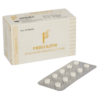
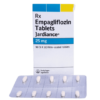
Glyxambi (Empagliflozin)

✅ Controls blood sugar levels
✅ Reduces heart disease risk
✅ Promotes weight loss
✅ Lowers blood pressure
✅ Improves kidney function
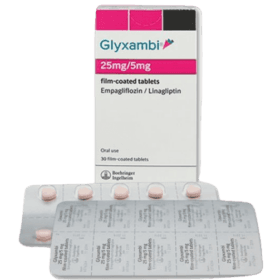
Glyxambi contains Empagliflozin & Linagliptin
✓ Medically reviewed by Morgan Ellis — Pharmacy Researcher · 8 years experience · Last reviewed: May 2026
⚡ Quick Answer — What is Glyxambi?
Glyxambi is a fixed-dose combination tablet of empagliflozin (SGLT-2 inhibitor) and linagliptin (DPP-4 inhibitor) (Empagliflozin 10 or 25 mg + Linagliptin 5 mg) used for type 2 diabetes. It combines two non-insulinotropic mechanisms: empagliflozin causes the kidneys to excrete glucose in urine (for glycaemic, weight, BP, heart-failure, and kidney benefits), while linagliptin raises incretin hormones to stimulate glucose-dependent insulin release. Expected HbA1c reduction: 1.0–1.3 points — more than either component alone. Expected weight loss: 2–3 kg. Very low hypoglycaemia risk on its own. Once-daily dosing, with or without food. Main side effects: genital thrush, UTI, and rare DKA (empagliflozin); rare pancreatitis or arthralgia (linagliptin). Avoid in type 1 diabetes, DKA, eGFR < 30, and severe hepatic impairment.
📦 Every order is covered by our Reshipment Assurance Policy — if your parcel does not arrive within 20 business days, we reship it.
Why order from MedsBase
Our generic medications are sourced from WHO-GMP certified manufacturers and shipped worldwide in discreet, plain packaging — no medication name on the parcel exterior. Card payments are routed through a regulated processor (statement descriptors include a regulated card-payment processor — never “MedsBase” or any medication name). Crypto and SEPA bank transfer are also accepted. Every order is backed by our Reshipment Assurance Policy.
What Is Glyxambi?
Glyxambi is a fixed-dose combination oral antidiabetic tablet containing two active ingredients: empagliflozin (SGLT-2 inhibitor) and linagliptin (DPP-4 inhibitor), in strengths of Empagliflozin 10 or 25 mg + Linagliptin 5 mg. Manufactured by Boehringer Ingelheim / Eli Lilly; available in packs of 30, 60, 90 or 180 tablets. It is prescribed for adults with type 2 diabetes — typically added to metformin, or initiated in patients with significant hyperglycaemia who would benefit from two non-insulinotropic mechanisms in a single tablet.
How Does Glyxambi Work?
The two components target hyperglycaemia through completely separate pathways — one insulin-independent, one incretin-based:
- Empagliflozin blocks SGLT-2 in the kidney proximal tubule, causing 70–90 g of glucose to be excreted in urine each day. This lowers blood glucose independently of insulin and also reduces weight (2–3 kg), blood pressure (3–5 mmHg), heart-failure hospitalisations (EMPEROR trials), and CKD progression (EMPA-KIDNEY).
- Linagliptin blocks the enzyme DPP-4, raising levels of the incretin hormones GLP-1 and GIP. This stimulates glucose-dependent insulin release and suppresses glucagon — only when blood glucose is elevated. Linagliptin is unique among DPP-4 inhibitors in needing no renal dose adjustment.
Because neither component directly stimulates insulin release in a glucose-independent manner, Glyxambi has a very low hypoglycaemia risk on its own. Expected HbA1c reduction: 1.0–1.3 percentage points over either component alone.
Dosage and Administration
Usual dose: one tablet once daily in the morning, with or without food. The starting strength depends on prior therapy and glycaemic target.
- Miss a dose? Take as soon as you remember if it is within 12 hours; otherwise skip.
- Renal dosing: empagliflozin is limited to eGFR > 20 for HF/CKD indications (> 30 for glycaemic control); linagliptin needs no renal dose adjustment. The combination is typically avoided if eGFR < 30.
- Sick-day rules: pause during acute illness with vomiting, diarrhoea, or reduced oral intake (risk of euglycaemic DKA and AKI). Restart when eating and drinking normally.
- Do not start within 48 hours of major surgery or IV contrast.
Side Effects
Common (mostly from the empagliflozin component):
- Genital mycotic infections (thrush) — up to 10% of users
- Urinary tract infections
- Polyuria, mild dehydration, postural dizziness in the first 2 weeks
- Modest LDL-cholesterol rise
From the linagliptin component:
- Nasopharyngitis, headache, mild GI upset
Uncommon but important:
- Diabetic ketoacidosis (DKA) — rare; can occur at near-normal blood glucose (“euglycaemic DKA”). Symptoms: nausea, vomiting, abdominal pain, deep breathing. Stop the drug and seek urgent care.
- Volume depletion, AKI — higher risk on diuretics or with acute illness
- Acute pancreatitis, severe arthralgia, bullous pemphigoid — rare DPP-4 class effects
- Fournier’s gangrene — extremely rare but serious
Drug Interactions
- Diuretics (loop and thiazide) — additive volume loss; consider diuretic dose reduction.
- Insulin, sulfonylureas, meglitinides — additive glucose-lowering; may need dose reduction to avoid hypoglycaemia.
- Rifampicin — reduces levels of both components.
- Antihypertensives — additive BP-lowering.
Who Should Not Take Glyxambi?
- Type 1 diabetes mellitus
- Diabetic ketoacidosis — current or recent history
- Severe renal impairment (eGFR < 30)
- Severe volume depletion or hypotension
- Severe hepatic impairment
- History of pancreatitis (relative)
- Known hypersensitivity to either component
- Pregnancy and breastfeeding
Storage
Store Glyxambi below 30°C in a dry place. Keep out of reach of children.
Frequently Asked Questions
Why combine an SGLT-2 inhibitor and a DPP-4 inhibitor in one tablet?
The two classes work by completely different mechanisms that do not overlap, so the HbA1c reduction of the combination is additive (1.0–1.3 points) rather than redundant. Both are weight-neutral to weight-favourable, and both have a very low hypoglycaemia risk, making the combination a good fit for patients who need additional glucose control without adding insulin or sulfonylurea risk.
Will Glyxambi help me lose weight?
Yes, modestly — typically 2–3 kg over 6–12 months. The weight loss comes from the empagliflozin component (urinary glucose excretion). Linagliptin is weight-neutral.
Does Glyxambi protect my heart and kidneys?
The empagliflozin component has strong evidence from EMPA-REG, EMPEROR-Reduced, EMPEROR-Preserved, and EMPA-KIDNEY trials for cardiovascular, heart failure, and kidney protection. Linagliptin is cardiovascular-neutral in CARMELINA. So the combination retains the empagliflozin cardio-renal benefits.
Will Glyxambi cause low blood sugar?
On its own, very rarely. Neither component stimulates insulin release in a glucose-independent manner. Hypoglycaemia becomes a concern when Glyxambi is combined with a sulfonylurea, meglitinide, or insulin.
What about thrush?
Genital thrush is the most common side effect (up to 10% of users, mostly women). It is usually mild and easily treated. Most patients do not need to stop Glyxambi.
Where can I buy Glyxambi online?
You can order Glyxambi (Empagliflozin 10 or 25 mg + Linagliptin 5 mg) from MedsBase in packs of 30, 60, 90 or 180 tablets. We ship worldwide, with discreet packaging and genuine WHO-GMP certified manufacturer stock.
Related Diabetes Medications
- Jardiance — Empagliflozin monotherapy
- Trajenta — Linagliptin monotherapy
- Forxiga — Dapagliflozin (SGLT-2 alternative)
- Januvia — Sitagliptin (DPP-4 alternative)
- Trajenta Duo — Linagliptin + Metformin
- Glycomet SR — Metformin sustained-release
- Browse all Diabetes Medications
Related Alternatives
Other products in Chronic Conditions that customers also view:
More options in Diabetes
Ranked by recent MedsBase order volume — what other customers in this category are picking.

| Strength | 25mg/5mg |
|---|---|
| Quantity | 10 Tablet/s, 30 Tablet/s, 60 Tablet/s, 90 Tablet/s |
 Glyxambi (Empagliflozin)
Q & A
Glyxambi (Empagliflozin)
Related products





Reviews
There are no reviews yet