








✓ Medically reviewed by · Last reviewed: May 2026
Pharmacy Researcher · 8 years experience
Pharmacy researcher with 8 years reviewing clinical drug information, generic formulation equivalence, and international pharmaceutical standards. Focuses on patient-facing accuracy in medication education.
potassium and blood pressure — Potassium and Blood Pressure: 9 Proven Ways the Right Balance Lowers Your Numbers. Read on for an evidence-backed guide covering everything you need to know.
Key Takeaways
- The sodium-to-potassium ratio is a stronger predictor of heart health than either mineral alone — and most adults fail on both sides.
- Adding roughly 2,000 mg of potassium daily can lower systolic blood pressure by about 5 mmHg — comparable to a low-dose medication.
- Foods like potatoes, spinach, salmon, and beans deliver far more potassium than a banana — and come with fiber and nutrients supplements lack.
- Three groups should NEVER increase potassium without a doctor: people with kidney disease, those on ACE inhibitors or potassium-sparing diuretics, and anyone with a history of hyperkalemia.
- You can see measurable blood pressure changes within 1–2 weeks, but the full effect takes about a month.
Table of Contents
- What Is the Link Between Potassium and Blood Pressure?
- How Does Potassium Lower Blood Pressure?
- Key Benefits of Optimizing Potassium and Blood Pressure
- Safety: Who Should NOT Increase Potassium
- What the Research Says About Potassium and Blood Pressure
- Potassium-Rich Foods vs Supplements: Which Works Better?
- How to Improve Your Potassium and Blood Pressure Balance: A Practical Plan
- Frequently Asked Questions
- The Bottom Line
Potassium and Blood Pressure: 9 Proven Ways the Right Balance Lowers Your Numbers
Potassium and blood pressure — roughly 120 million American adults have high blood pressure — and fewer than 1 in 4 have it under control. For decades, the advice has been the same: cut back on salt. Yet most people who dutifully avoid the salt shaker see only modest changes, if any. Here is what the latest research reveals: the problem is not just too much sodium. It is also too little potassium. And the balance between the two — your sodium-to-potassium ratio — may matter more than either number alone.
Potassium and blood pressure — by the time you finish reading, you will know exactly which foods deliver the most potassium for your effort, how quickly you can expect a change, the one supplement mistake cardiologists warn against, and the three groups who should never increase potassium without a doctor.
Potassium and blood pressure — one finding from a 2025 meta-analysis surprised even the researchers — we will cover it in the research section.
What Is the Link Between Potassium and Blood Pressure?

Potassium and blood pressure — potassium is an essential mineral and electrolyte that every cell in your body needs to function. It regulates fluid balance, sends nerve signals, and makes your muscles contract — including your heart muscle. But its most overlooked role may be its effect on blood pressure.
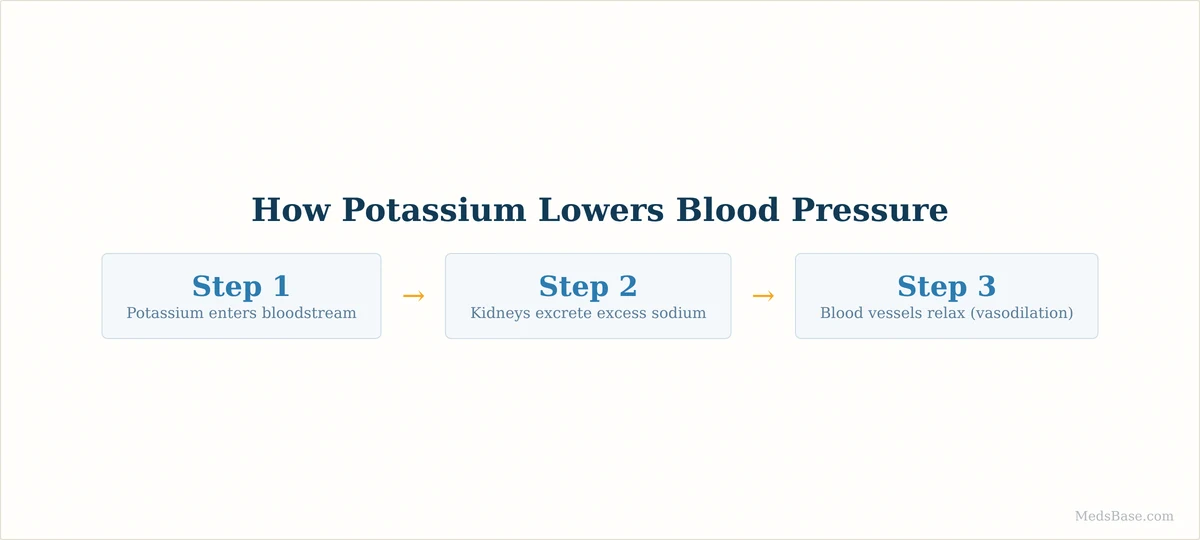
Here is the core relationship between potassium and blood pressure: sodium raises blood pressure by pulling water into your bloodstream, increasing the volume of fluid your heart has to pump. Potassium does the opposite — it signals your kidneys to remove sodium through urine and helps the smooth muscle in your artery walls relax, which widens the vessels and lowers the pressure inside them.
Think of it like a bathtub. Sodium is the faucet — still running. Potassium is the drain — and for most people, it is half-clogged.
Research published in the American Heart Association journals has shown that the sodium-to-potassium ratio is a stronger predictor of cardiovascular outcomes than either mineral measured in isolation. In other words, two people could eat the same amount of salt, but the one with higher potassium intake will tend to have lower blood pressure and a lower risk of stroke and heart attack.
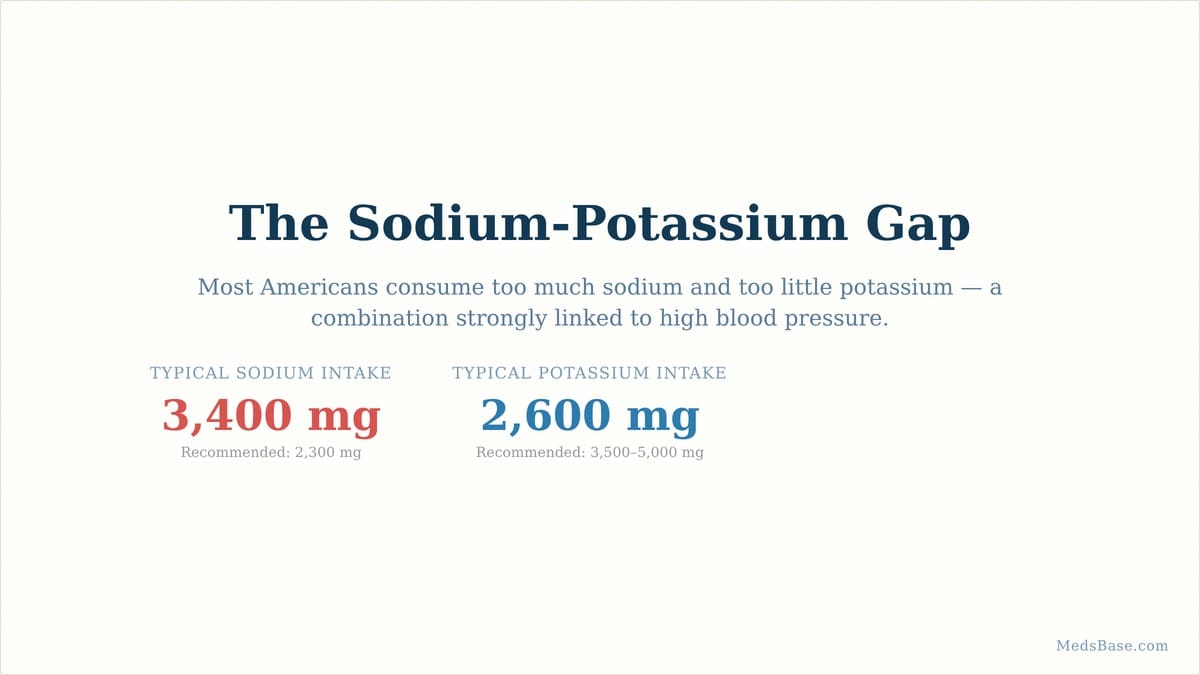
The scale of the mismatch is staggering. The average American consumes roughly 3,400 mg of sodium per day — well above the 2,300 mg recommended limit. At the same time, more than 98% of U.S. adults fail to meet the daily potassium recommendation. The result is a sodium-to-potassium ratio that is roughly double what it should be.
How Does Potassium Lower Blood Pressure?
The relationship between potassium and blood pressure works through three distinct pathways, each contributing to the overall pressure-lowering effect.
1. Sodium excretion (the kidney pathway). Your kidneys are constantly filtering your blood and deciding what to keep and what to send out as urine. When potassium levels are adequate, the kidneys become more efficient at removing sodium. This reduces the total volume of fluid in your bloodstream — less volume means less pressure against your artery walls.
2. Vasodilation (the artery pathway). Potassium directly relaxes the smooth muscle cells that line your blood vessels. When these muscles relax, the vessel widens — a process called vasodilation. A wider pipe means lower pressure. This effect is similar to how some blood pressure medications, like calcium channel blockers, work — but through a different mechanism.
3. Endothelial function (the lining pathway). The endothelium is the thin layer of cells that coats the inside of every blood vessel. It produces nitric oxide, a molecule that signals vessels to dilate. Low potassium impairs endothelial function and reduces nitric oxide production, while adequate potassium restores it. This is one reason why potassium and blood pressure research increasingly focuses on long-term vascular health, not just the immediate numbers on a cuff.
Here is where it gets interesting. The three pathways do not work equally fast. The sodium-excretion effect kicks in within days — less fluid volume almost immediately changes the numbers on a blood pressure cuff. The vasodilation and endothelial effects build more slowly, which is why the full blood pressure reduction from increasing potassium typically takes 2 to 4 weeks to materialize.
Key Benefits of Optimizing Potassium and Blood Pressure
1. Lower Blood Pressure Without Adding a New Medication
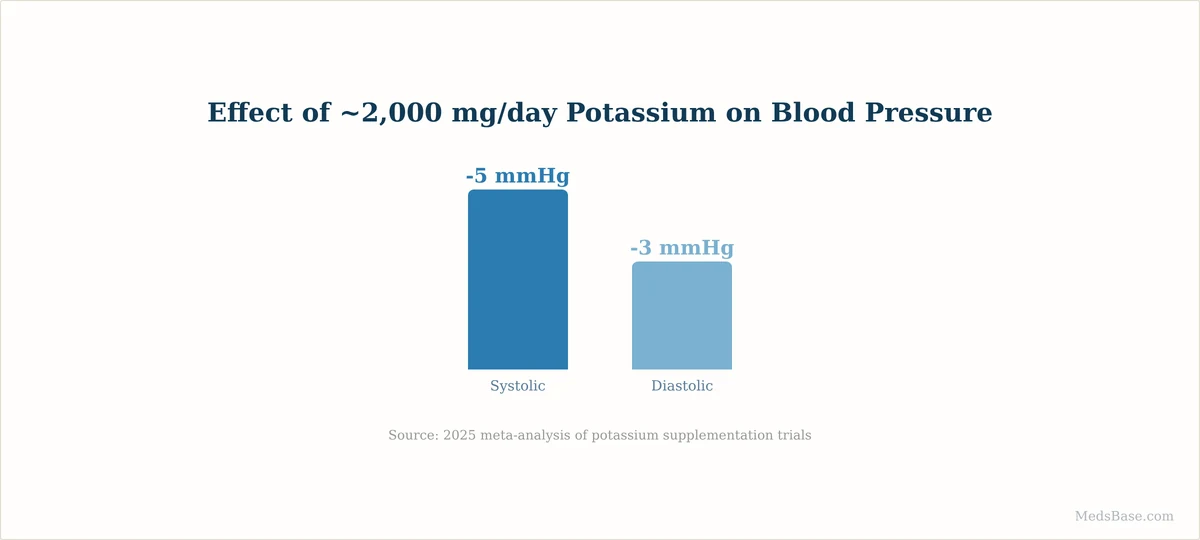
For someone with stage 1 hypertension (130–139 / 80–89 mmHg), improving the potassium and blood pressure balance through diet may be enough to bring numbers back into the normal range without a new prescription. The 2025 meta-analysis found an average reduction of roughly 5 mmHg systolic — that is comparable to the effect of a low-dose blood pressure medication in some people.
2. Stroke Risk Reduction
Higher potassium intake is independently associated with a lower risk of stroke, even after adjusting for blood pressure. A diet rich in potassium appears to protect the small blood vessels in the brain in ways that go beyond simply lowering pressure.
3. Kidney Stone Prevention
Potassium citrate — the form found naturally in fruits and vegetables — makes urine less acidic, which reduces the formation of calcium oxalate kidney stones. This benefit is separate from the blood pressure effects and is most pronounced in people who also consume adequate calcium.
4. Bone Density Preservation
When the diet is low in potassium-rich fruits and vegetables, the body pulls calcium from bones to buffer acid in the bloodstream. Adequate potassium intake from food sources reduces this calcium leaching, which supports bone density over decades.
5. Heart Rhythm Stability
Potassium is essential for the electrical signaling that keeps your heartbeat regular. This is why dangerously low potassium (hypokalemia) can trigger arrhythmias — and why people on certain diuretics that waste potassium need regular monitoring.
Who Should Avoid It? People with chronic kidney disease (especially stage 3 or beyond), anyone taking ACE inhibitors, ARBs, or potassium-sparing diuretics like spironolactone, and individuals with a history of hyperkalemia (high blood potassium). These groups should only modify potassium intake under direct medical supervision.
If dietary changes are not enough on their own to hit your blood pressure target, that is normal — roughly half of people with hypertension need medication. MedsBase carries a range of blood pressure medications in commonly prescribed strengths and classes, including ACE inhibitors, ARBs, beta blockers, and calcium channel blockers. What you do with your diet supports whatever your doctor prescribes — it is not one or the other.
Safety: Who Should NOT Increase Potassium
Here is the open loop we planted earlier. The three groups who should never increase potassium without speaking to their doctor first:
1. People with chronic kidney disease (CKD). Damaged kidneys cannot efficiently remove excess potassium from the blood. What is a healthy mineral for most people becomes a dangerous accumulation risk for someone with CKD. Even potassium-rich foods — not just supplements — may need to be limited in advanced kidney disease.
2. People on certain blood pressure medications. ACE inhibitors (like lisinopril, enalapril, ramipril) and ARBs (like losartan, telmisartan, valsartan) reduce the body’s ability to excrete potassium. If you take one of these and dramatically increase potassium intake, levels can rise to dangerous heights. The irony is painful: the very medications that lower blood pressure also make the dietary strategy that would help more risky to attempt without monitoring.
3. People on potassium-sparing diuretics. Spironolactone, eplerenone, amiloride, and triamterene all conserve potassium by design. Adding a high-potassium diet on top of one of these medications can cause hyperkalemia — a condition where potassium levels become high enough to disrupt heart rhythm, potentially fatally.
Symptoms of hyperkalemia to watch for: muscle weakness, fatigue, tingling sensations, nausea, or a slow or irregular heartbeat. If you are in one of these groups and experience any of those symptoms, seek medical attention immediately.
This is not a reason to avoid potassium — for the vast majority of people with hypertension, increasing potassium from food is safe and beneficial. But it is a reason to involve your doctor in the conversation if you fall into one of those three categories.
What the Research Says About Potassium and Blood Pressure
| Study | Year | Key Finding | Source |
|---|---|---|---|
| Meta-analysis of potassium supplementation trials | 2025 | ~2,000 mg/day potassium reduced systolic BP by ~5 mmHg and diastolic by ~3 mmHg in people with hypertension | PMC |
| AHA/ACC Clinical Practice Guideline | 2025 | Moderate potassium increase alone can lower BP by ~6/4 mmHg on average | PubMed |
| Sodium-to-potassium ratio review | 2023 | Urinary Na/K ratio is a stronger predictor of cardiovascular outcomes than sodium or potassium alone | PMC |
| InterSalt study follow-up | 2020 | High sodium intake linked to greater risk of hypertension; potassium showed protective inverse association | PMC |
| CDC NHANES dietary data | Multiple | >98% of U.S. adults fail to meet potassium recommendations; >70% of dietary sodium comes from processed/restaurant foods | PMC / PMC |
What this means for you: The evidence is consistent and spans decades — potassium and blood pressure are mechanistically and clinically linked. The 2025 guideline upgrade is notable because it moves from “consider potassium-rich foods” to a specific reduction estimate (roughly 6/4 mmHg), which puts dietary potassium in the same conversation as low-dose medication. The research does NOT suggest that potassium replaces medication for people who need it — but it strongly supports potassium as a first-line dietary intervention worth trying, with your doctor’s awareness, before or alongside pharmacologic treatment.
Potassium-Rich Foods vs Supplements: Which Works Better?
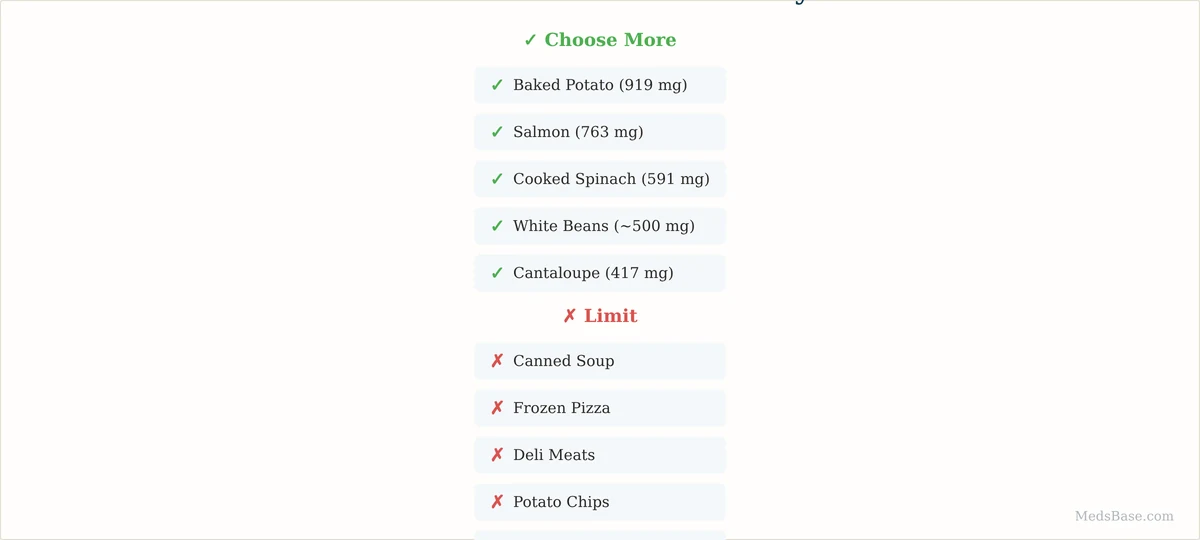
| Food | Potassium (mg) | Serving Size | Bonus Nutrients |
|---|---|---|---|
| Baked potato (with skin) | 919 | 1 medium | Vitamin C, B6, fiber |
| Baked salmon | 763 | 1 small fillet (3 oz) | Omega-3s, vitamin D, protein |
| Cooked spinach | 591 | 1/2 cup | Iron, magnesium, vitamin K |
| White beans (cooked) | ~500 | 1/2 cup | Fiber, protein, folate |
| Cantaloupe | 417 | 1 cup | Vitamin A, vitamin C |
| Milk (1%) | 388 | 8 oz | Calcium, vitamin D, protein |
| Pinto beans (cooked) | 373 | 1/2 cup | Fiber, folate, magnesium |
| Banana | 358 | 1 small | Vitamin B6, vitamin C |
| Plain yogurt (low-fat) | ~350 | 6 oz | Calcium, probiotics, protein |
| Edamame (cooked) | ~340 | 1/2 cup | Protein, fiber, folate |
Notice the banana — the food everyone associates with potassium — ranks near the bottom of this list. A medium baked potato delivers nearly three times the potassium.
Food beats supplements for three reasons:
First, potassium supplements in pill form are limited to 99 mg per capsule by regulation in many countries (including the U.S., where the FDA restricts over-the-counter potassium supplements to prevent accidental overdoses). To get 2,000 mg from pills, you would need to swallow 20 capsules — not practical, not affordable, and not how potassium is meant to enter the body.
Second, whole foods deliver potassium alongside other compounds that support blood pressure independently — magnesium, fiber, and phytochemicals that pills cannot replicate. The DASH diet (Dietary Approaches to Stop Hypertension) has been shown in multiple randomized controlled trials to lower blood pressure as effectively as some medications, and its benefit comes from the full package of nutrients, not potassium alone.
Third, high-dose potassium from supplements hits the bloodstream faster than food-derived potassium, which can trigger dangerous spikes in people with undiagnosed kidney issues. Food buffers the absorption, making it inherently safer.
Cardiologists nearly universally recommend potassium from food — not pills — for blood pressure management. Potassium chloride salt substitutes (like “lite salt”) are an intermediate option: they deliver more potassium than a supplement and can replace table salt in cooking, but they still lack the full matrix of nutrients that whole foods provide.
How to Improve Your Potassium and Blood Pressure Balance: A Practical Plan
Step 1: Know Your Starting Point (Days 1–3)
Before changing anything, track what you actually eat for three days — including one weekend day. Use any free food-tracking app that shows potassium and sodium. You do not need to do this forever; three days is enough to spot the patterns. Most people discover two things: their sodium is coming almost entirely from restaurant meals, packaged bread, canned soups, and deli meats (not the salt shaker), and their potassium is almost absent from breakfast and lunch.
Step 2: Swap Two Processed Items (Week 1)
Identify the two highest-sodium items in your tracker and swap them for lower-sodium alternatives. Examples:
- Canned soup homemade or low-sodium canned soup
- Deli meat sandwich tuna or egg salad sandwich
- Frozen pizza homemade flatbread with fresh toppings
- Salty snacks unsalted nuts or fresh fruit
This step alone — before you add any potassium — will start improving your sodium-to-potassium ratio and often shaves 500–1,000 mg off daily sodium intake.
Step 3: Add Two Potassium-Rich Foods Daily (Week 2+)
Pick two items from the food table above and make them a daily habit. Examples:
- Breakfast: Swap cereal for plain yogurt with cantaloupe (~750 mg potassium)
- Lunch: Add ½ cup of cooked spinach to a sandwich or grain bowl (~590 mg)
- Dinner: Make baked potato or salmon a regular rotation item (~760–920 mg)
- Snack: Edamame instead of chips (~340 mg per ½ cup)
Two additions of roughly 500–900 mg each gets you close to the 2,000 mg increase studied in the meta-analysis, while also displacing processed foods and their sodium.
Step 4: Recheck and Adjust (Week 3–4)
Take your blood pressure at home at the same time each day (morning, before food or caffeine, after sitting quietly for 5 minutes). Track the average for a week and compare it to your baseline. The full effect on potassium and blood pressure typically stabilizes by week 3–4. If you have seen a meaningful drop, maintain the changes and discuss the updated numbers with your doctor. If not, the dietary changes are still supporting your overall cardiovascular health — and your doctor can adjust your medication approach from a stronger foundation.
Common Mistakes to Avoid
- Relying on supplements instead of food. Over-the-counter potassium pills are too low-dose to make a difference, and high-dose prescription potassium is for treating deficiency, not managing blood pressure.
- Increasing potassium without reducing sodium. The ratio is what drives the cardiovascular benefit — adding potassium to a high-sodium diet mutes the effect.
- Skipping the doctor conversation if you are on medication. ACE inhibitors, ARBs, and potassium-sparing diuretics interact directly with potassium levels. Do not guess — ask.
- Expecting overnight results. The sodium-excretion effect starts within days, but the full vasodilation benefit takes 2–4 weeks. Be patient.
- Ignoring other lifestyle levers. Potassium and blood pressure management works best in combination with physical activity, weight management, and stress reduction — not as a standalone fix.
If diet and lifestyle changes alone are not enough to reach your target numbers, that is not a failure — it is just how hypertension biology works for many people. MedsBase offers a wide range of generic blood pressure medications in all major classes, and your doctor can help you find the right one to pair with your dietary efforts.
Related Reading
Frequently Asked Questions
Q: How does potassium lower blood pressure?
A: Potassium lowers blood pressure through two main mechanisms. First, it signals the kidneys to excrete more sodium through urine, which reduces fluid volume in the bloodstream. Second, it relaxes the smooth muscle cells lining artery walls, causing blood vessels to widen — a process called vasodilation. Both effects directly reduce the pressure inside your arteries.
Q: What is the best daily potassium intake for high blood pressure?
A: The American Heart Association recommends aiming for 3,500 to 5,000 mg of potassium per day to support blood pressure management, primarily from whole foods. The 2025 AHA/ACC clinical practice guideline notes that a moderate increase in dietary potassium alone can lower blood pressure by approximately 6/4 mmHg on average. Since over 98% of adults do not meet even the general recommendation of 4,700 mg, most people with hypertension have room to increase intake safely — after checking with their doctor about medication interactions.
Q: How long does it take for potassium to lower blood pressure?
A: The sodium-excretion effect of increased potassium begins within a few days — you may see early changes within the first week. The full vasodilation and endothelial benefits build more gradually, with the maximum blood pressure reduction typically stabilizing by weeks 3 to 4. Individual response varies based on genetics, baseline diet, age, and concurrent medications.
Q: Can too much potassium be dangerous?
A: Yes. Hyperkalemia — dangerously high blood potassium — can disrupt the heart’s electrical rhythm, potentially causing arrhythmias or cardiac arrest. This is rare from food alone in people with healthy kidneys, but it is a real risk for anyone with chronic kidney disease, people taking ACE inhibitors/ARBs/potassium-sparing diuretics, and those with certain adrenal disorders. Symptoms of hyperkalemia include muscle weakness, fatigue, tingling, nausea, and slow or irregular heartbeat. If you fall into any at-risk category, discuss dietary potassium changes with your doctor before making them.
Q: Which foods are highest in potassium?
A: The highest-potassium common foods are baked potato with skin (919 mg per medium potato), baked salmon (763 mg per small fillet), cooked spinach (591 mg per half cup), white beans (~500 mg per half cup), cantaloupe (417 mg per cup), and milk (388 mg per 8 oz). A banana — the food most people associate with potassium — provides only 358 mg and is outranked by many everyday foods.
Q: Should I take potassium supplements for high blood pressure?
A: For most people, no. Over-the-counter potassium supplements are limited to 99 mg per capsule in the U.S. and other countries — you would need roughly 20 capsules daily to reach the 2,000 mg dose studied in clinical trials. High-dose prescription potassium is designed for treating diagnosed potassium deficiency (hypokalemia), not for routine blood pressure management. Whole foods are the recommended source: they deliver potassium alongside fiber, magnesium, and other nutrients that independently support blood pressure and cardiovascular health, and the food matrix buffers absorption for better safety.
Q: What is the sodium-to-potassium ratio and why does it matter for blood pressure?
A: The sodium-to-potassium ratio compares how much sodium you consume relative to potassium. A 2023 review published in peer-reviewed literature concluded that this ratio is a stronger predictor of hypertension risk and cardiovascular mortality than either mineral measured alone. Most adults have a ratio that is roughly double the recommended level — high sodium, low potassium. Improving the ratio means both reducing sodium (from processed and restaurant foods) and increasing potassium (from fruits, vegetables, legumes, and fish), which together produce a larger blood pressure benefit than either change alone.
Q: Can increasing potassium and blood pressure management reduce my need for medication?
A: For some people with stage 1 hypertension (130–139/80–89 mmHg), dietary changes that improve the potassium and blood pressure relationship may bring numbers into the normal range, potentially reducing or delaying the need for medication. For people with higher blood pressure, dietary potassium can support the effectiveness of prescribed medications and may allow a lower dose — but it rarely eliminates the need for medication entirely. Never stop or reduce blood pressure medication without discussing it with your doctor. The goal is to use diet and medication together, not to choose one over the other.
The Bottom Line
The relationship between potassium and blood pressure is one of the most well-documented dietary connections in cardiovascular medicine — and one of the most underused. Decades of research, including updated 2025 clinical guidelines, consistently show that increasing dietary potassium while reducing sodium can lower systolic blood pressure by roughly 5–6 mmHg and diastolic by 3–4 mmHg on average. That is in the same range as a low-dose blood pressure medication — and it comes without a prescription, without side effects, and with bonus benefits for your kidneys, bones, and stroke risk.
The practical path is straightforward: track what you eat for three days, swap two high-sodium processed foods for whole alternatives, add two potassium-rich foods daily, and recheck your blood pressure in four weeks. For the vast majority of people with hypertension and healthy kidneys, this is safe, effective, and supported by the weight of clinical evidence.
One important note: if you have kidney disease, take an ACE inhibitor, ARB, or potassium-sparing diuretic, or have a history of high potassium — speak with your doctor before increasing potassium from any source. The benefits are real, but they must be weighed against your individual risk profile.
If diet alone is not enough to reach your target — and for many people it will not be — that is normal, not a failure. Hypertension is a complex condition, and medication is a proven, effective tool. Browse MedsBase’s blood pressure medication options to see what is available across all major drug classes.
Your next question might be: “Which blood pressure medication is right for me specifically?” Read our guide to how beta blockers and calcium channel blockers compare for different patient profiles. Or, if you are managing both high blood pressure and diabetes, read today’s companion piece on managing metformin gastrointestinal side effects — two conditions that often travel together.
Reviewed by Medical Professional | Last updated: 2026-08-21

Written by
Sophie ChenPharmaceutical Content Researcher · 8 years experience
Sophie Chen is a pharmaceutical content researcher with 8 years covering generic medication access and clinical pharmacology. She specialises in international regulatory frameworks, bioequivalence standards, and patient-facing education on therapeutic drug classes. She is not a clinician.