







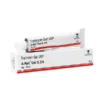
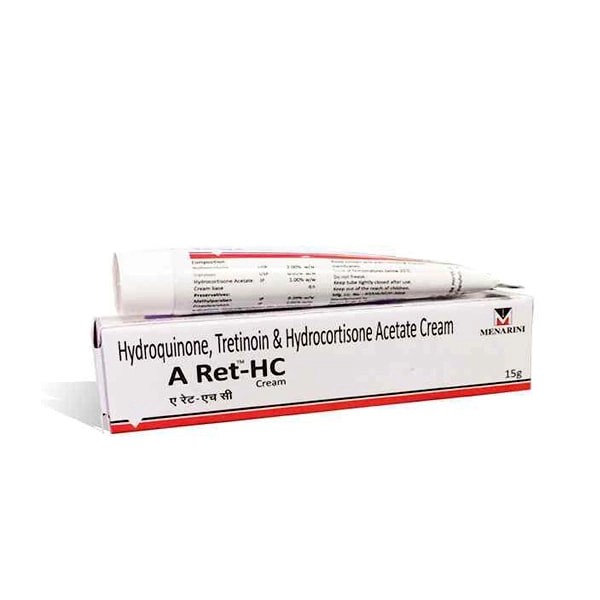
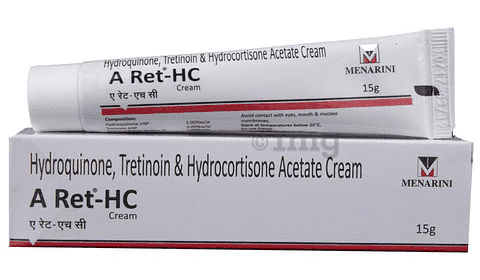
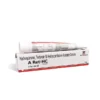
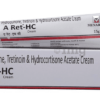
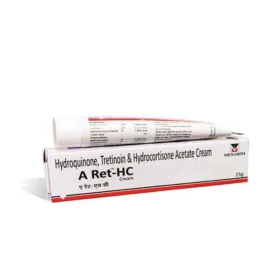
A Ret Hc Cream
✅ Reduces skin inflammation
✅ Lightens skin blemishes
✅ Treats acne effectively
✅ Promotes skin rejuvenation
✅ Minimizes wrinkles appearance
A Ret Hc Cream contains Hydroquinone, Tretinoin and Hydrocortisone
✓ Medically reviewed by Morgan Ellis — Pharmacy Researcher · 8 years experience · Last reviewed: May 2026
⚡ Quick Answer — What is A Ret HC Cream?
A Ret HC Cream is a topical “Kligman triple” depigmenting cream from Menarini containing hydroquinone 2% + tretinoin 0.025% + hydrocortisone 1%. It is a prescription-strength short-term treatment for melasma, post-inflammatory hyperpigmentation (PIH) after acne, and solar lentigines on the face. Apply a thin pea-sized amount to affected dark patches once nightly only, with a strict 8 weeks on / 8 weeks off cycling protocol — the included topical steroid (hydrocortisone, a mild (low-potency) corticosteroid) causes skin atrophy if used continuously. Daily SPF 50+ in the morning is mandatory — UV exposure undoes hydroquinone's effect within days. Do not use during pregnancy, breastfeeding, or on broken skin. Hydroquinone is restricted to specialist supervision in the US (FDA 2020) and EU.
📦 Every order is covered by our Reshipment Assurance Policy — if your parcel does not arrive within 20 business days, we reship it.
Why order from MedsBase
Our generic medications are sourced from WHO-GMP certified manufacturers and shipped worldwide in discreet, plain packaging — no medication name on the parcel exterior. Card payments are routed through a regulated processor (statement descriptors include a regulated card-payment processor — never “MedsBase” or any medication name). Crypto and SEPA bank transfer are also accepted. Every order is backed by our Reshipment Assurance Policy.
What Is A Ret HC Cream?
A Ret HC Cream is a topical depigmenting cream from Menarini containing three active ingredients in a fixed-dose combination: hydroquinone 2% + tretinoin 0.025% + hydrocortisone 1%. The formulation follows the classic Kligman protocol — the most clinically-validated short-term combination for treating melasma (chloasma), post-inflammatory hyperpigmentation (PIH) after acne or eczema, and stubborn solar lentigines.
A Ret HC Cream is intended for short-term use only — typically 8 weeks of nightly application, followed by an 8-week break. The hydroquinone component carries a pigmentary side-effect risk (exogenous ochronosis) with continuous use beyond 6 months, and the topical corticosteroid component causes skin thinning, telangiectasias and rebound dermatitis if used continuously. Used cyclically, the combination is safe and highly effective; used daily for years, it does damage that can be hard to reverse.
How Does A Ret HC Cream Work?
The three ingredients in A Ret HC Cream attack hyperpigmentation from different angles simultaneously:
- Hydroquinone — the most effective topical depigmenting agent currently available. Inhibits the enzyme tyrosinase inside melanocytes, blocking melanin synthesis at the rate-limiting step. Visible lightening at 4–8 weeks.
- Tretinoin — a topical retinoid that accelerates turnover of melanin-laden surface keratinocytes (so existing pigment leaves the skin faster), and increases hydroquinone penetration into the epidermis.
- hydrocortisone — a mild (low-potency) topical corticosteroid that suppresses the irritant dermatitis caused by hydroquinone + tretinoin (without it, the combination is too irritating to tolerate) and adds direct anti-inflammatory action that reduces post-inflammatory pigmentation.
Visible improvement at 4 weeks; clinically meaningful lightening at 8–12 weeks. Gains are UV-dependent — without rigorous sun protection, the depigmenting effect reverses within days of unprotected sun exposure.
Uses and Indications
- Melasma (chloasma) — symmetric brown patches on cheeks, forehead, upper lip and chin, often hormonally driven (pregnancy, OCPs, sun)
- Post-inflammatory hyperpigmentation (PIH) after acne, especially on Fitzpatrick III–VI skin
- Solar lentigines (sun spots, age spots) on the face and dorsum of hands
- Freckles (ephelides) — less effective; UV-driven and tend to recur
- Periorbital hyperpigmentation (dark under-eye circles) of melanin origin only — not effective for vascular dark circles
A Ret HC Cream is not for: dermal-pigment melasma (deep pigment that does not respond to topical therapy — needs laser or chemical peel), photodermatitis or any condition where the surrounding skin is broken or eczematous, or as a daily cosmetic skin-lightener. Daily long-term cosmetic use is the single most common cause of permanent hydroquinone-induced ochronosis.
A Ret HC Cream Dosage and How to Apply — CYCLING PROTOCOL
A Ret HC Cream comes in 20 g tube tubes containing hydroquinone 2% + tretinoin 0.025% + hydrocortisone 1%.
How to Apply A Ret HC Cream Properly
- Wash gently with a mild non-foaming cleanser, then pat dry. Wait 20–30 minutes for skin to fully dry.
- Apply a thin pea-sized amount only to the dark patches — not to the entire face. Spread thinly and only on the discoloured area. Avoid the surrounding healthy skin (the corticosteroid will thin healthy skin).
- Avoid eyes, mouth corners, nostrils, lips, mucous membranes, eyelids, and the neck.
- Once nightly only — never twice daily. Wash hands after application.
- CYCLING: 8 weeks of nightly use, then a mandatory 8-week break. Do not use continuously beyond 8 weeks at a time. After the break, you can resume another 8-week cycle if needed. Maximum 4 cycles in 12 months.
- Daily broad-spectrum SPF 50+ in the morning is mandatory — not just for the duration of treatment but indefinitely after, because UV reactivates pigment. Reapply every 2–3 hours if outdoors. Use a wide-brimmed hat. Avoid midday sun and tanning beds entirely.
- Stop immediately if you notice blue-black or grey discolouration of treated areas (sign of ochronosis), thinning skin with visible blood vessels, persistent stinging, or rebound darkening of the patch.
- Do not combine with leave-on AHA or BHA serums, retinol, peels or microneedling during the 8-week treatment cycle. The corticosteroid component does not protect skin from compounded irritation.
Side Effects of A Ret HC Cream
Common (mild, settles in 2–4 weeks):
- Mild dryness, peeling, scaling on the treated patch
- Stinging or burning on application (worst week 1–2)
- Mild redness
- Increased sun sensitivity
- Initial purge of microcomedones if used on acne-prone areas
Less common but important:
- Contact dermatitis (3–5%) — especially in patients with sensitive skin or eczema
- Halo effect — lightening of healthy skin around the dark patch (use minimum needed and apply only to the patch itself)
- Acneiform eruption from the topical corticosteroid component, particularly with overuse or facial application beyond 4 weeks
- Telangiectasias (fine red blood vessels) and skin thinning from the corticosteroid component — reversible only if caught early
- Perioral dermatitis from steroid use around the mouth
Rare but stop and seek dermatology review:
- Exogenous ochronosis — blue-black or slate-grey paradoxical hyperpigmentation that is the hallmark of hydroquinone overuse. Develops with continuous use beyond 6 months, particularly at higher concentrations and on Fitzpatrick V–VI skin. Difficult to reverse and can be permanent.
- Steroid rebound dermatitis — severe redness, burning and worsening pigmentation when the cream is suddenly stopped after prolonged daily use. Manage with a slow taper.
- Hypothalamic-pituitary-adrenal (HPA) axis suppression — theoretical with prolonged extensive corticosteroid application; rare with face-only use
- Severe contact dermatitis or eczematous reaction
Warnings and Precautions — CRITICAL
- Pregnancy and breastfeeding: contraindicated. Tretinoin component is FDA Pregnancy Category C; hydroquinone is also Category C with up to 35% systemic absorption documented. The corticosteroid adds further fetal exposure risk. Use azelaic acid (pregnancy-safe) for melasma instead.
- Sun exposure: daily broad-spectrum SPF 50+ is mandatory. Without it, hydroquinone's effect reverses within days and you risk ochronosis. Avoid tanning beds entirely.
- Cycling protocol is non-negotiable: never use continuously beyond 8 weeks at a stretch. Continuous daily use beyond 6 months risks exogenous ochronosis (which can be permanent) and corticosteroid-induced skin atrophy.
- FDA Action 2020: the FDA removed all over-the-counter hydroquinone products from the US market in 2020 after evaluating ochronosis case reports. Hydroquinone is now restricted to specialist supervision in the US, EU and most of Asia.
- Do not apply on broken skin, active eczema, severe sunburn, or open wounds.
- Do not apply around the eyes, on the eyelids, or on the lip vermilion. The corticosteroid causes rapid skin thinning in these zones.
- Waxing, threading, laser hair removal, dermabrasion, microneedling, chemical peels: stop A Ret HC Cream for at least 14 days before any of these procedures and resume only after skin has fully recovered.
- Asthma, severe atopic dermatitis: caution — sulfite preservatives in some hydroquinone formulations can trigger reactions.
- Children under 12: not for paediatric use.
Contraindications — Who Should NOT Use A Ret HC Cream
- Known hypersensitivity to hydroquinone, tretinoin, hydrocortisone, or any component of the cream base
- Pregnancy, planning pregnancy, or breastfeeding
- Active eczema, severe rosacea, broken skin, weeping dermatitis, or open wounds on the area to be treated
- Established exogenous ochronosis (blue-black hydroquinone-induced pigmentation)
- Existing facial corticosteroid-induced atrophy or telangiectasias
- Concurrent oral isotretinoin therapy
- Children under 12
- Patients unwilling to commit to daily SPF 50+ and the strict cycling protocol
Drug and Skincare Interactions
| Combine with | Effect | What to do |
|---|---|---|
| Other topical retinoids (tretinoin, tazarotene, adapalene) | Redundant with the tretinoin in A Ret HC Cream; severe stacked irritation | Stop other retinoids during the 8-week treatment cycle. |
| High-percentage AHA/BHA leave-on serums | Severe irritation, barrier damage, increased ochronosis risk | Avoid during the 8-week cycle. Resume only during off-cycle break. |
| Other topical corticosteroids | Compounded steroid atrophy | Do not use other facial steroids during A Ret HC Cream cycle. |
| Resorcinol, phenol-based products | Increased risk of ochronosis | Avoid combining. |
| Daily sunscreen (broad-spectrum SPF 50+) | Mandatory companion | Apply every morning. Reapply every 2–3 hours outdoors. |
| Vitamin C serum (L-ascorbic acid 10–15%) | Compatible — complementary tyrosinase inhibition + antioxidant | Vitamin C in morning under SPF, A Ret HC Cream at night. |
| Niacinamide 5% | Compatible — reduces melanosome transfer; supports barrier | Excellent off-cycle maintenance product. |
| Oral isotretinoin | Stacked retinoid + skin fragility | Stop A Ret HC Cream during oral isotretinoin course. |
Storage Instructions
- Store at room temperature, 15–25°C. Do not refrigerate or freeze.
- Keep the tube tightly closed and away from direct sunlight — hydroquinone oxidises (turns brown) when exposed to air and light, losing potency.
- If the cream has turned brown or grey in the tube, discard — oxidised hydroquinone is ineffective.
- Discard 6 months after first opening even if product remains in the tube.
- Keep out of reach of children.
Related Alternatives on MedsBase
Other depigmenting and acne products stocked on MedsBase:
- Melrio Cream (hydroquinone + tretinoin + fluocinolone)
- Melacare Forte Cream (hydroquinone + tretinoin + mometasone)
- Kojiglo Forte Cream (hydroquinone + tretinoin + mometasone)
- Epilite Liquid (hydroquinone 2%)
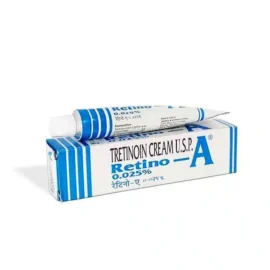
- Retino-A Cream (tretinoin 0.025% / 0.05%)
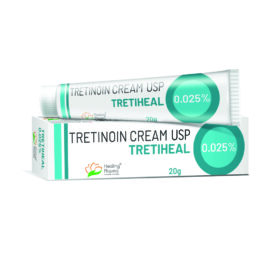
- Tretiheal Cream (tretinoin 0.025% / 0.05% / 0.1%)
- Isotroin (oral isotretinoin 5 / 10 / 20 / 30 mg)
Helpful reading: Tretinoin cream vs gel · Tretinoin vs retinol · Everything you want to know about acne.
Frequently Asked Questions
Why is the 8-weeks-on / 8-weeks-off cycling protocol important?
Two distinct risks drive the cycling rule: (1) hydroquinone causes exogenous ochronosis (paradoxical blue-black pigmentation that can be permanent) with continuous use beyond about 6 months; (2) the topical corticosteroid component causes skin atrophy, telangiectasias and rebound dermatitis with continuous facial use. The 8-on / 8-off cycle gives 32 weeks of treatment annually with documented safety. Continuous daily use is the single most common cause of permanent skin damage from depigmenting creams.
When will I see results from A Ret HC Cream?
Visible lightening at 4 weeks; clinically meaningful improvement at 8–12 weeks — just before the mandatory off-cycle break. Most patients need 2–3 cycles (8 weeks on, 8 weeks off) over 6–12 months for stable melasma clearance. Maintenance during the off-cycle break uses azelaic acid 15–20% or vitamin C + niacinamide.
Is hydroquinone safe? I have read it causes cancer.
Hydroquinone has been classified by IARC as Group 3 (not classifiable as to its carcinogenicity to humans) — meaning the rat data is not transferable to topical human exposure. Decades of dermatology use at 2–4% concentration cyclically have not shown increased human cancer risk. The real safety concern is ochronosis (a pigmentation side effect, not cancer), which is preventable by following the 8-week cycling protocol and SPF 50+ daily.
Why was hydroquinone restricted by the FDA?
The FDA removed OTC hydroquinone from the US market in September 2020 following evaluation of accumulated ochronosis case reports. Hydroquinone is still licensed for prescription use at concentrations up to 4%, but daily long-term cosmetic use is the population that triggered the ban. Prescription oversight is the safety mechanism — cyclical short-term use under medical supervision remains the standard for melasma.
Can I use A Ret HC Cream during pregnancy or breastfeeding?
No. All three ingredients are problematic in pregnancy: tretinoin (Pregnancy Category C, teratogenic in animal models), hydroquinone (up to 35% systemic absorption from facial application), and the corticosteroid (small but measurable systemic exposure). For pregnancy-related melasma, switch to azelaic acid 15–20% (Pregnancy Category B) and rigorous SPF 50+ daily.
Why do I need SPF 50+ every day?
UV exposure activates melanocytes and reverses every gain you have made. Without daily broad-spectrum SPF 50+ (mineral or hybrid is preferred for melasma), even small amounts of incidental sun (driving, walking outside) will undo weeks of cream use within days. SPF is the single most important variable in long-term melasma control — more important than the cream itself.
What is exogenous ochronosis and how do I avoid it?
Exogenous ochronosis is a paradoxical blue-black or slate-grey hyperpigmentation that develops in skin exposed to hydroquinone for too long — typically continuous daily use beyond 6 months, more common at concentrations >4% and on Fitzpatrick V–VI skin. It can be permanent. Prevention: stick to the 8-on / 8-off cycle, never use beyond 4 cycles per year, never apply to a wider area than necessary, and stop immediately if you notice darkening of the treated patch.
What can I use during the 8-week off-cycle break?
The standard maintenance routine: azelaic acid 15–20% (gentle tyrosinase inhibitor, pregnancy-safe), vitamin C 10–15% serum in the morning, niacinamide 5% (reduces melanosome transfer), and rigorous daily SPF 50+. Tranexamic acid (oral or topical) is also used for melasma maintenance under dermatologist supervision. Avoid all leave-on AHA/BHA serums during the off-cycle if you plan to resume A Ret HC Cream.
Can I use A Ret HC Cream on my body (chest, hands, neck)?
Generally not recommended — the corticosteroid component is too potent for prolonged use on body areas, and large surface-area application increases systemic absorption. For body hyperpigmentation, use plain hydroquinone or azelaic acid under dermatology supervision. A Ret HC Cream is intended for facial melasma and PIH only.
A Ret HC Cream vs azelaic acid — which should I use?
A Ret HC Cream is more potent and faster-acting but carries the cycling restrictions and ochronosis risk above. Azelaic acid 15–20% is gentler, pregnancy-safe, can be used continuously, and is excellent for maintenance after a Kligman-triple course or as primary therapy for milder hyperpigmentation. Most dermatologists alternate: A Ret HC Cream for active treatment cycles, azelaic acid for off-cycle maintenance.
Related Alternatives
Other products in General Health that customers also view:
More options in Beauty & Skin Care
Ranked by recent MedsBase order volume — what other customers in this category are picking.


| Strength | 2%/0.05%/1% (15g) |
|---|---|
| Quantity | 1 Tube/s, 3 Tube/s, 6 Tube/s |
| Pharma Form | Cream/s |
| Manufacturer | Menarini |
| Treatment | Melasma, Acne, Skin lightning |
| Generic Brand | Acitretin |
 A Ret Hc Cream
Q & A
A Ret Hc Cream
Related products






Reviews
There are no reviews yet