







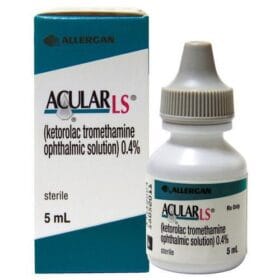
Acular LS Drop

Acular LS (ketorolac tromethamine 0.4%) — topical NSAID eye drop. Post-cataract CME prophylaxis and seasonal allergic conjunctivitis itching. Lower-sting LS formulation.
✓ Medically reviewed by Morgan Ellis — Pharmacy Researcher · 8 years experience · Last reviewed: May 2026
⚡ Quick Answer — What is Acular LS Drop?
Acular LS Drop is Ketorolac tromethamine 0.4%, a topical NSAID eye drop for post-operative pain and inflammation, allergic conjunctivitis, and prevention of cystoid macular oedema after cataract surgery. Used 2–4 times daily.
📦 Every order is covered by our Reshipment Assurance Policy — if your parcel does not arrive within 20 business days, we reship it.
Why order from MedsBase
Acular LS Drop is sourced from a WHO-GMP certified manufacturer and shipped worldwide in plain, discreet packaging. Every order is covered by our Reshipment Assurance Policy — if it has not arrived after 20 business days we reship at no extra cost. Backed by 1,400+ verified customer reviews.
What is Acular LS Drop?
Acular LS Drop is manufactured by Allergan and contains Ketorolac tromethamine 0.4% as a sterile ophthalmic solution. Topical NSAIDs reduce inflammation by blocking cyclo-oxygenase (COX) enzymes, decreasing prostaglandin production. They are non-steroidal and avoid the IOP elevation, cataract risk, and immune-suppression issues of topical steroids.
How It Works
Ketorolac tromethamine inhibits both COX-1 and COX-2 (directly) in ocular tissues. The result is reduced prostaglandin synthesis, less leukocyte trafficking, and decreased miosis, pain, and inflammation.
Indications
- Post-operative ocular inflammation after cataract surgery, refractive surgery, corneal cross-linking
- Cystoid macular oedema (CME) prophylaxis after cataract surgery — particularly in diabetic patients, prior CME, or epiretinal membrane
- Maintenance of intra-operative mydriasis during cataract surgery (reduces miosis from prostaglandin release)
- Seasonal allergic conjunctivitis — not first-line, but useful when antihistamines insufficient
- Post-operative pain control — reduces narcotic use after refractive surgery
Dosing
| Indication | Dose |
|---|---|
| Post-cataract inflammation | 1 drop four times daily for 2 weeks |
| CME prophylaxis (high-risk) | Pre-op for 1–3 days then continue 4–6 weeks post-op |
| Allergic conjunctivitis | 1 drop four times daily as needed |
Side Effects
Local: stinging on instillation (most common), conjunctival hyperaemia, foreign body sensation, transient blurred vision, ocular pruritus, corneal staining with prolonged use.
Hypersensitivity: rare bronchospasm in aspirin-sensitive patients, urticaria, angioedema.
Warnings & Contraindications
- Aspirin or NSAID-induced asthma — relative contraindication
- Pre-existing corneal disease (severe dry eye, neurotrophic keratitis, herpetic disease) — increased corneal melting risk
- Diabetic keratopathy — increased melting risk
- Concurrent topical steroid — additive corneal toxicity
- Bleeding diathesis or anticoagulant use — minor risk of intraoperative bleeding if used pre-operatively
- Late pregnancy (third trimester) — avoid (theoretical risk of premature ductus arteriosus closure if absorbed systemically; minimal from eye drops)
- Children — usually safe over age 3; rarely used under that age
Storage
Store at 15–25°C protected from light. Discard 28 days after first opening.
Frequently Asked Questions
What is Acular LS Drop used for?
Most commonly post-cataract surgery to reduce inflammation, control pain, and prevent cystoid macular oedema. Also used for allergic conjunctivitis, refractive surgery recovery, and as an alternative to steroids in patients with steroid response.
How is Acular LS Drop different from a steroid eye drop?
NSAIDs block prostaglandin synthesis without affecting the broader immune response. They do not raise IOP, do not cause cataract, and do not promote viral or fungal infection — making them safer for prolonged use. They are also less potent for severe inflammation; steroids are still preferred for active uveitis.
Why is Acular LS Drop used after cataract surgery?
Prostaglandins released during surgery cause pain, miosis, and contribute to cystoid macular oedema (a common cause of post-cataract vision loss). NSAIDs blunt this response. Many ophthalmologists use NSAIDs alongside steroids for the first 2 weeks, then continue NSAID alone for 4–6 weeks in high-CME-risk eyes.
What is corneal melting?
Rare but serious — the corneal epithelium breaks down and the underlying stroma thins, sometimes progressing to perforation. Risk factors: long courses, pre-existing corneal disease, diabetes, concurrent topical steroid. Stop the drop and seek same-day review for any unexplained worsening pain or vision drop.
Can I drive after using Acular LS Drop?
Mild blur for 5–10 minutes after instillation. Wait until vision clears.
Is Acular LS Drop safe in pregnancy?
Topical absorption is minimal. Avoid in the third trimester (theoretical premature ductus closure with systemic NSAIDs). Generally safe in earlier pregnancy when clearly indicated.
Can I use Acular LS Drop with a steroid eye drop?
Yes, but watch for additive corneal toxicity. The combination is standard after cataract surgery in many clinics. Wait 5 minutes between bottles.
What if I am aspirin-sensitive?
Cross-reactivity is possible. Avoid topical NSAIDs if you have a history of aspirin-induced asthma or anaphylaxis to oral NSAIDs.
What if I forget a dose?
Take it as soon as you remember unless the next scheduled dose is close.
How long is the typical course?
2–6 weeks depending on indication. Avoid courses longer than 6 weeks unless under specialist supervision because of cumulative corneal toxicity.
Other Eye-Care Medications
Customers viewing this product also consider these alternatives in our Eye Care range:
- Pred Forte (prednisolone acetate)
- FML Eye Drop (fluorometholone)
- Lotepred Eye Drop (loteprednol)
- Acular LS (ketorolac)
- Megabrom (bromfenac)
Medical Disclaimer
The information on this page is for educational purposes only and is not a substitute for medical advice from a qualified ophthalmologist or optometrist. Eye conditions can rapidly threaten sight — sudden vision loss, severe pain, or trauma is an ophthalmology emergency. Always consult an eye-care professional before starting, stopping, or changing any treatment.
More options in Eye Care
Ranked by recent MedsBase order volume — what other customers in this category are picking.
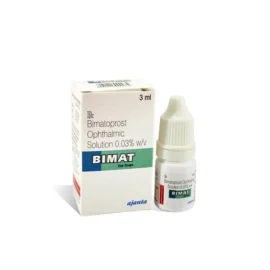
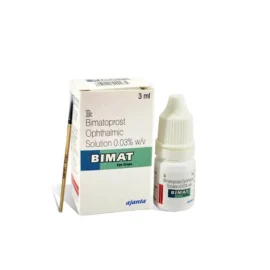
| Strength | 5 ml |
|---|---|
| Quantity | 1 Bottle/s, 2 Bottle/s, 3 Bottle/s, 6 Bottle/s |
 Acular LS Drop
Q & A
Acular LS Drop
Related products

Reviews
There are no reviews yet