







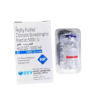
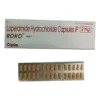
Betnesol

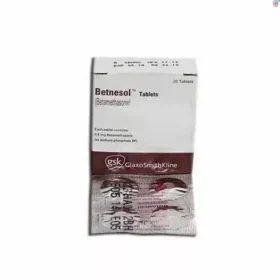
Betnesol (betamethasone 0.5 mg, GSK) — oral systemic corticosteroid for severe allergic, dermatological, rheumatic, and inflammatory conditions. Short course only; mandatory taper beyond 2–3 weeks.
✓ Medically reviewed by Morgan Ellis — Pharmacy Researcher · 8 years experience · Last reviewed: May 2026
Quick Answer — What is Betnesol?
Betnesol 0.5 mg is an oral tablet containing the synthetic glucocorticoid betamethasone — used as a short course for severe inflammatory and allergic conditions, including (but not limited to) widespread severe seborrhoeic dermatitis. It is a broad-use systemic corticosteroid, NOT a routine dandruff treatment. Most dandruff and scalp seborrhoeic dermatitis is managed with a medicated shampoo (Ketocip Shampoo) — see the red box below.
📦 Every order is covered by our Reshipment Assurance Policy — if your parcel does not arrive within 20 business days, we reship it.
Why order from MedsBase
Our generic medications are sourced from WHO-GMP certified manufacturers and shipped worldwide in discreet, plain packaging — no medication name on the parcel exterior. Card payments are routed through a regulated processor (statement descriptors include a regulated card-payment processor — never “MedsBase” or any medication name). Crypto and SEPA bank transfer are also accepted. Every order is backed by our Reshipment Assurance Policy.
Why order from MedsBase
Betnesol is supplied by a WHO-GMP certified manufacturer and dispatched from our fulfilment partner with discreet packaging. Worldwide shipping is available, and every order is covered by our Reshipment Assurance Policy. Customers can review independent feedback on our reviews page before ordering.
What Betnesol Is Used For
Betnesol 0.5 mg tablets are licensed for short-term, broad anti-inflammatory and immunosuppressive use across multiple specialties. Indications include:
- Severe allergic disorders — angio-oedema (after adrenaline if anaphylaxis), severe contact dermatitis, drug eruption, severe urticaria, allergic rhinitis unresponsive to antihistamines.
- Inflammatory skin disease — severe widespread seborrhoeic dermatitis with face/chest/back involvement, acute eczema flare, pemphigus / pemphigoid (specialist), discoid lupus, severe lichen planus.
- Severe asthma exacerbation — short-course oral steroid course alongside inhaled bronchodilator therapy.
- Rheumatic and connective-tissue disease — rheumatoid arthritis flare, polymyalgia rheumatica, temporal arteritis (high-dose), SLE flare, vasculitis.
- Nephrotic syndrome — minimal change disease in adults and children (specialist regimen).
- Inflammatory bowel disease and other autoimmune conditions — flare control under specialist supervision.
- Idiopathic thrombocytopenic purpura (ITP) — first-line.
Betnesol is also available as injection, eye / ear drops, and (different brand) scalp application. The 0.5 mg tablet is the oral form — used systemically.
How Betnesol Works
Betamethasone is a fluorinated synthetic glucocorticoid with very high anti-inflammatory potency (around 25× hydrocortisone, equipotent to dexamethasone) and minimal mineralocorticoid (sodium-retaining) activity.
It binds the intracellular glucocorticoid receptor, which then acts as a transcription factor — upregulating anti-inflammatory genes (lipocortin-1, IκBα, IL-10) and suppressing pro-inflammatory transcription factors NF-κB and AP-1. The downstream effects:
- Reduced phospholipase A₂ activity → less arachidonic acid release → less prostaglandin and leukotriene synthesis.
- Suppressed cytokine production (TNF-α, IL-1, IL-2, IL-6, IFN-γ).
- Reduced lymphocyte proliferation and migration.
- Stabilised mast cell and basophil membranes.
- Reduced capillary permeability and oedema.
Dose by Indication
| Indication | Adult dose | Duration |
|---|---|---|
| Severe allergic / dermatological flare | 2–8 tablets (1–4 mg) daily | 5–14 days; taper if >7 days |
| Severe asthma exacerbation | 4–8 tablets (2–4 mg) daily | 5–10 days, often no taper |
| Rheumatoid arthritis / PMR flare | 2–6 tablets (1–3 mg) daily | Specialist-directed; taper weekly |
| Severe widespread seborrhoeic dermatitis | 2–4 tablets (1–2 mg) daily | 5–7 days only; alongside topical antifungal |
| Nephrotic syndrome (induction) | Specialist-directed dose by weight | Specialist-directed taper |
| Maintenance use | Lowest effective dose | Reassess every 4 weeks; taper to off if possible |
Take with food in the morning to mimic the natural cortisol peak and reduce gastric irritation. Swallow whole with water — do not chew or crush.
Side Effects
The side-effect profile of any oral glucocorticoid is dose- and duration-dependent. Short courses (under 2 weeks) at moderate doses are generally well tolerated. Longer courses produce the classic Cushingoid pattern.
Short-course (acute use, <14 days): insomnia, mood changes (irritability, mild euphoria, occasionally low mood or psychosis at high doses), increased appetite, mild weight gain, fluid retention, transient blood-glucose rise, gastric irritation, increased risk of infection.
Medium-term (2–8 weeks): Cushingoid features begin — moon face, central weight gain, supraclavicular fat pads. Acne and skin thinning. Striae. Hypertension. Hyperglycaemia. Mood disturbance. Susceptibility to infection.
Long-term (>8 weeks): osteoporosis (calcium / vitamin D and bisphosphonate cover usually advised), proximal myopathy, cataracts and glaucoma, avascular necrosis of femoral head, growth suppression in children, skin atrophy with easy bruising, immunosuppression with reactivation of latent infections (TB, herpes zoster), psychiatric symptoms.
Drug Interactions
| Interaction | Effect | Action |
|---|---|---|
| NSAIDs (ibuprofen, diclofenac, naproxen) | Additive GI ulceration risk | PPI cover or avoid combination |
| Anticoagulants (warfarin, DOACs) | Variable INR effect; bleeding risk | Monitor INR closely |
| Diabetes medications | Steroid raises blood glucose | Monitor glucose; adjust insulin / OAD as needed |
| Live vaccines (MMR, varicella, yellow fever, BCG, oral typhoid) | Disseminated infection risk | Contraindicated at immunosuppressive doses |
| CYP3A4 inhibitors (clarithromycin, ketoconazole, ritonavir) | Raised steroid level → Cushing’s | Reduce steroid dose; monitor |
| CYP3A4 inducers (rifampicin, carbamazepine, phenytoin, St John’s wort) | Reduced steroid effect | Increase dose if needed |
| Loop and thiazide diuretics | Additive hypokalaemia | Monitor potassium |
| Quinolone antibiotics (ciprofloxacin, levofloxacin) | Increased tendon rupture risk | Caution — alternative antibiotic if possible |
Contraindications
- Systemic untreated infection — particularly fungal infection, latent TB (screen and treat first if long-term steroid is planned).
- Live vaccines at immunosuppressive doses (typically >20 mg/day prednisolone equivalent for 14 days, broadly equivalent to >3 mg/day betamethasone).
- Hypersensitivity to betamethasone or any tablet excipient.
Use with caution in: diabetes, hypertension, peptic ulcer disease, osteoporosis, glaucoma, psychiatric history (especially psychosis), congestive heart failure, recent intestinal anastomosis, myasthenia gravis, ocular herpes simplex.
Pregnancy, Breastfeeding, and Children
Pregnancy. Use only if benefit outweighs risk. Used routinely in late pregnancy to accelerate fetal lung maturation in threatened preterm delivery. First-trimester exposure is associated with a small (but not zero) increase in cleft lip / palate risk in some series. Specialist supervision.
Breastfeeding. Small amounts cross into breast milk. Short courses are compatible; for long-term use, time the dose immediately after a feed and monitor the infant for adrenal suppression at high maternal doses.
Paediatric. Used in nephrotic syndrome and other paediatric indications under specialist supervision. Long-term use suppresses linear growth — monitor height and weight regularly.
Storage
Store Betnesol below 25°C in the original blister, away from direct sunlight. Keep out of reach of children. Discard after the printed expiry date.
Frequently Asked Questions
Why is Betnesol listed under Dandruff Treatment?
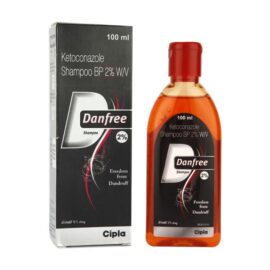
Severe widespread seborrhoeic dermatitis with extension to face / chest / back can occasionally need a short course of oral steroid alongside topical antifungal therapy. Betnesol is one option for that narrow indication. For routine dandruff, the right products are Ketocip Shampoo, Danfree 2%, or Selsun Suspension — not oral steroid.
How does Betnesol compare to prednisolone?
Betamethasone is roughly 5–6× more potent than prednisolone on an mg-for-mg basis (0.5 mg betamethasone ≈ 3 mg prednisolone). Betamethasone has minimal mineralocorticoid (sodium-retaining) activity, so it causes less fluid retention. Half-life is longer (36–54 hours vs 12–36 hours for prednisolone), so once-daily morning dosing is sufficient.
Why must I take Betnesol in the morning?
The body’s natural cortisol peak is in the early morning. Taking the steroid dose at this time mimics the natural rhythm and reduces HPA axis suppression. Evening dosing increases insomnia and disrupts the normal cortisol profile.
Can I stop Betnesol abruptly?
Only if the course has been very short (under 2–3 weeks at moderate dose). For longer courses, abrupt withdrawal can cause adrenal crisis — fatigue, low blood pressure, vomiting, shock. Always taper as directed by your prescriber. Carry a steroid emergency card on continuous therapy beyond 3 weeks.
Will I gain weight on Betnesol?
Short courses (under 2 weeks) typically cause minor fluid retention. Medium-term use (2–8 weeks) produces appetite increase and central fat redistribution — moon face, abdominal weight gain. Most weight settles within 2–6 months of stopping. Mitigation: regular meals, avoid added sugar, monitor portions.
Is it safe to drink alcohol on Betnesol?
Moderate alcohol is acceptable on short courses, but the combination raises gastric ulcer and bleeding risk — particularly with NSAIDs. Long-term steroid use plus alcohol increases osteoporosis risk markedly. Best avoided during the course.
Why are live vaccines contraindicated?
Glucocorticoids at immunosuppressive doses blunt the immune response to vaccines and can allow the live attenuated organism to disseminate. Inactivated vaccines (flu, COVID-19, pneumococcal, hepatitis A/B) are safe and recommended. Live vaccines (MMR, varicella, yellow fever, BCG, oral typhoid) should be deferred until at least 1 month after stopping immunosuppressive steroid.
What is a stress-dose increase?
Patients on continuous steroid therapy beyond 3 weeks have suppressed adrenal function. During major stress (surgery, severe infection, major trauma), the suppressed adrenal cannot mount the cortisol response that an unaffected person can. The treating clinician temporarily increases the steroid dose (or gives IV hydrocortisone) to cover the period — failure to do this can cause adrenal crisis.
Does Betnesol cause osteoporosis?
Long-term steroid use (typically >3 months at any meaningful dose) substantially increases osteoporotic fracture risk. Mitigation: dietary calcium (1,000–1,200 mg/day), vitamin D supplementation, weight-bearing exercise, avoid smoking and excess alcohol, and consider bisphosphonate cover for prolonged courses. Bone density (DEXA) should be monitored.
My child is on Betnesol — will it affect their growth?
Long-term steroid use in children does suppress linear growth via reduced GH/IGF-1 signalling and direct effect on growth plates. Short courses do not. Specialist-supervised regimens for nephrotic syndrome and similar conditions monitor height and weight carefully and use the lowest effective dose.
Other Dandruff & Scalp Treatments
For routine dandruff and seborrhoeic dermatitis, customers also view these targeted topical treatments:
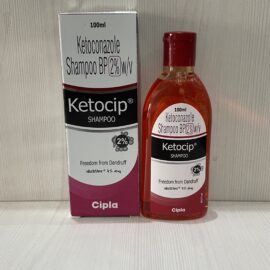
- Ketocip Shampoo (ketoconazole 2%)
- Selsun Suspension (selenium sulphide 2.5%)
- Tenovate Cream (clobetasol topical steroid)
- Halovate Cream (halobetasol topical steroid)
- Topinate Cream (clobetasol topical steroid)
More options in Dandruff Treatment
Ranked by recent MedsBase order volume — what other customers in this category are picking.

| Strength | 0.5 mg |
|---|---|
| Quantity | 200 Tablet/s, 400 Tablet/s |
 Betnesol
Q & A
Betnesol
Related products



Reviews
There are no reviews yet