





BPC-157
✅ Supports cellular regeneration
✅ Enhances tissue modeling
✅ Promotes fibroblast activity
✅ Stimulates angiogenic signaling
✅ Improves extracellular matrix stability
BPC-157 contains synthetic peptide compound.
✓ Medically reviewed by Morgan Ellis — Pharmacy Researcher · 8 years experience · Last reviewed: May 2026
Quick Answer — What is BPC-157?
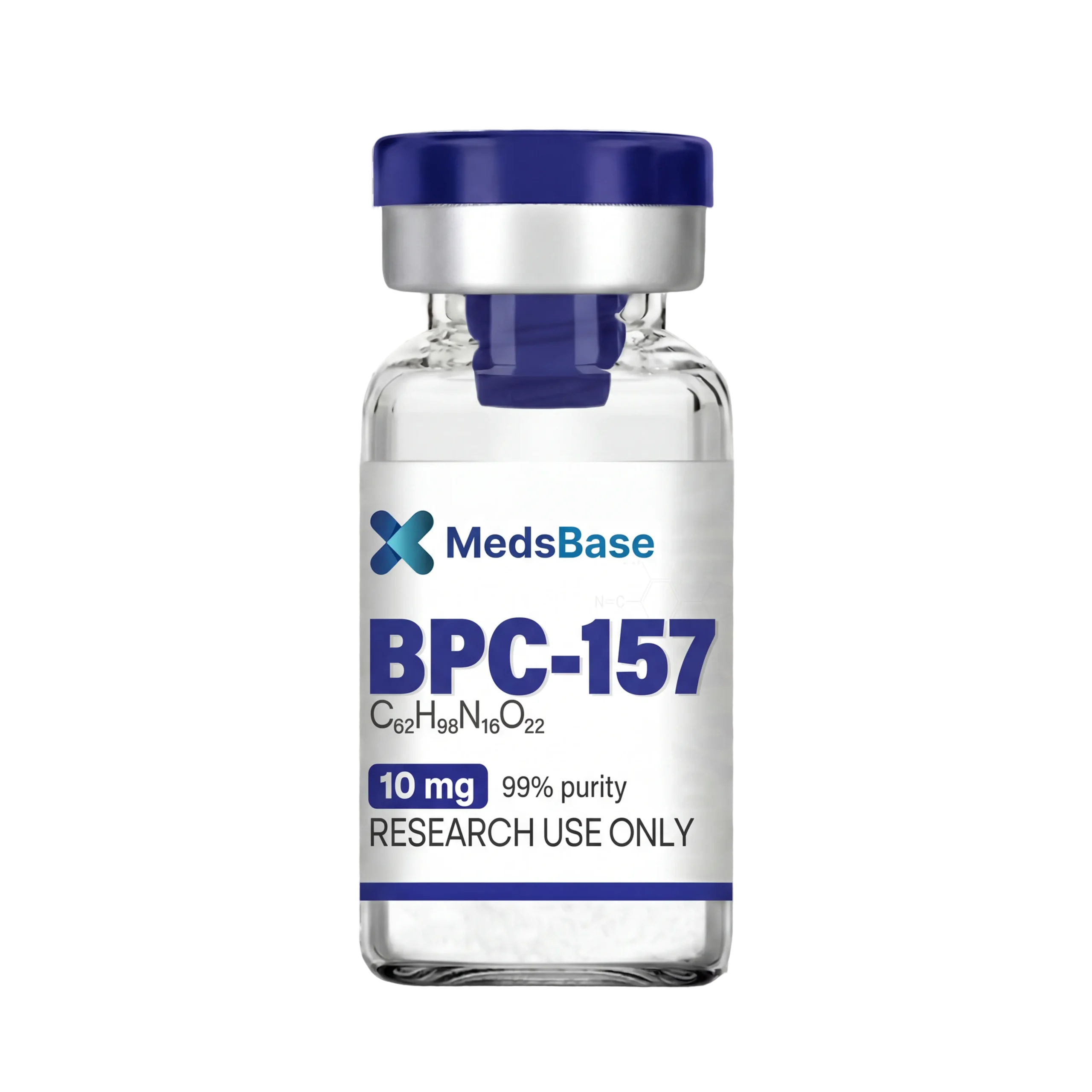
BPC-157 (Body Protection Compound 157) is a 15-amino-acid synthetic pentadecapeptide derived from a protective gastric protein. In published preclinical studies it has shown consistent effects on tendon, ligament, gut, muscle, and vascular tissue recovery via VEGF, nitric oxide, and growth-hormone-receptor signaling. Supplied in 2 mg to 10 mg lyophilized vials.
📦 Every order is covered by our Reshipment Assurance Policy — if your parcel does not arrive within 20 business days, we reship it.
| Specification | Detail |
|---|---|
| CAS Number | 137525-51-0 |
| Molecular Formula | C62H98N16O22 |
| Molecular Weight | 1419.55 Da |
| Sequence | Gly-Glu-Pro-Pro-Pro-Gly-Lys-Pro-Ala-Asp-Asp-Ala-Gly-Leu-Val (GEPPPGKPADDAGLV) |
| Form | Lyophilized powder (or as supplied) |
| Purity | ≥99% (HPLC verified, COA on request) |
| Storage | Lyophilized: 2–8 °C (refrigerator) for working stock; −20 °C for long-term storage of unopened vials. Reconstituted: 2–8 °C, use within ~30 days. Protect from light. Do not freeze–thaw the reconstituted solution. |
| Solubility | Bacteriostatic water (recommended) or sterile water for shorter use windows |
What Is BPC-157?
BPC-157 is the abbreviation of Body Protection Compound 157, a 15-amino-acid synthetic pentadecapeptide originally isolated as a fragment of a larger protective protein found in human gastric juice. Unlike most peptides it is stable in gastric acid, which has made it a frequent subject of oral-administration studies in rodent models alongside the more common subcutaneous route. BPC-157 is one of the most widely studied healing peptides in the preclinical literature, with published work spanning tendon, ligament, gut barrier, skeletal muscle, bone, and vascular tissue. The peptide sequence is GEPPPGKPADDAGLV, molecular weight approximately 1,419 Da, empirical formula C62H98N16O22. It is supplied as a high-purity lyophilized powder for reconstitution with bacteriostatic water. For a deep-dive on mechanism, published trial detail, and dosing considerations, see our full BPC-157 guide.
Mechanism of Action — Three Overlapping Healing Pathways
What differentiates BPC-157 from single-pathway peptides is its simultaneous activity across three distinct signaling routes, each contributing to the observed tissue-recovery phenotype in published studies:
- Angiogenesis / VEGF upregulation — BPC-157 upregulates vascular endothelial growth factor receptor 2 (VEGFR2) expression in injured tissue, promoting the formation of new capillaries. This improves local perfusion at repair sites, the rate-limiting step in tendon, ligament, and muscle healing.
- Nitric oxide (NO) pathway — BPC-157 enhances endothelial nitric oxide synthase (eNOS) activity and protects vascular endothelium against oxidative damage. In rodent models of portal hypertension, systemic vasoconstriction, and stomach ulcers, this effect is central to the compound’s protective action.
- Growth hormone receptor upregulation — BPC-157 increases growth hormone receptor (GHR) expression on fibroblasts and tenocytes, enhancing collagen type I synthesis. This mechanism is thought to underlie the observed tendon-strength gains in Achilles and medial-collateral-ligament transection models.
Because these three pathways converge on tissue that has been injured, BPC-157 produces faster and more complete recovery than single-pathway interventions in the same models. It is also notably well tolerated across the range of published doses, with minimal off-target signaling reported in toxicology studies.
Published Evidence
BPC-157 is used in clinical contexts that investigate:
- Tendon and ligament injury recovery — Achilles tendon transection, medial collateral ligament rupture, rotator-cuff tear rodent models (Chang et al., J Appl Physiol 2011; Staresinic et al., J Orthop Res 2003)
- Gut barrier integrity and ulcer studies — gastric ulcer, colitis, and inflammatory-bowel-disease models; BPC-157’s gastric-derived origin is mechanistically relevant here (Sikiric et al., Curr Med Chem 2011)
- Skeletal muscle regeneration — post-injury recovery kinetics, myoblast proliferation, and myotube formation studies
- Joint and cartilage studies — osteoarthritis rodent models, cartilage matrix composition, synovial inflammation
- Vascular angiogenesis — new-capillary formation and perfusion at injured-tissue sites
- Bone healing — fracture callus formation in osteotomy and bone-defect study models
- Comparative recovery — benchmarking against other healing peptides, especially TB-500 (Thymosin Beta-4) as the canonical systemic healing comparator. See the BPC-157 vs TB-500 comparison for a full side-by-side.
For broader context on where BPC-157 fits within the healing-peptide landscape, see the best peptides for muscle recovery cluster article and GHK-Cu copper peptide as a complementary anti-aging compound. Browse the full peptides catalog for related compounds.
Available Strengths and Concentrations
MedsBase stocks BPC-157 in the following lyophilized vial sizes. Each variation ships in 10-vial, 20-vial, and 30-vial pack formats with full reconstitution guidance:
| Vial Strength | Typical Use Case | Pack Sizes |
|---|---|---|
| 2 mg | Short protocols, pilot dosing, titration | 10, 20, or 30 vials |
| 5 mg | Standard strength, most commonly ordered | 10, 20, or 30 vials |
| 10 mg | Extended protocols, lowest per-mg cost | 10, 20, or 30 vials |
All three strengths are the same chemical form (lyophilized powder, 99%+ HPLC purity). Higher-mg vials require smaller reconstitution volumes per unit dose, which is useful when users want to minimise injection volume in rodent protocols.
How It Compares — BPC-157 vs TB-500
BPC-157 and TB-500 are the two most-cited healing peptides. They are often studied in parallel because they act via complementary, largely non-overlapping mechanisms. Many preclinical protocols combine them rather than using either alone.
| Criterion | BPC-157 | TB-500 (Thymosin Beta-4) |
|---|---|---|
| Length | 15 amino acids (pentadecapeptide) | 43 amino acids (thymic peptide) |
| Primary mechanism | VEGF + NO + GH receptor upregulation | G-actin sequestration, cell migration |
| Distribution | More localized at injection site | Systemic, distributes widely |
| Typical dose | 250–500 mcg, 1–2x daily | 2–2.5 mg, 2x weekly |
| Strongest signal | Tendon, ligament, gut barrier | Cardiac, systemic muscle, vascular |
| Stacking | Commonly co-administered with TB-500 in studies | Commonly co-administered with BPC-157 in studies |
For a full methodological comparison including dosing protocols and when users pick one over the other, read BPC-157 vs TB-500: which healing peptide for your recovery goal.
Storage and Reconstitution
Before reconstitution: store lyophilized vials refrigerated at 2–8 °C in original packaging. Lyophilized BPC-157 is stable under these conditions for up to 36 months. Avoid freeze-thaw cycles on the powder. Reconstitution procedure: inject bacteriostatic water down the side wall of the peptide vial (not directly onto the lyophilized cake) per the dilution table above. Swirl gently — do not shake — and allow 2–5 minutes for full dissolution. A correctly reconstituted solution should be clear and colourless. After reconstitution: store refrigerated at 2–8 °C and use within 30 days for optimal stability. Do not freeze reconstituted solution — freeze-thaw cycles degrade peptide integrity. Discard any vial showing cloudiness, precipitate, or discolouration.
Frequently Asked Questions
What is BPC-157 used for in studies?
BPC-157 is used in studies investigating tendon and ligament healing, gut barrier integrity, skeletal muscle recovery, vascular angiogenesis, anti-inflammatory signaling, and bone healing. It is not FDA-approved and is sold here strictly for clinical studies use only.
How is BPC-157 different from TB-500?
BPC-157 is a 15-amino-acid pentadecapeptide derived from gastric juice, acting mostly locally via VEGF, nitric oxide, and growth-hormone-receptor pathways. TB-500 is a 43-amino-acid thymic peptide that acts systemically via G-actin binding and cell migration. The two are often co-administered in studies because their mechanisms are complementary rather than overlapping.
What is the typical BPC-157 dose?
Published preclinical protocols typically use 250–500 mcg per administration, given once or twice daily for 4–8 week cycles. A 5 mg vial reconstituted with 2.0 mL bacteriostatic water yields 2.5 mg/mL — 10 ticks on a U-100 syringe equals 250 mcg.
Is BPC-157 FDA approved?
No. BPC-157 is not approved by the FDA, EMA, MHRA, or any other regulator for human therapeutic use.
How should BPC-157 be stored?
Lyophilized vials: refrigerated at 2–8 °C in original packaging, stable up to 36 months. Reconstituted solution: refrigerated at 2–8 °C, use within 30 days. Do not freeze reconstituted solution — freeze-thaw cycles degrade the peptide.
How do I reconstitute BPC-157?
Follow the reconstitution reference chart above. Add bacteriostatic water down the side wall of the vial (not onto the lyophilized cake), swirl gently, and allow 2–5 minutes for full dissolution. Do not shake the vial.
What strengths does MedsBase stock?
MedsBase carries BPC-157 in 2 mg, 5 mg, and 10 mg lyophilized vials. Each strength is available in 10-vial, 20-vial, or 30-vial pack sizes. All vials are supplied at 99%+ HPLC purity with a certificate of analysis available on request.
Can BPC-157 and TB-500 be stacked in studies?
Yes. BPC-157 and TB-500 are frequently co-administered in preclinical studies because their mechanisms are complementary. BPC-157 acts mostly locally via growth-factor upregulation; TB-500 acts systemically via G-actin binding and cell migration. Combined protocols are described in our comparison guide.
Does BPC-157 cause side reported effects?
Published preclinical studies across rodent species has reported a notably clean safety profile at typical doses, with no consistent off-target signals and good tolerability. Long-term human safety data are not available because human trials have not been completed.
What is the difference between oral and injectable BPC-157 in studies?
BPC-157 is unusually stable in gastric acid due to its gastric-juice-derived origin, so oral administration is feasible in rodent protocols (unlike most peptides). Subcutaneous injection remains the most common administration route in the literature because it produces more reproducible plasma concentrations.
What is the half-life of BPC-157?
In preclinical studies, BPC-157 has an estimated plasma half-life of approximately 4 hours following subcutaneous administration. Oral route studies in rodent models suggest shorter systemic clearance but sustained local effects within the gastrointestinal tract, attributed to the peptide’s unusual acid-stability.
How long does BPC-157 take to show effects in preclinical studies?
Most preclinical studies using BPC-157 in tendon, ligament, and gut injury models report measurable tissue-level changes within 7–14 days. The time-course varies with the study model, injury severity, route of administration, and dose used in the study design.
Can I order BPC-157 for international shipping?
Yes. MedsBase ships BPC-157 worldwide from our dedicated peptide shipping network. Peptide-only orders qualify for our standalone peptide shipping service. All orders ship in temperature-controlled packaging with full tracking.
BPC-157 protocols for tendon, ligament, and soft-tissue recovery typically pair it with TB-500 for synergistic angiogenic + cytoskeletal effects; for the bundled regimen see our Peptide Healing Stack (BPC-157 5 mg + TB-500 5 mg + bacteriostatic water) with both lyophilised vials and reconstitution water in one parcel at $0 peptide-shipping rate.
Other Peptides for Recovery and Performance
- TB-500 — Thymosin Beta-4 fragment — soft tissue and vascular recovery
- Ipamorelin — Selective ghrelin agonist — clean GH pulse without cortisol/prolactin
- CJC-1295 with DAC — GHRH analog with extended half-life
- GHK-Cu — Copper peptide — skin and connective tissue regeneration
- IGF-1 LR3 — Long-R3 IGF-1 analog — anabolic / regenerative support
Further Reading
📖 Learn the science behind this peptide
Read our complete evidence-based guide: BPC-157 — mechanism, trial data & outlook. Covers mechanism of action, published study data, typical dosing ranges, reconstitution protocols, stacking considerations, and safety/contraindication notes.
More options in Peptides
Ranked by recent MedsBase order volume — what other customers in this category are picking.
| Strength | 2 mg, 5 mg, 10 mg |
|---|---|
| Quantity | 10 Vials, 20 Vials, 30 Vials |
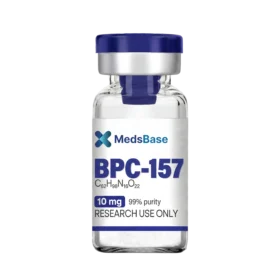 BPC-157
Q & A
BPC-157
Related products
Reviews
There are no reviews yet