







Cyclogyl Eye Drops
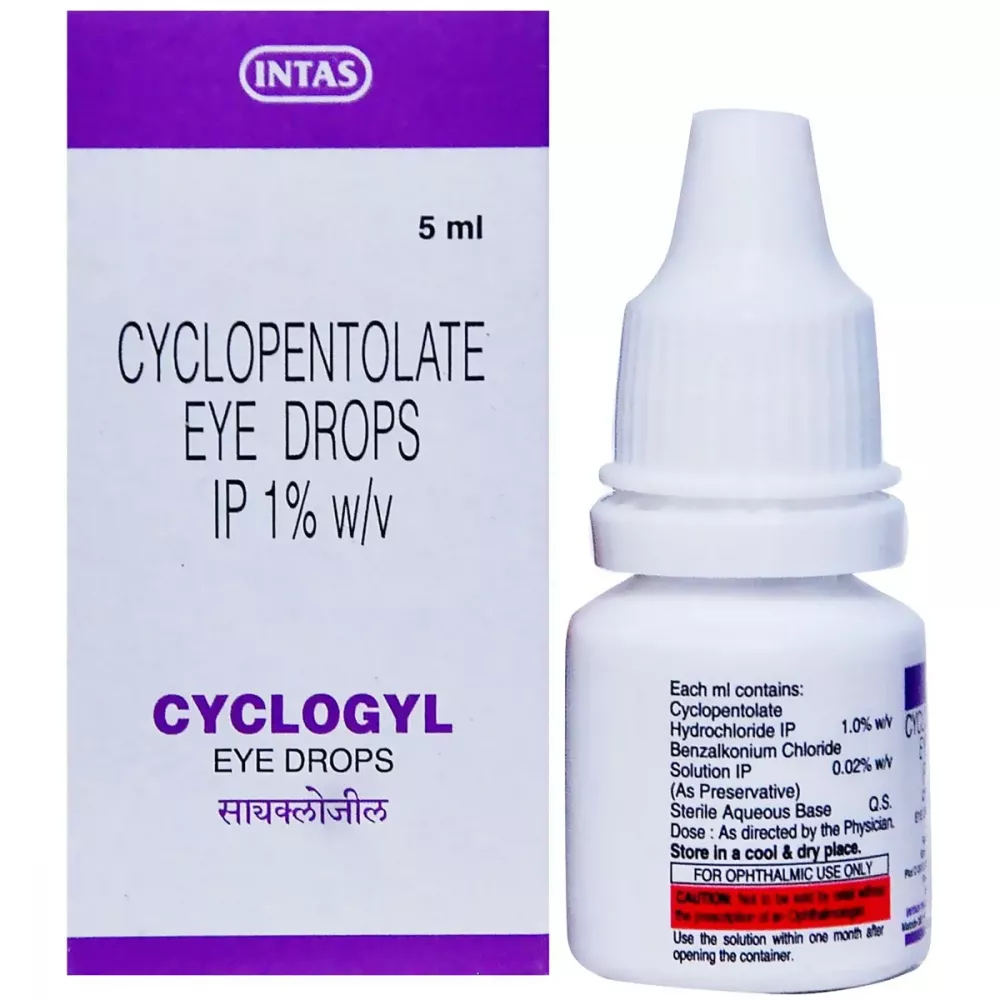
Cyclogyl (cyclopentolate 1%) — long-acting mydriatic for cycloplegic refraction (especially paediatric) and uveitis treatment. Anticholinergic toxicity caution under age 6.
✓ Medically reviewed by Morgan Ellis — Pharmacy Researcher · 8 years experience · Last reviewed: May 2026
⚡ Quick Answer — What is Cyclogyl Eye Drops?
Cyclogyl Eye Drops is Cyclopentolate HCl 1%, a mydriatic (pupil-dilating) eye drop used in eye exams, before cataract surgery, and to prevent posterior synechiae in uveitis. Effect lasts 4–8 hours (tropicamide) to 24+ hours (cyclopentolate). Driving and reading are difficult while the pupil is dilated.
📦 Every order is covered by our Reshipment Assurance Policy — if your parcel does not arrive within 20 business days, we reship it.
Why order from MedsBase
Cyclogyl Eye Drops is sourced from a WHO-GMP certified manufacturer and shipped worldwide in plain, discreet packaging. Every order is covered by our Reshipment Assurance Policy — if it has not arrived after 20 business days we reship at no extra cost. Backed by 1,400+ verified customer reviews.
What is Cyclogyl Eye Drops?
Cyclogyl Eye Drops is manufactured by Alcon and contains Cyclopentolate HCl 1% as a sterile ophthalmic solution. Cyclopentolate is a longer-acting anticholinergic with stronger cycloplegic effect (paralyses the ciliary muscle, blocking accommodation). Used for paediatric refraction and for uveitis treatment — duration 24+ hours.
How It Works
Cyclopentolate HCl blocks muscarinic M3 receptors on the iris sphincter and ciliary muscle. Sphincter blockade dilates the pupil; ciliary blockade paralyses accommodation (cycloplegia), making near vision impossible until the drug wears off.
Indications
- Dilated fundus examination — to see the optic nerve, macula, peripheral retina
- Cycloplegic refraction — particularly in children whose accommodation can hide a refractive error
- Pre-operative mydriasis for cataract surgery
- Uveitis / iritis treatment — prevents posterior synechiae (iris adherence to lens) and reduces ciliary spasm pain
- Diagnostic provocation — Adie’s tonic pupil, Horner’s syndrome differentiation
Dosing
| Indication | Dose |
|---|---|
| Paediatric cycloplegic refraction | 1–2 drops, refraction at 30–45 min |
| Uveitis | 1 drop 2–3 times daily until inflammation resolves |
Side Effects
Local: stinging, photophobia (dilated pupil lets in more light), blurred near vision (cycloplegia — cannot read for the duration), conjunctival hyperaemia.
Systemic (especially with cyclopentolate in children): drowsiness, hallucinations, behavioural changes, dry mouth, flushed skin, fever, tachycardia. Children < 6 are particularly susceptible to anticholinergic toxicity.
Warnings & Contraindications
- Narrow-angle glaucoma — absolute
- Anterior chamber shallow on examination — caution
- Children < 6 — cyclopentolate has caused CNS toxicity; tropicamide is preferred
- Premature infants — phenylephrine combinations contraindicated under specific gestational ages
- Severe cardiovascular disease (especially with phenylephrine combinations)
- Pregnancy / breastfeeding — discuss; topical absorption minimal but cycloplegics cross the placenta
Storage
Store at 15–25°C protected from light. Discard 28 days after first opening.
Frequently Asked Questions
How long does the dilation last?
Cyclopentolate lasts 24+ hours, especially in light-coloured eyes. Effects can last up to 48 hours in some patients.
Can I drive after dilation?
Avoid driving while your pupils are still dilated — bright lights cause uncomfortable glare and you cannot focus on near-distance objects (the speedometer may be blurred). Wait until vision returns to normal.
Why is everything bright after dilation?
A dilated pupil lets in 4–8× more light than a normal pupil. Sunglasses help. Photophobia resolves as the pupil constricts back to normal.
What is cycloplegia?
Paralysis of the ciliary muscle, blocking the eye’s ability to focus on near objects. Useful in paediatric refraction (so the child can’t ‘accommodate around’ a refractive error) and in uveitis (to rest the inflamed iris).
Why do I need to dilate for a fundus exam?
A small pupil hides most of the retina. Dilation reveals the optic nerve, macula, and peripheral retina — essential to detect retinal tears, diabetic retinopathy, age-related macular degeneration, and ocular tumours.
Can Cyclogyl Eye Drops cause an angle-closure attack?
Yes — mydriatics are a known precipitant in eyes with anatomically narrow angles. Symptoms include severe eye pain, blurred vision, halos, nausea. Same-day ophthalmology emergency.
Why is cyclopentolate avoided in young children?
Cyclopentolate has higher systemic absorption and can cause anticholinergic CNS effects — drowsiness, hallucinations, behavioural changes, fever — particularly in children < 6. Tropicamide is preferred in young children.
What if I'm pregnant?
Topical absorption is minimal but discuss with your prescriber. Routine eye exams that require dilation can usually proceed; cycloplegic refraction can often be deferred unless clinically urgent.
What if I'm a contact-lens wearer?
Remove lenses before instillation; reinsert after 10 minutes. The preservative can be absorbed by soft lenses.
What if dilation doesn't reverse?
If your pupil is still dilated 24 hours after tropicamide, contact your ophthalmologist. Atropine residue, mechanical pupil-margin damage, or pharmacologic mydriasis from another source may be at play.
Other Eye-Care Medications
Customers viewing this product also consider these alternatives in our Eye Care range:
- Tropicacyl (tropicamide)
- Tropicacyl Plus (trop+phenyl)
- Cyclogyl (cyclopentolate)
- Pilocar (pilocarpine — reverses dilation)
- Just Tears (artificial tears)
Medical Disclaimer
The information on this page is for educational purposes only and is not a substitute for medical advice from a qualified ophthalmologist or optometrist. Eye conditions can rapidly threaten sight — sudden vision loss, severe pain, or trauma is an ophthalmology emergency. Always consult an eye-care professional before starting, stopping, or changing any treatment.
More options in Eye Care
Ranked by recent MedsBase order volume — what other customers in this category are picking.
| Strength | 1%w/v 5ml |
|---|---|
| Quantity | 1 Bottle/s, 2 Bottle/s, 3 Bottle/s, 6 Bottle/s |
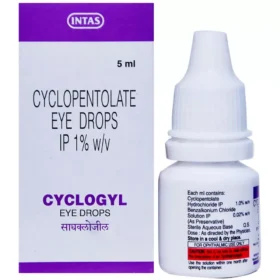 Cyclogyl Eye Drops
Q & A
Cyclogyl Eye Drops
Related products






Reviews
There are no reviews yet