








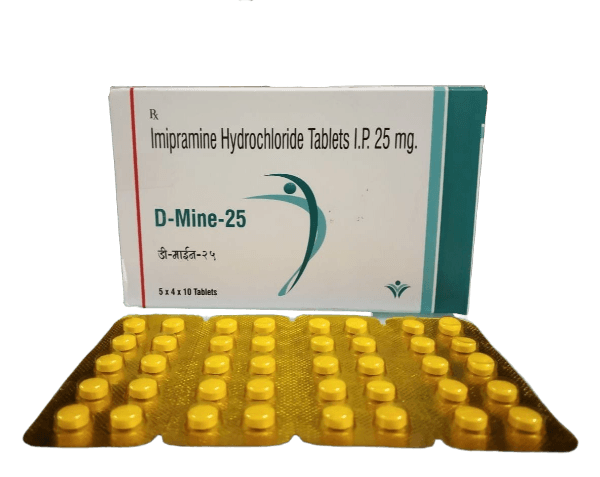
D-mine
✅ Alleviates depression symptoms
✅ Improves mood stability
✅ Reduces anxiety levels
✅ Enhances sleep quality
✅ Manages panic attacks
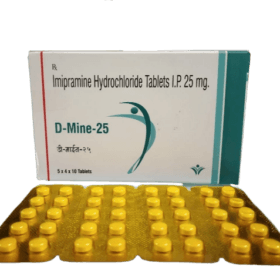
D-mine contains Imipramine.
✓ Medically reviewed by Morgan Ellis — Pharmacy Researcher · 8 years experience · Last reviewed: May 2026
⚡ Quick Answer — What is D-mine?
D-mine contains imipramine 25 mg from a WHO-GMP certified manufacturer (Sun Pharma) — the original tricyclic antidepressant, in continuous clinical use since 1959. Tertiary-amine TCA: serotonin and norepinephrine reuptake inhibition plus muscarinic, histamine H1, and alpha-1 antagonism (the source of side effects). Largely displaced by SSRIs for first-line depression but still used for: panic disorder (one of the most-evidenced TCAs for this), chronic neuropathic pain at low doses, and paediatric nocturnal enuresis (bedwetting) where it has FDA approval. Cardiac toxicity in overdose — baseline ECG before starting. Strong anticholinergic burden — not first-line in older adults.
📦 Every order is covered by our Reshipment Assurance Policy — if your parcel does not arrive within 20 business days, we reship it.
Why order from MedsBase
Our generic medications are sourced from WHO-GMP certified manufacturers and shipped worldwide in discreet, plain packaging — no medication name on the parcel exterior. Card payments are routed through a regulated processor (statement descriptors include a regulated card-payment processor — never “MedsBase” or any medication name). Crypto and SEPA bank transfer are also accepted. Every order is backed by our Reshipment Assurance Policy.
What Is D-mine?
D-mine is an oral tablet of imipramine hydrochloride 25 mg manufactured by Sun Pharma. Imipramine (US brand Tofranil) was synthesised in 1948 and identified as the first effective antidepressant in 1957 — the foundation of modern psychopharmacology. It is a tertiary-amine tricyclic antidepressant that inhibits serotonin and norepinephrine reuptake while also blocking muscarinic, histamine H1, and alpha-1 receptors. The serotonergic / noradrenergic actions drive efficacy; receptor blockade drives most of the side-effect burden.
Approved Indications
- Major depressive disorder — second- or third-line after SSRIs / SNRIs
- Panic disorder — one of the most-evidenced TCAs; effective but better tolerated alternatives exist
- Childhood nocturnal enuresis (bedwetting) — FDA-approved for ages 6+ when behavioural therapy and desmopressin have failed
- Off-label: chronic neuropathic pain, fibromyalgia, post-herpetic neuralgia, chronic low back pain
Dosing
| Indication | Start | Target | Notes |
|---|---|---|---|
| MDD (adult outpatient) | 25–75 mg/day at bedtime | 100–200 mg/day | Maximum 200 mg/day outpatient; up to 300 mg/day inpatient; titrate over 2–4 weeks |
| MDD (elderly) | 10–25 mg at bedtime | 25–100 mg/day | Lower target; greater anticholinergic and orthostatic risk |
| Panic disorder | 10–25 mg at bedtime × 1 week | 75–200 mg/day | Slow up-titration to avoid early panic exacerbation |
| Childhood enuresis (age 6–12) | 25 mg one hour before bedtime | 25–50 mg one hour before bedtime | Maximum 2.5 mg/kg/day; reassess after 3 months — relapse common on stopping |
| Childhood enuresis (age 12+) | 25 mg one hour before bedtime | 25–75 mg one hour before bedtime | Maximum 75 mg/day; same reassessment |
Side Effects (Anticholinergic Burden Is the Main Issue)
Side-effect profile by mechanism
| Mechanism | Effects | Notes |
|---|---|---|
| Anticholinergic (muscarinic blockade) | Dry mouth, constipation, urinary retention, blurred vision, cognitive impairment | Heavy — not first-line in older adults; caution with BPH, glaucoma, dementia |
| H1 blockade | Sedation, weight gain | Useful when insomnia is part of the depression; less useful daytime |
| Alpha-1 blockade | Orthostatic hypotension, dizziness, falls | Particularly problematic in older adults; check lying / standing BP |
| Cardiac (sodium-channel blockade) | QT and QRS prolongation, AV block | Baseline ECG before starting in patients > 50 or with cardiac history; deadly in overdose — do not provide bulk supplies to acute suicide-risk patients |
| Serotonergic / noradrenergic | Sweating, tremor, sexual dysfunction | Generally manageable |
| Other | Lowered seizure threshold, paradoxical mania (in unrecognised bipolar) | Caution in epilepsy, screen for bipolar before starting |
Drug Interactions
Absolute contraindications: MAOIs (14-day washout), recent myocardial infarction, severe uncontrolled cardiac disease.
Cardiac risk: avoid concurrent QT-prolonging drugs (citalopram > 20 mg, quetiapine, ziprasidone, ondansetron, methadone, fluoroquinolones).
CYP2D6 substrate: plasma levels rise with strong inhibitors (paroxetine, fluoxetine, bupropion, quinidine). Use lower doses.
Anticholinergic potentiation: combine cautiously with other anticholinergics (diphenhydramine, scopolamine, trihexyphenidyl, oxybutynin).
Sedation / orthostasis: alcohol, benzodiazepines, opioids, alpha-blockers.
Cardiac Safety and Overdose Risk
TCAs are among the most lethal drugs in overdose because of cardiac sodium-channel blockade, which produces wide-complex tachycardia, ventricular arrhythmias, and cardiogenic shock at doses 5–10x therapeutic. Baseline ECG is standard practice before starting in patients over 50 or with cardiac risk factors. Provide only 1–2 weeks of medication at a time to patients at meaningful suicide risk — a 30-day supply of imipramine 25 mg is potentially lethal.
Frequently Asked Questions
How long does D-mine take to work?
Mood response in MDD typically appears at 4–6 weeks. Panic disorder response at 4–8 weeks. Enuresis response in children is usually seen within 1–2 weeks of an effective dose.
Is D-mine safer than amitriptyline?
Imipramine and amitriptyline have similar profiles. Nortriptyline (Primox on this site) and desipramine (secondary-amine TCAs) are usually better tolerated — less anticholinergic and less sedating — if a tricyclic is needed.
Can children safely take D-mine for bedwetting?
Yes — imipramine has been used for paediatric nocturnal enuresis since the 1960s with FDA approval. Always third-line after behavioural / alarm therapy and desmopressin. Cardiac risk is low at standard enuresis doses but ECG should be checked if dose exceeds 75 mg/day or if there is a family history of arrhythmia / sudden death.
Why are TCAs no longer first-line for depression?
Side-effect burden (anticholinergic, sedation, orthostasis) and overdose lethality have shifted first-line treatment to SSRIs and SNRIs since the late 1980s. TCAs remain useful for refractory depression, neuropathic pain, and panic.
Will D-mine cause weight gain?
Yes — TCAs cause significant weight gain (5–10 kg or more over months) through H1 appetite stimulation. This is one of the main reasons patients switch to SSRIs.
Can I drink alcohol on D-mine?
Avoid heavy alcohol — additive sedation, orthostasis, and lowered seizure threshold. Light occasional alcohol is generally tolerated but caution is warranted.
What happens if I miss a dose?
Take it as soon as you remember unless close to the next dose. Imipramine has a long half-life so missing one dose rarely causes withdrawal.
Is D-mine safe in pregnancy?
Limited data — not first-line in pregnancy. SSRIs (sertraline preferred) have a far larger safety database. Late third-trimester exposure has been associated with neonatal withdrawal symptoms.
Can D-mine be combined with other antidepressants?
Sometimes — low-dose TCAs are added to SSRIs in treatment-resistant depression but only under prescriber direction. Combining with MAOIs is contraindicated.
How should D-mine be stored?
Store at 15–30 °C in the original blister packaging away from moisture and sunlight. Keep strictly out of reach of children — TCA overdose is rapidly lethal.
Related Alternatives
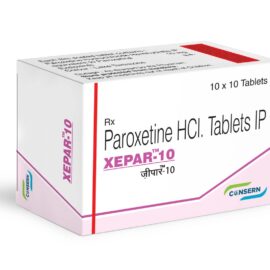
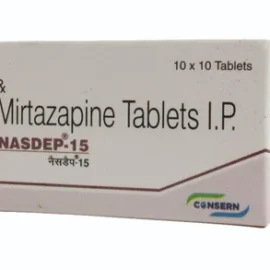
Other products in Chronic Conditions that customers also view:
More options in Situational Anxiety Treatment
Ranked by recent MedsBase order volume — what other customers in this category are picking.


| Strength | 25 mg |
|---|---|
| Quantity | 30 Tablet/s, 60 Tablet/s, 90 Tablet/s, 180 Tablet/s |
 D-mine
Q & A
D-mine
Related products



Reviews
There are no reviews yet