







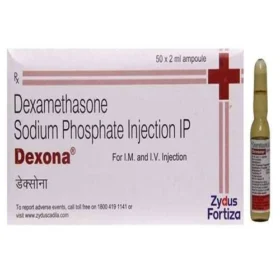
Dexona Injection
✅ Rapid relief from inflammation
✅ Effective pain management
✅ Treats severe allergies
✅ Manages autoimmune disorders
✅ Resolves respiratory issues
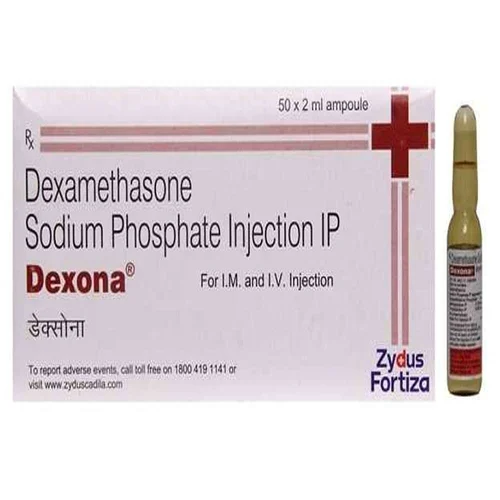
Dexona Injection contains Dexamethasone.
✓ Medically reviewed by Morgan Ellis — Pharmacy Researcher · 8 years experience · Last reviewed: May 2026
⚡ Quick Answer — What is Dexona Injection?
Dexona Injection is a dexamethasone sodium phosphate 4 mg/mL solution supplied in 2 mL ampoules (8 mg total), for intramuscular or intravenous use. It is the parenteral long-acting glucocorticoid of choice when IV or IM administration is required and when mineralocorticoid (salt-retaining) activity is not wanted — cerebral oedema, anti-emetic cover during chemotherapy, acute severe asthma, acute allergic reactions, and antenatal fetal lung maturation. Typical adult dose is 4–8 mg IM/IV, repeated based on the clinical setting.
📦 Every order is covered by our Reshipment Assurance Policy — if your parcel does not arrive within 20 business days, we reship it.
Why order from MedsBase
Our generic medications are sourced from WHO-GMP certified manufacturers and shipped worldwide in discreet, plain packaging — no medication name on the parcel exterior. Card payments are routed through a regulated processor (statement descriptors include a regulated card-payment processor — never “MedsBase” or any medication name). Crypto and SEPA bank transfer are also accepted. Every order is backed by our Reshipment Assurance Policy.
Dexona Injection 4 mg/mL (2 mL ampoule) is a sterile solution of dexamethasone sodium phosphate, the water-soluble salt of dexamethasone that permits rapid intravenous or intramuscular administration. Each 2 mL ampoule contains 8 mg of dexamethasone — a standard adult single dose for most acute indications.
The injection is preferred over oral dexamethasone when:
- Rapid systemic effect is required (acute allergic reactions, cerebral oedema, severe asthma)
- The patient cannot swallow (post-operative, post-stroke, vomiting, altered consciousness)
- Reliable bioavailability is essential (GI disease, vomiting, malabsorption)
- A depot IM effect is desired (antenatal lung maturation)
What Is Dexona Injection Used For?
- Cerebral oedema from brain tumours — loading IV dose, then switch to oral
- Anti-emetic cover for chemotherapy — 8–12 mg IV before highly emetogenic regimens
- Acute severe asthma or COPD exacerbation — 8 mg IV/IM single dose
- Acute allergic reactions, anaphylaxis — adjunct to adrenaline
- Antenatal fetal lung maturation — 6 mg IM q12h x 4 doses (2 days), between 24 and 34 weeks gestation
- Bacterial meningitis — as adjunct, 0.15 mg/kg IV q6h for 2–4 days
- Croup in children — single IM 0.6 mg/kg dose if oral route not tolerated
- Acute exacerbations of autoimmune disease — bridge therapy before oral steroids
- Spinal cord compression from malignancy — high-dose IV
- Haematological malignancy — chemotherapy components
Dexona Injection Dosing
- General acute adult dose: 4–8 mg IV/IM every 6–12 hours, adjusted to response
- Cerebral oedema: 10 mg IV loading, then 4 mg every 6 hours; step down to oral after 3–5 days
- Chemotherapy anti-emetic: 8–12 mg IV before treatment, continued as oral for 2–4 days
- Antenatal lung maturation: 6 mg IM every 12 hours for 4 doses
- Croup (IM): 0.6 mg/kg single dose
- Spinal cord compression: 16 mg IV loading, then 4 mg every 6 hours, with urgent radiation/surgery planning
IV administration: slow push over 1–2 minutes for doses up to 8 mg; dilute larger doses for infusion. IM administration: deep muscle injection, rotate sites. The solution can also be mixed with lidocaine for joint and soft-tissue injection by specialists.
Corticosteroid Potency and Equivalence
Different corticosteroids differ mainly in potency, duration of action, and mineralocorticoid (salt-retaining) activity. The table below gives the clinically useful equivalence — it lets you translate a dose of one steroid into the equivalent dose of another.
| Corticosteroid | Glucocorticoid potency | Equivalent dose | Mineralocorticoid | Duration |
|---|---|---|---|---|
| Hydrocortisone | 1 (reference) | 20 mg | Substantial | 8–12 h |
| Prednisolone | 4 | 5 mg | Low | 12–36 h |
| Methylprednisolone | 5 | 4 mg | Minimal | 12–36 h |
| Dexamethasone | 25–30 | 0.75 mg | None | 36–54 h |
| Betamethasone | 25–30 | 0.75 mg | None | 36–54 h |
Who Should Not Take Dexona Injection?
- Systemic fungal infection (other than as replacement therapy in adrenal insufficiency)
- Live vaccines during immunosuppressive doses (see specialist before BCG, MMR, yellow fever, varicella, oral typhoid)
- Active untreated bacterial infection (start antibiotics first)
- Active tuberculosis without anti-TB cover
- Known hypersensitivity to the active molecule or any excipient
- Use with caution in: diabetes mellitus, congestive heart failure, hypertension, osteoporosis, peptic ulcer, psychiatric disorders, glaucoma, herpes simplex ophthalmicus
- Pregnancy: use only if clearly needed — prednisolone and hydrocortisone cross the placenta less than dexamethasone/betamethasone, which are preferred when a fetal effect is intended (e.g. lung maturation)
Side Effects of Corticosteroids
Corticosteroid side effects are dose- and duration-dependent. Short courses (< 2 weeks) at moderate doses are usually well tolerated. Longer or higher-dose therapy produces the classic “Cushingoid” profile.
Short-term (first 1–2 weeks):
- Insomnia, anxiety, euphoria, irritability — particularly at doses > 20 mg prednisolone-equivalent
- Increased appetite, weight gain
- Raised blood glucose (especially in diabetes)
- Fluid retention, mild ankle swelling
- Heartburn, dyspepsia
- Hypertension — especially with higher mineralocorticoid activity (hydrocortisone, fludrocortisone)
Longer-term (weeks to months):
- Osteoporosis and vertebral fractures
- Muscle wasting and proximal myopathy
- Skin thinning, easy bruising, striae, impaired wound healing
- Cushingoid appearance — moon face, central obesity, buffalo hump
- Cataracts, glaucoma
- Infection susceptibility (bacterial, viral, fungal, parasitic)
- Avascular necrosis of the femoral head
- HPA-axis suppression — risk of adrenal crisis on abrupt withdrawal
- Psychiatric effects — depression, mania, psychosis
- Peptic ulcer, especially when combined with NSAIDs
Rare but serious: steroid psychosis, pancreatitis, posterior subcapsular cataract, severe osteonecrosis.
Never stop corticosteroids abruptly after a prolonged course. Any course longer than 2–3 weeks, or any dose above a physiological replacement level (approximately 7.5 mg prednisolone or 40 mg hydrocortisone per day) suppresses the hypothalamic-pituitary-adrenal axis. Stopping suddenly can trigger a life-threatening adrenal crisis — nausea, vomiting, low blood pressure, shock. Courses longer than 3 weeks must be tapered down, typically over 1–4 weeks depending on duration and dose. Carry a steroid warning card during prolonged treatment and inform any doctor, dentist, or surgeon you see about your steroid use.
Ordering & Delivery
MedsBase offers worldwide shipping on every order. Orders are dispatched in discreet packaging and arrive in branded manufacturer packs. If your preferred pack size is out of stock, contact customer support for an ETA.
Medical disclaimer. The information on this page is provided for general education only. It is not a substitute for advice from your own doctor or pharmacist. Talk to a qualified healthcare professional before starting, stopping, or changing therapy.
Frequently Asked Questions
What is Dexona Injection used for?
Dexona Injection (dexamethasone sodium phosphate 4 mg/mL, 2 mL ampoule) is used in hospital and clinic settings for cerebral oedema, chemotherapy anti-emetic cover, acute severe asthma, acute allergic reactions, antenatal fetal lung maturation, bacterial meningitis adjunct, croup, spinal cord compression, and acute autoimmune flares.
How is Dexona Injection different from hydrocortisone injection?
Dexamethasone is 25–30 times more potent per milligram than hydrocortisone, has no mineralocorticoid (salt-retaining) activity, and lasts 36–54 hours. Hydrocortisone has significant mineralocorticoid activity and a short half-life. For cerebral oedema and anti-emetic cover, dexamethasone is preferred. For adrenal crisis, hydrocortisone is preferred.
How fast does IV dexamethasone work?
Genomic anti-inflammatory effects begin within 1–2 hours; non-genomic (membrane-mediated) effects within minutes. Onset on cerebral oedema and chemotherapy-induced nausea is within 2–4 hours.
Can the injection be given IM?
Yes. IM gives a slightly slower onset than IV but has a depot effect suitable for 12-hourly dosing. The antenatal lung-maturation regimen uses IM dexamethasone 6 mg every 12 hours.
Can Dexona Injection be given into a joint?
Dexamethasone sodium phosphate can be used for intra-articular injection by specialists, often mixed with a local anaesthetic. Depot corticosteroids (methylprednisolone acetate, triamcinolone) are more commonly used for joint injections because of their longer local action.
Is Dexona Injection the same as the steroid used in severe COVID-19?
Yes — dexamethasone 6 mg (either IV or oral) once daily for up to 10 days is the standard care in severe COVID-19, based on the RECOVERY trial.
Can the injection be given at home?
No. Parenteral dexamethasone should be administered by a qualified healthcare professional in a healthcare setting.
Is Dexona Injection safe in pregnancy?
For maternal disease, prednisolone is usually preferred because it crosses the placenta less. Dexamethasone IM is deliberately used for fetal lung maturation when preterm delivery is threatened.
Can Dexona Injection be used in children?
Yes — particularly in severe croup (single IM dose of 0.6 mg/kg), bacterial meningitis, and paediatric chemotherapy. Dosing is weight-based.
Will the injection raise my blood sugar?
Yes. Dexamethasone raises blood glucose — diabetic patients need closer monitoring and may need insulin dose adjustment during a course of therapy.
Can I take oral dexamethasone after the injection?
Yes — a common pattern is IV/IM loading in hospital followed by oral dexamethasone or prednisolone step-down. The oral dose is matched to the IV dose using the potency equivalence table.
Related Alternatives
Other products in Chronic Conditions that customers also view:
More options in Pain Relief Medication
Ranked by recent MedsBase order volume — what other customers in this category are picking.
| Strength | 2 ml |
|---|---|
| Quantity | 10 Ampoule/s, 20 Ampoule/s, 30 Ampoule/s, 60 Ampoule/s |
 Dexona Injection
Q & A
Dexona Injection
Related products



Reviews
There are no reviews yet