







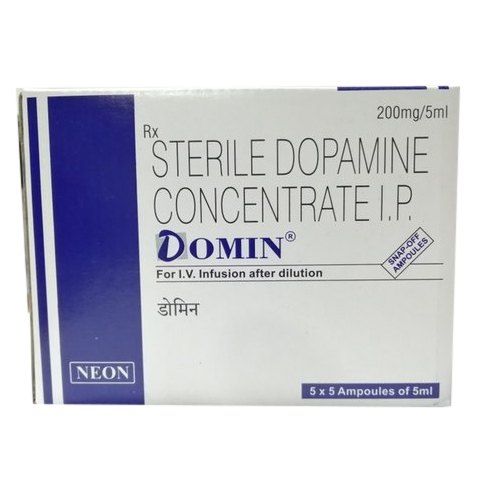
Domin Injection
✅ Improves blood circulation
✅ Enhances kidney function
✅ Manages shock
✅ Treats low blood pressure
✅ Regulates heart rate
Domin Injection contains Dopamine.
✓ Medically reviewed by Morgan Ellis — Pharmacy Researcher · 8 years experience · Last reviewed: May 2026
⚡ Quick Answer — What is Domin Injection?
Domin Injection is a sterile concentrate of dopamine hydrochloride 40 mg/mL (5 mL ampoule = 200 mg) used for intravenous infusion in critical-care settings. It is a vasopressor and positive inotrope indicated for the short-term haemodynamic support of shock (septic, cardiogenic, hypovolaemic after volume replacement), acute heart failure with hypotension, and symptomatic bradycardia. It must be diluted and given by continuous IV infusion with cardiac and blood-pressure monitoring, ideally through a central venous line. This is a hospital-use medicine — it is not suitable for self-administration or for outpatient use.
📦 Every order is covered by our Reshipment Assurance Policy — if your parcel does not arrive within 20 business days, we reship it.
Why order from MedsBase
Our generic medications are sourced from WHO-GMP certified manufacturers and shipped worldwide in discreet, plain packaging — no medication name on the parcel exterior. Card payments are routed through a regulated processor (statement descriptors include a regulated card-payment processor — never “MedsBase” or any medication name). Crypto and SEPA bank transfer are also accepted. Every order is backed by our Reshipment Assurance Policy.
Domin Injection 40 mg/mL (5 mL ampoule) is a sterile concentrated solution of dopamine hydrochloride. Each 5 mL ampoule contains 200 mg of dopamine and is intended for dilution and continuous intravenous infusion in hospital settings. Dopamine is on the WHO Essential Medicines List.
Dopamine is an endogenous catecholamine — the direct metabolic precursor of noradrenaline and a neurotransmitter in its own right. When given by IV infusion in pharmacological doses, it is a dose-dependent vasopressor and cardiac stimulant, with effects that change with infusion rate:
- Low dose (1–5 mcg/kg/min — “renal dose”): dopaminergic receptors; traditionally thought to increase renal perfusion, though modern evidence does not support routine “renal-dose” use for oliguria
- Moderate dose (5–10 mcg/kg/min): beta-1 adrenergic effects — increased cardiac contractility, stroke volume, and cardiac output
- High dose (> 10 mcg/kg/min): alpha-1 adrenergic effects — peripheral vasoconstriction and rise in systemic vascular resistance
Hospital use only. Domin Injection is a critical-care medicine. It must be administered by a qualified clinician in a hospital, intensive-care unit, or emergency department with continuous cardiac monitoring and prepared emergency equipment. It is not suitable for self-administration, outpatient use, or home use under any circumstances.
What Is Domin Injection Used For?
- Septic shock — when fluid resuscitation alone is not enough to restore blood pressure (noradrenaline is first-line in most modern guidelines, but dopamine remains a recognised alternative)
- Cardiogenic shock — particularly when heart rate is slow and inotropic support is required
- Acute heart failure with hypotension — low cardiac output with poor tissue perfusion
- Symptomatic bradycardia — when atropine and transcutaneous pacing are not available or are insufficient
- Post-cardiac-surgery low cardiac output
- Distributive shock after initial fluid resuscitation
- Severe anaphylaxis with refractory hypotension (as second-line after adrenaline and fluids)
Modern sepsis guidelines (Surviving Sepsis 2021) list noradrenaline as first-line vasopressor, with dopamine reserved as an alternative in selected patients (e.g. those with bradycardia and no arrhythmia risk). Use of dopamine for renal protection (“renal-dose dopamine”) is not supported by current evidence and is no longer recommended as routine.
How Does Dopamine Work?
Dopamine acts on three main receptor systems in a dose-dependent pattern:
- Dopamine receptors (D1, D2): renal, mesenteric, coronary vasodilation at low doses
- Beta-1 adrenergic receptors: myocardial contractility and heart rate at mid doses; increases cardiac output
- Alpha-1 adrenergic receptors: peripheral arterial vasoconstriction at high doses; raises mean arterial pressure
In practice, most patients receive dopamine in the mid-to-high dose range (5–20 mcg/kg/min), where beta and alpha effects overlap. Pure “renal-dose” infusions are no longer recommended for kidney protection.
Domin Injection Dosing and Administration
- Dilution: one 200 mg ampoule in 250 mL of 0.9% sodium chloride or 5% dextrose gives a concentration of 800 mcg/mL. Higher concentrations (1,600 mcg/mL) are used when fluid restriction is needed.
- Route: continuous IV infusion only. Central venous access is strongly preferred — peripheral extravasation can cause tissue necrosis and digital ischaemia.
- Starting rate: 2–5 mcg/kg/min; titrate upward in 2–5 mcg/kg/min steps every 10–30 minutes based on blood pressure, heart rate, urine output, and signs of tissue perfusion.
- Usual effective range: 5–20 mcg/kg/min; doses above 20 mcg/kg/min rarely add benefit and are associated with tachyarrhythmias and worsened outcome.
- Monitoring: continuous ECG, invasive arterial BP, central venous pressure or equivalent, urine output, serum lactate, and clinical signs of perfusion.
- Weaning: taper gradually (reduce rate by 25–50% every 10–30 minutes based on haemodynamic response). Abrupt discontinuation can cause hypotension.
Extravasation is an emergency. If dopamine leaks out of the infusion site into surrounding tissue, it causes severe local vasoconstriction and can lead to skin necrosis. Stop the infusion immediately, do not remove the cannula before specialist advice, and infiltrate the area with phentolamine (5–10 mg diluted in 10–15 mL normal saline) as soon as possible.
Who Should Not Receive Domin Injection?
- Known hypersensitivity to dopamine
- Phaeochromocytoma — unopposed alpha stimulation causes hypertensive crisis
- Uncorrected tachyarrhythmias — dopamine is pro-arrhythmic
- Ventricular fibrillation
- Uncorrected hypovolaemia — volume resuscitation must come first; using a vasopressor on an empty tank is harmful
- Use with extreme caution in: recent myocardial infarction, ischaemic heart disease, peripheral vascular disease, Buerger’s disease
- Concurrent MAOI use — greatly amplifies pressor effect (reduce dopamine dose to one-tenth)
- Concurrent phenytoin — may cause hypotension and bradycardia
Side Effects
- Common: tachycardia, ectopic beats, hypertension at high doses, nausea and vomiting
- Frequent at high doses: ventricular and supraventricular arrhythmias, angina, hypertension
- Locally: infusion-site pain, phlebitis, tissue necrosis if extravasated
- Other: peripheral vasoconstriction with cold extremities and digital ischaemia, worsening of myocardial ischaemia, suppression of thyroid-stimulating hormone, immunosuppressive effect (relevant in ICU)
Drug Interactions
- MAOIs: extreme caution — use one-tenth of the usual starting dose
- Phenytoin: may cause severe hypotension and bradycardia
- Other vasopressors (noradrenaline, adrenaline, vasopressin): additive cardiac and vascular effects; often combined in ICU
- Beta-blockers: may blunt the inotropic response
- Alpha-blockers: blunt the pressor response
- Tricyclic antidepressants, cocaine, ergot alkaloids: amplify pressor effect
- Inhalational anaesthetics (halothane, cyclopropane): may sensitise the myocardium to dopamine-induced arrhythmias
Ordering & Delivery
MedsBase offers worldwide shipping on every order. Orders are dispatched in discreet packaging and arrive in branded manufacturer packs. If your preferred strength or pack size is out of stock, contact customer support for an ETA.
Medical disclaimer. The information on this page is provided for general education only. It is not a substitute for advice from your own doctor or pharmacist. Talk to a qualified healthcare professional before starting, stopping, or changing therapy.
Frequently Asked Questions
What is Domin Injection used for?
Domin Injection (dopamine HCl 40 mg/mL) is used in critical-care settings for haemodynamic support in shock (septic, cardiogenic, distributive), acute heart failure with hypotension, and symptomatic bradycardia. It is a hospital medicine given by continuous IV infusion with cardiac monitoring.
Is Domin Injection a blood-pressure medicine?
It raises blood pressure, so in a literal sense yes — but it is used only in emergency and intensive-care settings for patients who are in shock or have dangerously low blood pressure. It is not a medication for chronic high blood pressure (hypertension); in that context it would be the wrong class and potentially dangerous.
Can Domin Injection be given at home?
No. Dopamine is a critical-care medicine that requires continuous IV infusion, cardiac and arterial pressure monitoring, and immediate access to emergency equipment. It is given in hospitals, ICUs, and emergency departments by qualified clinicians — not at home, not in outpatient settings, not by a patient.
Why is dopamine given by continuous infusion rather than a single injection?
Dopamine has a half-life of only 2 minutes in circulation. A single bolus would have an effect lasting a minute or two at most. To maintain steady haemodynamic support, it must be given by continuous infusion at a controlled rate, titrated against blood pressure and clinical response minute to minute.
Is dopamine the same as noradrenaline?
Both are vasopressors used in shock, but they differ. Dopamine has dopaminergic, beta, and alpha effects depending on dose. Noradrenaline is almost purely an alpha-adrenergic vasopressor with some beta-1 effect. Modern sepsis guidelines (Surviving Sepsis 2021) recommend noradrenaline as first-line; dopamine is an alternative in selected patients, particularly those with bradycardia.
Does dopamine protect the kidneys?
Not reliably. “Renal-dose dopamine” (1–3 mcg/kg/min) was historically used for kidney protection or to treat oliguria. Randomised trials and meta-analyses have not shown clinically meaningful benefit on renal function or on mortality, and current guidelines recommend against routine use for this indication.
What is extravasation and why is it an emergency?
Extravasation is when the IV fluid leaks into surrounding tissue rather than the vein. With dopamine, the intense local vasoconstriction can cause tissue necrosis, skin breakdown, and (at severe end) digital ischaemia. If it occurs, the infusion must be stopped immediately and phentolamine (an alpha-blocker) injected into the affected area as soon as possible.
Can dopamine cause arrhythmias?
Yes — particularly at higher doses (> 10 mcg/kg/min). Tachycardia, ectopic beats, atrial fibrillation, and ventricular tachycardia all occur. Continuous cardiac monitoring during dopamine therapy is standard.
How is the dose calculated?
Dopamine is dosed in micrograms per kilogram of body weight per minute (mcg/kg/min). Starting rate is typically 2–5 mcg/kg/min, titrated upward based on blood pressure and perfusion. The prescribing team calculates the infusion pump rate from the patient’s weight and the ampoule concentration.
Can Domin Injection be given into a muscle?
No — dopamine is for continuous IV infusion only. It cannot be given intramuscularly or subcutaneously.
Is Domin Injection used in children?
Yes, at weight-based doses. Paediatric dopamine is used in neonatal and paediatric intensive care for shock and low cardiac output states, under specialist supervision.
Related Alternatives
Other products in Chronic Conditions that customers also view:
- Budecort Inhaler
- Neurobion Forte RF Injection (Methylcobalamin + B6 + B3) — Nerve Repair
- Pirox Gel
- Xepar
- Topicon
More options in Heart & Blood Pressure
Ranked by recent MedsBase order volume — what other customers in this category are picking.
| Strength | 40 mg/ml (5ml) |
|---|---|
| Quantity | 5 Ampoule/s, 10 Ampoule/s, 15 Ampoule/s, 30 Ampoule/s, 60 Ampoule/s |
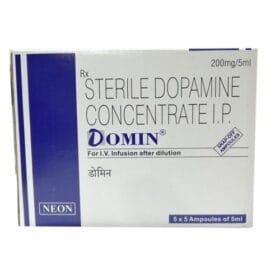 Domin Injection
Q & A
Domin Injection
Related products

Reviews
There are no reviews yet