







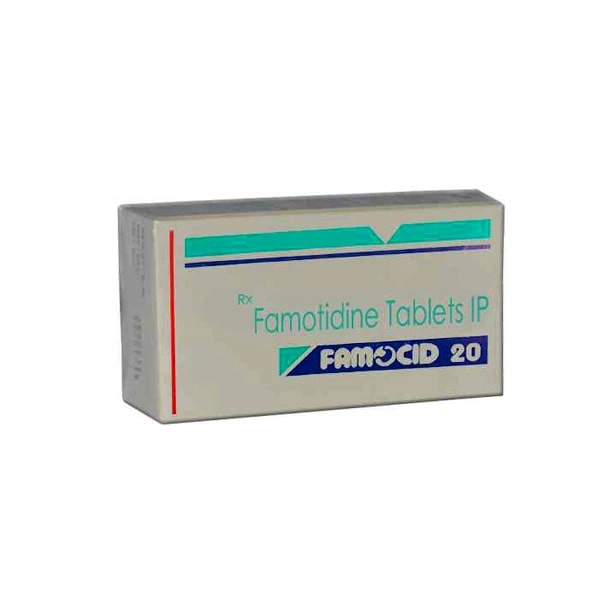
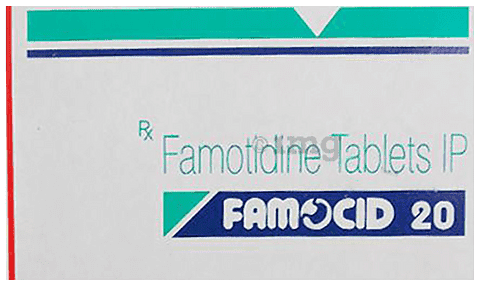
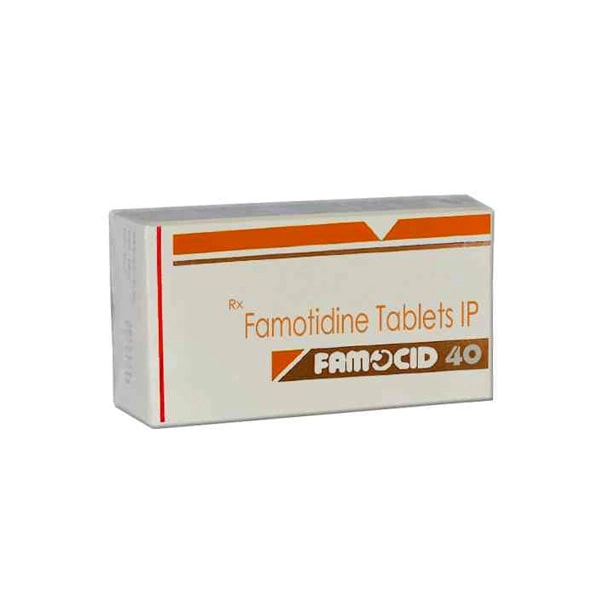
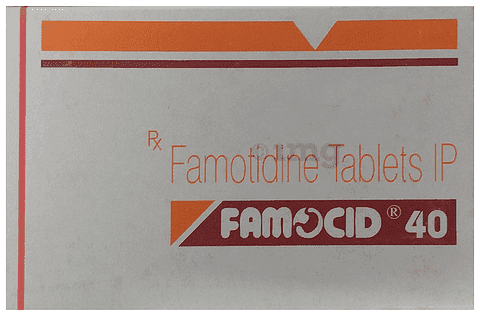
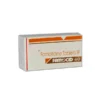
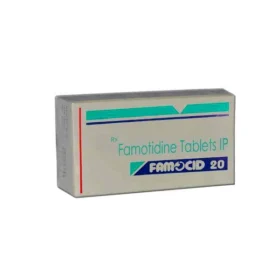
Famocid
✅ Reduces Excess Stomach Acid
✅ Alleviates Acid-Related Symptoms
✅ Treats Stomach Ulcers Effectively
✅ Manages GERD Effectively
Famocid contains Famotidine
✓ Medically reviewed by Morgan Ellis — Pharmacy Researcher · 8 years experience · Last reviewed: May 2026
⚡ Quick Answer — What is Famocid?
Famocid is famotidine 20 mg or 40 mg tablets by Sun Pharma from a WHO-GMP certified manufacturer. Famotidine is a histamine H2 receptor antagonist — it blocks the histamine signal that drives stomach acid secretion. Standard adult dose: 20 mg twice daily, or 40 mg once at bedtime, for up to 8 weeks. Onset is faster than a PPI (about 30 minutes), but the maximum acid-suppression effect is smaller. Famotidine is the modern safe substitute for ranitidine — ranitidine was withdrawn globally in 2020 over NDMA contamination, and famotidine is the H2 antagonist that all major regulators recommend in its place. Useful for breakthrough symptoms on a PPI, on-demand mild GERD, NSAID ulcer prophylaxis, and night-time acid breakthrough. Tachyphylaxis (loss of effect) develops after 7–14 days of continuous daily use — this is why famotidine is best used on-demand or for short courses, with PPIs as the first choice for chronic disease.
📦 Every order is covered by our Reshipment Assurance Policy — if your parcel does not arrive within 20 business days, we reship it.
Why order from MedsBase
Our generic medications are sourced from WHO-GMP certified manufacturers and shipped worldwide in discreet, plain packaging — no medication name on the parcel exterior. Card payments are routed through a regulated processor (statement descriptors include a regulated card-payment processor — never “MedsBase” or any medication name). Crypto and SEPA bank transfer are also accepted. Every order is backed by our Reshipment Assurance Policy.
What Famocid Is
Famocid is the Sun Pharma brand of famotidine, a third-generation H2-receptor antagonist. Each tablet contains either 20 mg or 40 mg of famotidine. Famotidine is the safest and most widely used H2 antagonist on the modern market — particularly since ranitidine (Aciloc, Rantac) was withdrawn from most major markets in 2020 over the discovery of N-nitrosodimethylamine (NDMA, a probable human carcinogen) contamination. The other H2 antagonist still available in some markets is cimetidine, but cimetidine has a much heavier drug-interaction burden than famotidine and is rarely used today.
How Famocid Works (Mechanism)
Stomach acid secretion is controlled by three signals reaching the parietal cell: acetylcholine (vagal nerve), gastrin (G-cells in the antrum), and histamine (enterochromaffin-like cells). The histamine signal is the dominant one, and it acts through H2 receptors on the parietal-cell basolateral membrane. Famotidine is a competitive, reversible antagonist at this H2 receptor. By blocking histamine, it shuts down the most powerful single driver of acid secretion. Effect onset is about 30 minutes after oral dosing, peak at 1–3 hours, and duration roughly 10–12 hours — long enough that twice-daily or once-at-bedtime dosing covers most patients.
This is a different mechanism from proton-pump inhibitors. PPIs work downstream — they block the proton pump itself, the final common pathway. PPIs give deeper, longer acid suppression but take 3–5 days to reach full effect. H2 antagonists give shallower acid suppression but work within an hour, and they preserve the partial-secretion response to vagal stimulation. The two classes can be combined — PPI in the morning, famotidine at bedtime — for night-time acid breakthrough, a strategy that has reasonable evidence in refractory GERD.
Indications — What Famocid Treats
1. Mild-to-moderate GERD — on-demand or short-term
For occasional or mild reflux symptoms, an H2 antagonist taken on demand often gives sufficient relief without the commitment of a chronic PPI. Onset within an hour, useful for symptoms after a known trigger meal.
2. Breakthrough symptoms on a PPI — particularly nocturnal
Some patients on adequate PPI therapy still experience night-time acid breakthrough. Adding famotidine 20–40 mg at bedtime improves nocturnal pH control. Tachyphylaxis means this strategy is best reserved for as-needed use.
3. Peptic ulcer disease
Famotidine heals duodenal and gastric ulcers, although PPIs are more effective. Useful where PPI is poorly tolerated or contraindicated. Healing duration is 4–6 weeks for duodenal ulcer, 6–8 weeks for gastric ulcer.
4. NSAID-associated ulcer prophylaxis
For lower-risk patients on chronic NSAID therapy, double-dose famotidine (40 mg twice daily) is an alternative to PPI for ulcer prevention. PPI remains preferred for higher-risk patients.
5. Stress-ulcer prophylaxis (where PPI is not preferred)
Some recent ICU practice has shifted back toward H2 antagonists for stress-ulcer prophylaxis because of concerns about PPI-related C. difficile infection and ventilator-associated pneumonia.
6. Zollinger-Ellison syndrome (high-dose adjunct)
Used in addition to high-dose PPI in selected hypersecretory states.
7. Aspiration prophylaxis before surgery
A 40 mg dose the night before and 2 hours before induction reduces gastric volume and acidity (Mendelson syndrome prophylaxis).
Dosing
| Indication / patient | Adult dose | Duration / notes |
|---|---|---|
| GERD — mild-to-moderate | 20 mg twice daily, or 40 mg at bedtime | 6–12 weeks; review |
| On-demand reflux | 10–20 mg as needed, max 40 mg/24 h | as needed |
| Duodenal ulcer healing | 40 mg at bedtime, or 20 mg twice daily | 4–6 weeks |
| Gastric ulcer healing | 40 mg at bedtime | 6–8 weeks |
| NSAID ulcer prophylaxis | 20–40 mg twice daily | duration of NSAID therapy |
| Renal impairment (CrCl < 50) | 20 mg once daily | reduce dose |
| Severe renal impairment (CrCl < 10) | 10 mg once daily or 20 mg every 36–48 h | specialist-led |
| Children > 1 yr (with prescriber) | 0.5 mg/kg twice daily (max 40 mg/dose) | paediatric supervision |
Famotidine can be taken with or without food. Onset is faster on an empty stomach. Avoid taking at the same time as an antacid (Acigene) — separate by at least 1–2 hours.
Side Effects
Common (1–3%): headache, dizziness, constipation, diarrhoea, fatigue.
Uncommon but important:
- Confusion, agitation, hallucinations — particularly in elderly or renally impaired patients (more common with high doses)
- Bradycardia or arrhythmia (very rare; reported with rapid IV administration)
- Thrombocytopenia, leukopenia (rare; reversible)
- Hepatitis, jaundice (rare; reversible on stopping)
- Severe hypersensitivity (rash, angioedema, anaphylaxis — very rare)
Famotidine has a much cleaner side-effect profile than cimetidine. Unlike cimetidine, it does not cause gynaecomastia, impotence, or anti-androgen effects.
Drug Interactions
Famotidine has a much smaller drug-interaction burden than cimetidine. The main interactions are absorption-related rather than enzyme-mediated:
| Drug / class | Interaction | Action |
|---|---|---|
| Atazanavir, rilpivirine (HIV) | Acid-dependent absorption; H2 antagonists reduce levels | Separate by 12 hours; specialist input |
| Itraconazole, ketoconazole | Acid required for absorption; reduced by famotidine | Avoid combination if possible; choose fluconazole |
| Iron supplements | Reduced acid impairs ferrous-iron absorption | Use vitamin-C-fortified iron, or switch to IV iron if marked deficiency |
| Calcium carbonate | Acid-dependent absorption reduced | Switch to calcium citrate for osteoporosis treatment |
| Antacids | May reduce famotidine absorption | Separate by 1–2 hours |
| Probenecid | Reduces renal clearance of famotidine | Reduce famotidine dose if combined long-term |
| Tizanidine | Famotidine has no clinically significant effect (cimetidine does — but famotidine is safe) | Monitor only if dose adjusted |
Contraindications and Cautions
- Known hypersensitivity to famotidine or any H2 antagonist
- Severe renal impairment — reduce dose
- Caution in elderly — central nervous system side effects (confusion) are more common
- Long-QT syndrome and conditions predisposing to QT prolongation — rare arrhythmia signal at very high doses
- Acid-related symptoms with alarm features (weight loss, dysphagia, GI bleeding, anaemia, age > 55 with new symptoms) — require investigation, not empirical H2-antagonist therapy
Pregnancy, Breastfeeding, and Children
Pregnancy: Famotidine has reasonable safety data and is widely used in pregnancy when antacids and lifestyle measures are insufficient. Generally preferred over PPIs in the first trimester.
Breastfeeding: Compatible with breastfeeding — small amounts in breast milk, no observed effects on the infant.
Children: Famotidine is FDA-approved from 1 year of age at 0.5 mg/kg twice daily (max 40 mg/dose). Useful in paediatric reflux as an alternative to PPI.
Storage
Store at 15–30 °C in the original blister, protected from light and moisture. Keep out of reach of children. Do not use beyond expiry date.
Frequently Asked Questions
Famotidine vs PPI — which should I choose?
For chronic moderate-to-severe reflux, peptic ulcer disease, erosive oesophagitis, or H. pylori eradication, a PPI is more effective — deeper acid suppression, larger evidence base. For mild on-demand reflux, breakthrough symptoms on a PPI (especially night-time), or short-term use, famotidine has advantages — faster onset (within an hour) and a different safety profile. Many patients use a PPI in the morning and famotidine at bedtime as needed.
Why is famotidine the recommended substitute for ranitidine?
Ranitidine was withdrawn from most major markets in 2020 because routine drug-quality testing revealed N-nitrosodimethylamine (NDMA), a probable human carcinogen, in finished ranitidine products. The contamination was traced to instability of the ranitidine molecule itself — ranitidine breaks down to NDMA in storage, particularly with heat and humidity. Famotidine has the same mechanism (H2 antagonism) but a chemically stable structure that does not produce NDMA. The FDA, EMA, MHRA, and Health Canada have all recommended famotidine as the preferred H2-antagonist substitute.
How fast does Famocid work?
Onset within about 30 minutes when taken on an empty stomach, peak effect at 1–3 hours, duration 10–12 hours. This is faster than a PPI (which takes 3–5 days to reach maximum effect) but the depth of acid suppression is smaller.
Will I develop tolerance?
Yes — H2-antagonist tachyphylaxis is well described. After 7–14 days of continuous daily dosing, the acid-suppression effect partially diminishes as the parietal cell up-regulates other pathways. This is why famotidine is best used on demand or for short courses (< 2 weeks). For chronic continuous use, a PPI is more appropriate.
Can I take it with my PPI?
Yes — combining a morning PPI with a bedtime H2 antagonist is a recognised strategy for nocturnal acid breakthrough. The strategy works best on an as-needed rather than continuous basis (because of tachyphylaxis). Talk to your prescriber if night-time symptoms persist on PPI alone.
Is Famocid safe in pregnancy?
Famotidine has reasonable pregnancy safety data and is one of the preferred prescription acid-suppressing options in pregnancy when antacids and sucralfate are insufficient. Discuss with your obstetrician.
Does it cause sexual side effects like cimetidine?
No. Cimetidine has anti-androgenic effects (gynaecomastia, impotence, reduced libido), particularly at high doses. Famotidine does not bind androgen receptors and does not have these effects.
What if I have kidney disease?
Famotidine is renally cleared and accumulates in renal impairment. Reduce the dose: CrCl 30–50 ml/min → 20 mg once daily; CrCl < 30 → 20 mg every 36–48 hours or 10 mg once daily. CNS side effects (confusion, agitation) are more common in renal impairment, so dose reduction matters.
Can I take it with antacids?
Yes — an antacid (such as Acigene) gives immediate relief while famotidine takes effect. Separate by 1–2 hours to avoid antacid interfering with famotidine absorption.
Can I drink alcohol while on Famocid?
No direct dangerous interaction. Alcohol is, however, a major reflux trigger — it relaxes the lower oesophageal sphincter and stimulates acid secretion. If reflux is the indication, cutting back on alcohol substantially improves the response.
Related Alternatives
Other products in General Health that customers also view:
More options in Acid Reflux Treatment
Ranked by recent MedsBase order volume — what other customers in this category are picking.


| Strength | 20 mg, 40 mg |
|---|---|
| Quantity | 28 Tablet/s, 56 Tablet/s, 84 Tablet/s |
| Pharma Form | Tablet/s |
| Manufacturer | Sun Pharma |
| Treatment | Gastro Health |
| Generic Brand | Lansoprazole |
 Famocid
Q & A
Famocid
Related products


Reviews
There are no reviews yet