








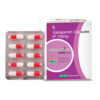
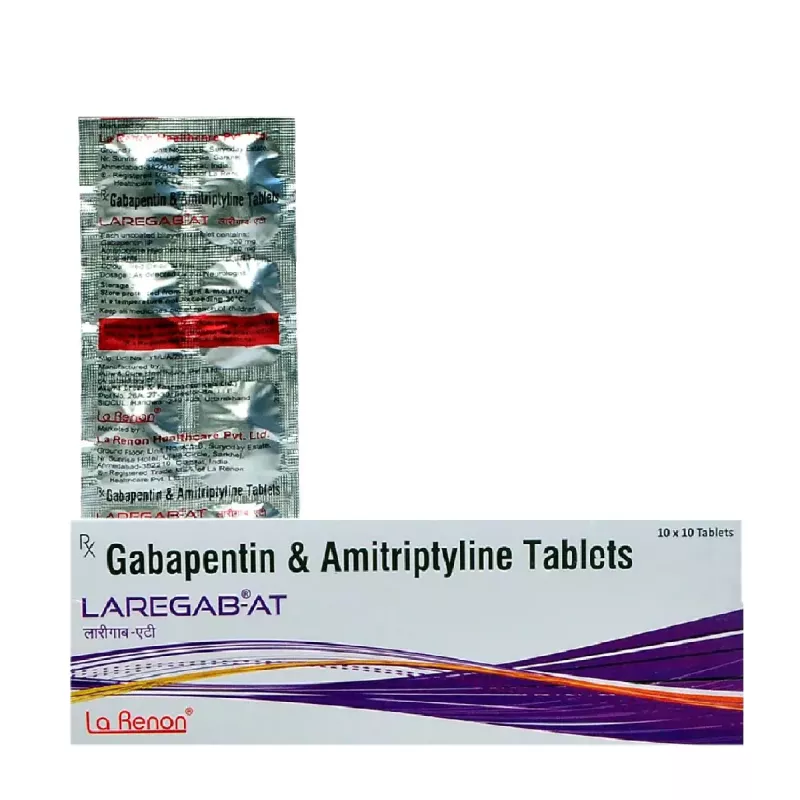
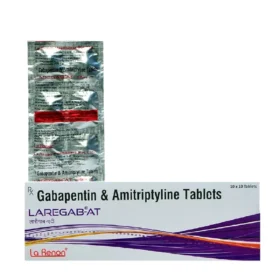
Laregab AT (Gabapentin 300 mg + Amitriptyline 10 mg) — Refractory Nerve Pain
✅ Relieves nerve pain
✅ Combats depression
✅ Manages neuropathy
✅ Improves sleep quality
✅ Reduces anxiety
Laregab AT contains Gabapentin and Amitriptyline.
✓ Medically reviewed by Morgan Ellis — Pharmacy Researcher · 8 years experience · Last reviewed: May 2026
📦 Every order is covered by our Reshipment Assurance Policy — if your parcel does not arrive within 20 business days, we reship it.
Why order from MedsBase
Our generic medications are sourced from WHO-GMP certified manufacturers and shipped worldwide in discreet, plain packaging — no medication name on the parcel exterior. Card payments are routed through a regulated processor (statement descriptors include a regulated card-payment processor — never “MedsBase” or any medication name). Crypto and SEPA bank transfer are also accepted. Every order is backed by our Reshipment Assurance Policy.
Quick Answer
Laregab AT is a fixed-dose combination of gabapentin 300 mg + amitriptyline 10 mg, used for refractory neuropathic pain that has not responded adequately to gabapentin or amitriptyline alone. The two molecules act on complementary pain pathways: gabapentin reduces excitatory neurotransmitter release at hyperexcitable nerve terminals, while amitriptyline boosts descending pain inhibition by raising synaptic noradrenaline and serotonin. Typical dose is one tablet at bedtime initially, increasing to twice daily. Both molecules cause drowsiness — start at night, drive cautiously, and taper slowly when stopping.
What Is Laregab AT?
Laregab AT is an Indian-manufactured combination tablet containing two well-established neuropathic-pain agents:
- Gabapentin 300 mg — alpha-2-delta calcium-channel ligand, anticonvulsant, neuropathic-pain analgesic
- Amitriptyline 10 mg — tricyclic antidepressant, low-dose neuropathic-pain analgesic, sleep modulator
The combination targets the multiple mechanisms underlying chronic nerve pain, often producing better symptom control than either drug alone — particularly when sleep disturbance and pain co-exist.
How the Two Molecules Complement Each Other
| Mechanism | Gabapentin | Amitriptyline |
|---|---|---|
| Calcium-channel modulation | Binds alpha-2-delta-1 subunit; reduces glutamate, substance P release | — |
| Descending pain modulation | — | Boosts noradrenaline and serotonin in descending inhibitory pathways |
| Sleep effect | Mild sedation | Strong sleep-promoting effect at low dose (anticholinergic, antihistaminic) |
| Anxiety / mood lift | Modest, off-label | Modest at 10–25 mg; full antidepressant effect 75–150 mg |
Indications
- Diabetic peripheral neuropathy
- Post-herpetic neuralgia (shingles pain)
- Post-traumatic and post-surgical neuropathic pain
- Chemotherapy-induced peripheral neuropathy
- Mixed nociceptive-neuropathic chronic low back pain with sciatica
- Fibromyalgia (off-label combination use)
Dose & Administration
| Step | Dose | Timing |
|---|---|---|
| Week 1 | 1 tablet at bedtime | Night dose first — covers nocturnal pain and supports sleep |
| Week 2 onward (if tolerated) | 1 tablet morning + 1 tablet bedtime | Twice daily |
| Selected patients | 1 tablet three times daily | If pain control inadequate |
| Elderly | 1 tablet at bedtime, slow titration | Anticholinergic risk higher in age 65+ |
| Renal impairment | Avoid or use with strict caution | Gabapentin component is renally cleared; alternative regimen often safer |
Common Side Effects
- Drowsiness, sedation (additive from both components)
- Dizziness, light-headedness on standing
- Dry mouth (amitriptyline)
- Constipation (amitriptyline)
- Weight gain (both)
- Mild peripheral oedema (gabapentin)
- Blurred vision (amitriptyline)
- Vivid dreams
Serious Side Effects
- Severe drowsiness or breathing difficulty (especially with opioids or alcohol)
- Cardiac conduction effects — prolonged QT, arrhythmia (amitriptyline)
- Suicidal ideation (anticonvulsant and tricyclic class warning)
- Urinary retention
- Severe allergic reaction
Contraindications
- Recent myocardial infarction, second- or third-degree heart block, arrhythmia
- Closed-angle glaucoma
- Severe hepatic impairment
- Use of MAO inhibitors within the previous 14 days
- Known hypersensitivity to either component
Drug Interactions
- Opioids — additive CNS and respiratory depression; large mortality signal in real-world data
- Other CNS depressants (benzodiazepines, alcohol, antihistamines) — additive sedation
- SSRIs / SNRIs — risk of serotonin syndrome with amitriptyline component
- Tramadol — additive serotonergic and seizure-threshold-lowering effect
- Antiarrhythmics (Class IA, III) — additive QT prolongation
- Antacids containing aluminium / magnesium — reduce gabapentin absorption; separate by at least 2 hours
Storage
Store below 25 °C in a dry place, away from direct sunlight. Keep in original blister packaging. Keep out of reach of children — amitriptyline overdose in children is potentially life-threatening.
Frequently Asked Questions
How is Laregab AT different from gabapentin alone?
Laregab AT pairs gabapentin 300 mg with amitriptyline 10 mg. Amitriptyline targets the descending pain-inhibitory pathway via noradrenaline and serotonin — a different mechanism from gabapentin’s calcium-channel binding. Combining the two often improves pain control when either alone has been insufficient, and the amitriptyline component also improves sleep.
Why is Laregab AT taken at night first?
Both components cause drowsiness, and the amitriptyline component has a strong sleep-promoting effect. Starting at bedtime avoids daytime sedation and lets the body adjust. Once tolerance to sedation develops, a morning dose can be added.
How long until Laregab AT works for nerve pain?
Gabapentin’s pain effect builds over 2–4 weeks. Amitriptyline’s analgesic effect (separate from its antidepressant effect) builds over 1–3 weeks. Most patients experience meaningful improvement by week 4 of regular dosing.
Can I drink alcohol with Laregab AT?
Avoid alcohol. The combination amplifies drowsiness, dizziness, and falls risk. Amitriptyline also lowers seizure threshold; combining with alcohol withdrawal can be dangerous.
Will Laregab AT make me gain weight?
Possibly — both molecules can promote weight gain. Average gain across the gabapentin + amitriptyline combination is 2–5 kg over 12 weeks. Watch portion sizes, prioritise protein, and stay active during titration.
Why can you not ship Laregab AT to certain US states?
Gabapentin is a controlled substance under state law in Kentucky, Michigan, Tennessee, Virginia, and West Virginia. We cannot ship to addresses in those states. Other US states are unaffected.
Is Laregab AT a controlled substance?
In most jurisdictions, gabapentin is not a federally controlled substance — but several US states (KY, MI, TN, VA, WV) have scheduled it. Amitriptyline is not controlled. Check local regulations before ordering.
Can I drive on Laregab AT?
Caution is essential, especially in the first 2–4 weeks. The combination causes more sedation than either drug alone. Do not drive until you know how the medication affects you, and avoid driving after the bedtime dose.
Is Laregab AT safe in pregnancy?
Both components have pregnancy concerns. Gabapentin has limited human data; amitriptyline has been linked with respiratory and feeding problems in newborns when used in late pregnancy. Discuss alternatives with your obstetrician.
How do I stop taking Laregab AT?
Always taper. Reduce by one tablet every 1–2 weeks. Sudden cessation can cause withdrawal from either molecule — anxiety, insomnia, rebound pain, vivid dreams, and (rarely) cholinergic rebound symptoms.
Does Laregab AT help with my mood?
The amitriptyline 10 mg dose is below the typical antidepressant range (75–150 mg). It will not provide a full antidepressant effect, although better sleep and reduced pain often improve mood indirectly. If depression is a primary concern, a dedicated antidepressant at therapeutic dose is more appropriate.
Patients responding to the gabapentin component of Laregab AT but tolerating amitriptyline poorly can switch to Gabasign (gabapentin monotherapy) at the same gabapentin dose without the anticholinergic burden of the TCA combination.
See also: Gabasign 300 / 600 mg — Cipla’s gabapentin generic — same FDA-approved molecule, full dose range from 300 mg starter to 600 mg maintenance.
See also: Synaptol 150 mg — tolperisone alternative when cyclobenzaprine sedation is unacceptable — centrally acting without H1 antihistamine drowsiness.
Related Alternatives
Other products in Chronic Conditions that customers also view:
More options in Neuropathic Pain Medication
Ranked by recent MedsBase order volume — what other customers in this category are picking.


| Quantity | 30 Tablet/s, 60 Tablet/s, 90 Tablet/s, 180 Tablet/s |
|---|
 Laregab AT (Gabapentin 300 mg + Amitriptyline 10 mg) — Refractory Nerve Pain
Q & A
Laregab AT (Gabapentin 300 mg + Amitriptyline 10 mg) — Refractory Nerve Pain
Related products



Reviews
There are no reviews yet